
DnD Builds: The Mad Tactician
A high-sustain Battle Smith build for players who like big swords, bad science, and too many defensive reactions.


Valadriel the Mad Build 1: The Mad Tactician
A high-sustain Battle Smith build for players who like big swords, bad science, and too many defensive reactions.
Battle Smith Artificer 18 / War Magic Wizard 2
Some D&D characters begin as carefully balanced sheets of math.
Some begin as a bad idea with a name.
Valadriel the Mad is both.
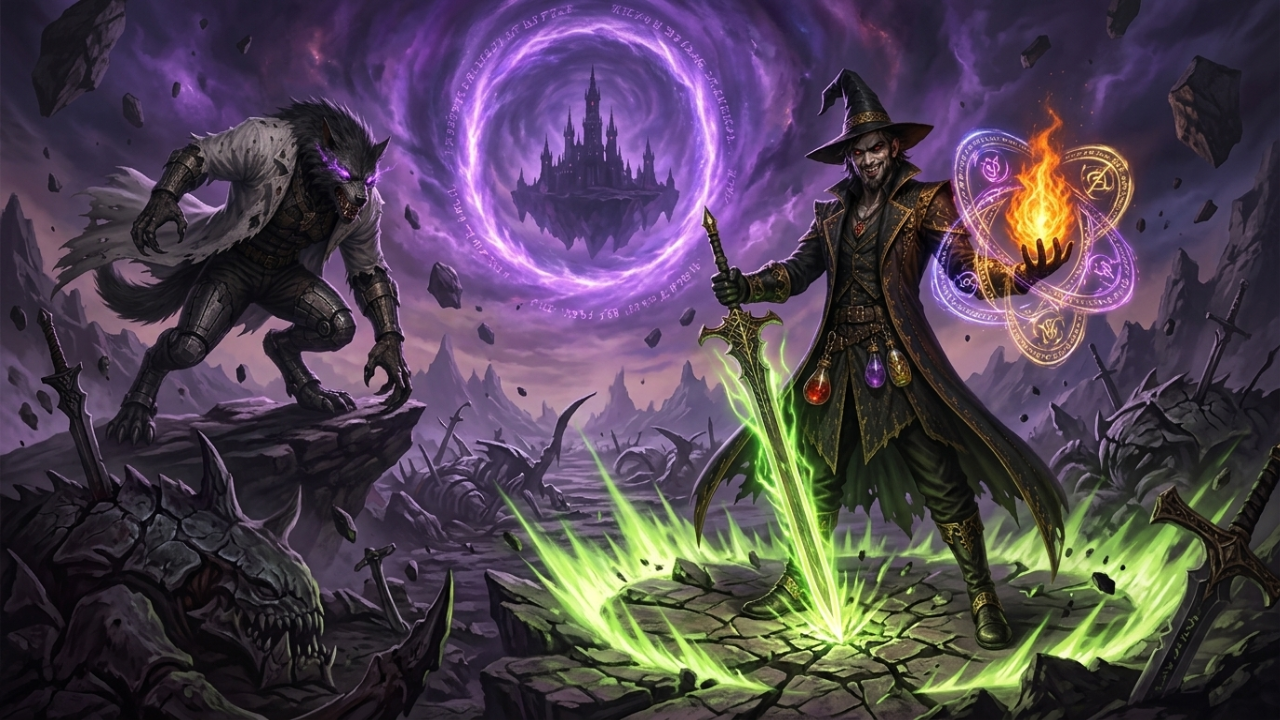
He is my recurring chaos engine whether I am playing at the table or DMing behind the screen. He is a Dhampir, a mad scientist, an occasional monster hunter, and absolutely not a hero in the traditional sense. He does not hunt monsters because he is noble. He hunts monsters because a proper scientist needs test subjects, body parts, unstable magical tissue, and at least one jar labeled "do not open."
Most versions of Valadriel are Artificers, but not the polished steampunk kind. He is less brass goggles and tidy clockwork, more Frankenstein's laboratory bolted onto a spelljammer ship and powered by questionable ethics.
This week's build is The Mad Tactician.
The Core Concept
This is a martial Intelligence build built around a two-handed weapon, defensive reactions, battlefield control, and a mechanical attack dog that makes enemies regret participating in the encounter.
The goal is simple. Take a smart character, give him a big sword, wrap him in magical defenses, and make every enemy attack feel like they picked the wrong option.
This build plays like a front-line martial character, but it has the tool kit of a half-caster and the defensive tricks of a Wizard. You are a heavily armored problem with spell slots.
The build does three things well. It tanks with armor, infusions, Shield, Absorb Elements, Arcane Deflection, Flash of Genius, healing, and a Steel Defender. It deals sustained magical damage with Intelligence-based attacks, a greatsword, infusions, the Steel Defender, and Arcane Jolt. It also survives through a crowded reaction economy that gives you answers to almost every common threat.
Race and Table Rules
Valadriel is a Dhampir.
That matters more for the character fantasy than the raw numbers. He is pale, sleep-deprived, blood-drinking, academically unstable, and absolutely the kind of person who looks at a monster and thinks, "That organ could be useful."
At my table, everyone gets a feat at level 1 if it fits the character.
For this build, that feat is Mobile.
Mobile is the reason the early build works. It lets you make a melee attack against a creature and then move away from that creature without provoking opportunity attacks from it for the rest of the turn.
That is perfect for Booming Blade.
If your table allows a free level 1 feat, play Dhampir and take Mobile. If your table is strict RAW and does not allow a free feat, the cleaner optimizer version is Custom Lineage with Mobile.
Either way, the goal is the same.
Hit them with Booming Blade, walk away, and make movement their problem.
Starting Ability Scores
Intelligence should be your highest stat. Dexterity and Constitution should both be solid, ideally around 14 each. Wisdom is useful if you can afford it. Strength and Charisma are dump stats for this build.
This is a mad scientist build. He does not need to be charming. He needs to be correct, dangerous, and hard to kill.
At level 1, you are not using Intelligence for weapon attacks yet. That comes online at Battle Smith level 3. Until then, Dexterity keeps you functional.
Level 1: Artificer
Start as an Artificer and take Booming Blade and Mending as your cantrips.
Booming Blade is the combat engine from the beginning. Mending is here for later, when Mr. Fluffers enters the build and needs repairs between fights.
For level 1 spells, I recommend Absorb Elements, Cure Wounds, and Faerie Fire.
Absorb Elements is one of the best defensive spells in the game for a front-line character. When you take acid, cold, fire, lightning, or thunder damage, you reduce the damage and store some of that energy for your next melee hit. That is exactly the kind of spell Valadriel would love.
"Interesting. The dragon breath is conductive."
Cure Wounds gives you emergency healing when the experiment starts bleeding more than expected. You are not the party's main healer, but you can keep someone from dying. Sometimes that someone is you. Sometimes it is the fighter you still need for the experiment.
Faerie Fire is excellent early because it can reveal invisible creatures and give your party advantage against affected targets. Advantage makes everyone better, and glowing enemies are much easier to study.
Why No Shield at Level 1?
Artificers are proficient with shields, so yes, you can use one at level 1.
For this build, I do not recommend it yet.
The reason is spellcasting logistics.
At level 1, your Artificer spellcasting requires you to have artisan's tools or thieves' tools in hand as your spellcasting focus. Booming Blade also requires the weapon you are attacking with. If you are holding a weapon in one hand and a shield in the other, your hands are occupied.
That makes your spellcasting awkward before infusions come online.
So at level 1, I prefer weapon in one hand and Artificer tools in the other. No shield yet.
It is less defensive, but it keeps the build clean and lets you use Booming Blade every turn without arguing with your equipment.
Level 1 Combat
At level 1, this build is in the "lab coat with a blade" phase.
Because Artificers start with simple weapons, your best Dexterity melee option is usually a dagger unless another feature gives you better weapon proficiency.
That is fine. The dagger is temporary. The tactic is what matters.
The combat loop is simple. Move into melee, cast Booming Blade, attack with your dagger, use Mobile to move away, and make the enemy choose whether it wants to chase you.
With a dagger and 14 Dexterity, your hit deals 1d4 plus 2 damage. The average damage is 4.5.
If the target willingly moves before your next turn, Booming Blade adds 1d8 thunder damage. The average added damage is 4.5.
That makes the total average damage 9 if the enemy moves.
At level 1, that is solid damage. More importantly, it gives you control. The enemy can stay still and waste positioning, or it can move and take the thunder damage. Either outcome helps you.
Level 2: Infusions
At Artificer level 2, the build gets much cleaner.
The two infusions that matter most are Enhanced Weapon and Enhanced Defense.
Enhanced Weapon gives your weapon a bonus to attack and damage rolls. More importantly, your infused weapon can now function as your Artificer spellcasting focus.
That solves the level 1 shield problem.
Now you can hold your infused weapon, carry a shield if you want, and still cast your Artificer spells cleanly.
Enhanced Defense improves your armor or shield, giving you another simple AC boost.
You are still using Booming Blade every turn, but now your defense and accuracy are both better.
Level 3: Battle Smith Comes Online
At Artificer level 3, take Battle Smith.
This is where the build becomes the build.
You gain martial weapon proficiency, which means you can finally pick up a greatsword. You also gain the Battle Smith feature that lets you attack with Intelligence when using a magic weapon.
That is the entire reason this build works.
Infuse your greatsword with Enhanced Weapon, grab it with both hands, and start swinging.
You also gain Battle Smith spells. The big one is Shield, which gives you plus 5 AC as a reaction when you are hit by an attack.
This is one of the best defensive spells in the game, and Battle Smith gives it to you automatically.
Level 3 Greatsword Damage
Assuming 16 Intelligence and a plus 1 Enhanced Weapon, one greatsword hit deals 2d6 plus 3 plus 1 damage.
The average damage is 11.
With Booming Blade, if the target moves, the damage becomes 2d6 plus 3 plus 1 plus 1d8.
The average damage is 15.5.
That is a major jump from the level 1 dagger phase. You are no longer a weird scientist with a knife. You are a weird scientist with a magically engineered greatsword and a deeply questionable safety record.
The Steel Defender
Battle Smith also gives you the Steel Defender.
For Valadriel, mine is flavored as a mechanical werewolf named Mr. Fluffers.
The Steel Defender is amazing for this build because it gives you a bonus action attack, a defensive reaction, another body on the battlefield, a way to protect allies, and a construct you can heal with Mending between fights.
At level 3, the Defender's attack deals 1d8 plus your proficiency bonus in force damage.
Your proficiency bonus is plus 2 at this level, so the average damage is 6.5.
A level 3 turn can look like this. Valadriel hits with Booming Blade for 11 average damage. Mr. Fluffers attacks for 6.5 average damage. That gives you 17.5 average damage before Booming Blade movement damage.
If the enemy moves, the total average damage becomes 22.
That is strong for level 3, and it only gets better as your Intelligence, proficiency bonus, weapon infusion, and class features scale.
Level 4: ASI or Gift of the Gem Dragon
At level 4, the strongest mathematical choice is usually an Ability Score Improvement to raise Intelligence.
That said, my preferred fun pick is Gift of the Gem Dragon, especially if it rounds up an odd Intelligence score.
I flavor this as Valadriel's Dhampir mind lashing out with unstable vampiric telepathy.
Mechanically, the feat gives you a reaction that can punish a creature that damages you within 10 feet.
The damage is 2d8 force damage. The average damage on a failed save is 9. The average damage on a successful save is 4.5.
That is reliable reaction damage, and force damage is rarely a bad damage type.
This is where the build's reaction economy starts getting interesting. You can use Shield when you need a large AC boost, Absorb Elements against elemental damage, Gift of the Gem Dragon when you can take the hit and want to punish the attacker, and your Steel Defender can impose disadvantage with its own reaction.
That last part matters. The Steel Defender uses its own reaction, not yours.
Level 5: Extra Attack vs. Booming Blade
At Artificer level 5, you get Extra Attack.
Now you need to decide whether to attack twice or cast Booming Blade.
Assume you have a greatsword, 18 Intelligence, and a plus 1 Enhanced Weapon.
One greatsword hit deals 2d6 plus 4 plus 1 damage. The average damage is 12.
With Extra Attack, two hits average 24 damage if both attacks hit.
At character level 5, Booming Blade adds 1d8 thunder damage on the hit and 2d8 if the target willingly moves.
With Booming Blade, the hit damage becomes 2d6 plus 4 plus 1 plus 1d8. The average damage is 16.5.
If the target moves, Booming Blade adds another 2d8 thunder damage. The average added damage is 9.
That makes the total average damage 25.5 if the target moves.
So which is better?
Use Extra Attack when the enemy is likely to stay in place. Use Booming Blade when you think the enemy needs to move.
Extra Attack is usually better for consistency because two attacks give you two chances to hit. Booming Blade is better when positioning matters or when you can force the enemy into a bad choice.
Mobile keeps Booming Blade relevant because you can hit the target, walk away, and force it to decide whether chasing you is worth the thunder damage.
Either way, your Steel Defender can still use your bonus action to attack when you want more pressure.
Level 5 Spell Advice
At this level, you get 2nd-level Artificer spells, and the list gives you some very useful tools.
Web is one of the best control spells available to you. Restrained enemies are easier to hit, worse at Dexterity saving throws, and generally less successful at ruining your day.
Aid is simple, efficient, and useful before a dangerous fight. More maximum hit points for multiple party members is never flashy, but it is always welcome.
Lesser Restoration is not exciting, but it is practical. Poisoned, diseased, paralyzed, or blinded allies become tactical problems very quickly.
Vortex Warp is excellent if your table allows it. You can move an ally out of danger, move a target into danger, or place something exactly where Mr. Fluffers can have a professional conversation with it.
Level 6: First Wizard Level
At character level 6, take your first level in Wizard.
The build already gets Shield from Battle Smith, so you do not need the Wizard dip just to grab it. Instead, this level gives you more utility, better ranged options, and a few classic Wizard tools that fit the mad scientist fantasy.
Find Familiar is the big one. Scouting, Help actions, trap testing, suspicious hallway inspection, and general magical nonsense all become easier when you have a disposable assistant. Valadriel would absolutely create a familiar and then insist it is not emotionally significant.
Magic Missile is your reliable ranged damage option. Sometimes you do not need a clever plan. Sometimes you need three darts of force damage to hit the annoying thing in the back of the room.
For Wizard cantrips, take Green-Flame Blade, Chill Touch, and Fire Bolt.
Green-Flame Blade gives you another melee option when enemies are standing close together. Chill Touch shuts down healing. Fire Bolt gives you reliable ranged damage when melee is a bad idea.
Level 7: War Magic Turns the Build On
At character level 7, take your second Wizard level and choose War Magic.
This is where the build becomes fully online. You now have your Battle Smith foundation, your Steel Defender, your greatsword, Shield, Booming Blade, and the Wizard dip that makes the whole thing harder to kill.
War Magic gives you Tactical Wit and Arcane Deflection.
Tactical Wit lets you add your Intelligence modifier to initiative. That is excellent because Valadriel wants to set the terms of the fight early. Going first means you can position before the enemy does, cast Faerie Fire or Web, engage the most dangerous target, or send Mr. Fluffers directly into someone's personal space.
Arcane Deflection is the real prize. When you are hit by an attack or fail a saving throw, you can use your reaction to increase your defense.
The downside is that after using it, you can only cast cantrips until the end of your next turn.
For many Wizards, that restriction hurts. For this build, it barely matters.
You are already happy using Booming Blade, Green-Flame Blade, Fire Bolt, or regular weapon attacks. Your default combat plan does not depend on casting leveled spells every round.
That makes Arcane Deflection much stronger here than it looks on paper.
The Reaction Game
By level 7, this build has a defensive answer for almost every common threat. The trick is knowing which reaction to use.
Use Shield when you are being attacked multiple times, when a dangerous attack hits you, or when the plus 5 AC is likely to turn several hits into misses.
Use Arcane Deflection when one attack barely hits you, when you fail an important saving throw, or when you want to save spell slots.
Use Absorb Elements when you take acid, cold, fire, lightning, or thunder damage.
Use Gift of the Gem Dragon when a nearby creature damages you, you can survive the hit, and you want to punish the attacker.
Later, Flash of Genius gives you another powerful defensive option. Use it when you or an ally fails an important saving throw or ability check and the roll matters enough to spend the reaction.
The Steel Defender adds another layer because Deflect Attack uses the Defender's reaction, not yours. If an attack targets you or an ally near Mr. Fluffers, the Defender can impose disadvantage without consuming your own reaction.
Valadriel reacts.
Mr. Fluffers also reacts.
The enemy regrets having a turn.
After Level 7: Back to Artificer
After Wizard 2, go Artificer the rest of the way.
At this point, the build is online. You have Battle Smith, the greatsword, Mr. Fluffers, Shield, Arcane Deflection, Tactical Wit, and your core melee plan.
From here, the rest of the build is about scaling what already works.
At Artificer 6, take the infusions that support your playstyle. Mind Sharpener is excellent if you are concentrating on Web, Faerie Fire, or Haste. Enhanced Weapon and Enhanced Defense stay useful for most of the game.
At Artificer 7, Flash of Genius makes your Intelligence even more important. When you or an ally fails an ability check or saving throw, you can add your Intelligence modifier to the roll.
For Valadriel, this is him shouting, "Duck, you idiot. The rune is inverted."
At Artificer 8, raise Intelligence if it is not already maxed. This improves your attacks, damage, spell DC, Flash of Genius, Steel Defender, and overall effectiveness.
If Intelligence is already handled, consider Gift of the Gem Dragon, Resilient Wisdom, Shadow Touched, or Fey Touched.
At Artificer 9, Arcane Jolt gives you extra damage or emergency healing when you or your Steel Defender hits. It starts at 2d6, averaging 7 damage or healing. Later, it improves to 4d6, averaging 14. It is flexible, reliable, and very useful.
For later spells, keep it practical. Haste is powerful, but protect your concentration. Revivify keeps the party alive. Dispel Magic solves magical problems. Fire Shield is perfect for a front-line character who likes punishing enemies for hitting him. Banishing Smite gives you a strong late-game weapon payoff.
Spell-Storing Item at Artificer 11 is one of the biggest reasons to stay Artificer. Web, Cure Wounds, Aid, and Invisibility are all strong options depending on your campaign. It gives you repeatable magic without burning your normal slots every time.
Final Form
By the end, the build is Battle Smith Artificer 18 and War Magic Wizard 2.
You have Intelligence-based greatsword attacks, strong armor, excellent infusions, a Steel Defender, Shield, Absorb Elements, Arcane Deflection, Tactical Wit, Flash of Genius, Arcane Jolt, Spell-Storing Item, and enough defensive tools to make your DM reconsider several life choices.
This is not the biggest nova build in D&D.
It is worse.
It is consistent.
It is hard to kill.
It always has another button.
And it brought a mechanical werewolf.
Final Damage Snapshot
At higher levels, assume 20 Intelligence, a plus 2 Enhanced Weapon, a greatsword, Extra Attack, a Steel Defender bonus action attack, and Arcane Jolt available.
One greatsword hit deals 2d6 plus 5 plus 2, for an average of 14 damage.
Two greatsword hits average 28 damage if both hit.
The Steel Defender attacks for 1d8 plus 6, averaging 10.5 damage.
Arcane Jolt adds 4d6, averaging 14 damage.
If both of your attacks hit, the Steel Defender hits, and you add Arcane Jolt, that is 52.5 average damage.
That is before Booming Blade movement damage, outside buffs, extra magic items, or whatever campaign-specific nonsense your DM allows.
Final Thoughts
The Mad Tactician is exactly what I want from a Valadriel build.
It is smart, durable, strange, and mean. It fights with a greatsword, survives with layered defenses, and solves problems like a scientist who views battlefield ethics as a loose suggestion.
You are not just swinging a sword.
You are testing a theory.
The theory is that everyone else should have stayed farther away.
Related Articles
Rebuilding Lycanthropy for Dungeons & Dragons: https://vocal.media/gamers/rebuilding-lycanthropy-for-dungeons-and-dragons
Expanding Lycanthropy in Dungeons & Dragons: The Lycanthropy Feat System https://vocal.media/gamers/expanding-lycanthropy-in-dungeons-and-dragons-the-lycanthropy-feat-system
About the Creator
Juan Alfonso
Former Marine Corps correspondent with newspaper and magazine experience. I own a digital marketing company and write about games, TV, movies, comics, and pop culture. Husband, dad, and cat dad 🖖 #LLAP
Enjoyed the story? Support the Creator.
Subscribe for free to receive all their stories in your feed.
Comments
There are no comments for this story
Be the first to respond and start the conversation.