
Buy-to-Play Isn’t Always the Better Deal. My Steam Backlog Proved It.
Free-to-play gets blamed for draining your time and money. But unplayed games can drain you too, one Steam sale at a time.
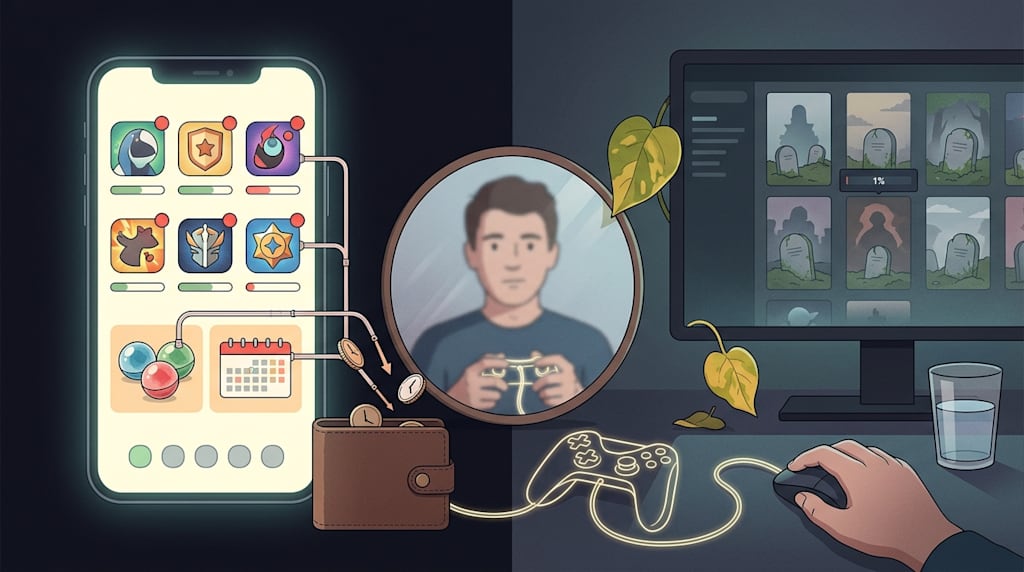
Many players say the same thing: buy-to-play games are a better deal.
At first, that sounds obvious. Free-to-play games cost nothing. Buy-to-play games cost money. How could the paid option be cheaper? Then you play a few free games. You see how they work. Free is the entrance. Inside, gacha, skins, battle passes, monthly cards, first-time recharge bonuses, limited bundles, and seasonal quests pull money and time out of you through thin pipes.
You start by playing casually. Three months later, your phone has six icons with red dots. Your monthly card has three days left. Your battle pass is seven levels short. Someone in the guild chat tags you for an event. You add it up: monthly card 30, battle pass 68, two skins 128, first-time recharge 6. That is 232 yuan. You have not counted the nights you stayed up finishing daily quests.
A 300-yuan buy-to-play game starts to look reasonable.
But the story has another side.
Your library can be full of buy-to-play games you bought with excitement and never opened again. Red Dead Redemption 2 at an all-time low of 60 yuan. Bought. Disco Elysium at 10 yuan. Bought. Maitetsu at 20 yuan. Bought. Death Stranding: ten hours. ATRI: three hours. Assassin’s Creed Odyssey: thirty minutes. The Witcher 3: stopped after White Orchard. Skyrim: stopped after saving the little girl. Divinity: Original Sin 2: stopped after boarding the ship. Baldur’s Gate 3: spent time in character creation in the Family Library and never returned.
When you bought them, you thought, “I will finish this someday.” Later, you notice that someday never arrived.
So is buy-to-play a better deal? It depends on what you count.
Buy-to-play is more controllable as a model. On a personal budget, it can still become a trap. We think we are buying games. Often, we are buying a future version of ourselves who will play them.
The buy-to-play advantage is certainty
The main advantage of buy-to-play is not a low price. It is clear rules.
A game costs 30, so it costs 30. It costs 300, so it costs 300. Before you buy, you know the total cost. You can read reviews, watch gameplay, check the refund policy. The Steam checkout page says 60. Below it, in small print: within 14 days of purchase, with under 2 hours played, you can request a refund.
After you buy, the game usually stops asking for money. It does not punish you for missing three days by removing daily rewards. It does not make you miss a limited skin because the season ended. It does not block you at a level because you refuse to pull for a gacha character.
That certainty matters.
Free-to-play breaks one large expense into countless small ones. Spending 300 yuan at once hurts. You hesitate. You ask whether you need it. A 6-yuan first-time recharge, a 30-yuan monthly card, a 68-yuan battle pass, and a 128-yuan bundle do not look expensive. Each payment is small enough to feel like a tap. Added together, those taps often cost more than a buy-to-play blockbuster.
Buy-to-play also aims at a complete experience. You pay to reach the ending, to move through a designed journey. Free-to-play aims at retention. It wants you to return every day, stay in the system, compare, chase, and pay. One wants you to leave satisfied. The other wants you never to leave.
When players say buy-to-play is a better deal, they mean it puts payment upfront and returns control to the player. You know what you spent. You know when you can stop. Free-to-play puts payment later and keeps control in the system. You think you are playing for free. You are paying with time and attention.
Free-to-play hides the bill in painless payments
Free-to-play reduces the pain of paying.
Buy-to-play makes you pay 300 yuan first, then play. That order forces a decision. Free-to-play reverses it. It lets you play first, then pay. By then, you have invested time, emotion, social ties, and a sense of identity. Spending 6, 30, or 68 yuan meets less resistance.
This is mental accounting.
You treat buy-to-play as buying a game, a proper purchase. You treat in-game purchases as supporting the developers, trying one pull, or buying one skin. Money is money. Time is time. Daily quests, stamina systems, battle passes, and limited events charge you in another currency: attention.
Free-to-play also creates a feeling that stopping means losing. You have played fifty hours. You have done daily quests for thirty days. People in the guild wait for you. You are a few levels from the season reward. Quitting makes your previous effort feel wasted. That is sunk cost. It keeps you playing, paying, and following the system.
Free-to-play is not free. It splits the bill, delays payment, and turns part of the money cost into time cost, social cost, and emotional cost. You think you saved money. You may have paid something more expensive.
Buy-to-play can avoid some of this. It does not avoid all of it.
The buy-to-play trap: the backlog is a graveyard of wishes
Buy-to-play has its own trap. It is quieter.
It does not force you online. It does not give you daily quests. It does not make you pull gacha. It sits in your library like a promise you never kept. When you bought it, you were not going to play it now. You believed your future self would play it. You believed a weekend would free up, a holiday would bring the right mood, a night would bring energy. You believed an all-time low was rare. You bought first and thought later. You believed in someday.
Someday often does not come.
New games keep appearing. You buy an old game, then a new release arrives. You finish an opening, then a friend recommends another. You think about returning to The Witcher 3, then Baldur’s Gate 3 gets a patch. Your attention breaks into pieces. Old games sit. New games become old games. Your library grows. The number of games you finish shrinks.
The certainty of buy-to-play becomes an illusion. The price is certain. The refund window is certain. Your time is not. Your interest is not. Your future energy is not. If you bought Red Dead Redemption 2 for 60 yuan and played it for a hundred hours, you got a great deal. If you never download it, its value is zero. An all-time low is only a low price. The opportunity cost of your time stays the same.
The more buy-to-play games you buy, the less of a deal they become. That is true on a personal level.
The problem is not buy-to-play itself. The act of buying changes flavor. You stop buying to play. You buy to collect, hoard, make up for missed purchases, relieve anxiety, and satisfy a quick desire. You are not buying a game. You are buying the security of ownership. Owning is not experiencing. Adding to your library is not playing.
The value equation
We simplify the question into buy-to-play versus free-to-play. The value equation is different:
Satisfaction gained ÷ Total cost (money + time + attention + emotion)
A buy-to-play game that costs 10 yuan is expensive if you never play it. A free-to-play game is expensive if daily quests torment you and you play with anxiety and exhaustion. A 300-yuan buy-to-play game can be cheaper than any free-to-play game if you play it for three hundred hours. A free-to-play game can be a good deal if you only play a few matches with friends and never buy anything.
The key is not the business model. The key is whether you got the experience you wanted.
Buy-to-play usually does not stop you from stopping. You can finish it, drop it, or return a year later. Free-to-play often does not want you to stop. It uses dailies, seasons, social pressure, rankings, and limited rewards to keep you in the system. If you have strong self-control and a clear schedule, free-to-play can be cheap. If your self-control is weak, buy-to-play can become another consumption trap. You keep buying, hoarding, missing refund windows, and building a longer library list.
Buy-to-play is not morally superior. It is not a guarantee of saving money. It is a payment model. It gives you certainty. It does not manage your desires.
The more you play, the less you play
Modern players live with a strange dilemma. The more you play, the less you play.
The number of games you have played goes up. The time you spend going deep into one game goes down. You open countless beginnings. You rarely reach an ending. You know many tutorials. You struggle to enter the midgame. New games attract you with freshness, discussion, and social topics. Old games demand relearning, remembering, and reinvesting. Starting is easier. Going deep is harder.
A larger backlog means more choices and more scattered attention. Scattered attention makes each game shallower. A shallow experience makes it easier to think, “This game is not that good,” and move to the next one. You buy games faster than you play them. You add to your library faster than you finish.
The backlog becomes a graveyard of wishes.
Every unplayed game represents a someday you never cashed in. Every someday represents a misjudgment of your time, energy, and interest. You are not lying to yourself on purpose. You are too ready to believe your future self will be freer, more disciplined, and more patient.
Your future self is still you. He will be tired. He will be distracted. He will be drawn to new games. He will not automatically become the person who finishes every game in your library.
How to make buy-to-play a better deal for you
If you want buy-to-play to work on a personal level, buy more accurately.
First, only buy the game you will play in the next twenty hours. Do not buy maybe-someday games. Do not buy because an all-time low will not last. Do not buy to make up for having pirated a game before. An all-time low is not a reason to buy. Time is.
Second, install one game. Play it to the end or decide clearly to drop it. Then buy the next one. Do not start five games at once. Games are not books. They do not gain value by sitting on a shelf. They need your time. Your time is limited.
Third, admit that buying games is also a pleasure. If buying games makes you happy, that is fine. Be honest: that is the pleasure of collecting and consuming, not necessarily the pleasure of playing. Do not confuse it with playing games.
Fourth, set hard limits for free-to-play. No gacha. Only buy things with clear prices. Set a monthly budget. Do not let free become your reason for paying.
Fifth, accept that you cannot play everything. You cannot finish every good game. You do not need to finish every good game. You only need to play the games that satisfy you.
Buy-to-play or free-to-play is not the main question
Many players think buy-to-play is a better deal because it resists the continuous harvesting of free-to-play. It has clear prices. It delivers a complete product. It does not force you online. It does not trap you in daily quests and battle passes. It returns choice to the player.
Buy-to-play does not guarantee a personal good deal. If you keep adding games because of all-time lows and fantasies, buy-to-play becomes a worse deal. You spend more money, hoard more games, and play less. You think you are buying happiness. You end up with a longer to-do list.
The question is not buy-to-play or free-to-play.
The question is:
Am I buying a game, or am I buying the future version of myself who will play it?
If you only buy the next game you will play, buy-to-play works for you. If you keep adding games because of sales, anxiety, and fantasy, buy-to-play becomes a quieter, more respectable consumption trap.
Games were meant to let people step away from reality and live another life. If playing games turns into tasks, backlog, and anxiety, then you are not playing the game. The game is playing you.
Buy-to-play or free-to-play. They are tools. The model is not what makes a game a good deal. What matters is whether you spent your limited time on joy that belonged to you.
I close the store page. The wishlist email is still in my inbox. Subject line: “All-time low ends in 6 hours.” I open my library. I find Red Dead Redemption 2. The download button lights up. The progress bar reaches 1%. Another leaf on the pothos has turned yellow. I go to pour water.
About the Creator
Jin
Writer of reamstories
https://reamstories.com/jin
Enjoyed the story? Support the Creator.
Subscribe for free to receive all their stories in your feed. You could also become a paid subscriber, letting them know you appreciate their work.
Comments
There are no comments for this story
Be the first to respond and start the conversation.