
The Economist 2026 Cover: A Symbolic and Conspiratorial Analysis of the Future
The Economist 2026+Oliver tree


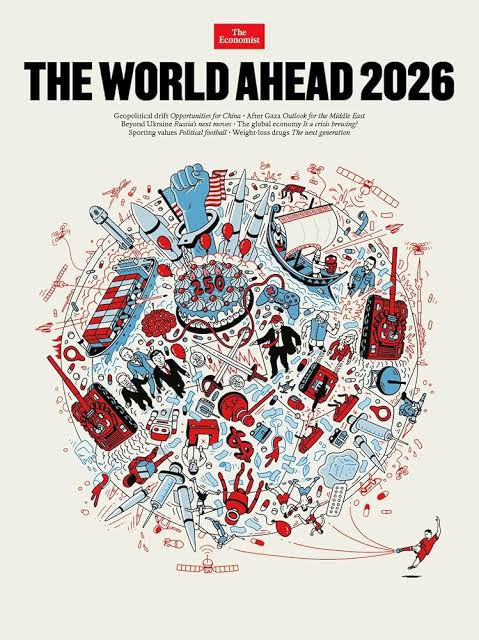
Every year, the cover of The Economist generates intense debate among political analysts, researchers, and conspiracy theorists alike. Supporters of symbolic interpretation argue that these covers are not merely artistic illustrations but coded messages that hint at major global events expected in the coming year. Whether one sees them as predictions, warnings, or simply clever editorial design, the imagery often reflects the fears, ambitions, and uncertainties shaping the world.
The 2026 cover presents a chaotic globe packed with symbols of war, technology, economics, health, politics, and social unrest. At first glance, the image appears overwhelming, yet every element seems intentionally placed. To those who view the world through a conspiratorial lens, the cover can be interpreted as a roadmap of what powerful institutions expect—or perhaps intend—to unfold during 2026.
This article explores the symbolism of the cover through a speculative and conspiratorial perspective.
A World in Controlled Chaos
The first thing that stands out is the circular composition. The world appears crowded with objects colliding into one another, creating a sense of instability and disorder.
In conspiracy circles, chaos is often viewed as a tool used by powerful groups to reshape society. The concept of "order out of chaos" suggests that crises can be used to justify major political, economic, or technological changes.
The cover seems to communicate a world where multiple crises occur simultaneously:
Economic uncertainty
Military tensions
Technological disruption
Political instability
Public health concerns
Rather than showing one dominant issue, the image suggests a convergence of events affecting every aspect of human life.
The Raised Fist: The Age of Protest
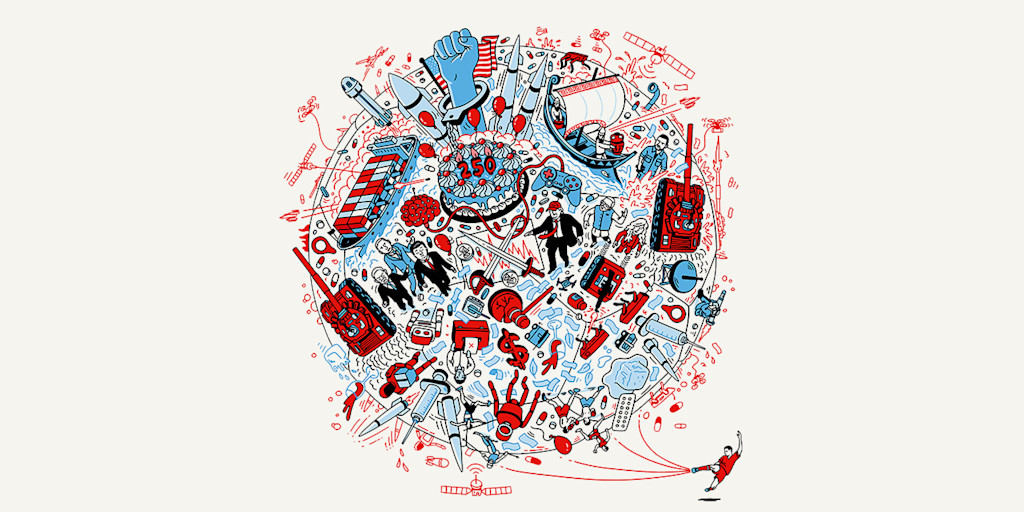
One of the largest symbols on the cover is the blue raised fist emerging from the globe.
Historically, the raised fist has represented:
Resistance
Revolution
Social movements
Popular uprisings
A conspiratorial interpretation might suggest that 2026 will witness widespread public dissatisfaction around the world. Rising living costs, economic inequality, political polarization, and concerns over technological surveillance could fuel protests across multiple countries.
Some researchers believe global institutions anticipate growing unrest as societies struggle to adapt to rapid change. The fist may symbolize the reaction of ordinary people against systems they perceive as increasingly centralized and disconnected from public interests.
Missiles and Weapons: The Expansion of Global Conflict
Several missiles and military objects appear throughout the image.
These symbols suggest that military competition remains a major concern. In recent years, geopolitical tensions have increased among major powers, and the cover appears to indicate that such tensions will continue into 2026.
A conspiratorial reading would argue that wars often benefit powerful financial and industrial interests.
Military conflicts can:
Increase government spending
Expand surveillance programs
Reshape alliances
Influence resource distribution
The presence of multiple weapons rather than a single battlefield suggests that conflict may not be limited to one region but could involve several areas of the world simultaneously.
Satellites and Space: The New Frontier of Power
Orbiting around the globe are satellites and space-related symbols.
Space has become increasingly important for:
Communications
Military operations
Navigation systems
Intelligence gathering
Conspiracy researchers often claim that future control will depend not only on physical territory but also on control of information networks.
The satellites may symbolize:
Global surveillance systems
Internet infrastructure
Artificial intelligence networks
Competition between governments and corporations
As technology advances, the battle for dominance may increasingly move beyond Earth itself.
The Mysterious "250" Cake
At the center of the image sits a large cake marked with the number 250.
Officially, this likely refers to the 250th anniversary of the United States in 2026.
However, symbolic analysts often pay close attention to objects placed near the center of a composition.
The cake may represent:
The end of one historical cycle
The beginning of another
A major turning point for Western civilization
Many conspiracy theories suggest that global systems undergo periodic restructuring. Whether political, financial, or cultural, the number 250 may symbolize the conclusion of an era and the emergence of a new world order.
Syringes and Biotechnology
Large syringes occupy a prominent position on the cover.
Health and biotechnology have become increasingly influential in global affairs.
Potential interpretations include:
Genetic engineering
Personalized medicine
Biotechnology breakthroughs
Public health initiatives
More skeptical observers view the symbolism differently.
They argue that future societies may become increasingly dependent on biological technologies, creating ethical debates about privacy, bodily autonomy, and human enhancement.
Regardless of perspective, the inclusion of medical imagery suggests that health remains a central issue in the years ahead.
The Gaming Controller: Artificial Intelligence and Digital Reality
A gaming controller appears surprisingly close to the center of the image.
At first glance it may seem insignificant, yet symbolism often works through unexpected objects.
The controller may represent:
Artificial intelligence
Digital entertainment
Virtual reality
Algorithmic influence
Conspiracy-minded analysts frequently discuss the idea that modern societies are increasingly shaped by invisible algorithms.
From social media feeds to recommendation systems, digital technologies influence:
Opinions
Consumer behavior
Political discourse
Social interactions
The controller raises an intriguing question: Who is holding the controls?
Some see this as a symbol of humanity losing control to machines. Others interpret it as a warning about those who design and manage digital systems.
Political Figures: The Battle for Leadership
Scattered throughout the cover are several human figures that appear to represent politicians, business leaders, and influential decision-makers.
Interestingly, none dominate the composition.
Instead, they appear surrounded by larger forces.
This could suggest that leaders themselves are navigating a rapidly changing environment shaped by technology, economics, and public pressure.
From a conspiratorial perspective, visible leaders are often viewed as representatives of deeper power structures operating behind the scenes.
Whether or not one accepts this idea, the cover emphasizes leadership struggles as an important theme for 2026.
The Dollar Symbol: Economic Turbulence Ahead
Near the lower portion of the image is a prominent dollar sign.
Financial symbolism has appeared on many previous Economist covers.
Possible meanings include:
Inflation
Debt crises
Currency competition
Market volatility
Many analysts believe the global economy is entering a period of transition.
Questions surrounding:
Digital currencies
National debt
Trade relationships
Economic inequality
continue to shape international discussions.
Conspiracy theorists often speculate that financial instability is used to justify major reforms and greater centralization of economic systems.
The dollar symbol suggests that money remains one of the key forces driving global events.
The Boxing Gloves: Polarization and Conflict
Boxing gloves symbolize confrontation.
Unlike missiles, which represent international conflict, boxing gloves imply direct competition between opposing sides.
This may reflect:
Political polarization
Cultural disputes
Ideological battles
Modern societies are increasingly divided over issues such as:
Technology
Identity
Governance
Freedom of speech
The gloves suggest that conflict is no longer limited to nations but exists within societies themselves.
Communication Devices and Security
The radio and communication-related symbols point toward security concerns.
Governments worldwide are investing heavily in:
Cybersecurity
Intelligence systems
Emergency preparedness
Conspiracy interpretations often connect these developments with expanded monitoring capabilities.
Supporters argue that such measures improve public safety.
Critics worry they could reduce privacy and increase centralized control.
The cover does not provide answers but clearly highlights security as an important issue.
The Red Robot: The Rise of Machines
One of the most intriguing symbols is the red robotic figure.
Artificial intelligence is transforming industries across the globe.
Potential implications include:
Automation
Robotics
Military AI
Labor market disruption
The robot's placement among economic and political symbols suggests that AI may influence nearly every sector of society.
Conspiracy researchers sometimes describe AI as the foundation of a future technocratic system in which algorithms manage increasingly complex aspects of life.
Whether optimistic or pessimistic, few would deny that AI is becoming one of the defining forces of the modern era.
The Athlete: Distraction or Unity?
At the edge of the image, a sports figure appears in motion.
Sports have historically served multiple functions:
Entertainment
National identity
Cultural influence
International diplomacy
Some conspiracy theories claim that major sporting events are used to distract public attention from larger issues.
Others argue that sports unite people across cultural and political divisions.
The athlete's presence may symbolize both possibilities.
The Hidden Message of Interconnection
Perhaps the most important aspect of the cover is not any single symbol but the way all symbols interact.
Nothing stands alone.
Technology influences politics.
Politics influences economics.
Economics influences public health.
Public health influences social stability.
Every element appears connected within the same global system.
This interconnectedness reflects one of the defining realities of the modern world.
A crisis in one region can affect markets on the other side of the planet within hours.
Information spreads instantly.
Technological innovations reshape entire industries overnight.
The cover seems to emphasize this interconnected nature of contemporary civilization.
Conclusion: Prediction, Warning, or Reflection?
The Economist's 2026 cover can be interpreted in many ways.
A conventional analysis sees it as a visual summary of the major issues likely to shape the coming year:
Geopolitical tensions
Artificial intelligence
Economic uncertainty
Biotechnology
Political change
Social unrest
A conspiratorial analysis goes further, suggesting the cover may reveal the expectations—or intentions—of influential institutions preparing for a period of profound transformation.
Ultimately, the image serves as a mirror reflecting the hopes, fears, and uncertainties of our time.
Whether one believes it contains hidden messages or simply represents careful editorial symbolism, the cover conveys a powerful theme:
The world is entering an era where technology, economics, politics, health, and conflict are becoming more interconnected than ever before.
And in that interconnected world, even the smallest change can send ripples across the entire globe.
+ The Oliver Tree Connection: Coincidence or Hidden Symbolism?
One of the most controversial interpretations surrounding The World Ahead 2026 emerged after the tragic death of musician Oliver Tree in a helicopter accident during 2026. While no evidence suggests that The Economist was predicting this event, some alternative researchers believe the symbolism on the cover became far more intriguing after the fact.
Several observers pointed to the appearance of aerial imagery, including helicopter-like elements and floating objects, alongside what appears to be a tree among the cover's crowded symbols. To most readers, these details may seem insignificant. However, conspiracy analysts often focus on seemingly minor images, arguing that hidden messages are frequently placed in plain sight.
The symbolism becomes especially interesting because Oliver Tree's stage name contains the word "Tree." Following his death, some theorists suggested that the tree symbol could represent a public figure associated with that name. Others connected the aerial imagery to the circumstances of the helicopter crash itself.
The red balloons visible in the composition have also attracted attention. In symbolic analysis, balloons can represent celebration, fame, public attention, or fleeting success. Some interpretations suggest they may symbolize individuals whose rise to prominence is followed by sudden tragedy or transformation.
Skeptics argue that these connections are examples of retrospective interpretation, where people assign meaning to symbols only after an event occurs. Nevertheless, believers in predictive symbolism see the combination of the tree, aerial elements, and global chaos as more than a coincidence.
Whether viewed as a remarkable coincidence or an example of hidden symbolism, the Oliver Tree connection demonstrates why The World Ahead covers continue to fascinate researchers, conspiracy theorists, and curious readers around the world. The covers often contain enough imagery to allow countless interpretations, especially when major world events later seem to echo their visual themes.

"Perhaps the greatest mystery of The World Ahead 2026 is not whether it predicted specific events, but why so many of its symbols appear to gain new meaning as the year unfolds. Coincidence, careful forecasting, or something more hidden—the debate continues."
References
The Economist Group. The Economist launches The World Ahead 2026. Available at: The Economist – The World Ahead 2026. Accessed June 2026.
Agence France-Presse. “US singer Oliver Tree aboard helicopter in deadly mid-air crash in Brazil.” Available at: AFP Report on Oliver Tree Crash. Accessed June 2026.
Associated Press/CBS News. “Singer Oliver Tree among 6 killed in helicopter collision over Rio de Janeiro.” Available at: CBS News Report. Accessed June 2026.
The Guardian. “US musician Oliver Tree, 32, killed in helicopter crash in Brazil.” Available at: The Guardian Report. Accessed June 2026.
El País. “El cantante Oliver Tree y el youtuber Gaspi mueren al chocar dos helicópteros en el aire sobre Río de Janeiro.” Available at: El País Report. Accessed June 2026.
SFGATE. “Former label confirms death of Santa Cruz-born singer and SF State alum in helicopter crash.” Available at: SFGATE Report. Accessed June 2026.
Los Angeles Times. “Oliver Tree, musician and Santa Cruz native, dies in helicopter crash.” Available at: Los Angeles Times Report. Accessed June 2026.
Washington Post. “Officials in Brazil investigate helicopter crash that killed 6.” Available at: Washington Post Report. Accessed June 2026.
EnigmAnónimo. “The Economist The World Ahead 2026 Official Cover Full Analysis.” YouTube. Available at: YouTube Analysis Video. Accessed June 2026.
El Hilo Rojo. “The Economist World Ahead 2026: The Cover That Heralds a New Era of Wars.” YouTube. Available at: The Red Thread Analysis. Accessed June 2026.
Note for Readers
The symbolic interpretations discussed in this article represent speculative and conspiratorial viewpoints. The references documenting the deaths of Oliver Tree and Gaspar Prim are factual news reports, while interpretations linking those events to The World Ahead 2026 cover remain subjective opinions rather than verified evidence.
About the Creator
JONATAN DAVID VEGA
Hello Welcome! I am Jonatan Vega
Iam self-published mexican author living Sacramento,California
My Instagram: @JonatanVega_writesbooks
My published books in lulu.com
www.lulu.com/spotlight/JonatanVega
Amazon: Jonatan Vega
Enjoyed the story? Support the Creator.
Subscribe for free to receive all their stories in your feed.
Comments
There are no comments for this story
Be the first to respond and start the conversation.