VOICES ACROSS THE VOID: ARTEMIS II AND THE ISS COMPLETE THE FARTHEST RADIO CALL IN HUMAN HISTORY
When you are floating hundreds of thousands of miles away from everything you have ever known, what do you talk about when you finally get to call your friends back home?
If you are the crew of NASA’s Artemis II mission, you talk about the staggering beauty of the universe, the tight quarters of your spaceship, and spicy green beans.
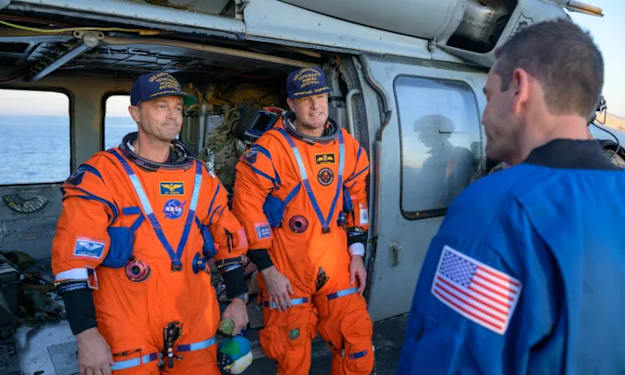
On April 7, humanity witnessed a quiet but monumental milestone in space exploration. For the first time in history, two entirely separate crews of astronauts, traveling in two completely different spacecraft, connected for a live ship-to-ship audio broadcast. On one end of the line was the International Space Station (ISS), cruising in low-Earth orbit. On the other end was the Orion capsule, carrying the four Artemis II astronauts on their record-breaking loop around the Moon.
To truly understand the weight of this conversation, you have to look at the sheer, terrifying math of the distance between them.
When the call connected, the Artemis II crew was roughly 232,141 miles away from the ISS. To put that into perspective, if you were to sail a cargo ship from Boston all the way down to the Panama Canal, you would have to make that entire grueling journey 92 times just to equal the physical gap between these two spacecraft. Yet, across that massive expanse of blackness, the voices came through crystal clear.
"It's fun to be up in space with you at the same time," radioed Jeremy Hansen, the Canadian Space Agency astronaut who waited seventeen years for his first spaceflight.
Down in Earth orbit, NASA astronaut and ISS Expedition 74 crew member Jessica Meir answered back. "We know how fortunate all of us are as humans, to come up here and look down at the Earth from above," Meir said. "We really wanted to hear what that felt like—how different that felt—now from your new perspective around the Moon."
What followed was a deeply human exchange that stripped away the sterile, highly technical jargon of typical mission control broadcasts. Artemis II Mission Specialist Christina Koch, who previously spent nearly a year living on the ISS, took the microphone to express a profound sense of homesickness—not just for Earth, but for the space station itself.
"The views there at the ISS are awesome. Being able to see specific places, being able to see your home... I miss them every day, almost," Koch admitted to her former colleagues. But she noted that flying to the Moon had fundamentally shifted her perspective. "The thing that changed for me, looking back at Earth, was that I found myself noticing not only the beauty of the Earth, but how much blackness there was around it—and how it just made it even more special."
Koch's words summarized the core philosophy of the Artemis generation. "It truly emphasized how alike we are," she continued. "How the same thing keeps every single person on planet Earth alive. We evolved on the same planet. We have some shared things about how we love and live that are just universal."
Despite the philosophical weight of the moment, astronauts are still human, and the conversation quickly evolved into the kind of banter you would expect from close colleagues.
Victor Glover offered a very practical reality check about life inside the Orion capsule compared to the sprawling, multi-module layout of the ISS. Out near the Moon, there are no extra rooms to hide in. "Everything we do, essentially, starts with a spatial conflict, and we have to take the time to work it out in every activity," Glover explained.
Meanwhile, Jeremy Hansen confessed that he was having an incredible time as the rookie of the crew, even revealing that he had grown a mustache on a dare from Meir before launching. He also admitted to being the worst offender on the ship for leaving the drinking water dispenser open too long.
Commander Reid Wiseman then shared a hilarious story about their outbound journey. During the translunar injection burn, the Orion capsule had to dip incredibly close to Earth—less than half the altitude of the ISS—before slingshotting outward. As the Earth rapidly expanded in the capsule's windows, Hansen, experiencing orbital mechanics for the first time, nervously joked, "I'm not sure. I think we're going to run right into it."
As the historic call drew to a close, the two crews engaged in a time-honored human tradition: comparing their lunch menus. The Artemis II crew was dining on sweet and sour chicken, butternut squash, and Kona coffee. The ISS crew was enjoying mango salad. But both crews happily reported they were eating spicy green beans—a favorite in microgravity, where hot sauce and spices are heavily relied upon to overcome the dulling of taste buds.
Before signing off, Meir revealed one final joke. When Artemis II hit its absolute furthest distance from Earth (over 252,000 miles), breaking the Apollo 13 record, the ISS crew literally ran to the far wall of the space station. They wanted to officially claim the title of being the furthest possible humans away from the Artemis capsule at that exact second.
Commander Wiseman laughed, noting that the Artemis crew had jokingly tried to do the exact same thing inside their tiny cabin, pressing themselves against the far walls before getting back to work.
It was a brilliant, lighthearted end to a deeply historic moment. Two outposts of humanity, separated by a quarter of a million miles, sharing a laugh in the dark.