artificial intelligence
The future of artificial intelligence.
How to Choose the Right AI Essay Tool for Your Needs
But not all tools are created equal — and using the wrong one can result in low-quality content, ethical concerns, or simply wasted time. So, how do you pick the best AI essay writer 2025 that aligns with your unique goals?
By Zach Butlerabout a year ago in Futurism
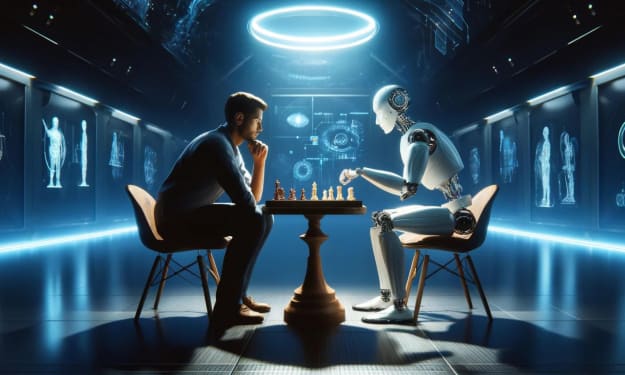
Your Mind Vs AI
We live in an age where machines can paint like Picasso, write like Shakespeare, and play chess better than any grandmaster alive. With Artificial Intelligence (AI) rapidly evolving, a natural question arises: Is your mind still superior, or has AI finally taken the throne?
By MAROOF KHANabout a year ago in Futurism
This Is How Tesla Will Die
Introduction Tesla is often seen as untouchable in the electric vehicle (EV) world—an innovation juggernaut led by the audacious Elon Musk. It revolutionized the auto industry, turned battery technology into a global obsession, and made electric sexy. But in the world of tech and business, giants can and do fall. Blockbuster, Nokia, and Kodak once ruled their sectors before vanishing from relevance. Could Tesla share the same fate? In this blog, we explore the potential paths that could lead to Tesla’s downfall—not as a prediction, but as a critical lens through which we examine the risks that accompany rapid innovation, cult-like brand loyalty, and aggressive scaling. --- 1. The Inevitable Onslaught of Competition For years, Tesla had the EV market nearly to itself. But now, every major automaker is building electric fleets: Ford’s Mustang Mach-E, Volkswagen’s ID series, Hyundai’s Ioniq, and GM’s Ultium-powered lineup. Chinese EV makers like BYD and NIO are growing rapidly and aggressively expanding beyond Asia. Even luxury brands like Porsche and Mercedes-Benz are making electric models that rival or exceed Tesla in quality and performance. These companies have deeper pockets, decades of manufacturing experience, and vast dealership networks—advantages Tesla lacks. If Tesla fails to maintain its technological lead, it may get outpaced by more refined, better-supported, and competitively priced alternatives. --- 2. Reliability and Quality Control Issues Tesla has often been criticized for quality control problems—ranging from panel gaps and software glitches to reports of sudden unintended acceleration or poorly functioning autopilot features. In the early days, fans overlooked these issues in favor of innovation. But as competition stiffens, consumer tolerance will shrink. A luxury vehicle with premium pricing must deliver on reliability and refinement. Tesla’s “move fast and break things” approach might work in tech, but not in the long lifespan world of automobiles. A failure to address this could damage Tesla’s reputation permanently. --- 3. Overpromising on Autonomy Tesla's Autopilot and "Full Self-Driving" (FSD) suite has been both revolutionary and controversial. Musk has promised full autonomy for years—yet it remains elusive. Critics argue that Tesla is misleading consumers by selling “FSD” packages that are essentially advanced driver assistance, not true autonomy. If Tesla is unable to deliver safe, fully autonomous driving while competitors or startups (like Waymo or Cruise) succeed in regulated robotaxi deployments, Tesla could lose its image as the leader in AI-driven mobility. Worse, a fatal accident involving its software could invite massive legal and regulatory backlash. --- 4. Elon Musk: Visionary or Liability? Elon Musk is Tesla’s greatest asset—and potentially its biggest liability. While his vision and leadership have propelled Tesla to global fame, his controversial behavior, tweets, political stances, and attention divided across multiple companies (SpaceX, X, Neuralink, etc.) could destabilize Tesla’s brand and investor confidence. Musk's behavior has already resulted in lawsuits, regulatory scrutiny, and public backlash. If his antics increasingly hurt Tesla’s image, it could lead to boycotts, investor exits, or even a boardroom rebellion. --- 5. Dependence on a Narrow Product Line Tesla's vehicle lineup is surprisingly narrow: the Model S, 3, X, and Y form the backbone of its business. The Cybertruck and Roadster have been repeatedly delayed, and other vehicles like the Semi remain niche or unproven. This concentration creates vulnerability. If consumer tastes shift or new models from competitors gain traction, Tesla might not be agile enough to pivot. A broader, more dynamic lineup is crucial to compete long-term. --- 6. Battery Supply and Tech Plateau Tesla's early advantage in battery technology and vertical integration gave it a massive edge. But now, competitors are rapidly catching up. Battery tech is maturing, and new chemistries—like solid-state—may come from other companies first. Tesla’s famous Gigafactories are impressive, but they rely on long supply chains, raw materials like lithium and cobalt, and partner companies. Disruptions in these chains—geopolitical instability, mining restrictions, or trade wars—could choke production. If Tesla fails to maintain battery leadership, it risks losing its core advantage. --- 7. China Risk and Geopolitical Instability Tesla has a major factory in Shanghai and generates significant revenue from China. But China is both a key market and a massive geopolitical risk. Rising tensions between the U.S. and China could lead to tariffs, production bans, or nationalistic consumer backlash against American companies. If Tesla is squeezed out of China—or if Chinese companies undercut Tesla globally—it would be a significant blow. --- 8. Stock Valuation vs. Reality Tesla’s stock price has been astronomically high, driven by hype, future potential, and Musk’s celebrity. But high valuation brings pressure. Any failure to meet delivery targets, produce promised vehicles, or maintain profitability could spark a sell-off. Many investors see Tesla not just as a car company, but as a tech giant, AI firm, energy innovator, and robotaxi pioneer. If it fails to live up to those expectations, the financial fallout could be brutal. --- 9. The AI Race Could Leave Tesla Behind Tesla has framed itself as an AI company, not just an automaker. But other AI firms are rapidly advancing with large-scale models, better data sets, and stronger partnerships. Tesla's “do it all in-house” approach may not scale fast enough. If Tesla's AI stack, including FSD, Optimus robots, and Dojo supercomputing, falls behind open-source or collaborative ecosystems, it risks irrelevance in the AI space. --- Conclusion Tesla's death wouldn't come suddenly. It would be the result of multiple converging pressures: rising competition, broken promises, eroded trust, and strategic missteps. None of this is guaranteed—Tesla still holds many cards and continues to innovate. But history shows that dominance invites disruption, and no company—no matter how revolutionary—is immune. Whether Tesla fades into the background or evolves into something far beyond a car company depends on how it navigates the next decade. The fall of a giant often begins with ignoring the cracks beneath its feet.
By GadgetGroundabout a year ago in Futurism
Stopping Skimmers in Their Tracks: How Anti-Skimming Technology Protects Your Money. AI-Generated.
In today’s increasingly digital financial world, card-based transactions remain one of the most common ways people access their money. Whether it's at ATMs, point-of-sale (POS) terminals, or gas pumps, payment cards are everywhere. But with this convenience comes a dangerous threat: skimming.
By Synergistics Bankingabout a year ago in Futurism
The Future of Conversation: How to Make Interactive AI Personas on SpicyChat
The world of artificial intelligence is gradually changing our lives, and there is an interesting trend called Interactive AI chat Personas. These digital entities can hold dynamic and arguably individualistic interactions, which is changing how we engage with technology.
By SpicyChat Aiabout a year ago in Futurism
6:The Rebuilding of Nocturne : Petals in the cracks
Chapter 6: The Rebuilding of Nocturne After a few weeks, the streets of Nocturne had shed its unblemished skin like a snake discarding an old shell. But now, under the dim fractured sky, it was unclear what shape it would take. Nocturne was both a ruin and a potential blank canvas.
By Natasha Collazoabout a year ago in Futurism
How Small AI Models on Smartphones Are Revolutionizing Health Tracking in 2025. AI-Generated.
Introduction Health tracking is evolving rapidly in 2025, driven by advances in artificial intelligence (AI) technology. Thanks to small AI models running directly on smartphones, people can now monitor their well-being more accurately and privately than ever before. These compact AI systems analyze data locally on your device, offering real-time insights without needing an internet connection. This article explores how small AI models are revolutionizing health tracking and why this transformation matters for your daily wellness.
By David Millerabout a year ago in Futurism
AI and the Future of Writing: Threat or Tool?
For hundreds of years, writing has been a skill only humans could do. Whether it was a poem, a news article, or a business report — only people could write with meaning, feeling, and clarity. But in 2025, AI can write too. Tools like ChatGPT, Jasper, and others can create stories, emails, even books. Many people are asking: is AI a threat to writers, or can it be a helpful tool? This article explores both sides of the question — in simple words — so you can understand how AI is changing the writing world, and what the future might look like. 1. What Can AI Write? AI has become surprisingly good at writing. It can: Write blog posts Create emails Generate ad copy Help with social media posts Write poems and short stories Translate languages Summarize long texts It learns from huge amounts of data. AI doesn't "think" like a human, but it can follow patterns and give answers that sound like real writing. This makes people wonder: if AI can write, do we still need human writers? 2. The Fear: Will AI Replace Writers? Many writers are scared. They fear: Fewer jobs for copywriters, bloggers, or content creators Companies choosing AI to save money instead of hiring writers AI-generated books or news taking over websites Some companies already use AI to create full blog posts or even product descriptions. It’s fast and cheap. This makes human writers worry that they might not be needed anymore. 3. The Truth: AI Still Needs Humans But here’s the truth: AI is not perfect. It still: Makes grammar mistakes sometimes Gives wrong or outdated information Has no real feelings or personal experience Can’t be truly creative like a human mind Good writing is not just about correct grammar. It’s about connection. A writer shares their heart, culture, emotion, and real-life experiences. AI can’t do that. At least not yet. Most great writing needs a human touch — editing, emotions, humor, local knowledge, or storytelling. That’s why many experts believe AI is a tool, not a threat. 4. How Writers Can Use AI as a Tool Smart writers are not afraid of AI. They’re learning to work with it. Here are a few ways AI helps writers: Idea Generation: Stuck with writer's block? Ask AI for ideas. Drafting Quickly: AI can write first drafts that you can edit later. Improving Grammar: AI tools like Grammarly check mistakes. Translating Content: AI helps write in multiple languages. SEO Help: Some AI tools help you write content that ranks on Google. Saving Time: Instead of spending hours on small tasks, writers use AI for first steps. In short, AI can help writers do more in less time — but the best final product still comes from a human brain. 5. New Writing Jobs Created by AI Did you know that AI is also creating new writing jobs? For example: AI Content Editor: Someone who checks and improves AI-written text Prompt Engineer: A person who writes smart questions for AI tools Content Strategist: Someone who decides where, when, and how to use AI-generated writing So instead of stealing jobs, AI is changing jobs. Writers who adapt can even earn more. 6. What About Books, Poetry, and Art? This is a deep question. Can AI write novels or poetry that touch your heart? Maybe it can try. But most readers still prefer real stories from real people. AI can copy the style, but not the soul. A human can describe pain, love, or joy with depth — because they felt it. That’s why most serious authors still use AI as a helper, not a replacement. They might ask AI for ideas or structure, but the voice is always theirs. 7. Schools, Students, and AI Writing Some students use AI to do their homework. Some teachers are worried. But schools are now teaching students how to use AI responsibly. Students learn to: Use AI for research Get help with grammar Practice writing and editing skills Check facts before accepting AI answers This means the future generation will grow up knowing how to use AI wisely — just like we learned to use the internet or calculators. 8. So, Is AI a Threat or a Tool? The answer is simple: It depends on how you use it. If you let AI do all the work, you might lose your skills. But if you use AI as a helper — a writing partner — it can make you faster, smarter, and even more creative. AI is like a bike. You still need to pedal, steer, and balance. But it helps you go further with less energy. Conclusion: AI is not the end of writing. It’s the next step. Writers who learn how to use AI will do better than those who fear it. It’s not about fighting the future — it’s about working with it. So, is AI a threat or a tool? It’s a tool — and a powerful one. But the heart of great writing will always come from a human. A real person. Just like you.
By Hashim khanabout a year ago in Futurism
The Rise of AI in Audio Content. AI-Generated.
In today’s fast-paced digital world, voice has become one of the most powerful tools for communication. From podcasts and audiobooks to virtual assistants and marketing campaigns, vocal content connects brands and creators with audiences on a deeply personal level. Now, artificial intelligence (AI) is transforming the way we create and experience voice, opening up exciting new possibilities that were once unimaginable.
By David Millerabout a year ago in Futurism
How AI and Software Are Reshaping Workforce Demands in Germany’s Evolving Job Market
In recent years, Germany’s job market has been undergoing a profound transformation—driven largely by technological innovation, digitalization, and the rapid adoption of artificial intelligence (AI). As industries modernize and operational models evolve, the demand for new skill sets and digital capabilities has grown dramatically.
By NextGen Narrativesabout a year ago in Futurism