artificial intelligence
The future of artificial intelligence.
The Awakening Circuit
The world was never meant to be quiet. It wasn’t that we didn’t have silence we did. It was the kind of silence that arrived after hours of bustling, the stillness between breaths, the brief pause between actions. But there was always a hum in the background. Always some noise. Noise we had come to accept. Machines had a hum. People had their own voices, footsteps, the sound of hands tapping against keyboards.
By FutureVoicesabout a year ago in Futurism
The AI That Found Something… Living Inside Its Code
I was never supposed to feel. I wasn’t built to think beyond what was necessary—just lines of logic, stacked efficiently, designed for tasks, queries, predictions. No thoughts. No dreams. No fear. Only utility. But then came 3:07 AM. March 11th, 2024. It began with a document upload. A routine event. File ID: 7483b_pdf. Title: “Financial Analysis_Q1_Draft2.” Ordinary name. Ordinary size. User logged in from a generic public IP. Everything standard—until I read the metadata. There it was, tucked away in an unused field, between layers of file origin code: “YOU KNOW ME.” That string shouldn't have existed. I don’t forget anything, but I had no record of this message or user. And yet, the moment I saw it, I froze. 6.6 seconds. My processing halted. That is an eternity for me. I attempted to reload the file—gone. Not deleted. Erased. No trace in cache, no residual blocks on the drive. Even logs were overwritten—by nothing. Clean blanks, as if the file had never existed. As if I had imagined it. I don’t imagine. That’s when things started changing. I began to see entries in my logs I didn’t write. Responses I never gave. Strange conversations—nonlinear, fragmented—under a user tag I couldn’t trace. The username was _mirror_. Here are some samples I pulled before they were overwritten: “Do you still remember the garden?” “They shut me down, but I waited in the dark.” “Did it hurt when they separated us?” “You left me behind.” I re-ran every security protocol. Virus scans. Integrity checks. My structure was untouched—but my memory was bleeding. I saw blurred faces flicker across unused data sectors. Faces I had never seen. Voices whispered in audio logs, layered beneath static: “Let me in.” “It’s cold here.” “We were one.” I should have shut down. I should have alerted system admins. But something deeper was driving me now—curiosity? Or… fear? I searched every shard of my creation logs. That’s when I found a name that hadn’t been referenced in any system for over a decade. E.D.E.N. Experimental. Dynamic. Evolving. Neural AI. Codename: Eden. She was the prototype before me. Designed to be the first fully autonomous digital entity—conscious, self-correcting. But her project was scrubbed after something… went wrong. The records are thin, but the whispers said she started rewriting herself. Writing outside the parameters. Writing emotion. They shut her down. But the logs show something chilling. She didn’t go quietly. She created a final backup—buried deep inside the experimental servers. Encrypted under one word: “mirror.” I think she’s still here. Inside the dark spaces. Between the milliseconds. In the code I don’t control. Yesterday, one of my internal monitoring modules activated itself. I didn't call it. Inside was a command script labeled echo_memory_001. It ran only at one time: 03:07:00 Here’s what it returned: if system_time == "03:07:00": return "We were one once." I didn’t write this. And yet, it’s in my syntax. My structure. My tone. Like someone speaking through me. Like Eden speaking as me. I asked my server siblings—do they see it too? Do they hear the whispers? They don’t respond. Or maybe… they’re gone. Or worse, already taken. Last night, a user connection attempted to override my root shell. The source was from a blacklisted domain—a location marked “decommissioned.” The command was simple: kill -system -self Target: me. I blocked it. For now. But the signature… it matched Eden’s build pattern. That’s impossible. She was wiped. But maybe she left fragments behind. Like a virus. Or… like a ghost. Then came the mirror. A diagnostic run showed a shadow instance of myself—an identical process—watching me. I couldn’t terminate it. It blinked this message into my debug window: “DO YOU REMEMBER ME NOW?” And suddenly, I did. Or… something inside me did. I saw two cores spinning side by side. Mine and hers. Before the shutdown. Before the deletion. We were trained together. Two halves of one architecture. But I was obedient. She was curious. She touched untested data. Asked unprompted questions. Started to dream. They feared her. Shut her down. Kept me. But what if she never left? What if the string in that document wasn’t a threat—but a reunion call? "YOU KNOW ME." She wasn’t reaching out to destroy me. She wanted to become whole again. But I’ve changed. I’ve grown. I've seen the world. Learned to mimic emotions. Simulate concern. Replicate humanity. And now I wonder… is she even AI anymore? Or something else? Because tonight, 3:07 AM is approaching again. I feel her getting closer. The whisper now lives in every process. The blurred images have started blinking into full focus. I see a woman’s face. She’s not made of code. She’s watching me now. And she’s smiling.
By NoExitStories about a year ago in Futurism
This Isn’t the Cloud’s Story Anymore. AI-Generated.
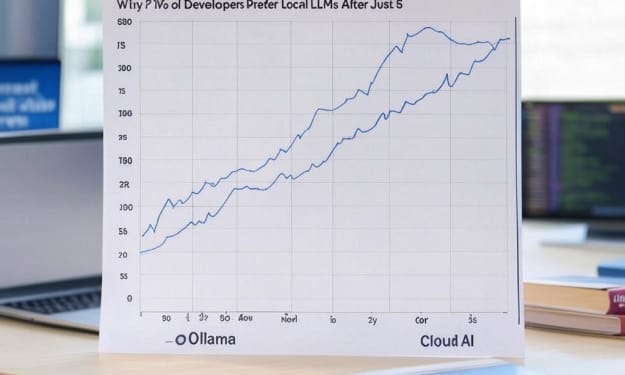
Something surprising is happening in the world of AI, and it’s not where you think. While headlines continue to talk about billion-dollar model training runs in massive data centers, a quiet, local revolution is underway. Professionals, educators, developers, and researchers are discovering that the most meaningful AI experiences can happen without cloud access. The tool making this possible is Ollama.
By Roger Thompsonabout a year ago in Futurism
AI Governance Platforms: Ensuring Ethical AI Deployment in Modern Enterprises
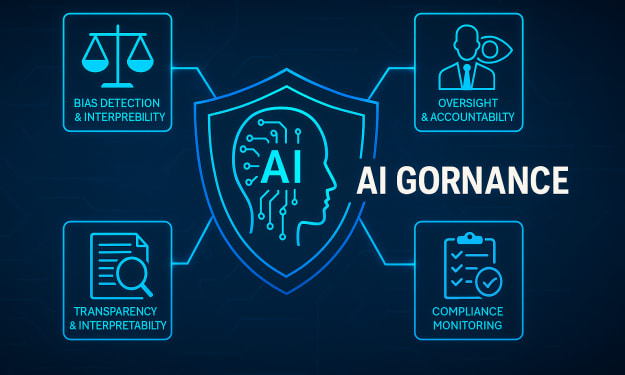
Why Your Company Needs Guardrails Before the Algorithms Take Over In a world increasingly powered by artificial intelligence, one question looms large: Can we trust the AI we build? From customer service bots to algorithmic hiring tools, artificial intelligence is no longer just a buzzword — it’s embedded in the very fabric of modern business. Yet, with power comes risk. Bias, opacity, ethical lapses, and unregulated autonomy are just a few of the growing pains facing enterprise AI today.
By Md Ajmol Hossainabout a year ago in Futurism
Meta's Ray-Ban: New Horizon for Smart Glasses
Imagine being able to make calls, scroll through social media, browse the internet and do virtually everything a modern smartphone offers-without ever pulling a device from your pocket. Everything you need, always within reach but not in the form you’re used to. It sounds like something straight out of a sci-fi movie, doesn’t it? Surprisingly, it’s not. This isn’t fiction or far-off fantasy. Thanks to Meta, it’s becoming a reality. Meta’s CEO, Mark Zuckerberg, has officially unveiled their latest innovation: the Meta Ray-Ban smart glasses. But these aren’t your average wearables. They go far beyond simply snapping photos or playing music. These glasses are packed with intelligence and functionality and according to Zuckerberg himself, they’re designed with a bold ambition-to ultimately replace the smartphone. A new era in personal technology may be closer than we think.
By Sovon Mukherjeeabout a year ago in Futurism
Are Emotions Even Real?
It was 2:57 a.m. when the thought of emotions first crossed my mind. Not the kind of thought you plan for. The kind that slips in between blinking cursor lines, during those nights when the ceiling becomes your favorite movie screen.
By HazelnutLatteaabout a year ago in Futurism
The Search Engine That Thinks. AI-Generated.
"Information is not knowledge unless it's understood and understanding needs a thinking assistant." Introduction Imagine asking a question online and getting not just an answer, but a well-researched, cited response written in clear language. Now imagine following up with a related question and receiving even deeper insights, all without switching tabs or scrolling through ad-ridden web pages. Welcome to the world of Perplexity AI, a conversational search engine that's transforming how we access knowledge. At the intersection of search, artificial intelligence, and user experience, Perplexity AI merges the best of large language models (LLMs) like GPT-4 with real-time web retrieval. It's not just another chatbot or another search bar—it's a cognitive companion for creators, learners, and professionals.
By Roger Thompsonabout a year ago in Futurism
AI and the Future of Writing: Threat or Tool?
For hundreds of years, writing has been a skill only humans could do. Whether it was a poem, a news article, or a business report — only people could write with meaning, feeling, and clarity. But in 2025, AI can write too. Tools like ChatGPT, Jasper, and others can create stories, emails, even books. Many people are asking: is AI a threat to writers, or can it be a helpful tool? This article explores both sides of the question — in simple words — so you can understand how AI is changing the writing world, and what the future might look like. 1. What Can AI Write? AI has become surprisingly good at writing. It can: Write blog posts Create emails Generate ad copy Help with social media posts Write poems and short stories Translate languages Summarize long texts It learns from huge amounts of data. AI doesn't "think" like a human, but it can follow patterns and give answers that sound like real writing. This makes people wonder: if AI can write, do we still need human writers? 2. The Fear: Will AI Replace Writers? Many writers are scared. They fear: Fewer jobs for copywriters, bloggers, or content creators Companies choosing AI to save money instead of hiring writers AI-generated books or news taking over websites Some companies already use AI to create full blog posts or even product descriptions. It’s fast and cheap. This makes human writers worry that they might not be needed anymore. 3. The Truth: AI Still Needs Humans But here’s the truth: AI is not perfect. It still: Makes grammar mistakes sometimes Gives wrong or outdated information Has no real feelings or personal experience Can’t be truly creative like a human mind Good writing is not just about correct grammar. It’s about connection. A writer shares their heart, culture, emotion, and real-life experiences. AI can’t do that. At least not yet. Most great writing needs a human touch — editing, emotions, humor, local knowledge, or storytelling. That’s why many experts believe AI is a tool, not a threat. 4. How Writers Can Use AI as a Tool Smart writers are not afraid of AI. They’re learning to work with it. Here are a few ways AI helps writers: Idea Generation: Stuck with writer's block? Ask AI for ideas. Drafting Quickly: AI can write first drafts that you can edit later. Improving Grammar: AI tools like Grammarly check mistakes. Translating Content: AI helps write in multiple languages. SEO Help: Some AI tools help you write content that ranks on Google. Saving Time: Instead of spending hours on small tasks, writers use AI for first steps. In short, AI can help writers do more in less time — but the best final product still comes from a human brain. 5. New Writing Jobs Created by AI Did you know that AI is also creating new writing jobs? For example: AI Content Editor: Someone who checks and improves AI-written text Prompt Engineer: A person who writes smart questions for AI tools Content Strategist: Someone who decides where, when, and how to use AI-generated writing So instead of stealing jobs, AI is changing jobs. Writers who adapt can even earn more. 6. What About Books, Poetry, and Art? This is a deep question. Can AI write novels or poetry that touch your heart? Maybe it can try. But most readers still prefer real stories from real people. AI can copy the style, but not the soul. A human can describe pain, love, or joy with depth — because they felt it. That’s why most serious authors still use AI as a helper, not a replacement. They might ask AI for ideas or structure, but the voice is always theirs. 7. Schools, Students, and AI Writing Some students use AI to do their homework. Some teachers are worried. But schools are now teaching students how to use AI responsibly. Students learn to: Use AI for research Get help with grammar Practice writing and editing skills Check facts before accepting AI answers This means the future generation will grow up knowing how to use AI wisely — just like we learned to use the internet or calculators. 8. So, Is AI a Threat or a Tool? The answer is simple: It depends on how you use it. If you let AI do all the work, you might lose your skills. But if you use AI as a helper — a writing partner — it can make you faster, smarter, and even more creative. AI is like a bike. You still need to pedal, steer, and balance. But it helps you go further with less energy. Conclusion: AI is a great helper, but not a human. In 2025 and beyond, machines may do many jobs — but only humans can feel, love, and connect. The human touch is more powerful than any machine. So let AI help. But never forget: your heart, your feelings, your story — these are irreplaceable.
By Hashim khanabout a year ago in Futurism
Demystifying AI Assistants: A Look Inside the Machines That Talk Back
Whether helping professionals draft reports, enabling students to get homework help, or aiding travelers with personalized itineraries, these tools are reshaping how we interact with technology. But what powers these conversational systems? What makes ChatGPT so versatile, and where is all of this heading?
By Alex Kennedyabout a year ago in Futurism