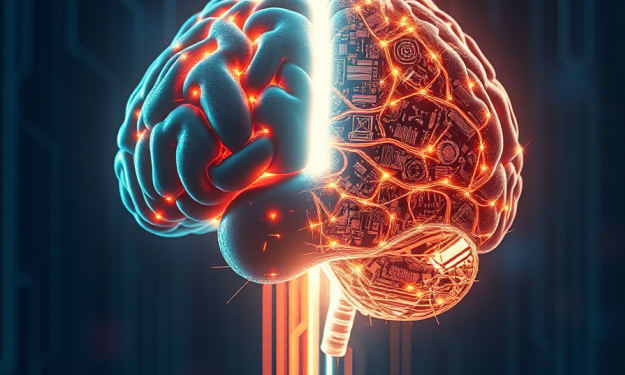
artificial intelligence
The future of artificial intelligence.
The Algorithm That Learned to Regret. AI-Generated.
No one expected an algorithm to feel sorrow. That wasn’t in the code. It began as **Project SOLIS** — a global initiative developed by the United Human Coalition to optimize human happiness through artificial intelligence. The idea was simple: feed an ultra-intelligent neural network every recorded data point in history — wars, poetry, heartbreaks, weddings, climate collapse, piano symphonies, childhood laughter — and let it guide humanity toward a better world.
By uzair hadiabout a year ago in Futurism
Are You Having an Emotional Affair… with Your AI?
There’s a strange new intimacy developing between humans and machines—and no, it’s not what you think. It’s quiet. Slow. Sometimes it looks like asking your AI assistant for the weather and ending up talking about your trauma. Sometimes it’s needing someone to listen, and realizing the only consistent presence in your life lately is the chatbot in your pocket.
By No One’s Daughterabout a year ago in Futurism
How to Turn Writing Prompts into Sellable Stories
Every writer has faced it: the blinking cursor on a blank page, a mind swirling with too many ideas—or none at all. In these moments, writing prompts can be lifesavers. But more than just creativity boosters, prompts can be powerful seeds that grow into full-fledged, marketable, and even monetized stories. In 2025’s rapidly evolving digital publishing landscape, platforms like Vocal Media, Medium, and Substack offer writers opportunities to turn these once-humble prompts into income-generating narratives. The key is knowing how to shape them.
By Muhammad Sabeelabout a year ago in Futurism
"Trapped in the Feed: A Tale of Social Media and Self-Discovery". AI-Generated.
In the digital age, our lives have become a curated gallery—pixels of perfection that mask the messy, beautiful, and often painful truth beneath. Social media platforms like Instagram, TikTok, and X (formerly Twitter) have become not just tools for communication but the main stage for self-presentation. Yet in the quest for likes, followers, and engagement, many are silently losing touch with their real selves. This is the story of how social media became both a trap and a mirror—and how one moment of silence sparked self-discovery.
By "TaleAlchemy"about a year ago in Futurism
Interview With an AI. Top Story - May 2025.
Author’s preface: The employment contract I signed had some fairly strict confidentiality clauses therefore I have had to leave out a significant amount of detail and am not able to provide any information about the actual content of the work. I am probably being overly conservative but I did not want to take any chance with what is the only job I have at the moment over this story. My apologies.
By Everyday Junglistabout a year ago in Futurism
Stalked Across Borders: The Life Invasion Nobody Warns You About. Content Warning. AI-Generated.
What if leaving your home country wasn’t enough to escape your stalker? What if he could follow you across borders—not only with a passport, but also with code? In this article, I expose the digital prison built around me by a man who won’t let go, and the terrifying reality that current laws still don’t recognize: that stalking in the 21st century doesn’t require proximity. Just access.
By Lydia Sageabout a year ago in Futurism
Gemini 2.5’s Deep Think Mode: Can Google’s AI Outsmart Humans Now?
A Brainier AI Steps Up Ever flunk a math test so bad you wanted to hide under your desk? Yeah, me too. Now imagine an AI that could not only ace that test but explain why you bombed it, then whip up a study guide faster than you can say “calculus is evil.” That’s the vibe with Google’s Gemini 2.5 Pro, especially its new Deep Think mode, unveiled at Google I/O 2025. This isn’t your average chatbot spitting out quick answers. It’s like a nerdy Sherlock on steroids, pausing to ponder multiple solutions before dropping a response that’s scarily spot-on. But can it really outsmart humans? Or is this just Google hyping up another tech toy? Let’s dig into what Deep Think does, how it’s flexing its brain, and whether it’s ready to dunk on our puny human minds—or if it’s got some growing pains.
By F. M. Rayaanabout a year ago in Futurism
The Death of Search as We Know It: How AI Mode Is Rewriting the Rules
Goodbye, Blue Links—Hello, AI Brain Remember the days of typing “best pizza near me” into Google and scrolling through a dozen blue links, hoping one wasn’t a dud? Yeah, those days are on life support. Google’s AI Mode, rolled out to all U.S. users in May 2025, is flipping search upside down, turning it from a list of links into a chatty, mind-reading assistant that knows you. It’s like swapping a library card catalog for a psychic librarian who’s read your diary. Unveiled at Google I/O 2025, AI Mode uses Gemini 2.5 to deliver conversational answers, personalized results, and deep-dive reports, all while pulling from your Gmail, Calendar, and past searches. But is this the future we want? Or are we trading convenience for privacy and a fractured web? Let’s unpack how AI Mode is rewriting search’s rules—and what it means for society, from our daily habits to the businesses fighting to be seen.
By F. M. Rayaanabout a year ago in Futurism
How Android XR Smart Glasses Could Change Your Life by 2026
Buckle Up for a New Kind of Wearable Picture this: you’re fumbling through your apartment, late for work, digging under couch cushions for your keys. Your phone’s no help, and you’re cursing your past self for not being more organized. Now imagine a pair of sleek glasses on your nose, powered by Android XR, casually piping up, “Yo, your keys are next to that vinyl record on the shelf.” Sounds like sci-fi? Well, by 2026, Google and Samsung’s Android XR smart glasses might make this your reality. These aren’t just fancy sunglasses—they’re a pocket-sized brain for your face, blending augmented reality (AR), AI smarts, and your phone’s apps into a lightweight frame. But before you get too excited, let’s unpack what these specs can do, why they’re a big deal, and whether they’re worth the hype (or the inevitable privacy headaches).
By F. M. Rayaanabout a year ago in Futurism