Short Story
When the Streetlights Come On
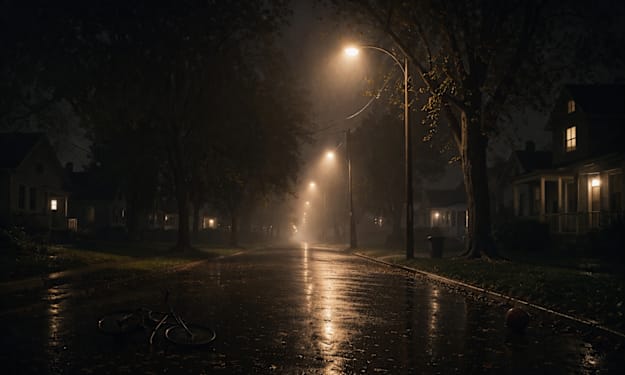
Nobody had to tell us to be home before the streetlights came on. We just were. Not because we were good. Not because we listened. Kids don’t work like that. We rode our bikes too far. Let the basketball roll into the street. Climbed fences we weren’t supposed to touch. Skinned our knees. Lied about where we’d been. Came home sweaty, filthy, and half wild. But when the streetlights flickered, the whole neighborhood changed shape. You could feel it before you saw it. A tightening. Like the evening itself had drawn in a breath and decided not to let it go. The glass over the bulbs would buzz once, then tremble into light, pale and sickly at first, and all at once the street would break open. Bikes dropped mid-spin. A ball left bouncing into somebody’s yard. Kids running full tilt for porches and screen doors and the square yellow safety of kitchen windows. Mothers in doorways with dish towels in their hands. Fathers on the porch with that sharp-edged patience adults get when they’ve already asked twice. And from outside—always from outside—you’d hear your parent call your name. That was enough. You ran faster. No one stood there wondering why the voice sounded farther away than it should. No one stopped to ask why their mother sounded like she was calling from the dark instead of the porch. No one tested it. You heard your parent. You ran. You didn’t stop to think about it. Until Leo. We were twelve when he disappeared, and old enough to think that made us harder to kill. Leo was my identical twin, which meant people said dumb things about us all the time. That they couldn’t tell us apart. That it was like seeing double. That if one of us smiled, the other one looked guilty. We hated most of it, but there was one part that was true: I knew his voice better than anything else in this world. Better than my own, maybe. That night, the streetlights flickered while we were still in the woods. We had cut through because it was faster. Because we were late. Because the long way home felt like admitting we’d misjudged the time, and boys would rather gamble with the dark than lose to a clock. The trees were already going black around the edges. The path was barely a path, just dirt packed hard by years of bad decisions. Roots rose through it like knuckles. The air smelled wet and green and old. Then, from somewhere behind us, our mother called: “Leo. Nico. Get home. Now.” Clear as church bells. We ran. I can still feel the first blind burst of it in my chest. Shoes tearing through leaves. Branches lashing at my arms. That ugly panic that comes when your body decides before your mind does. Leo was right behind me. Until he wasn’t. I heard him hit the ground. A hard sound. Flesh, dirt, roots. All the breath in him leaving at once. I slowed. Not enough. Just enough to know I had. Then his voice split through the trees. “Wait.” Not our mother. Leo. I turned my head just enough to see him in pieces through the dark—one hand in the dirt, one knee bent wrong, face turned toward me— And then something yanked him backward. Not dragged. Not pulled. Yanked. Like the dark itself had gotten tired of waiting. I ran. I ran out of the woods and across the ditch and up the porch steps so fast I nearly broke my face on the front door. My mother grabbed my shoulders. I remember that. Her hands, hot and solid. The porch light. The smell of fried onions coming from the kitchen like the world had the nerve to still be normal. “Where’s Leo?” “He fell,” I said. That was what I gave her. He fell. Like that covered it. Like the woods had simply misplaced him. We went back with flashlights. My father crashed through brush like noise alone could scare the dark into giving his son back. My mother called until her voice shredded. I stood there shaking and watched our lights move across tree trunks and briars and the uneven ground where the path dipped. All we found was his baseball cap. And the marks. The dirt looked torn up. Not like footprints. Not like an animal, either. More like someone had tried to hold on with both hands and failed. Furrows cut into the ground. Lines dragged through leaves. The shape of fear left behind after the body was gone. The forest here was too quiet. The kind of silence that feels heavy, like it’s holding its breath. There was no blood. Just those deep, desperate gouges in the loam. They ended at the base of a tree, bark stripped raw where something had met it hard enough to leave a mark. Whatever had taken him hadn’t lifted him up; it had simply made him cease to be part of the ground. No one said much after that. They didn’t have to. Something in the whole town bent. Parents got meaner when the sun went down. Kids got quicker. By late afternoon, yards started emptying on their own. Nobody played near the woods anymore. Nobody cut through them. Nobody looked toward them if they could help it. And when the streetlights flickered, every porch became a mouth and every house swallowed its children whole. We moved before winter. My mother called it needing a fresh start. My father called it practical. I called it nothing. I stopped calling it anything at all. Years passed. The kind that make people think what happened to them has settled into the past, when really it has just found a quieter room to wait in. Then we came back. The town had shrunk. You could see it in the empty houses with grass grown up around the steps, in the playground with more rust than paint, in the school windows gone dark wing by wing. But our street was still our street. Same poles. Same tired wires overhead. Same road split by old cracks like healed bones. Same woods at the end of the block, dense and silent and pretending to be just trees. I avoided them at first. Then I avoided thinking about them. Then one evening I lost track of time. That’s how it happens. Not with intention. Not with drama. Just a day that runs longer than you meant it to. A sky going from gold to gray while you tell yourself you’ve still got a minute. A block becoming two. Then the whole neighborhood pulling tight around you like a fist. The streetlight above me flickered. My stomach dropped so fast it felt like missing a step in the dark. I ran. The long way home would take too long. I knew that before I had fully turned. My body chose the shortcut before my guilt could object. The woods. Same path. Same mistake. I hit the tree line at a sprint. Branches clawed at my shirt. Dirt kicked loose under my shoes. The smell hit me first—that same wet rot, same green-dark stink of earth and leaves and things left too long alone. I knew this path. I knew every bend of it. I knew where it narrowed, where the roots broke through, where the ditch ran shallow after rain. I knew it right up until the second I didn’t. My foot caught. I went down hard enough to skin both palms and bite my tongue. For one long second everything emptied out. No wind. No insects. No sound but blood hammering in my ears. Then— “Wait up.” I froze. Every part of me went cold at once. Because I knew that voice. Not the way you know a familiar song. Not the way you recognize somebody after years apart. Closer than that. It sounded like me. Not because it was mine. Because it was his. Leo. I shoved myself off the ground and ran. Branches snapped across my face. My breath came ragged and wet. My heart was beating so hard it felt less like panic and more like impact, like something trying to get out. Behind me: “Wait…” Closer. Then, with a crack in it—small, human, almost ashamed— “Please.” My legs kept moving. That was the worst part. Not that I wanted to stop. That I almost did. The trees thinned ahead. Through them I could see the road and the scattered burn of porch lights—warm squares in windows, yellow bulbs over doors, the thin ordinary glow of people washing dishes and arguing and living. Home was there. The world was still there. I only had to reach it. Then the voice came again. Quieter now. Not chasing. Not angry. Almost tired. “Don’t leave me again.” That slid under my ribs and opened something rotten. Because I had heard that plea before. The night I left him. “Don’t leave me.” I didn’t stop. Memory doesn’t need truth. It feeds on what you felt. And this— this felt the same. Leo on the ground. Leo reaching for me. Leo’s voice breaking behind me while I ran— and kept running. I still dream about it with my teeth clenched. My stride faltered. The road was right there. The ditch. The curb. My porch light burning like a tiny private heaven. Behind me: “Wait.” Then softer— “Please.” I slowed. Just enough to feel it. The pull. Not a hand. Not breath on my neck. Nothing I could name and survive naming. Just that awful, intimate certainty that if I turned around, something would be there waiting in the shape of what I loved most. My head started to move. Barely. The beginning of a turn. The first betrayal. Then porch light hit my face through the trees, sudden and gold, and I lunged toward it like a man surfacing from deep water. I broke out of the woods at a stumble, hit the road wrong, nearly fell again, caught myself on the porch rail, and shoved through the front door hard enough to rattle the frame. I barely made it inside. The house smelled like detergent and old wood and whatever my mother had cooked hours ago and forgotten to put away. The clock over the stove ticked too loudly. The kitchen light made everything look flatter than it should have, like the room had been copied from memory and pasted back wrong. My mother stood at the sink. She turned when she heard the door slam. For one second neither of us said anything. I must have looked wrecked. Mud on my jeans. Blood on my palms. Face white as paper. She took a step toward me. I flinched. That stopped her. The silence that followed felt crowded. Like the house was no longer empty around us. Like I had dragged something in with me without meaning to. Then, from the living room— Static. Thin at first. Then louder. A dry electrical hiss, like a voice trying to be born through sand. Neither of us moved. The television was on. Or had been. The screen washed the wall in cold blue pulse. A newscaster’s voice pushed through the static in broken pieces. “…local officials are urging families to keep children indoors after dark…” “…another disappearance reported late last night…” “…residents describe hearing voices—” The signal cut. More static. “…school districts are considering closures due to declining enrollment…” “…authorities continue to advise—” The screen flickered. Then another voice came through. Not the newscaster. Quieter. Closer. “…don’t leave me out here.” My mother crossed the room in three steps, snatched up the remote, and turned the TV off. The black screen held us both. Nobody said a word. Outside, down the block, a porch light stayed on too long.
By Tifani Power 6 months ago in Fiction
THIRTEEN
The first Tuesday of every month, we gathered in the community room of the Ashford Apartments with dishes covered in foil and Tupperware lids that didn't quite seal. Someone brought macaroni. Someone brought green beans. Someone, always, brought pie.
By Edward Smith6 months ago in Fiction
The Lesson
I had just deplaned in Austin after a torturous flight from Sacramento. The weather had been bad when we lifted off and didn’t seem to get much better throughout the flight, with an unexpected delay in Vegas that lasted more than three hours. I was already wound up tight for this trip, a work gig that was going to involve either me or someone else losing their job, so the tension of the delays didn’t help me much. Turbulence makes me nervous, and I could definitely feel my shoulders and my gut paying the price. Needless to say, when the plane finally landed, I was more than ready to disembark.
By David Muñoz6 months ago in Fiction
Silence of Shame. Content Warning.
The house sat quietly at the end of the street, illuminated by dim street lights and the fading red glow of sunset. Inside, seated at the family’s wooden dining table, 10-year-old Amelia closed her homework notebook and set down her pencil. She looked around at the silent and still kitchen, listening to the quiet buzz of the neighborhood outside the window.
By Elizabeth Kaye Daugherty6 months ago in Fiction
LHS Class of 01 Reunion '21
Megan leaned forward, her tone becoming conspiratorial, and whispered, “We should definitely give her a heads‑up about the reunion; she’d love to see us all again, and I know she’s been missing the old crew.” The two women agreed to draft a concise, friendly email that would both respect Emily’s busy schedule and convey the excitement they felt for the event, proving that even the most meticulous planning could accommodate the unpredictable nature of adult responsibilities.
By Forest Green6 months ago in Fiction
LHS Class of 01 Reunion '21
It has been about a year since Covid shut down places around the globe and the lockdown had changed the lives of many all over the world. But once the regulations had been lifted, many things changed. The same goes for the Lincoln High School class of 2020 and the upcoming class of 2021. The school had to shut down and the students had to resort to remote learning and because they couldn’t have prom or a in school graduation, the diplomas would be sent home. The class of 2021 would have some challenges but would make something work as they manage to return to class but under new guidelines. Mrs. Martin had retired after the 2020 school year ended and Mrs. Smith had stepped in as the new principal with the class of 2021 to be the first one to graduate under her. As for the class of 2001, their upcoming 20 year reunion is on a different track, but everybody made plans on going regardless. Keeping a distance and having masks are part of the guidelines until further notice and the school gym has not changed since the 15th reunion. So Mrs. Smith would have to do some quick thinking especially after realizing that the senior prom and the reunion were accidentally scheduled on the same day.
By Forest Green6 months ago in Fiction
Tears from the Sky
She was new, the girl with the red hair. It was copper, the color of brand-new shiny pennies, and looking at it, Randall wanted to run his hands through it and feel how soft it was. He didn't do that, of course. Instead, he sat down at the long table in the mess hall across from her and said, simply, "Hello."
By Raistlin Allen6 months ago in Fiction
Stocking Feet. Honorable Mention in The Rule Everyone Knows Challenge.
Moving day came for Jeremy and his new family. The jet lag had set in hard. Worse than he could have ever imagined. It gave him a pounding headache and horrible disorientation. He’d been a coast-to-coast redeye guy for years, but this was a whole nother level.
By David Deane Haskell6 months ago in Fiction
Chili, like in Italy
A fly whirs its wings and flies away from a flickering bulb in the corner of a hospital corridor. The pistachio-green paint smells of newness and sterile freshness. The metal that connects lined-up chairs, obediently in a row of five along the walls opposite the consulting room doors, matches the green. It’s 8 p.m., so only one is still open. Emergency care must be accessible at any time. You never know when something might happen to you.
By George Roast6 months ago in Fiction