Satire
THE TSAR’S CROWN
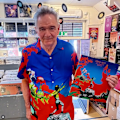
I was buying my Christmas outfits at Traki, a store known for cheap clothes, but with the extravagant touch of the Tsar of Beauty, Osmel Sousa. Back then, my girlfriend was Susana Janiott, a conceptual artist working on a statue for a plaza—a pixelated Simón Bolívar riding a nyan cat, wielding a flaming holographic sword. The Masonic society wasn’t happy about it at first, but when she offered to add an Illuminati symbol, they gave in right away. The AC was blasting so cold I told Susana my dick was standing at attention for no reason, and that we’d be stuck freezing for a while. It didn’t matter—outside, the streets were crawling with rats, peddlers were with women who stank to high heaven, and men armed with pure bad vibes. The cashiers wore pins shaped like hangers and a pink heart on their left breast, straight out of some populist propaganda. Susana was pissed there wasn’t any trendy European stuff, and someone called security. They locked us in a dressing room, all in black, but with mirrors everywhere. There was nothing to do but kiss.
By Eliseo Villafañe6 months ago in Fiction
DON JUAN IN DONGGUAN
Dongguan is a Chinese city where men are scarce. There are so many women that they’d rather share their boyfriends than be alone, so a guy can easily have three women without a problem. Plus, he gets to be kept, because the competition is tough, and the women would rather support a man than end up alone.
By Eliseo Villafañe6 months ago in Fiction
The Well of Secrets
I. The Village of Mirabad The village of Mirabad had no secrets — or so the elders claimed. Nestled between two hills like a sleeping child between its parents' arms, it was the kind of place where the smell of bread from one household drifted to another, where every birth was celebrated by the whole street, and every death was mourned by every soul who could walk to the graveyard. People believed that here, under the open sky, nothing could stay tv hidden for long. But there was the well. It stood at the very center of the village square, older than anyone could remember. The stone walls were dark with age, the rope that hung over it had been replaced a hundred times, and the water that rose from its depths was the coldest, clearest water in the entire valley. Children drank from it. Women washed vegetables beside it. Old men sat on its edge and told stories that had no endings. Everyone used the well. But no one — not even the oldest elder — knew how deep it truly went. It was beside this well that the trouble began, on the last Tuesday of October, when the body of Tariq the miller was found. ⸻ ✦ ⸻ II. The Morning After Rukhsana was the one who found him. She had come before dawn, as she always did, to draw water before her mother-in-law woke and demanded tea. The lantern in her hand threw a pale circle of light onto the cobblestones — and there he was, Tariq, slumped against the base of the well, his eyes wide open, staring at nothing. She did not scream. Rukhsana had grown up in this village and she had seen death before — her father, a drought that killed their crops and then their animals, two children buried before they could learn to speak. She set down her lantern. She pressed two fingers to Tariq's neck. Cold. Long gone. Then she noticed something. His right hand was clenched tight around a piece of cloth — torn, dark blue, the kind of fabric the wealthy men of the village wore. Rukhsana stared at it for a long moment. Then she looked up, into the dark mouths of the houses surrounding the square, the shuttered windows, the closed doors. She felt the village watching her, even in its sleep. She left the cloth where it was and went to wake the headman. "In a village this small, a secret is not something you keep. It is something you bury — and pray the rains do not come." III. The Questions Begin By midmorning, the square was full. The headman, old Bismillah Khan, sat on a wooden chair that had been brought out from his house, and one by one the men of the village came to stand before him. The women watched from a distance, gathered in tight clusters, their voices low. The constable from the district town had been sent for, but the road was muddy from the night's rain and it would be hours before he arrived. In the meantime, Bismillah Khan asked the questions himself. Who had seen Tariq last? His wife, Zainab, said he had left after the evening prayer, saying he needed to check on his mill wheel. He had not returned. She had assumed he stayed there, as he sometimes did when the work ran long. She had gone to sleep. Who had been in the square after dark? No one admitted to it. And the cloth in Tariq's hand? Bismillah Khan held it up. The crowd went very quiet. It was good fabric, fine weave, the colour of deep water. Several eyes shifted — briefly, involuntarily — toward the house of Saleem the merchant, the richest man in Mirabad, whose long coat was made of exactly that kind of cloth. Saleem stood at the edge of the crowd, arms folded, his face as smooth and unreadable as river stone. ⸻ ✦ ⸻ IV. What Rukhsana Knew It was Rukhsana who held the real secret, though she had not yet decided what to do with it. Three weeks ago, she had been drawing water late at night — her mother-in-law had been feverish, and she needed water for the medicine. The square had been empty, the village asleep. But as she pulled up the bucket, she had heard voices from the alley beside the merchant's storehouse. Tariq's voice and another — hushed, urgent, arguing. She had caught only fragments. "You promised. The land was to be mine—" "Keep your voice down. Things have changed." "I have the papers. I have proof of what you did." Then silence, and footsteps fading, and she had gone home and told herself it was none of her business. Village men argued about land constantly. It meant nothing. Now Tariq was dead and Rukhsana stood in the crowd with the weight of those words pressing against her ribs like a stone. She looked at Saleem. He was already looking at her. Their eyes met for just a second — and in that second, something passed between them. An acknowledgment. A warning. Rukhsana looked away first. ⸻ ✦ ⸻ V. The Well Gives Nothing Back That afternoon, one of the boys threw a stone into the well to measure its depth. They waited for the sound. And waited. And waited. There was no splash. The boys went pale and ran home and told their mothers, who told their husbands, and by evening everyone in Mirabad was talking about the well — about how deep it truly was, what was really at the bottom, whether it had always been so silent or whether something had changed. The constable arrived at dusk, a tired young man with mud on his boots and no patience for village superstitions. He examined Tariq's body, took the cloth as evidence, wrote in his notebook, and told Bismillah Khan that the cause of death appeared to be a blow to the back of the head. Murder. He would return in three days with an investigator from the city. Three days. The village settled into an uneasy silence. That night, Rukhsana lay awake listening to her mother-in-law snore. She thought about Tariq's wife, Zainab, who had wept all afternoon with a grief that looked genuine. She thought about the papers Tariq had mentioned — proof of what Saleem had done. Where were those papers now? Had Saleem found them? Had he been searching Tariq's mill, even now, in the dark? She rose before her husband could stir, wrapped her shawl around her shoulders, and slipped out into the night. ⸻ ✦ ⸻ VI. The Mill The mill sat at the edge of the village where the stream ran fast over smooth rocks. The door was ajar. Rukhsana pushed it open and stepped inside. A figure was already there, crouched by the far wall, holding a lantern. He stood when he heard her — and the light fell on his face. It was not Saleem. It was Zainab. Tariq's wife looked at Rukhsana with red, swollen eyes and clutched something to her chest — a folded bundle of papers, tied with string. "I knew he kept them here," Zainab said. Her voice was very calm, in the way that voices go calm when all the fear has already passed through them. "He told me once, when he was drunk. He said: if anything ever happens to me, go to the loose stone behind the millstone. He knew this day might come." Rukhsana stepped forward. "Are those—" "Land records. Forged signatures. Saleem has been stealing land from the families of this village for fifteen years. Tariq found out six months ago. He was going to give these to the investigator from the city." Zainab's jaw tightened. "He waited too long." Outside, the stream rushed over its stones. Somewhere in the village, a dog barked twice and went quiet. "What will you do?" Rukhsana asked. Zainab looked down at the papers. Then she looked up, and in her eyes was something that Rukhsana recognized — the look of a woman who has nothing left to lose and has therefore become the most dangerous kind of person in the world. "I will not wait," Zainab said. ⸻ ✦ ⸻ Epilogue When the investigator arrived from the city three days later, Zainab was waiting for him at the entrance to Mirabad, the papers in her hands. Saleem the merchant was arrested before the afternoon prayer. The stolen land was the subject of a case that would take two years to resolve but would, in the end, return what had been taken. No one ever determined exactly how deep the old well was. But the morning after Saleem was taken away, the boys threw another stone into it — and this time, faint and far below, there was a sound. Small. Distant. Real. A splash. The village of Mirabad breathed again. — The End —
By Ikram Ullah6 months ago in Fiction
Adolf Hitler Eternal Therapy Session 669
Lucifer Morningstar sits behind a black mahogany desk, typing away in a sleek grey Google Chromebook. He has moon-shaped spectacles over his red eyes, the blacks of his stained white with exhaustion. A large counter over his head continuously ticks up in number to larger and larger numbers.
By Hope Martin6 months ago in Fiction
VOID. Content Warning.
What if everything you know exists inside a boundary you cannot see? Not a wall. Not a limit you can touch. But a condition. An invisible frame that defines what is real, what is possible, and what is allowed to be understood.What if?
By Kelly Munala Brookes6 months ago in Fiction
Andreas Szakacs on Michael: An Actor’s Reflection on Legacy, Performance, and Emotion
As an actor, I didn’t approach this film as a historian or critic. I approached it as someone trying to understand performance, emotion, and the weight of becoming a legend. And in that sense, the film offers more questions than answers.
By Andreas szakacs7 months ago in Fiction