
THE TSAR’S CROWN
A wild, irreverent journey through the absurd world of Venezuelan fashion royalty, where beauty, power, and chaos collide in a hilarious satire that will leave you questioning reality—and your wardrobe.

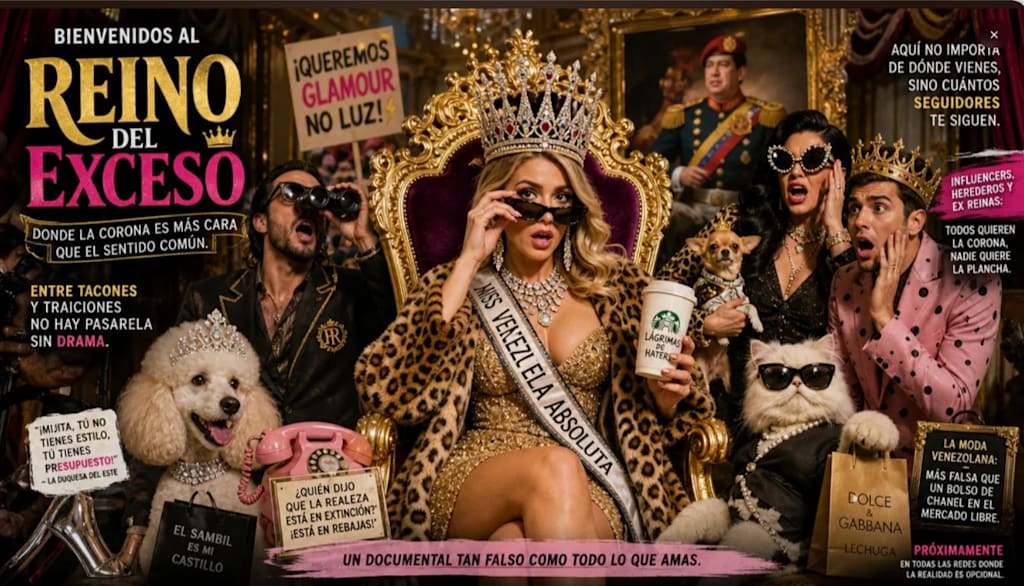
I was buying my Christmas outfits at Traki, a store known for cheap clothes, but with the extravagant touch of the Tsar of Beauty, Osmel Sousa. Back then, my girlfriend was Susana Janiott, a conceptual artist working on a statue for a plaza—a pixelated Simón Bolívar riding a nyan cat, wielding a flaming holographic sword. The Masonic society wasn’t happy about it at first, but when she offered to add an Illuminati symbol, they gave in right away. The AC was blasting so cold I told Susana my dick was standing at attention for no reason, and that we’d be stuck freezing for a while. It didn’t matter—outside, the streets were crawling with rats, peddlers were with women who stank to high heaven, and men armed with pure bad vibes. The cashiers wore pins shaped like hangers and a pink heart on their left breast, straight out of some populist propaganda. Susana was pissed there wasn’t any trendy European stuff, and someone called security. They locked us in a dressing room, all in black, but with mirrors everywhere. There was nothing to do but kiss.
By pure chance, the Tsar of Beauty himself, Osmel Sousa, showed up to check that everything was in order. That meant fashionable clothes, raspberry scent in the aisles, and a staff weighing no more than 35 kilos. I hadn’t seen him yet, but I could smell Osmel Sousa in the air. Under the fitting room door, I spotted his diamond shoes and his purple cape with gold-outlined cats—or something super sparkly. One of the skinny security guards told us to come out, that we weren’t worthy of looking at his gray contact lenses. After Sousa sized us up—especially my crotch—he hugged us by the neck and struck a pose for a whole bunch of TV cameras. I don’t know how he did it—maybe like an octopus—but somehow, he kissed my neck. It was gross and awkward.
He was surprised that the most famous internet artist was shopping at his store, with Susana, to whom he said, “You’re fat.” His synthetic leopard-skin cane gave me Willy Wonka vibes, except he was more like Osmel in his factory of overly operated women. His boots clicked fabulously as he showed us, in detail, every piece of clothing that caught his eye, spouting lines full of glamour. He ordered the guards to strip a mannequin and invited me to try on a shirt with golden ogres, black palm trees, and a black-and-white rainbow in the background. It was hideous—maybe I could handle ogres or palm trees, but not ogres, palm trees, and a black-and-white rainbow all together. I felt humiliated, but I put on my fakest smile and opened my arms to Osmel, like a dinosaur hugging his killer comet.
“Tada!” I said, and he was thrilled. “Divine! Glorious! Bravo! This is the juiciest thing I’ve seen in weeks. Don’t you want to come with me to show my new collection in Japan?” I was left speechless. Susana pinched me and I said, “Yeah, sure, of course. But please, tell me where I can buy that amazing perfume.”
After a week of dieting, gym, nose job, butt job, and elbow job, I showed up dazzling in a Tokyo hall, being made up by Henry, Enrique, and Enri—three makeup artists giving me tips to look even more diva and spectacular on the runway. They gave me a golden, glittery pair of underwear the size of a strawberry, so tight I couldn’t feel my dick. It hurt, but Osmel’s smile made me believe the plan would work. My heart was pumping glitter. I posted on social media that I’d be on E! Entertainment Television. I heard a Japanese woman talking, but didn’t catch a thing—just my name, and someone shoved me into a cloud of smoke. Then I walked, my butt sashaying from side to side, setting off explosions of excitement in the audience. The cameramen were stunned, boyfriends shielded their girlfriends’ eyes. Donald Trump, who was funding the whole circus, clapped the loudest. It was my package intimidating the crowd. It was my mother’s dream. It was me, at my most diva moment.
Backstage, someone done up like a vixen screamed, “You’re world news, everyone’s talking about you and your glittery package! Our tight, purple, sparkling undies will be a new milestone in fashion history.” I was so happy I thought about using my power as the new king of fashion—after breaking up with Susana by voice note. Osmel Sousa handed me a wad of cash and thanked me for boosting sales of his outrageous clothes. I thanked him for picking me, but I’d already surpassed the master, so I told him his Botox jobs didn’t work anymore and his style was out since the seventies. Osmel faded away like a video game villain after you win. That’s when I realized I’d been chosen to make the world of fashion even bigger.
I told Europeans to dress like starving African kids. The next day, all of Europe was shirtless, showing off ribs and worm-bloated bellies. Since nobody was eating to stay fashionable, there was tons of leftover food, so it got sent to the hungry in Africa. Once their basic needs were met, Africans started dressing like Europeans. Then I issued a statement: the chicest thing for women was to cover their faces with a black veil, and for men, to wear a red ribbon on their foreheads—just like a Muslim suicide bomber about to blow up a mosque. The next day, all the airline managers canceled their flights. Later, people got used to it, and things went back to normal. But when everyone started dressing like Muslim protesters, the real Muslim protesters got jealous and switched to dressing like Jehovah’s Witnesses. Then I said indigenous fashion was the ultimate, and nudity took over the world—colors everywhere, artificial feathers hanging from necks. Unexpected male and female erections made life more exciting, with less rape and less inequality between men and women. It was a perfect world; from my fashion throne, everything was great. Until my ex conspired against my genius.
One warm summer fashion afternoon, I was in my office, explaining to the Jews why they should dye their beards rainbow, when Susana Janiott walked in, telling me with all seriousness that she wanted to get back together. I closed my eyes and said, in my best duchess voice: No.
She moved to a spot the security cameras couldn’t see, but the cameras still followed her. She lifted her pixelated pineapple T-shirt and showed me her nipples—little balls that, undeniably, were still beautiful, like an untouched Latin American field, ready to flourish like a multinational company moving in.
I told myself I shouldn’t do it. I was the Tsar of Beauty now, supposed to be saving the world with my smile, focused on bigger things. She told me, softly: “I want you to make conceptual art with my body, to your favorite music. I even bought you chocolate brownies.”
I started insulting her, with the cutest adjectives: “Damn beautiful, wretched babe, adorable bastard.” She took that as a yes—Susana, violate me—and I turned off the cameras and lights and dove into her bed like a tsar after the communist revolution kicks him out. Her skin was delicious, even though she was dressed like a monster—who mixes purple with frosted white, with that body, with that hair? No way...
But while I kissed her neck, Osmel Sousa barged in with the international press and his bodyguards. As I kissed a big birthmark, someone shoved a blue, glittery mic at my lips and asked: “How does it feel to have broken the first rule of being the Tsar of Beauty? Why are you making out with a middle-class conceptual artist instead of saving the world through fashion? How does it feel to be just a regular person again?” I started babbling, unable to say anything in the face of Osmel Sousa’s wicked laughter. I looked at the cameras with the face of a scolded puppy, and even with lipstick on my lips, said: “Kids of the future, I only tried to save the universal homeland. Wear whatever clothes you like, but never match the same colors in an outfit.”
The next day, I was a regular guy again, back in my Caracas office, choking on traffic and smog with my conceptual girlfriend, making holograms of trees as a sharp critique of society. I drank decaf, shaved my beard, got the gold dye out of my hair, undid the nose, butt, and elbow jobs. I was happy again, even if I was only wearing a black-and-white striped shirt. Just another link in the style chain. I checked out the new fall collection and told myself:
After all, none of this is worth a damn.
About the Creator
Eliseo Villafañe
Eliseo Villafañe (Barinas, Venezuela. 1996) is one of the boldest voices in young Venezuelan literature. His work bridges literary tradition and digital culture, portraying crisis, the body, and faith with a language laden with irony.
Enjoyed the story? Support the Creator.
Subscribe for free to receive all their stories in your feed.
Comments
There are no comments for this story
Be the first to respond and start the conversation.