Mystery
The Last Letter from the Lighthouse
The Last Letter from the Lighthouse The wind howled across the rocky shore, carrying the salty tang of the sea deep into the crevices of the old lighthouse. Elijah Mercer, the solitary keeper, stood at the edge of the jagged cliffs, eyes scanning the restless waves. His weather-beaten coat flapped in the biting wind, and the lantern light from the tower behind him flickered faintly against the encroaching twilight. For fifteen years, Elijah had lived alone in the lighthouse perched on Widow’s Point, tending its ancient light that warned ships away from the treacherous rocks below. The steady routine was a balm for his bruised soul—a life of quiet purpose, away from the ghosts of his past. But tonight, the sea was restless in a way it hadn’t been before, and something shifted in the air. As Elijah’s gaze drifted down to the shore, a glint caught his eye among the tangled seaweed and driftwood. Curious, he descended the slippery path to the beach. There, half-buried in wet sand, lay a weathered envelope, its edges tattered but the seal still intact. He picked it up gingerly, the paper rough and fragile beneath his fingers. The seal bore a faded crest—a family emblem Elijah recognized instantly. His heart thudded unevenly as memories stirred, unwelcome yet insistent. He retreated to the lighthouse, the letter clutched tightly in his hand. The fire in the hearth crackled as he settled into the worn armchair by the window, the only warm spot in the drafty room. With a trembling hand, he broke the seal and unfolded the letter inside. The handwriting was delicate, flowing — unmistakably hers. My dearest Elijah, If this letter finds you, it means the tides have finally carried it home, or rather, that the sea has not yet forgotten us. It has been so long since I left Widow’s Point, but the memories of our nights beneath the stars, the promises whispered against the crashing waves, remain etched deep within me. There are truths I must confess — truths that I hid not out of malice but out of fear. The choice I made was not to abandon you but to protect us both from a danger I could not fight. Please, if you still remember the light in my eyes, the dreams we shared, meet me at the Old Dock in the town of Greyhaven. There, the past may find its reckoning. Forever yours, Amelia Elijah closed his eyes and the years rushed back in a flood — the laughter, the warmth of Amelia’s touch, the reckless hope they once shared. But then the silence that followed her disappearance, the whispers of betrayal, and the unbearable loneliness. He had thought she had left him, broken their bond without a word. But now, this letter was a bridge across the decades, a fragile thread pulling him back to a time he thought was lost forever. The next morning, with the letter folded safely in his coat pocket, Elijah set out from Widow’s Point. The journey to Greyhaven was long, and the landscape changed from rugged coastlines to the quiet streets of a town that seemed to carry its own shadows. At the Old Dock, Elijah waited, the chill sea breeze tugging at his clothes. Hours passed, and just as the sun began to dip beneath the horizon, a figure appeared through the mist. Amelia. She looked older, the years marked by silver streaks in her hair and lines around her eyes, but the light in her gaze was unmistakable. She smiled softly, a mixture of relief and sorrow. “Elijah,” she said, voice trembling. “Thank you for coming.” He nodded, words caught in his throat. Instead, he simply reached out and took her hand. They walked slowly along the dock, the waves whispering secrets as Amelia spoke. “There’s much I owe you — and much I’ve kept hidden,” she began. “When I left, it was not because I wanted to. There was a man… powerful, dangerous. My family was caught in his web. I feared for your safety, for the life we could have had. So I disappeared to protect you, to shield us both.” Elijah listened, the pieces falling into place. The silence, the abandonment — all a mask to guard them from harm. “But why now?” he asked gently. “Because the danger is gone,” Amelia said. “And because I could no longer live with the silence between us. The years have been long, but my heart never strayed from the light you kept burning at Widow’s Point.” For the first time in years, Elijah felt a warmth thawing the frost that had settled deep in his chest. The light in the lighthouse behind him seemed to glow brighter, as if echoing the hope rekindled between them. Together, they stood on the edge of the sea, two souls weathered but unbroken, ready to face the future — no longer shadows of the past but beacons of a love that endured beyond time and tide.
By Hammad younasabout a year ago in Fiction
The Whispering Library
The Whispering Library Genre: Mystery / Fantasy Theme: Truth vs. Family Loyalty | Power of Knowledge Word count: ~750 --- In the forgotten town of Elderbrook, where fog rolled in like soft ghosts over broken cobblestone streets, stood a building that no one dared enter: The Elderbrook Library. Its roof sagged, ivy gripped its crumbling walls, and rusted chains held the massive oak doors shut like the mouth of some ancient creature. But the real reason no one went near it was the whispers. Anyone who wandered too close on a quiet night swore they heard them—voices calling from inside, soft as breath, repeating secrets no one could quite understand. Sixteen-year-old Lila Maren had grown up with the stories. Some said witches once kept spells there. Others claimed it was cursed. But for Lila, it was something more personal. Her grandfather—Elias Maren—had vanished years ago after spending countless hours in that library. No one in her family spoke of him. If she asked, her mother’s lips tightened into a thin, pale line. That silence was what led her here. One evening, armed with a flashlight, a notebook, and a stolen iron key she found hidden inside her grandfather’s old writing desk, Lila stood at the entrance. Her heart raced as she slid the key into the old lock. The chains fell away with a sharp, metallic clatter, echoing into the quiet night. As she pushed the heavy door open, a gust of stale, cold air rushed past her. Dust swirled in the beam of her flashlight, and tall shelves stretched endlessly into the darkness. Books sat forgotten, their spines cracked and worn by time. And then she heard it. Whispers. They drifted from the shelves, curling around her like silk threads — soft voices, some speaking clearly, others just murmurs on the edge of meaning. Some told stories, others whispered names, dates, regrets. Drawn by a voice clearer and more urgent than the rest, Lila moved deeper into the library. The voice seemed to know her. Finally, she stopped in front of a solitary table. On it sat a large, worn book, its leather cover cracked with age. The title, barely visible under layers of dust, read: “The Maren Lineage: Truths Unspoken.” Her breath caught. Maren. Her family name. Hesitating only for a second, she opened the book. A sudden, cold draft swept over her. Then, the whispers stopped — all except one. “Lila… at last.” The voice was familiar and distant, like an old record playing in another room. It was her grandfather. Frozen in place, Lila listened as the voice continued: "They buried the truth, but you deserve to know. I was not lost—I was hidden, hidden by those who feared what I uncovered here.” As Lila turned the pages, strange glowing ink swirled to life, forming words, maps, family trees. Images rose from the pages like smoke, forming fleeting pictures in the air—memories from another life. She saw her grandfather standing in the very library where she stood now, surrounded by books whispering ancient histories. She saw council meetings in shadowed rooms, decisions made to protect some great secret. “Beneath this very building,” Elias’s voice whispered, “is something our family was tasked to guard for generations — a hidden archive of knowledge too dangerous for the world above. But greed grew within the family. They locked me away with silence because I refused to keep it hidden any longer.” Lila’s hands trembled. Suddenly, everything made sense — the unspoken words at family dinners, the missing photos of her grandfather, the quiet shame that hung like a fog over their home. The last pages of the book formed a map. “There’s a door below the library,” the whisper said. “The truth is yours to find. But beware — once you know it, you cannot un-know it. Knowledge is power, Lila, but it’s also a burden.” The whispers around her resumed like a storm starting in the distance, louder now, echoing truths long forgotten. For the first time, Lila didn’t feel afraid. She felt chosen. Clutching the book to her chest, she walked toward the back of the library, where the floor sloped downward into darkness. The truth waited for her there, and with it, the answers her family had buried. And the whispers followed her every step of the way. Moral :Knowledge is a gift — and a responsibility.”
By Abdul Musawer about a year ago in Fiction
Until the Sky Fails .
They made the promise when they were ten. Sitting on the rusted roof of an abandoned train car, legs swinging over the edge, dirt on their cheeks and sun in their hair, Eli turned to Mara and said, “Promise me you’ll never leave.” Mara laughed, twirling a blade of grass between her fingers. “Not until the sky fails.” It became their thing. Not just words, but a bond. “Will you still talk to me when we’re old and boring?” “Until the sky fails.” “Will we still climb trees and swim in the river?” “Until the sky fails.” “Will you still love me?” “Always. Until the sky fails.” --- The world shifted as they grew. Childhood melted into adolescence, soft edges turned sharp, and dreams grew heavier. The river they swam in shrank with each summer drought. Factories shut down. People moved away. The sky never failed—but life cracked in other ways. Eli got a job at his father’s garage straight after high school. Mara wanted something more—more than dirt roads and rust and the same four corners of town. She left with a suitcase and a full scholarship to a city school. Eli stayed behind, grease under his fingernails and silence in his heart. They wrote. At first. Every week a letter. Then every month. Then birthdays. Holidays. A quiet message when someone in town passed away. Then the letters stopped. But the promise didn’t. Not for Eli. --- Years passed. The town shrank further. The sky grew stranger—storms that came too fast, heatwaves in winter, ash in the air some summers from fires far away. Still, he’d look up and whisper, “Not yet.” He met someone, once. A girl named Kate. She liked poetry and painted her nails green. She kissed softly and listened deeply. But after six months, she asked, “Is there someone else?” And he could only say, “There was.” She left the next week. --- It was thirteen years before Mara came back. The news spread fast: Mara Ashton, the girl who made it out, was back in town. Her mother had passed. The house was hers now. No one knew if she’d stay. Eli didn’t go to the funeral. He stood by the river instead, skipping stones that sank too fast. He thought about calling. Walking over. Saying anything. But he didn’t know how to begin. Then, one night, his doorbell rang. There she stood, hair shorter, eyes older, but still her. “I drove past the tracks,” she said quietly. “The train car’s gone.” “It collapsed years ago,” Eli replied. “Figures. The sky’s still up, though.” He smiled, lips trembling. They talked until midnight. Caught up. Tiptoed around what hurt. Laughed at what didn’t. She hadn’t found forever in the city. Just noise and walls and more people than warmth. She missed the stars. The silence. “You waited,” she said suddenly, her voice soft. “Yeah,” he said. “Until the sky fails.” --- They didn’t pretend to start over. They began again, with what they had: older hearts, old stories, and something stronger than memory. They restored her mother’s house together. He showed her how the town had changed—barely. She taught art classes at the school. He still fixed cars. And every evening, they walked hand in hand through the same old fields, under a sky that never failed them. Not yet. --- Years later, when their hair grayed and their hands trembled, they sat in rocking chairs under a violet sky. “Do you think the sky ever will fail?” Mara asked. Eli looked up, smiling. “Someday, maybe. But not today.” She leaned her head on his shoulder. “And even if it does,” she whispered, “we had this.” --- Because some promises aren’t broken by time. They hold—quietly, fiercely—until the sky fails.
By Azmat Roman ✨about a year ago in Fiction
Letter to the Ocean.
They said she talked to the ocean like it was an old friend. Every morning at dawn, Lena would walk barefoot across the cold sand of Greyrock Bay, a folded piece of paper clutched in her hand. She’d stand where the waves met the shore, let the foam kiss her toes, and read her letter out loud. No one ever knew what the letters said. She never showed them to anyone. When she finished, she’d place the letter in a glass bottle, seal it tight with a cork, and toss it into the sea. Some said it was ritual. Others said it was madness. But Lena believed the ocean was the only one still listening. --- It had started years ago—five, to be exact. The day her brother Jonah disappeared. He was a fisherman, like their father before him. He had salt in his blood and tides in his soul. He used to say the ocean spoke to him in dreams. Lena had always thought it was poetic nonsense. Until the storm. It came without warning. One moment, the sky was clear, the boat steady. The next, wind howled like a wounded animal, and the waves rose like giants. Three boats were lost that day. Most of the bodies were recovered. Jonah’s never was. Lena had been only sixteen. --- She wrote her first letter to the ocean a week after the storm. It was more like a scream than a message. She cursed the sea, cursed its cruelty, cursed herself for not telling him to stay ashore that day. But when she finished, she didn’t burn the letter. She didn’t bury it. She placed it in a bottle and threw it into the water. And the next morning, she wrote another. The letters changed over time. From rage to sorrow, from sorrow to longing. She wrote about her dreams, her regrets, her joys and mistakes. She told Jonah about the boy who kissed her on the old pier, about the time she failed her math exam, about the night she snuck out to watch the stars. She told him about their mother’s silence, their father’s drinking, about how their dog still waited at the door every evening like he might come home. Every single day. For five years. The villagers stopped asking questions. Some mornings, children would gather quietly to watch her, and go home mimicking the ritual with shells and driftwood. Artists sketched her from a distance. Tourists whispered and took photos they thought she didn’t see. She didn’t care. Because one morning, everything changed. --- It was late August, and the fog was thick. The ocean stretched out, endless and gray, swallowing the horizon. Lena walked to the shore, her letter folded as always, ready to send it into the world like a prayer. But something caught her eye. A bottle. Rolling with the tide, then caught in the sand. A bottle—with paper inside. Her breath caught. She ran to it, hands trembling. The glass was familiar, but the handwriting on the parchment wasn’t hers. She pulled out the note. It read: “Lena. I never stopped listening. — J.” She stared at it, heart pounding. It couldn’t be real. It had to be a cruel trick, some prank or coincidence. But deep in her chest, she felt it—a warmth, a knowing. The ocean didn’t answer in waves or thunder. It answered in whispers. She sank to her knees, tears mixing with saltwater, letter pressed to her chest. For the first time in years, she didn’t toss her own letter into the sea. She held it close and whispered, “Thank you.” --- Lena still walks the shore, but not every day. She writes less often now. Not because she’s forgotten—but because she’s healing. Her letters are gentler, sometimes joyful. Sometimes short. But she always ends them the same way: “Wherever you are, keep listening. I’ll always write.” And the ocean, in its patient hush and endless motion, listens still.
By Azmat Roman ✨about a year ago in Fiction
The House that Listens
They say the house at the edge of the woods can hear you. Not in the way people overhear secrets or dogs tilt their heads at sound. No—the house listens. It pays attention. It remembers. No one lives there now. Not really. But once, long ago, it was full of life—laughter echoing through halls, footsteps on warm wooden floors, the smell of bread wafting from the kitchen. That was before the war came, before the town forgot, before the house grew quiet. Except for the listening. --- When Lila arrived in Marrowbend, she was looking for silence. She had buried too many voices in the city—her mother’s, her lover’s, her own. The doctors said she needed rest, peace, a slower pace. She found the house by accident, hidden down a crooked road where no GPS reached. It looked abandoned: ivy climbing up the stone walls, shutters hanging like tired eyes. But something about it drew her in. Not fear, not awe—just a feeling, like the house had been waiting. The locals warned her. “That place is haunted,” one old man said. “Not with ghosts, but with memory. It watches. Listens.” She laughed, politely. By the second week, she stopped laughing. It began with whispers—not voices, exactly, but something just under sound. When she cried herself to sleep, the floorboards creaked as if shifting closer. When she read aloud to chase away the silence, the windows stopped rattling. She spoke into empty rooms and found… comfort. Not words in return, but a presence, like the house was leaning in to listen. She started talking more. She told the house about her mother’s slow decline, the way cancer had stolen not just her body but her mind. She told it about Emma, her partner of six years, taken too fast in a car crash that left nothing but bent steel and unfinished sentences. She told it about the numbness that followed, the way time blurred and meaning drained from her days. The house didn’t answer. But it listened. On the 21st night, she woke to find words written in dust on the hallway mirror: “I remember.” She stared at it, breath caught. She didn’t scream. Somehow, she wasn’t even afraid. Instead, she whispered, “What do you remember?” The mirror cleared. “Emma loved the rain.” Lila fell to her knees. --- Over the weeks, the house told her more—through shapes in fogged windows, letters arranged on dusty shelves, creaks in floorboards that formed patterns like Morse code. The house remembered everything she told it, and over time, it began to share what it had stored from others. Children who once lived there and hid under the stairs during thunderstorms. A woman who wrote poems and tucked them under floorboards for her lost husband. A soldier who kissed his child goodbye in the foyer before never coming back. The house was full of echoes, and now it shared them. Lila began to write again. For the first time in years, the words came. Poems. Letters. Pages of memory. She read them aloud at night, and the house would settle like an old friend curling closer. She no longer felt alone. One morning, months later, a young couple from the village knocked on the door. They had heard a writer was living there now. They were expecting a child, looking for a place to build a new life. Was the house for sale? Lila looked at the walls. The house was silent. She asked aloud, “Is it time?” From the fireplace, a burst of warm air stirred the ashes—and there, faintly glowing, the word: “Yes.” She smiled. --- Years passed. The couple moved in. Children filled the rooms again. They heard the house sometimes too—especially when they whispered secrets or cried in the dark. But they weren’t afraid. They grew up knowing the house listened. That it cared. As for Lila, she moved on. She never stopped writing. Her books became known for their aching memory and quiet grace. People asked her where the inspiration came from. She always smiled and said, “From a house that listened when no one else could.” And somewhere, beneath ivy and stone, a quiet house remembered every word.
By Azmat Roman ✨about a year ago in Fiction
Our Names in the Ashes
The wind blew soft over the charred remains of the village. Smoke still curled like the fingers of the dead, grasping at the sky in silent mourning. Beneath the scorched earth, the bones of yesterday whispered names long forgotten, names now written only in the ashes. Mira stood at the edge of what used to be her home, her bare feet blackened with soot. The world she knew had vanished overnight, taken not by nature’s wrath, but by the hands of men who burned for conquest. The Northern Army had come like a storm, banners flapping like broken wings, their torches lighting the night with cruel celebration. She had escaped only because her brother, Kael, had hidden her beneath the floorboards of the old mill. He had kissed her forehead and whispered, “If I don’t come back, remember who we were.” She had waited for hours, covering her ears against the screams outside, the sound of blades, the thunder of horses. But Kael never returned. Now she walked the ruins in silence, a ghost among ghosts. The temple bell, blackened and bent, still hung from the fallen arch. She reached out and touched it. Cold. Like everything else now. Mira remembered the way the town used to gather here during festivals—lanterns in hand, children laughing, elders telling stories by firelight. Her mother had taught her the songs of their ancestors beneath that bell, her voice soft and strong. She could still hear it sometimes in her dreams. But dreams were dangerous now. They made the loss sharper. She wandered past the market square where merchants once shouted and bartered, past the well where her best friend Liora used to draw water every morning. Nothing remained but ash, wood splinters, and melted iron. Every step stirred up memories like embers. She found Kael’s satchel near the edge of the woods, singed but intact. Inside, a single piece of parchment remained dry: a drawing she had made of their family, smiling beneath the sun. Kael had kept it all this time. She pressed it to her chest, letting the tears fall freely now. Her grief no longer had a reason to hide. But amid the ashes, a thought sparked. Mira made her way to the old scribe’s house, miraculously spared the worst of the flames. The ink bottles had exploded from the heat, their contents staining the walls in wild, angry strokes. But the main ledger—the book where the village’s births, marriages, and deaths were recorded—remained sealed beneath a charred slab of wood. She pulled it free, coughing against the smoke. She turned its pages carefully, eyes scanning for names she knew—her parents, Liora, the baker’s son, the old healer. All there. Their lives reduced to ink and paper. And then she did something she didn’t fully understand until years later. She picked up a piece of coal from the hearth, still warm, and turned to the last page. Beneath the final official entry, in a child’s shaky script, she began to write: Mira of Harthaven, daughter of Elen and Joran. Sister to Kael. Alive. Then: Kael of Harthaven, son of Elen and Joran. Brave. Lost in the flames. She wrote every name she could remember. Those who were gone. Those who might still be wandering, like her. She filled the page, then the next, and the next—each name written in dark, smudged coal, a fragile act of rebellion against oblivion. As night fell, Mira lit a small fire in the remains of the square. She placed the book beside it, not to burn, but to protect it. She built a crude shelter and stayed there for days, then weeks. Other survivors came, drawn by the smoke or the hope of familiar voices. They found her there, with her coal-stained hands and haunted eyes, guarding the book. Together, they began again. They cleared rubble, rebuilt roofs, planted seeds. Slowly, painfully, the village breathed once more. Years later, when Mira was old and the town was thriving again, a traveler asked about the worn book displayed in the new temple. She smiled, touching its cover. “That,” she said, “is how we remembered. That is how we kept our names from being lost. In the ashes, we wrote ourselves back into the world.”
By Azmat Roman ✨about a year ago in Fiction
She Forgets Me Every Morning.
The first time she forgot, I thought it was a joke. Ellie had always been playful, the kind of woman who left notes in my shoes, who named the spider in the corner “Gerald,” who kissed me every morning and said, “Nice to meet you, stranger.” So when she looked at me one Wednesday morning with blank eyes and asked, “Who are you?” I smiled. I told her I was the man lucky enough to marry her. She smiled back, unsure, and laughed in that familiar way that made my heart want to sing. But the next morning, it happened again. And again. The doctors used complicated words like early-onset Alzheimer’s, temporal lobe degeneration, and progressive deterioration. None of them could tell me when it would stop. Only that it wouldn’t. “She may forget more,” they said. “Possibly everything.” But I remembered. I remembered the café where we met—she ordered tea and spilled honey on my book. I remembered how her hands trembled when she first told me she loved me. I remembered our wedding, how she whispered, “Promise me, even when I forget the words, you’ll still speak them.” I promised. So now, every morning, I do the same thing. --- I wake before her. I brew the tea just the way she likes it—lavender and mint, three sugar cubes, no milk. I set it by her side of the bed, then sit in the old rocking chair across the room. When her eyes flutter open, I see the same confusion creep in like fog. She blinks at the ceiling, then at the cup, then at me. “Good morning,” I say softly. “I made you tea.” She hesitates. “Do I... know you?” And I smile, even though my chest aches. “Not yet. But you will.” --- Some days, she asks questions. “Where are we?” “Are you a nurse?” “Do I have a job?” Some days, she just nods and sips her tea, quiet and cautious, like a deer unsure of its surroundings. But every day, around the time the sun leans through the curtains and catches the dust in golden beams, something in her sparks. It might be a joke I make. Or a song on the radio. Or the way I tuck a flower behind her ear while pretending to be clumsy. Something breaks through the fog. Her eyes widen. And she says, almost like a gasp: “It’s you.” --- That moment—those three words—are why I get up every day. Why I wait through the silence, the questions, the pain. Because in that instant, she knows me. Not just my name, not just my face. She remembers us. All of it. And for that hour, or two, or sometimes just a fleeting minute, I get her back. She tells me stories she’s told a hundred times. She hums our wedding song. We dance in the kitchen while toast burns in the oven. We laugh until she cries, and I pretend I don’t see the tears because I’m too busy kissing them away. Then slowly, like dusk swallowing the day, she drifts. She forgets again. And I let her go gently, guiding her to rest, brushing her hair behind her ear. --- At night, when she’s asleep, I write in a journal. I fill it with what she remembered, what she smiled at, what made her laugh. I write it for me, yes—but mostly for her. For the woman who wakes each morning not knowing who she is or who I am. Because love, I’ve learned, isn’t just memory. It’s patience. It’s presence. It’s showing up for someone who cannot show up for you in the same way—and doing it anyway. --- Tomorrow, she will forget me again. But I will remember her. Enough for bothfs
By Azmat Roman ✨about a year ago in Fiction
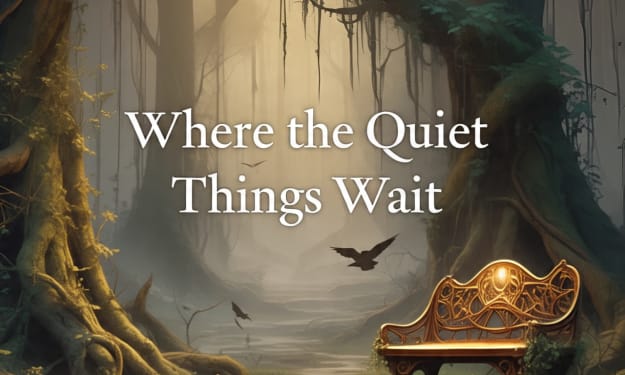
Where the Quiet Things Wait.
It began with a hum. Not a loud one, not anything you’d notice in a crowd. But in the stillness of the woods behind the old Thatcher house, it hummed low and constant—like the earth itself was whispering. Mara heard it first. She was twelve the summer her family moved into the Thatcher house, a lopsided structure that looked like it was exhaling. Her parents loved its "character." Mara loved its attic—dusty, quiet, full of trunks and forgotten books that smelled of cedar and ghost stories. The woods behind the house were thick, tangled, and wrapped in silence. The neighbors warned her not to go in too far. “They’re different,” the old woman next door had said, pointing with her cane. “Those trees remember things.” But Mara wasn’t afraid of quiet things. She was made of quiet—soft-footed and daydream-shaped, her thoughts filled more pages than her voice ever could. So on a cloudy Tuesday, with a notebook in her satchel and crumbs in her pocket, she slipped into the woods. The humming began by the third tree. She stopped. Listened. It vibrated through the soles of her sneakers, barely there, but somehow alive. The deeper she walked, the stranger the forest became. Not threatening—just still. Leaves didn’t rustle. Birds didn’t sing. No twigs cracked beneath her step. It was like she had wandered into a memory not quite her own. Then she found it. A clearing, perfectly round. In its center stood a small wooden bench, carved with words nearly worn away by time. Ivy coiled gently around its legs. The air was thick but gentle, like standing inside a breath. And on that bench, something waited. Not a creature. Not a ghost. Just a feeling—presence without form. It wrapped around her softly, like warm wool and half-forgotten lullabies. Mara sat down. At first, nothing happened. Then she took out her notebook and began to write. “I am Mara, and I have found the place where the quiet things wait.” The words poured out—memories she hadn’t known she kept, stories of dreams half-dreamed, the sound of her grandmother’s voice, the way it felt to lose her once and never say goodbye. She wrote until the sun shifted, and the hum faded gently into the dusk. She came back the next day. And the next. Each time she sat on the bench and wrote, the clearing welcomed her. The ivy grew a little thicker. The air grew a little warmer. Once, she heard laughter—not loud, not even quite human—but joyful and far away, like it had been waiting a long time to be remembered. Her parents worried, of course. “Don’t wander so far,” her mother would call. “You spend too much time alone,” her father frowned. But Mara didn’t feel alone. The quiet things had taken root inside her—gentle truths, aching thoughts, beautiful sorrows. She began to hear them even outside the woods: in raindrops, in candlelight, in her own careful voice. One day, she brought a second notebook. She left it on the bench. “If someone finds this,” she wrote on the first page, “this place is safe. It doesn’t speak with words. But it remembers everything you forget.” Years passed. The Thatcher house changed hands. The woods grew denser. The bench remained. Children grew up with rumors of the quiet clearing where strange things lived—things that didn’t chase or bite, but waited. Listened. Held you softly when the world felt too loud. They said if you found it, the hum would greet you. And if you sat down and opened your heart, the quiet things would stir. Not to haunt. Not to harm. But simply to be with you. Because in a world that rushes and shouts, someone must rememb h wait.
By Azmat Roman ✨about a year ago in Fiction