Mystery
The Journey of Silence
Not every silence is peaceful. Some scream so loudly inside you that the noise drowns out your soul. This is a story I never thought I’d tell. Not because it’s dramatic. But because it’s… quietly terrifying. I met him at a chai dhaba during winter. A quiet boy with haunting eyes who always sat at the corner bench, sketching on the back of old bills. No one spoke to him. He didn’t speak either. I don’t know why, but one day, I walked up and asked, “Tum kya bana rahe ho?” He looked up slowly. “Memories,” he said. Just one word. And he smiled—a tired, worn-out kind of smile, like he hadn’t used those muscles in a long time. Over the next few weeks, we met often. I never learned his real name, so I started calling him “Noor”—because he brought light into dark places without knowing it. He was a silent storyteller. His sketches weren’t art—they were wounds on paper. Each one told a story of pain, escape, or something too complex to label. Sometimes, he would draw strangers too. People sitting nearby, unaware that Noor was quietly turning them into memories. One day, he sketched an old man feeding birds. Another time, a mother scolding her child gently. He found beauty in moments most of us overlook. One evening, I asked him, “Why don’t you talk to others?” He looked out into the foggy night and said something that still burns in my memory: “Because I did… once. And the world didn’t listen. It laughed.” Noor wasn’t mentally unstable. He was deeply aware—too aware. He had lost both parents in a fire when he was ten. He lived in a shelter for most of his life, then drifted between cities. Every time he tried to connect with people, they either mocked his silence or forced him to be someone he wasn’t. But he never stopped drawing. One day, he handed me a folded sketch. It was me. But not just my face—my thoughts. My fears. My loneliness. All captured in ink. “How did you—?” I asked, choking on my words. “I listen,” he whispered. “Even when you don’t speak.” That was Noor’s superpower. He heard what others buried. And carried it. And just like that… he disappeared. No note. No goodbye. Just one final sketch left at our usual spot—two figures on a bench, one drawn in heavy lines, and the other fading away into the fog. I searched for him. Everywhere. But Noor was like a shadow—seen only when light hit the right angle. It’s been five years. Sometimes, I sit at that same dhaba, alone. And sometimes… just sometimes… I feel a sketch slide under my tea cup. A rough corner. A faint signature: "N." He lives, somewhere. Maybe in another city. Maybe drawing for someone else. Maybe still listening to unsaid words. I kept his sketches safe. I framed one. Another one stays folded in my wallet. A reminder that not every connection needs words. That sometimes, silence has more meaning than an entire book. And me? I’ve stopped chasing noise. I’ve learned to listen—to others, to myself, to silence. Because Noor taught me this: “Some people speak loudly. Some speak through silence. Both deserve to be heard.”
By Zain ul abidin about a year ago in Fiction
When the World Forgot Me
There was no explosion, no great betrayal, no dramatic exit. Just... silence. It started slowly, like background static you don’t notice until one day it’s the only thing you hear. The texts stopped coming. The calls dried up. Invitations vanished. At first, I told myself everyone was busy. Life happens. People get caught up in careers, relationships, their own spiraling universes. But days became weeks, and weeks became months. And I realized something terrifying: The world had moved on without me. --- 🕳️ A Life That Faded Quietly I wasn’t always invisible. There was a time when my phone buzzed constantly. I had group chats lighting up like fireworks, coffee dates scribbled in my planner, people tagging me in photos and posts. It was a kind of noisy comfort—proof that I was wanted, seen, needed. Then came the job loss. Followed by the breakup. Then a relocation that I told myself was a fresh start but felt more like a vanishing act. The algorithm forgot me. So did my friends. The worst part wasn’t being alone. It was realizing how easy it was for people to forget you existed—and how few noticed you were gone. --- 🕰️ Days That Blurred Together Morning, afternoon, night. There was no difference. I would wake up, scroll mindlessly, wait for a notification that never came. I’d watch people online living lives full of smiles and movement, like I was observing humanity from behind a pane of glass. I tried reaching out a few times. “Hey, long time!” “Let’s catch up soon?” “Thinking of you.” Some replies trickled in, always polite but never followed by action. Eventually, I stopped trying. I convinced myself I wasn’t interesting enough. That maybe I deserved to be forgotten. That was the darkest place. --- 🌱 The Shift But rock bottom is oddly quiet. And in that stillness, something small began to grow. One morning, I decided to walk. Not for exercise. Not for social media. Just… to move. I passed by a neighbor’s cat. It meowed at me. That little meow felt like the first acknowledgment I’d had in days. The next morning, I walked again. Then I started journaling. At first, it was bitter. Angry. But slowly, the words softened. I wasn’t writing for an audience anymore. I was writing for me—to make sense of what I felt, to remember who I was before I tied my worth to validation. I started doing things I used to love. Reading. Drawing. Cooking meals just for myself, lighting a candle even if no one else was there to enjoy it. It wasn’t a grand comeback. It was small. Intentional. Real. --- 🔦 Learning to Be Seen Again Months passed. One day, someone messaged me—an old friend who had been going through their own battle. “I’ve been meaning to reach out. I saw something you wrote and… it hit home. Can we talk?” That single message broke the wall I’d built around my heart. Not because it meant I was “remembered,” but because I realized this: We’re all a little forgotten sometimes. And we all need someone to remind us we’re still here. --- 🪞 When the World Forgets You, Remember Yourself Being forgotten by the world taught me something no busy, social, “connected” life ever could. It taught me how to sit with myself. How to find value beyond applause. How to be okay with silence. And, most importantly, how to be the person who remembers others when they start to fade. I now reach out more. I message first. I check in on the quiet ones. Because I know how it feels to vanish in plain sight. And maybe the world didn’t really forget me. Maybe it was waiting for me to remember myself first.
By Azmat Roman ✨about a year ago in Fiction
The Silence Beneath Glass
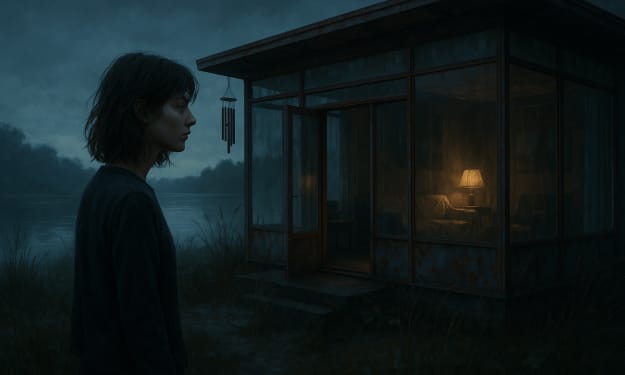
Part 1: The House That Shouldn't Exist There are places in the world where sound feels wrong. Like it doesn't bounce right. Like it's afraid to echo. That’s what I noticed first about the glass house. It stood on the edge of the lake, partially hidden by overgrown cattails and a collapsed boathouse. I’d been driving for two hours, aimlessly following back roads with the windows down and no music on. My phone had died somewhere around the last gas station, and I wasn’t sure what state I was even in anymore. But when I saw the house, I hit the brakes without thinking. It wasn’t on any map. It wasn’t for sale. It simply existed — wrong and silent — like it had been built out of a secret someone tried to bury and failed. The house was all glass, but not in the modern, luxury-home sense. It looked like something that had been abandoned for years, possibly decades — the frame eaten by rust, the panels fogged and stained with streaks like old tears. There was a front path choked by weeds and a metal wind chime hanging by the door that didn’t make a sound, even when the breeze hit it. I should’ve left. Any sane person would’ve. But sanity is relative when you’re running from something you don’t fully remember --- I don’t know why I started driving in the first place. The therapist — a warm woman with careful eyes and an office that smelled like lemon disinfectant — said it was common for memory loss to work that way. That the brain has its reasons for blacking out trauma. That it might come back in pieces. So when I found myself behind the wheel on a random June morning, wearing shoes I don’t remember buying and with a suitcase in the backseat packed by someone who clearly knows me better than I do, I figured: Maybe this is how it comes back. Maybe this is the road back to myself. Or maybe this is another kind of escape entirely. I stepped out of the car. The grass swallowed my ankles. The glass house watched me approach. The doorknob was warm, like someone had just touched it. Inside, it smelled like lavender and something deeper — not rot, exactly, but age. An old memory perfuming the air. I stood still for a moment, waiting for the floor to creak, for a ghost to whisper, for my mind to scream. None of those things happened. Instead, I heard the softest sound of a piano. One note. Just one. And then silence again. The furniture was covered in white sheets, some stained with water rings. There was a spiral staircase leading to an open loft with a massive window that faced the lake. A dusty photo frame sat on a small table near the entrance. I picked it up, my hand trembling. In the photo, I stood between two other people — a man and a woman. All of us were smiling. My hair was shorter, dyed a color I didn’t recognize. The man had his arm around me. The woman wore a dress with sleeves that looked like glass petals. I stared at my own face. My mouth knew that smile, but my brain did not. I flipped the frame over. On the back, in thick black ink: Summer, 2021 – Home again. Don’t forget. The handwriting was mine. I turned in a slow circle, heart pounding. The glass walls offered no safety, only exposure. I was being watched — not from outside, but from the past. This was my house. Or it had been. And someone had wanted me to forget it. I wandered through the house in a daze, touching everything. A chipped ceramic mug. A pair of ballet flats by the door. A record player half-covered by a moth-eaten scarf. In the kitchen, a knife block sat full — except for one empty slot. On the fridge, held by a magnet shaped like a black cat, was a postcard. A line of text in all capital letters: “YOU LEFT SOMETHING BEHIND.” No signature. No return address. Just a postmark: Three days ago. I dropped it. My hands had started shaking. That night, I didn’t sleep. I lay on the couch in the living room — sheets removed, just cracked leather against my back — and watched the reflection of the moon ripple across the lake, then against the walls of the house. I thought about the photo. About the missing knife. About the strange silence, like even the insects were holding their breath. And about the single piano note. Was it a memory? Or a warning? To Be Continu
By Dr Gabriel about a year ago in Fiction
When the Moon Forgot Her Name
The first time they found her, she was lying in a wheat field just outside the edge of town—barefoot, dazed, and humming a song no one could place. Her skin shimmered faintly, as if dusted with frost under the midsummer sun. She didn’t speak. She didn’t run. She simply stared at the sky like it had let her down.
By Kamran Zebabout a year ago in Fiction
How To Disappear: Part One
(Trigger warning: mentions of suicide, self-harm, homophobia, and bullying behavior) ~ Three days ago, Gabriel Hernandez threw himself from the fourth floor of his school building. The time was precisely four o’clock in the afternoon. He unlatched a window in the art classroom, stepped out onto the ledge, and jumped a distance of fifty feet down, landing on the concrete below.
By angela hepworthabout a year ago in Fiction
The Girl Who Laughed When the World Slept
Some nights, the quiet holds a secret, and if you listen closely, you’ll hear her laugh. They say the town of Marrow’s End falls silent after midnight. The streets empty, the windows darken, and the only sound is the soft hum of the wind weaving through the cracks in the old wooden houses. But there’s one exception — a sound no one can explain and no one ever talks about. A laugh, ringing clear and sharp, slicing through the silence like a blade.
By Muhammad Ilyasabout a year ago in Fiction
The Boy Who Wasn't
I walked out my back door and there he was, the boy with the dark brown hair and the Nerf gun. Looked like he’d stepped right out of the ‘80s. It shocked me more than I care to admit. Not because I didn’t know him, or because he was trespassing on my property. Not because of the mischievous twinkle in his eye as he ducked behind the abandoned hot tub in my back yard. Not even because everything about the kid screamed a hot summer day in 1986. No, it was something else . . . something less . . . tangible . It was the feeling – no, the certainty , the absolute conviction that the boy wasn’t really there .
By Laura Pruettabout a year ago in Fiction
The Girl Behind the Door
1. The Whispering House In the overlooked town of Elmbrook—where the wind murmured like a overlooked bedtime song and the crows roosted like prophets—stood an ancient, exhausted house. It had no title, but everybody called it The Wilt House. Children strolled quicker close it; older folks whispered supplications; and those who had once challenged to trespass carried their hush like a mystery curse.
By Muhammad Abdullahabout a year ago in Fiction
The Time Traveler's Dilemma
Dr. Emma Taylor had spent years studying the mysteries of quantum mechanics, and finally, she had cracked the code. She stood at the threshold of a new era, ready to revolutionize the field of time travel. With a deep breath, she stepped into the time machine, set the coordinates, and disappeared into the past. Her first journey took her to ancient Egypt, where she witnessed the construction of the Great Pyramid. The sun beat down on her skin as she walked among the workers, marveling at their ingenuity and skill. She saw the pharaoh's procession, with its elaborate rituals and majestic grandeur. But as she watched, she noticed a young apprentice who seemed out of place. He was dusty and tired, but his eyes sparkled with curiosity. In a moment of curiosity, she whispered a few words of encouragement to the boy, who later became a renowned architect. Returning to her own time, Emma realized that the world had changed. The pyramids stood taller, and the ancient civilization seemed more advanced. The Egyptians had developed a sophisticated system of mathematics and architecture, and their art reflected a deeper understanding of human anatomy. But as she delved deeper, she discovered that her actions had created a ripple effect, altering the course of history in ways she never intended. The Roman Empire had risen to power earlier, and their engineering feats had surpassed anything she had learned in school. The Industrial Revolution had started centuries earlier, and the world was a vastly different place. Emma's small act of kindness had created a butterfly effect, changing the course of human history. Undeterred, Emma traveled again, this time to the Wild West. She rode into town on a dusty horse, feeling the rough texture of the saddle beneath her. She met a young outlaw, Jesse, and helped him escape a deadly trap. But when she returned to her own time, she found that Jesse had become a legendary hero, and the West had been won by outlaws instead of lawmen. As Emma continued her journeys, she created multiple parallel universes, each with their own version of history. She saw civilizations rise and fall, witnessed pivotal moments unfold differently, and realized that every decision, no matter how small, had far-reaching consequences. She began to feel like a puppeteer, pulling strings and watching as the world reacted. But with each new reality, Emma's sense of identity began to blur. Which timeline was her true home? Which version of herself was the authentic one? She began to question the nature of reality and her place within it. Was she a scientist, exploring the boundaries of knowledge, or was she a reckless adventurer, tampering with the fabric of time? As the multiverse expanded, Emma encountered versions of herself from different timelines. Some were brilliant scientists, while others were notorious outlaws. There was Emma the engineer, who had built a utopian society; Emma the artist, who had created breathtaking masterpieces; and Emma the warrior, who had fought in epic battles. Each version of herself was unique, with their own strengths and weaknesses. Together, they formed a coalition, determined to understand the complexities of time travel and find a way to navigate the ever-branching paths. They shared their knowledge and experiences, trying to find a way to reconcile the disparate timelines. But as they worked together, they realized that their actions had created a new problem: the multiverse was becoming increasingly unstable. Timelines were merging and diverging, creating chaos and unpredictability. The coalition knew they had to act fast, or risk losing control of the timestream. They worked tirelessly, using their combined expertise to develop a new theory of time travel. Slowly but surely, they began to understand the underlying mechanics of the multiverse. "The Dilemma" Emma's journey raised fundamental questions: Can we truly control the timeline? Do our actions create new realities, or do they merely uncover hidden paths? And what does it mean to be ourselves in a multiverse of possibilities? As the story unfolds, Emma's quest for knowledge becomes a journey of self-discovery. Will she find a way to reconcile the disparate timelines, or will she become lost in the infinite expanse of the multiverse? The Time Traveler's Dilemma invites you to ponder the consequences of playing with the fabric of time. Join Emma on her thrilling adventure, and explore the boundless possibilities of the multiverse. As you read, ask yourself: What would you do if you had the power to shape the course of history? Would you try to fix the past, or would you forge a new future? The story of Emma Taylor is a testament to human curiosity and the unquenchable thirst for knowledge. It reminds us that every decision, no matter how small, has far-reaching consequences. And it challenges us to think about the nature of reality and our place within it. As Emma navigates the complexities of time travel, she discovers that the greatest mystery is not the multiverse, but her own identity. Who is she,
By Salman Ahmadabout a year ago in Fiction