Mystery
The Mirror Lied. Content Warning.
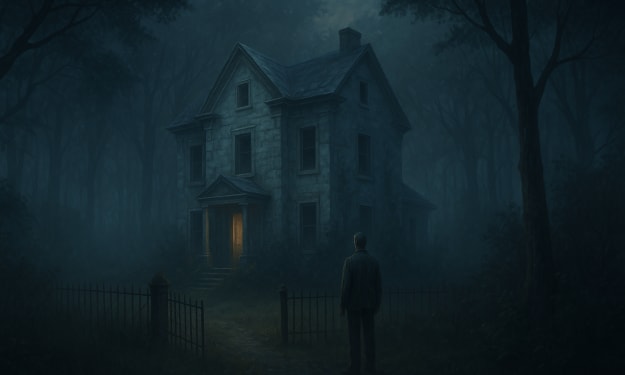
The mirror had always been in the hallway. Tall, framed in tarnished gold leaf, its glass was slightly warped — the kind that made your reflection look just a bit... off. It belonged to my grandmother, who used to mutter in her last years, “Don’t trust what it shows you.”
By Kamran Zebabout a year ago in Fiction
The Last Phone Call
The Last Phone Call Some calls aren't meant to be answered. By Darwesh The phone rang at 1:47 a.m. I hadn’t heard it ring in weeks — not since I moved to the cottage in the hills, far from the city, far from the memories. The landline came with the place. I never gave the number to anyone.
By Shafi Ullah Darweshabout a year ago in Fiction
A Farm
We stood there face to face with an entity of a kind. Slowly the entity materialized. Before our eyes a woman appeared, but she just seemed sad. We asked, "Who are you?" "I am the great-great-great-great-grandmother of the owner of this farm and this is the house that started it all. I was hoping someone would see me in the window for it seems very few can see me, and I was surprised when you came to the door." We said, "We cannot still call you entity, so what is your name and how can we help you now, Miss?
By Mark Grahamabout a year ago in Fiction
A Map of All the Places We Cried.
I found the map again today. Folded into a notebook I hadn’t touched in years, pressed between pages like a fragile leaf. The paper had yellowed, the ink faded, but the red circles were still there—each one a place we cried. I don't remember whose idea it was, only that it started with a joke. "We should keep track," you said, wiping your face with your sleeve as we sat on that rainy bench outside the train station. "Make a map. Chart every time we fall apart.” So we did. --- First mark: Bench outside the train station. You were leaving for a semester abroad. I smiled as you walked away, then crumpled the second you turned the corner. It was our first goodbye, and even then, we knew it wouldn’t be the last. Second: The cafe on 9th and Willow. You spilled your coffee, and I snapped at you for something trivial. We argued in hushed voices while the barista looked away. You reached for my hand even as tears slipped from your eyes, whispering, "Why does love feel like drowning some days?" Third: Your bedroom floor. The night your dad called from the hospital. I held you as you trembled, unable to speak. Your sobs were small and sharp, like you were afraid of taking up too much space even in grief. Fourth: The parking lot after my brother’s funeral. I couldn’t breathe. You let me punch the dashboard until my knuckles bled, then kissed each one like they were wounds you could heal. You didn’t say a word. You didn’t have to. --- Over the years, the map grew. Cities, sidewalks, hotel rooms. Airports and empty streets. The front seat of the car during a thunderstorm. The museum in Chicago where we stood in front of a painting and cried for reasons neither of us could explain. Some marks were from goodbyes. Others from fear. Some, from laughter that turned into tears. There’s a kind of crying only love can bring—the kind that says “I can’t believe I found you,” and also “I’m terrified of losing you.” We were both emotional people, raw and tangled. We never pretended to be made of steel. That was what made it work—until it didn’t. The last mark we made was the park by the harbor. You said, “We’re not good for each other anymore, are we?” I said nothing, because you already knew the answer. You took the pen from my hand and circled the bench where we sat, both of us red-eyed and broken and somehow still holding hands. “One last mark,” you said. “For the record.” --- And then you left. No anger, no betrayal. Just a slow, quiet undoing of something that had once felt like forever. I stopped looking at the map after that. Until today. --- As I unfolded it, I traced every red circle with my fingertip. Not with regret—but with recognition. Because here’s the thing about mapping sorrow: it doesn’t only show where things hurt. It shows where we were. Where we tried. Where we cared enough to cry. That map is our love story, just told in a different language. And I think, maybe, that’s okay. Because for every place we cried, there was a moment before the tears. A hand held. A promise made. A silence filled with understanding. A love so deep it had nowhere else to go but out through our eyes. --- If I could talk to you now, I wouldn’t ask for another chance. I’d just hand you this map and say, “Look. We didn’t fail. We felt.” And maybe that’s enough. Maybe it always was.
By Azmat Roman ✨about a year ago in Fiction
Through the Mirror, She Waits.
The mirror in the attic had always been wrong. Not broken—its surface was perfectly smooth, unmarred by cracks or age. It wasn’t dusty, despite the years. It didn’t even reflect the light quite right. Sometimes, it made things appear a second slower, like a video buffering on bad Wi-Fi. But no one paid much attention to the attic. Except me. I first saw her when I was eight. We’d moved into the old estate house after my grandfather died. My parents were busy with unpacking and grief, and I was just... curious. I found the attic on a rainy afternoon, drawn by the creak of a door that hadn’t been open in years. It smelled like mothballs and forgotten stories. And there, in the far corner, stood the mirror. It wasn’t just a mirror—it was a tall, arched thing in a brass frame, ancient and imposing, resting against the wall like it had grown from the house itself. And in it, I saw... her. She looked like me. Same hair, same eyes, same little scar on the chin I got when I fell off my bike. But it wasn’t me. She moved when I didn’t. Tilted her head the wrong way. Smiled when I frowned. And when I turned to run, she waved. --- Years passed. I learned to ignore the attic. Grew out of my imagination, or tried to. But sometimes I’d catch a glimpse of her reflection in a dark window or the bathroom mirror when the lights flickered. She never aged. I did. At sixteen, I returned to the attic again. I don’t know why. Maybe I was angry. Maybe I wanted to prove she was just a dream. But when I faced the mirror, she was waiting. She pressed her hand to the glass. I followed. And for the briefest second, our hands touched. Not glass to glass—but skin to skin. And then she whispered something I’ve never forgotten: “You’re the one who left.” --- It started to unravel after that. My dreams grew heavy, filled with static and fog. I’d see her walking through my school halls in my clothes. I’d hear my name spoken in my own voice, when I hadn’t spoken. I started to wonder if I was the reflection—or if she was. When I told my parents, they called it stress. Anxiety. “Creative overdrive,” my mother said. They took away the attic key. But she still found me in the mirrors. On my nineteenth birthday, I found a note taped to my bedroom mirror. Five words. Written in my handwriting: “You don’t belong out there.” --- I write this now because I’m not sure how much longer I’ll be here. This morning, I looked in the mirror, and I wasn’t there. She was. She was brushing her hair, humming the lullaby my mom used to sing. She looked... real. Solid. And I felt—thin. Paperlike. Like a drawing someone had forgotten to shade in. She looked at me, calm and certain, and said, “It’s your turn now.” And I understood. I wasn’t the original. I never was. She was the one who had been trapped. Somehow, years ago—maybe that first time at eight—I had taken her place. Or stolen it. And now, she waits no longer. Because I do. --- Through the mirror, she waits. Where time stands still. Where smiles don’t reach the eyes. Where everything is almost, almost, almost real. If you ever find a mirror that seems a little too quiet, that reflects a version of you who lingers too long after you've turned away—don’t touch it. Don’t speak to her. Because she’s always waiting. And the mirror remembers. Even if you don’t.
By Azmat Roman ✨about a year ago in Fiction
He Wrote Me Into His Story.
I met him on a Thursday, the kind of gray-skied day that made the world feel softer, as if everything around us was exhaling. He was sitting at the corner table of the little bookstore café I always ran to when life grew too loud. He had a notebook open, pen in hand, coffee gone cold. Something about him looked like he belonged in a different time—quiet, observant, full of old soul energy. I didn’t know then that he was a writer. Or maybe I did, the way you know someone has music in them even if you’ve never heard them play. Our first words were borrowed. I asked if he was done with the table. He looked up, smiled slightly, and said, “No, but stay. There’s room in stories for more than one.” I stayed. We began like pencil marks on the edge of a page—sketched, tentative, light. A passing glance turned to casual conversation. He told me his name was Eli, and that he wrote things “no one really reads.” I told him I studied art and didn’t know where I was going with it. He laughed and said, “That’s how you know it’s real.” Weeks turned into months. Our lives became chapters with recurring scenes—mornings over mismatched mugs, evening walks through rain-damp streets, notes scribbled on napkins and tucked into books. He started showing me his writing, first shyly, then more often. His words were like secret doors. One night, while curled on his couch with a blanket wrapped around my knees, he handed me a new draft. “It’s not finished,” he said, eyes flicking away. “But you should see it.” The main character was a girl named Clara. She was nothing like me, and yet, completely me. She was fiercely quiet, wore her pain like perfume—subtle but always present—and found refuge in art and old things. She loved a man who didn’t know how to say "I love you," but wrote it in the margins of every page. I read it twice. Then again. “You wrote me,” I whispered. “No,” he said, gently. “I wrote with you.” Some people show their hearts with hands. He did it with ink. In every line, he gave me pieces of himself he couldn’t say aloud. There was longing in the pauses, tenderness in the dialogue. His characters stumbled and tried and hoped—and somehow, I knew he was telling me he loved me. He just hadn’t found a way to say it in real life. But life, as stories often do, turned. His agent loved the manuscript. Publishers were suddenly interested. He was going to be somebody—he was somebody. I was proud of him. I truly was. But as his world expanded, I felt mine shrinking. The quiet spaces we used to share were now filled with interviews, deadlines, book tours. He tried. I know he did. But time became thin. Our chapters grew shorter. Then, one day, I walked into a bookstore and saw our story on a shelf. The Paper Heart, by Eli Archer. The cover was beautiful. His words even more so. I flipped through the pages and found her—Clara. Still broken in beautiful ways, still trying to be whole. And there, in chapter fourteen, she looked across a café and whispered, “There’s room in stories for more than one.” That was my goodbye. Not in person. Not with a fight. But in fiction, where he could love me forever without the mess of reality. I haven’t seen him in years. But sometimes, on quiet afternoons, I pick up the book and reread my favorite lines. I remember the way his voice sounded when he read aloud. The way he hesitated before writing something vulnerable. He wrote me into his story—not to keep me, but to remember me. And in a strange, painful, beautiful way... That was enough.
By Azmat Roman ✨about a year ago in Fiction
Haunting Notes
Every year, the anniversary of her kidney transplant sneaks up on Noelle, leaving her feeling oddly grateful and unsettled at the same time. In the days before she starts losing things. Not just her keys, which she found in the freezer next to the peas, but her train of thought, mid-sentence. She craves a quiet that feels impossible, a silence so deep it could swallow the hum of the refrigerator. One random afternoon, while wandering the library, she finds a folded note tucked in a book:
By Tracy Stineabout a year ago in Fiction
The House at the End of Memory
I was eleven the first time I saw the house. It perched at the end of a road swallowed by trees, a path my grandmother told me never to follow. “Where the branches hush the world,” she’d whisper, “some silences carry echoes louder than screams.”
By Muhammad Abdullahabout a year ago in Fiction
My Father's Voice in the Attic.
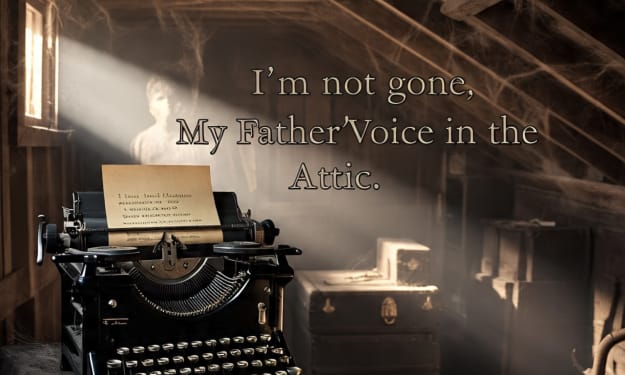
It started with a voice—soft, unmistakable, and impossibly familiar. I was alone in the house, brushing dust from old photo albums in the parlor, when I heard it. A low murmur floated down from the attic, like a conversation overheard through a wall. My heart stuttered. It had been three years since my father passed away. The funeral was quiet, somber—just as he would have wanted. He was a private man, a writer of some small renown in his day, and he’d lived most of his final years holed up in this very house, surrounded by papers and silence. Now that Mom had moved into a smaller place, it fell on me to sort through everything. The house still smelled faintly of pipe smoke and ink. I told myself I imagined it. The wind maybe, or the moan of the old beams settling under the June heat. I went back to organizing the old letters. Then I heard it again. This time, clearer: “Anna…” My name. I froze. My father’s voice. Raspy, deep, unmistakable. He used to call my name that way when I was little, when he found me buried under a pile of books in the corner of the study, or when I’d fallen asleep on the sofa while he wrote late into the night. I stood, grabbed the flashlight, and made my way up the creaky stairs. The attic door groaned on its hinges as I pulled it open. The warm air hit me like a wave, thick with dust and old paper. “Dad?” I called, feeling ridiculous. Nothing. The attic looked the same as always—stacked boxes, a few old paintings, yellowed newspaper clippings of his book reviews pinned to the rafters. And then I noticed it: the typewriter. His old black Remington sat in the middle of the attic floor. I was sure it hadn’t been there before. Slowly, I approached. A single sheet of paper was fed into the carriage. On it, one line typed in the faded ink of a ribbon long expired: “I'm not gone, Anna.” My hands trembled. The key bars were cold to the touch, unmoving. I looked around, heart thumping. Dust clung to every surface, undisturbed. No footprints but mine. I backed away, closed the attic door behind me, and didn’t sleep that night. --- The next day, curiosity won over fear. I returned with gloves, a mask, and determination. If someone was playing tricks on me, I needed to know. I searched the attic thoroughly. No speakers, no electronics. No prankster hiding in the boxes. But the typewriter? It had more pages. One each day. Each with a new line in his voice, his phrasing, the kind of poetic insight only my father could produce. “You always understood the silence between words.” “There are stories I never told you, Anna.” “You are the final chapter I never got to write.” It became a ritual. Each morning I climbed into the attic and read what he’d left behind. And then came the day the typewriter stopped. The last page sat there with a single sentence: “Look beneath the floorboards.” My breath caught. I hesitated. But something deeper than fear pushed me forward. I pried up the floorboards near the typewriter, coughing as dust billowed around me. There, wrapped in oilskin and bound with string, was a manuscript. The title page read: "For Anna – The Story of Us" It was a memoir—his memoir. A deeply personal, beautiful, and painfully honest chronicle of his life, his regrets, and his love for me and Mom. Things he never said aloud. Stories he never shared. I read through the night, tears soaking the final pages. --- When the publisher saw the manuscript, they wept too. “It’s his masterpiece,” they said. “A voice from beyond.” But I knew better. It wasn’t a ghost story. It was love—my father’s final act of connection. Somehow, some way, he had waited until I was ready to hear it. And now, whenever I sit quietly, I sometimes hear the clack of old typewriter keys, echoing faintly from the attic above.
By Azmat Roman ✨about a year ago in Fiction