Historical
The Island of No Signal
The Island of No Signal Written by Mirza It was supposed to be their escape. Maya and Ibrahim had been planning the trip for months. Both in their late twenties, they worked corporate jobs in Berlin and had grown tired of city noise and screens. They found an Airbnb listing for a secluded stone cottage on a private Croatian island—Otok Mrak, which translated eerily to “Island of Darkness.” But the photos looked serene: turquoise water, wild olive trees, and a promise of “complete disconnection.” Exactly what they needed. From the mainland port of Split, they took a ferry with a handful of tourists, then transferred to a rusty local fishing boat captained by a man who barely spoke English. “No internet. No cell. Just quiet,” he grunted, almost like a warning. Ibrahim chuckled. “Perfect.” The island came into view like a secret whispered to the sea—small, lush, and surrounded by limestone cliffs. A crooked wooden dock led them inland. The cottage sat in a clearing, surrounded by thick woods and the faint smell of salt. That night, with a candlelit dinner and the sound of waves crashing, they felt like they'd found paradise. Day Two. Maya woke to bird calls she couldn’t name. She grabbed her phone to take a photo—but the signal bars were gone. Ibrahim tried his too. No service. No Wi-Fi. Just like the listing had said. They spent the day hiking trails that circled the island. Around the northern cliffs, they found a collapsed structure—what looked like an old military outpost. Bullet holes marked its concrete walls. A rusted sign read: “Zabranjeno!”—Croatian for “Forbidden.” “Must’ve been from the Yugoslav wars,” Ibrahim guessed. That night, a storm rolled in quickly. The wind howled, and something slammed against the cottage roof. They stayed awake, holding each other as branches scratched the windows like claws. Day Three. Maya noticed it first. Her journal was missing. She always kept it by the bedside. Now, it was gone. “I didn’t touch it,” Ibrahim said. “Maybe it fell off?” They searched the room. Nothing. Then, out by the garden, she found it: soggy and half-buried near a rock. Pages torn out. That afternoon, they walked to the outpost again. Ibrahim brought a flashlight. Inside, beneath fallen beams, they found something they hadn't noticed before: an old wooden crate. Inside were used ration cans... and a stack of photos. Black and white. Faded. All of couples—laughing, hugging, sitting by the cliffs. Until the final ones. People running. A blurry figure in the trees behind them. A chill ran down Maya’s spine. “Maybe someone used to live here after the war?” Ibrahim offered. She nodded slowly. But something in her gut twisted. That night, Maya woke to the sound of whispering. She shook Ibrahim awake. He listened, eyes wide. The voices were faint, like a radio just out of tune. They grabbed their flashlight and stepped outside. Nobody. But in the dirt just outside their door were footprints—barefoot. Deep. Leading into the forest. Day Four. They decided to leave. No signal meant no ferry to call. They packed their things and walked to the dock. The boat was gone. So was the radio in the boathouse. Something was watching them. They could feel it. At sunset, they spotted movement in the woods—a silhouette. Then another. And then they heard it again. Whispers. This time, closer. They ran back to the cottage and locked the door. Ibrahim held a kitchen knife. Maya cried quietly as they pushed furniture against the windows. “What do they want?” she whispered. “I don’t know,” he replied. “But we’re not staying another night.” Day Five. At first light, they crept out toward the cliffs where the outpost sat. The boat wasn’t returning. No flares. No contact. But the cliffs... maybe they could signal from the highest point. At the top, they built a fire. Thick smoke curled into the sky. Nothing. Then Maya turned—and screamed. Someone was standing at the edge of the trees. Watching. It was a woman. Pale, barefoot, with wild hair. In her hand was Maya’s missing journal. Ibrahim moved forward. “Who are you?!” The woman stepped back into the trees and disappeared. Behind her, carved into the cliff wall, was a message in English: “We live here now.” That evening, just before sunset, a faint rumble came from the sea. A boat. A patrol vessel. Ibrahim waved a towel as Maya cried with relief. The boat came closer, its siren slicing the stillness. Two officers jumped ashore. “You’re the couple from Berlin?” one asked. “We've been searching for five days. Your host said you never checked out.” They looked at each other, confused. “But we still had two nights left,” Maya said. “No, ma’am,” the officer replied. “You were booked for three nights. You disappeared after the first.” The couple turned around one last time. The cottage was gone. Only rocks and sand where it once stood. Epilogue Back in Berlin, Maya couldn’t sleep. She kept hearing whispers. Ibrahim tried to rationalize it all—hallucination, stress, some old trauma in the woods. But three days later, a package arrived. No return address. Inside was Maya’s torn journal. And a photograph. Of them. Standing on the cliffs. But they didn’t remember anyone taking it.
By Moonlit Lettersabout a year ago in Fiction
In the Heart of Shadows
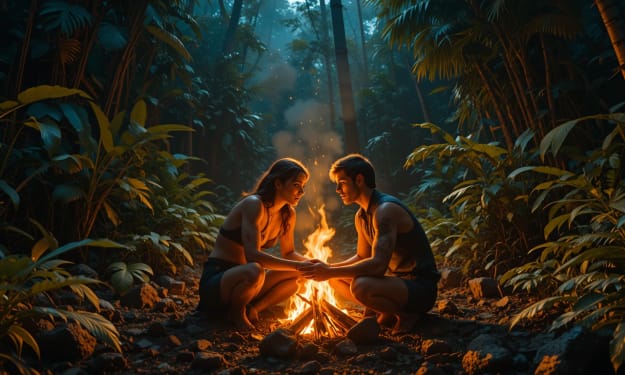
In the Heart of Shadows Written by Noor Khan It was supposed to be a guided trek—nothing more. Lara, a wildlife biology student from Austria, had traveled to the Choco Rainforest in Colombia for her research internship. She wanted solitude. She wanted data. She didn’t want distractions, and especially not people like Jayden—the overconfident British travel vlogger tagging along on the same eco-tour. They met on day one: he had a drone, she had a notebook. He cracked jokes, she rolled her eyes. Their guide, a local named Mateo, assured them the trail was safe and the group of five would stay close. But on day three, disaster struck. A sudden landslide blocked the return trail. And as panic spread among the group, Lara and Jayden were separated from the others. They had no guide, no map, no GPS signal. And they were deep in one of South America’s densest rainforests—with wild cats, venomous insects, and no idea how to get out. --- The First Night: They found temporary shelter under a large rock overhang. Jayden made a fire with some dry moss and twigs, while Lara bandaged a scratch on his arm with strips from her shirt. “You always this calm in disaster?” he asked, trying to lighten the mood. “No,” she replied, “but panic won’t get us out.” He admired that. She was serious, sharp, and determined. Everything he wasn’t—at least on the surface. --- The Jungle Tests Them: The next few days were brutal. They had to filter water from muddy pools, survive on wild fruits, and constantly watch out for snakes, jaguars, or poisonous frogs. The air was thick, the sun barely pierced the canopy, and the nights echoed with eerie howls and buzzing swarms. Jayden, who had always relied on tour guides and edited travel reels, found himself completely out of his element. Lara took the lead—reading moss patterns to find direction, tying sticks to create makeshift traps, even fighting off a wild monkey that tried to steal their food. But as brave as she seemed, Jayden noticed her hands trembled at night. When he asked if she was scared, she nodded, whispering, “I just don’t have time to be weak.” That’s when something shifted between them. --- Rain, Fire, and Secrets: On the fifth night, a thunderstorm drenched them. Their fire went out. They huddled under a broad-leafed tree, shaking, soaked, and exhausted. Jayden, whose light-hearted personality had faded days ago, finally broke down. “I thought I was strong. But I’m just… useless out here.” Lara looked at him—really looked. “You’re not useless,” she said quietly. “You’ve kept me sane. Your stupid jokes? They helped me breathe when I felt like I couldn’t.” In that moment, something raw passed between them. Not passion. Not yet. But recognition. Of fear. Of effort. Of two people brought down to their most human form. The next morning, while crossing a stream, Lara slipped and cut her leg badly on a sharp rock. The wound bled heavily. She couldn’t walk. Jayden carried her for hours, through mud, vines, and thorny bushes, whispering, “Just a little more,” every time she cried out. They finally found an abandoned wooden ranger hut. Inside were old emergency supplies: a flare, a first-aid kit, and some canned food. He patched her leg. They lit a flare that night and hoped someone would see it. --- Love, in the Darkest Place: That night, lying on the floor of the hut with jungle winds howling outside, they talked about life. About her dreams of becoming a conservationist. About his fear that his videos were shallow. “I want to matter,” he said. “You do,” she whispered. Then silence. Then, their fingers touched. Then, finally—a kiss. Not rushed. Not cinematic. Just real. Worn, dirty, exhausted—and still, there was warmth. --- The Rescue: A rescue team spotted the flare and reached them two days later. They were taken to a medical camp, then to the city. Before parting ways, Jayden looked at her. “I don’t want this to be just a story we tell someday.” She nodded. “It doesn’t have to be.” --- Epilogue: Months later, Jayden’s channel took a different direction—real stories, raw truths, no filters. In one video, he shared their jungle story, dedicating it to Lara. In the comments, one viewer wrote: "Some people find love in candlelight. Others find it fighting panthers in the jungle. Respect."
By Moonlit Lettersabout a year ago in Fiction
The Girl Who Could Burn Memories. AI-Generated.
The First Burn I was thirteen when I first learned I could burn memories. Not metaphorically literally. My grandmother had just passed away, and I was holding one of her old scarves when the scent lavender and rosewater hit me like a wave. I closed my eyes, thinking of her hands, her voice, her laughter. A memory. Warm and vivid.
By Arif Aadeeabout a year ago in Fiction
Love in the Shadows of Cappadocia
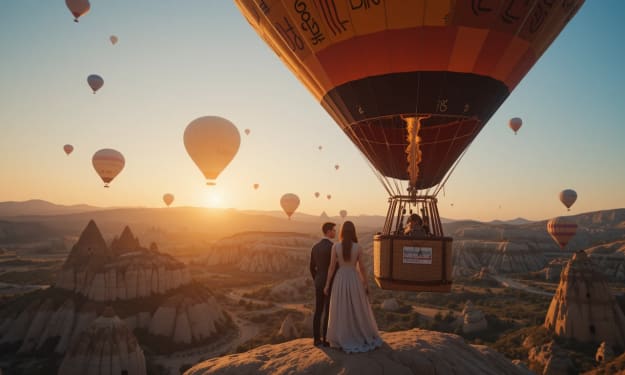
Love in the Shadows of Cappadocia Written by Noor Khan It was supposed to be just another solo trip for Amara—a quiet escape to heal after the slow, painful collapse of her three-year relationship. She had planned the tour months ago, long before things ended. She thought about canceling, but her heart whispered otherwise. Turkey had always called to her, and Cappadocia’s fairy chimneys and dreamy balloon-filled skies seemed like the perfect place to lose—and maybe rediscover—herself. The dusty airport road to Göreme welcomed her with warmth, simplicity, and charm. Mountains stood like guardians around the villages, and the air felt ancient. Her boutique cave hotel offered sweeping views of the valley, and for the first time in months, she exhaled deeply. The next morning, Amara joined a small group for a guided sunrise tour to the Red and Rose Valleys. The group was diverse: a family from Spain, a newlywed couple from Denmark, and then… him. He introduced himself as Elias, from Lisbon, Portugal. His olive skin and tousled hair made him look like a character from an old European film. He wasn’t trying to be charming—but he was. He offered a polite nod and a soft “Bom dia” when they climbed into the dusty van. Amara responded with a smile, unsure if her voice even came out. Their first interaction was accidental. She had paused at a ledge in Red Valley, staring at the layered rock that resembled ancient flames frozen in time. Elias stood beside her. “It looks like fire trapped in stone,” he said quietly. Amara looked at him. “Exactly what I was thinking.” A few hours later, they were both seated on a stone bench at Love Valley, laughing about how the name didn’t quite match its odd phallic rock formations. By lunch, they sat together, talking about travel, old heartbreaks, and the silence of solo adventures. She learned that Elias had lost his mother a year ago and had been traveling since, trying to fill the silence she left behind. That night, after the tour ended, they went for tea at a hillside café that overlooked the lantern-lit rooftops of Göreme. The call to prayer echoed softly in the background as they sipped hot apple tea and exchanged stories about childhood, regrets, and small joys. It wasn’t rushed. It wasn’t planned. For the next four days, they toured together—Derinkuyu Underground City, the frescoes of Göreme Open Air Museum, and the old Greek houses of Mustafapaşa. Their moments were effortless—shared headphones on bus rides, trading bites of Turkish delight, laughing at tourists who stumbled during camel rides. Elias had a Nikon camera and loved taking candid pictures of Amara—capturing her laughing in front of fairy chimneys or with her scarf blowing in the wind during a sunset hike. “You don’t smile like that in posed pictures,” he said once. She didn’t reply, but she blushed. On the fifth morning, they booked a hot air balloon ride. It was still dark when they were picked up and taken to the launch site. As the sky blushed pink, and the balloons rose one by one, they found themselves floating above ancient valleys and winding trails carved by centuries. The wind was light, the air crisp. Amara stood at the edge of the basket, holding her breath at the magic of it all. Elias stood behind her, not touching her, just there. “You ever wish moments like these could stretch longer?” he asked. Amara looked back at him, eyes soft. “I wish they didn’t have to end.” But they both knew they would. On her last night in Cappadocia, they sat again at the café. This time, the silence was heavier. She was flying back to London the next morning; Elias was headed toward the Aegean coast. “I don’t believe in vacation romances,” she whispered. “Me neither,” he replied. “But I believe in this one.” She looked at him, unsure whether to cry or smile. “What is this one?” He reached for her hand. “Something real, even if short.” When morning came, she left a note on his bed instead of saying goodbye in person. It read: “You gave me back something I didn’t even know I’d lost—hope. Thank you. Maybe one day, somewhere else in the world, we’ll find each other again.” She boarded her flight with tears that tasted like both grief and gratitude. Months passed. They exchanged a few messages, sent the occasional picture. But life resumed its usual rhythm. Then, one snowy evening in London, Amara opened a small package delivered to her flat. Inside was a photo of her—standing at the edge of the balloon basket, the wind in her hair. On the back of the photo were only three words: “Stretching the moment.” She looked at it for a long time before smiling through tears. That day, she booked a flight—not knowing if he was waiting, but knowing that some stories, even the briefest ones, are too real to leave unfinished.
By Moonlit Lettersabout a year ago in Fiction
Lost in Lisbon, Found in Love
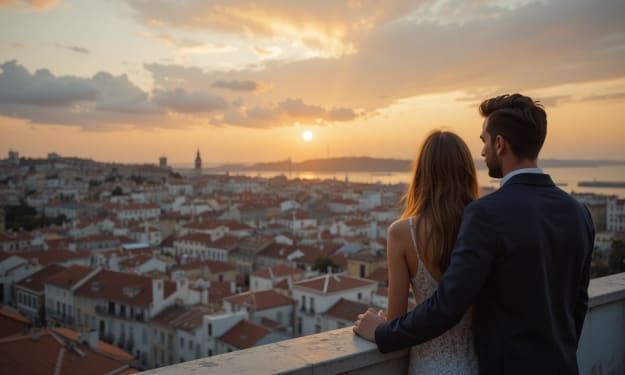
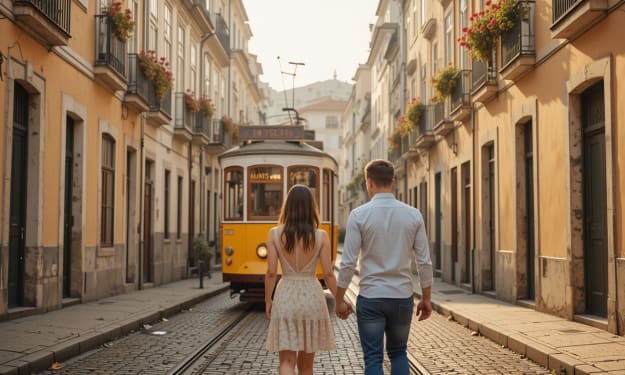
“Lost in Lisbon, Found in Love” Written by Noor Khan It was supposed to be just another stop on her solo trip across Europe—a three-day stay in Lisbon, Portugal, to relax before flying back home. Areeba had booked the trip months ago after quitting her corporate job in Manchester. She needed to escape, to breathe. Lisbon’s colorful streets, vintage trams, and soulful Fado music were the perfect backdrop for that kind of healing. But what she hadn’t planned for was him. 🌍 Day 1: The Missed Turn The late afternoon sun cast a golden glow on the tiled streets of Alfama, and Areeba—clutching her little map and DSLR—was chasing the perfect picture. She had just finished exploring the São Jorge Castle and was looking for a quiet café nearby when she took a wrong turn. “Excuse me, is this Rua da Saudade?” she asked a man standing near a blue-tiled building, checking his phone. The man turned. Tall, dark hair, olive skin, a soft British accent. “Actually, it is. I’m headed that way too. Want to walk together?” His name was Adam. He was a Pakistani-born Londoner on a two-week vacation after a recent breakup. “Lisbon is my detox,” he joked. They laughed and chatted as they walked the cobbled streets, passing small homes with hanging laundry and old women peering from balconies. It didn’t feel like a tourist interaction. It felt…easy. 🍷 Day 2: Rain, Wine, and Fado The next morning, Areeba thought she wouldn’t see him again. But just as she was deciding where to eat lunch, she got a WhatsApp message. Adam: “Hungry? I found this place near Baixa that serves the best bacalhau. Meet me?” She hesitated. She didn’t usually accept invitations this quickly. But something about Lisbon—something about him—felt different. They had lunch at a rustic tavern where the owner served them wine with every dish and sang Fado between courses. Outside, it had started raining, so they stayed, talking for hours. About their families. Their heartbreaks. Their dreams. “Funny, isn't it?” Adam said, staring at the candle between them. “We spend years building lives that don’t make us happy, and then in two days with a stranger, we feel...light.” That evening, instead of heading back to their hotels, they walked along the Tagus River, the rain now just a drizzle, Lisbon glowing under the wet streetlights. They didn’t kiss. They didn’t hold hands. But they didn’t need to. 🧭 Day 3: The Decision The next morning, they met again. No plans, no schedule. They just wanted to explore together. From the ancient Monastery of Jerónimos to the pastel-colored trams in Bairro Alto, Lisbon became their canvas of connection. But travel romances have one rule—they come with a clock. Areeba was leaving the next morning. Adam still had a week left. They sat in a tiny café at night, both sipping espresso, both quiet. “So,” she said, looking at her phone screen, “This is it?” He didn’t answer immediately. “What if it doesn’t have to be?” “What do you mean?” “I mean… I was supposed to go to Porto next. But maybe… I could book a flight. With you.” “You’d come to Manchester?” “No,” he said, smiling. “You said your last stop is Paris, right? I’ll meet you there. Let’s not call this the end yet.” ✈️ Two Weeks Later – Paris The Eiffel Tower looked beautiful under the twilight sky, but Areeba wasn’t looking at it. She was looking at Adam. They sat on a bench near the Seine. It had been ten days since Lisbon. They’d exchanged voice notes, video calls, late-night texts. And he’d kept his promise—he flew to Paris just for one day, just to see her. “I don’t know where this is going,” she whispered. “Neither do I,” he replied. “But I know where it started. And I want to find out where it ends.” He pulled out a small box. No ring. Inside was a tiny compass. “For our next destination. Together.” She smiled, held his hand, and nodded. ❤️ : One Year LEpilogueater They didn’t marry overnight. They didn’t post selfies with cheesy captions. They just kept meeting. From Manchester to London. From Cappadocia to Croatia. One city at a time. One memory at a time. And one year after they met in Lisbon, they returned. Same streets. Same blue tiles. Same little café. This time, the box had a ring. And this time, she said yes.
By Moonlit Lettersabout a year ago in Fiction
Before the Sky Changed
In the spring of 1986, the trees lining the streets of Prypiat bloomed early. Pale blossoms clung to the boughs like quiet promises, stirring gently in the river breeze. Fourteen-year-old Katya Ivanenko rode her bicycle down Lenina Avenue, her hair braided in twin ropes, her face flushed with the freedom of an early dismissal from school.
By M.R. Cameoabout a year ago in Fiction
The Revenant’s Mark
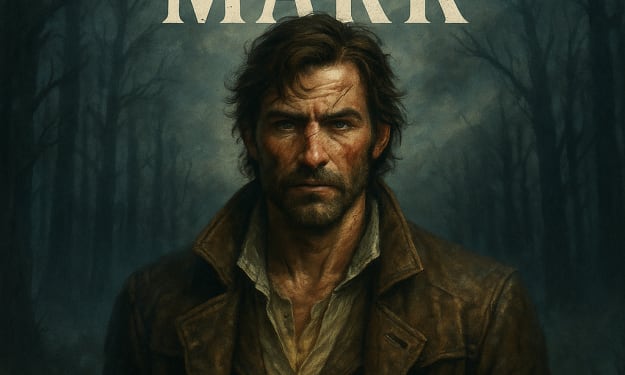
Jacob Hawthorne clawed his way out of the grave like a man only half-born. His fingers tore through frozen dirt, and his lungs strained for air that no longer tasted like breath. Blood crusted his navy coat, the fabric stiffened by cold. When he coughed, the tang of iron and ash clung to his tongue. Darkness still surrounded him—he knew that much—but the moon hung high, and the sky shimmered like cut glass in winter.
By Wesley C. Martinabout a year ago in Fiction
The Silent Mountain
The Silent Mountain Written by Noor Khan Part I: The Whisper of the Carpathians In the autumn of 1947, just two years after the end of World War II, Europe was still licking its wounds. Towns were rebuilding, families were reuniting, and the continent's scars ran deeper than any map could show. But in a quiet café on the outskirts of Brașov, Romania, a different story was about to unfold. The café was filled with cigarette smoke and murmurs when a man named Elias Kovács stepped inside. A Hungarian linguist and former codebreaker during the war, Elias wasn’t there for coffee. He carried a leather satchel filled with maps, letters, and a single photograph: a grainy black-and-white image of a snow-covered mountain with strange markings near its peak. “I need a team,” Elias said quietly to the woman sitting at the corner table. Her name was Ana Petrova, a Bulgarian geologist who had studied fault lines all through the Balkans. She took a sip of tea, then nodded slowly. “I’ve heard of this mountain. Locals call it Tăcerea, the Silent One. No birds fly near it. No one who climbs it ever speaks of what they saw.” By the end of that week, five had joined the expedition: Elias, the linguist and seeker of hidden codes. Ana, the scientist chasing seismic anomalies. Luca, an Italian war photographer haunted by the past. Elena, a Polish nurse turned herbalist, fascinated by ancient cures. And Henrik, a stoic Austrian mountaineer with lungs like bellows and eyes that missed nothing. They set off from Brașov with mules, canvas tents, and little fanfare. Their destination: a forgotten path through the southern Carpathians, rumored to lead to a site that predated Roman rule—a mountain lost in silence and time. --- Part II: The Mountain That Watched The climb began gently. Green meadows gave way to dense fir forests. Villagers in nearby hamlets whispered warnings in half-lost dialects: “Don’t stay on the mountain after sundown.” Others simply crossed themselves and closed their doors. On the third night, as the group camped near a frozen stream, Henrik said he’d seen figures among the trees—silent, unmoving, and gone when he looked back. “Elk, maybe?” Luca offered. Henrik shook his head. “Elk don’t watch. These did.” On the fifth day, they reached the base of Tăcerea. The snow was thin but icy. Strange spirals were carved into the rocks—patterns that Elias matched with symbols found in a pre-Christian manuscript from Transylvania. “These weren’t just markings,” he said. “They’re warnings. Directions, maybe. Or barriers.” Elena found herbs growing where no light reached. “This plant shouldn’t exist here. It’s used in rituals... old ones.” And Ana, placing a seismograph into the ground, discovered constant vibration—not from the earth below, but from within the mountain itself. That night, the wind howled in bursts like whispers. The fire wouldn't stay lit. Luca’s camera snapped twice—no one had touched it. --- Part III: The Descent into Silence On the seventh morning, Henrik didn’t wake up. He was alive, but stiff as stone, eyes wide open, lips murmuring nonsense in an unknown tongue. When Elias leaned closer, he gasped. “He’s repeating the same five words… over and over. But it’s not a language I know.” They tried to carry Henrik down the mountain, but as they descended, the mountain began to change. The trail they had marked was gone. The rock underfoot seemed to breathe. Luca tried to photograph the spirals again, but every picture came out black—except one, which showed six shadows instead of five. Panic set in. Elena, normally calm, broke down crying. “We were warned. We shouldn’t have come here. This isn’t science or history—it’s something older. Something angry.” On the ninth day, with food low and sanity fading, the group split. Elias and Ana tried to trace their steps back. Luca insisted on finding the spiral chamber again. Elena stayed to care for Henrik, who now spoke clearly—but in a dead language no one understood. Only Ana returned. --- Part IV: What She Told the World Ana was found two weeks later by a shepherd. She was pale, bruised, and holding a cloth bag containing only Henrik’s compass and Luca’s broken camera. She never spoke publicly about what happened. In a letter to her sister, smuggled out of a hospital in Vienna, Ana wrote: > “The mountain doesn’t want to be known. It was never meant to be touched. Whatever was buried there… watches still. We weren’t the first. We won’t be the last. But I pray the next ones don’t come so soon.” The film from Luca’s last shot was eventually developed. It showed a cavern lined with glowing moss and a dark figure standing just beyond the group—tall, faceless, arms stretched wide. That photograph, now locked in an archive in Warsaw, has never been released.
By Moonlit Lettersabout a year ago in Fiction