Fantasy
Two Sides of the Same Coin
I remember my childhood in bits and pieces, like framed pictures of specific events that exist independently of all the other memories. There was the time I challenged my brother to a foot race down the steps of the rocky hill on the side of my grandfather’s house. My mother warned us to never run down the hill lest we injure ourselves. But that did not thwart us at all. We waited for her to go to work and proceeded with our plans. What else was there to do in the hot summer sun but run, hide, play, and take in all of the day’s light. There was also the time I climbed the mango tree in my grandfather’s backyard and got stuck. So I snacked on mangoes and hoped the house girl would find me before my grandfather came home. The Haitian sun was always more bearable in the shade of a tree and a cool breeze, and this tree was my favorite. It had the juiciest mangoes, branches that extended every which way, and was so full it shaded almost the entire courtyard. My grandfather, a tall, lanky man with a balding spot at the top of his head that he regularly covered with a gray felt hat; a hat that looked like it had seen as many good and bad days as he had, hated when we climbed his mango tree. He’d complain that we’d shake the fruit right out and that they’d burst and spoil when they fell on the ground. Though he was a man of few words, he spoke with a deep voice; you could not help but stop whatever you were doing and listen. Now, as I watch my daughter play in the grass under the tall oak tree in our yard, I wonder how much she’ll remember. I wondered if this day of swinging in the shade, twirling in the specks of sunlight, and inspecting blades of grass for ladybugs would make it into the archives of her memories. I wondered if I would be part of this memory or if I would fade into the fuzzy details of the day. Nothing of particular significance happened to me on the day that I got stuck in my grandfather’s mango tree. Nothing I remember, at least. It was not the first time I had been stuck in a tree. Climbing was never the issue; it was always the trip down that scared me. And yet, I remember that moment, the juiciness of the mango, how sticky my fingers got, and the look on my grandfather’s face when he found me in the tree. But the thing about memories is that the more you member them, the less reliable they become. My mother, who grew up in that house, does not remember a mango tree. No matter how much I described it. “Not my father’s house,” she would say. “We were never allowed in the courtyard. How would you have gotten to a tree?” She’d ask in wonderment and confusion. I’m sure, if she could, my mother would call me a liar. But, instead, she said, “these memories are not yours, dear,” and waved me off, as all Haitian parents do. As if my memories could somehow belong to someone else. It did not matter. If my memories did not reconcile with hers, it was as though they never were. I remember visiting my grandfather before he passed. I wanted so badly to believe my memories and hold on to that day as it was; I booked a flight and made the one thousand five hundred mile journey back to Haiti to ask him about the day he found me in the mango tree. “My child!” he exclaimed with a smile and a warm embrace. In his arms and the warmth of his body, I felt that it had been too long since our last embrace. “What has an old man done to deserve this visit?” His voice, scent, the breeze, and the faint sounds of life passing just beyond the house gates all reminded me of how much I had missed home. It brought tears to my eyes that surprised us both. “Do not cry,” he quipped “you are here now.” And I remembered how uncomfortable tears made him feel. I never understood how a military man with so much strength and discipline could handle bullets, bombs, and the chaos of the battlefield yet floundered at the sight of tears. It made me smile. We sat in silence for some time on the bench facing the courtyard, enjoying the afternoon breeze and the evening sun. “Do you remember the mango tree, grandpa?” I asked him. “You mean this one right there? That you fell off of after I told you not to climb it?” He responded affectionately while pointing at the tree that cast shade on us. “Yes,” I smiled. I had forgotten that part. Or maybe I had blocked it out of my memory entirely. “Mama said we were never allowed in the courtyard.” “The courtyard? My courtyard?” He interrupted. “Yes. She said,”— “No.” He interrupted again, this time more certain. “Not my daughter. She would not say such a thing,” he continued shaking his head. “She and the boys were always in the yard, climbing my trees and spoiling my mangoes,” he chuckled. “No matter how much I insisted or how many times I punished you, I could not keep you off of it.” “You mean mama, right?” “What?” “You mean you could not keep mama off of it.” “Right,” he replied, almost in a whisper, and looked at me as though it were for the first time. “That’s what I said. Maybe she is confused,” he continued. “Those memories aren’t hers.” I remember we sat in silence afterward. The evening became dusk, and our versions of events filled up the space between us. I wonder if there will come a day when I will dismiss my daughter’s recollection of her life. If this disconnect is a right of passage into motherhood, and if she will quietly accept it as I have.
By M Uzair Khan (UK)5 months ago in Fiction
Riku, Mighty Hunter of Rumiko Village
The darkness was giving way to daylight in the Southern Woods. The wind rustled the trees and cooled the face of Rumiko Village's mightiest Hunter. Riku stood at five feet ten inches tall with long black hair that fell about his waist, and green eyes that glowed menacingly in the early morning light as he stared down the path waiting for his victim.
By Richard Baranowski5 months ago in Fiction
Dreamwalker Protocol. Content Warning.
As he lay motionless on the leather recliner I had invested in to offer my clients more than the usual comfort, I prepared myself. It was never easy walking through another's dreams, no matter how many decades I had been a practitioner of this so-called dark art. I always had a generous two thumbs, forget the fingers, of 10-year Islay whisky to settle my heart and lungs. Then I could begin. As long as I had my subject at the forefront of my mind, it was straightforward in principle. In practice it was like a bad fucking trip. Having this session monitored and streamed online made it even trickier.
By Paul Stewart5 months ago in Fiction
The Bluish Story of Dot
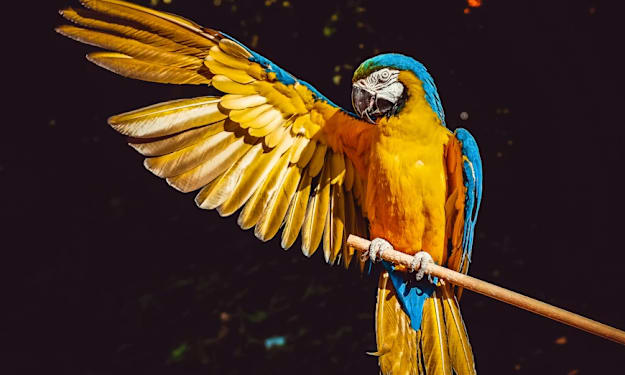
Xylo-phone, the gigantic parrot, moved on in life. From Dot with love to a family with three kids, with two kids, with one kid, where he slept on shelves, hid in cupboards, and was abandoned in a zoo to be recovered again at the Lost and Found of a big tech company in the middle of the country.
By Petra Van Geenen5 months ago in Fiction
Wanna Be Yours- Chapter 7
Around noon the household servants gathered and watched as Lady Luzcrezia and her daughter Lady Lucina got thrown into a carriage. Royal knights escort them to a prison where they will be monitored. Some erupt in cheers, others quietly wipe away their tears. Soon as that’s over with Milan clasps her hands together.
By Hazel Rivers5 months ago in Fiction
The Crashed Train in the Jungle.
The Crashed Train in the Jungle We were five friends chasing an old rumor during our trip through Central Java. Me (Adi), my cousin Budi, Lina, Reza, and Sara. The story was about a passenger train that derailed and disappeared into the jungle in the 1980s. Locals said it was still there, overgrown and untouched. It sounded like the perfect adventure for our last night before heading back to the city. We hired a local guide who took us deep into the jungle for four hours until he suddenly refused to go further. “That place is not for visitors,” he said, then turned back alone. We laughed at his superstition and kept walking. Then we found it. The train was lying on its side like a dying metal snake, half swallowed by thick vines and trees. The carriages were covered in moss, but the windows were strangely clean. Some doors were still closed. The number on the side read “KA 472” — a train that officially vanished in 1987. “Wow… this is insane,” Reza whispered. The sun was already setting. Instead of turning back, we decided to explore quickly and camp nearby. Big mistake. We entered the first carriage through a broken window. Inside, everything was eerily preserved. Seats were upright. Luggage still sat in the racks. A newspaper dated 1987 lay on a table. The air smelled of old dust and something sweet, like rotting flowers. That’s when we first heard the breathing. Soft, wet breathing coming from multiple directions at once. We told ourselves it was just the jungle wind. But then we saw the first creature. It was sitting in seat 14C, wearing the remains of a faded blue train uniform. Its body was twisted — spine bent at an unnatural angle, arms too long, fingers stretched like they had been pulled. Its head was turned 180 degrees, facing backward. The skin was pale gray and stretched tight. No eyes. Just smooth skin. But it knew we were there. It slowly turned its head toward us with a wet cracking sound. Its mouth opened slightly, showing small, crowded teeth. Then it whispered in perfect Indonesian: “Ticket… please.” We ran to the next carriage. The further we went, the worse it became. Every carriage had more of them. Twisted passengers still sitting in their original seats. Some had broken necks. Some had limbs folded in impossible positions. They all looked like they had been rearranged after the crash — bones reset wrong, bodies forced back into sitting positions. Lina started crying when one of them reached out and gently touched her hair. Its fingers left a wet black smear on her cheek. “You smell like my daughter,” it whispered with a voice that sounded like multiple people speaking at once. We tried to leave, but the jungle had changed. The path we came from was gone. Vines had grown across it in minutes. We were trapped. Night fell fast. The creatures began moving. They didn’t run or chase aggressively. They moved slowly, patiently, crawling over seats and along the ceiling like broken spiders. Their joints made constant soft popping sounds. They seemed to enjoy our fear. The more we panicked, the more active they became. Reza was the first. At around 1 a.m., while we were hiding in the dining car, one creature pressed its face against his. It stayed there for a long time, breathing into his mouth. Reza started shaking violently. When the creature pulled away, Reza’s eyes were completely white. He looked at us with a sad smile and said, “The train is leaving soon. We have to stay in our seats.” Then he walked straight to an empty seat and sat down. His neck snapped backward with a loud crack as he settled in. He never moved again. We couldn’t even scream anymore. Sara lasted until the third night. She kept saying she could hear her mother calling her from another carriage. One of the creatures had learned her mother’s voice perfectly. It kept whispering “Sara… come home” from the darkness. Eventually she broke. She walked toward the voice crying. We heard her scream once, then nothing. When we found her body later, she was sitting neatly in a seat, hands folded on her lap, with a peaceful expression. Her spine was bent exactly like the others. Budi tried to burn the train. He poured our remaining kerosene on the floor of one carriage. The creatures watched him silently from the shadows. When he lit it, the fire burned for only a few seconds before dying out completely, as if the train itself refused to burn. One creature then slowly crawled down from the ceiling and placed its long fingers around Budi’s head. It pressed until we heard his skull crack. He died whispering apologies to his mother. Now only Lina and I remain. We have been here for six nights. The creatures no longer hide. They sit around us, watching. Sometimes they copy our voices and have conversations with each other, pretending to be us. They argue about whose turn it is to die next. Lina is getting weaker. She hasn’t spoken in two days. One of the creatures has been sitting next to her for hours, gently stroking her hair and whispering childhood memories only she would know. Her eyes are starting to turn white. I am typing this on my phone with 6% battery, hidden in the toilet of the last carriage. They know I’m here. I can hear them outside the door, breathing patiently. The train feels different now. Sometimes I feel it moving slightly, as if trying to continue its journey. The creatures seem excited. They keep bringing me food — fruit and rice that appears fresh every morning. They want me strong enough to last longer. If you ever hear about a crashed train in the jungle, do not look for it. The passengers never completed their journey. And they are still collecting tickets. Lina just screamed my name from the next carriage. But it wasn’t her voice. It was mine. They have learned me now. The door is opening.
By Esmat Zafari5 months ago in Fiction
Wanna Be Yours- Chapter 6
Milan took over her aunt’s chambers. Blankets and furniture were rearranged to her liking. By now the moon has risen. She stood at her balcony, gazing at the stars in the sky. She smiled sadly, “How long could I have had this view for?” There was no response. Not even from her mind. She sighed, turning around, her back leaning against the railings. There was a withering plant hanging from the rooftop. She gently raised her hand, her finger brushing against its tip. It suddenly sprang to life. It hangs low like a long vine. Running down the stoned walls till met the floor. One moment she was gazing at the grass. Next, a horse comes into view. She blinked. As the horse and the man riding on it came into view.
By Hazel Rivers5 months ago in Fiction
From: QuickStop Manager Your shift has been extended.
Marcus had been working at the QuickStop for eight months. It was a small gas station at the edge of town. One pump. One cooler. One bathroom that never locked. The night shift was usually quiet. A few trucks. A few drunks. Nothing scary. But tonight was different. It started at 11:00 PM when a woman in a white car pulled up to Pump 2. She pumped exactly one gallon of gas. Then she walked inside, bought a carton of milk, paid with a $100 bill, and sat down in the corner booth. She hadn't moved since. Just sat there. Staring at the window. Not blinking. Marcus tried to talk to her. She didn't answer. He tried to call his manager. No answer. He tried to call the police. The line was dead. At 1:47 AM, the text arrived. Your shift has been extended. Do not leave. Do not unlock the doors. Marcus walked to the front door and pushed. It didn't open. He pushed harder. Nothing. The lock was broken. The door should have opened. But it didn't. It felt like something heavy was holding it shut from the outside. He looked through the glass. The parking lot was empty. No cars. No people. Just the woman's white car at Pump 2. But the pump was still running. The hose was still in her car. Gasoline was pouring onto the ground. A huge puddle was spreading toward the store. Marcus ran to the back door. Same thing. Locked. Stuck. He couldn't get out. He went back to the front. The woman in the booth hadn't moved. But her milk carton was empty. And her face was different. Her mouth was open wider now. Too wide. Like her jaw had unhinged. "You should sit down," she said. Her voice was low and wet. "They'll be here soon." "Who?" Marcus asked. "Who's coming?" She smiled. Her teeth were black. "The ones who extended your shift." Marcus grabbed his phone. No signal. He tried the landline behind the counter. Dead. He looked at the security camera monitors. Every screen showed the same thing. The front door. The parking lot. The puddle of gas growing wider and wider. Then he saw something on the last screen. Camera 7 pointed at the road. Headlights. A line of headlights. Cars were coming. Dozens of them. All moving slow. All driving toward the station. The first car pulled up. An old sedan. No driver. The door opened by itself. A man got out. He had no face. Just smooth skin where his eyes and nose and mouth should be. He walked to the front door and pressed his blank face against the glass. Then more cars arrived. More faceless people. They surrounded the building. Dozens of them. Pressing their faces against every window. Against the glass door. Their hands slapped the walls. Soft at first. Then harder. Marcus backed away. The woman in the booth stood up. Her body made cracking sounds. "They're here for the shift change," she whispered. "But you're not leaving. No one ever leaves." She walked toward him. Her feet didn't touch the ground. Marcus ran to the cooler. The big walk-in freezer in the back. He pulled the heavy door shut behind him. It was dark. Cold. His breath fogged in the air. Outside, the slapping stopped. Then the front door broke open. He heard hundreds of footsteps. Soft. Wet. Coming closer. The freezer door handle turned. Marcus held his breath. He closed his eyes. The handle stopped turning. Then a voice. Not the woman's voice. A deeper voice. A voice that sounded like gravel and old radio static. "Your shift has been extended indefinitely. The cooler is your new booth. Welcome to QuickStop. Population: you." The lights went out. And somewhere outside, the gas pump was still running.
By Esmat Zafari5 months ago in Fiction
In Another Life- Chapter 3
It had been days since Count Marzen Stellae’s passing. Lissana hadn’t left her family's home until his funeral. Today she sat in the front. His father sat on her left and her mother on her right. She stared mindlessly at his casket. They had just put it under ground. A priest reading a blessing over his grave.
By Hazel Rivers5 months ago in Fiction