family
The Echoes of the Yellow Scarf
When Mira stepped off the subway at 14th Street, the crowd swept around her like waves. It was the same platform, same train, same morning routine—but today, something was different. Clutched in her hand was a yellow scarf. Not hers. She had found it on the park bench she always sat on before heading to work. It was soft, handmade, and slightly frayed at the edges, with initials stitched in the corner: S.H. She hesitated before picking it up earlier that morning. Normally, she'd ignore lost items, let someone else deal with them. But something about this scarf felt… personal. Like it was meant for her to find. By the time she reached her office on the 22nd floor of a glass-paneled building, she couldn’t stop thinking about the initials. Who was S.H.? Why did it feel like more than just a lost scarf? She Googled the initials with “yellow scarf” and “New York”—of course, nothing. A thousand meaningless results. But then came the dreams. That night, Mira dreamt of a girl in a yellow scarf standing under a streetlamp, eyes full of sorrow. She said nothing. Just stood. Watching. Silent. The next night, she returned. This time, Mira spoke. “Who are you?” The girl looked up. “Help me find home.” Mira jolted awake. The scarf was on the chair beside her bed—right where she’d left it. But it looked newer. Less worn. As if time had reversed. In the days that followed, the dreams grew more vivid. The girl—always in that yellow scarf—stood by a bench, her back to Mira, facing a lake Mira had never seen before. And every time, she'd whisper, “Almost there.” Mira started drawing the scenes. She was no artist, but the urge was uncontrollable. She filled pages with images of the girl, the lake, the scarf fluttering like a whisper caught in wind. Her friends thought she was spiraling. “You need sleep,” they said. “You’re obsessing over nothing.” But she couldn't stop. One rainy Sunday, Mira walked aimlessly through Central Park, the scarf wrapped around her neck, the dreams echoing in her thoughts. And then—she saw it. The bench. Not just any bench. The bench. The one from her dreams. It faced a small, quiet lake. Willow trees bowed along the edges. A streetlamp flickered nearby. It was all real. She sat. A soft breeze passed. Leaves rustled. The scarf lifted slightly. And then, across the lake, stood the girl. Real. Flesh and bone. Same yellow scarf. Same solemn eyes. Mira stood. “Who are you?” The girl smiled faintly. “You found me.” Mira stepped forward, breath caught in her throat. But before she could speak again, the girl turned and walked toward the trees—fading like mist in morning light. Gone. Mira looked down. The scarf had vanished. In its place, on the bench, was a note. “Thank you. I’m home now. – S.H.” That was three years ago. Since then, Mira walks the park every Sunday. She never saw the girl again, but sometimes, when the breeze picks up just right, she feels a soft warmth on her neck—as if a scarf, unseen, still lingers. She doesn’t tell many people the story. Who would believe her? But if you ever find a yellow scarf where it shouldn't be… Hold on to it. Someone might be waiting.
By Arshad khanabout a year ago in Fiction
Between Our Cups of Tea
She placed the teacup in front of me, just like she always did — handle turned exactly to the right, the way I liked it. No sugar. No milk. Just like our mornings now. Bland. Quiet. Ritualistic. “Thanks,” I said, my voice low but audible. She didn’t answer. She never really did these days. She took her seat across from me, the chair creaking slightly under her, and lifted her own cup without a glance. The steam rose between us like a ghost — thin, silent, vanishing quickly. We sipped. Two strangers in a house we once called home. --- There was a time when mornings meant laughter. When she’d lean over the table, teasing me about my uncombed hair. When I’d kiss her forehead while the kettle boiled. When we’d talk — really talk — about dreams, books, movies, and silly ideas that only mattered to us. Now, we sip in silence. --- “What time are you heading out?” she finally asked, eyes still on her tea. “Around ten,” I replied. “You?” “Maybe earlier. I have to stop by the pharmacy.” I nodded. Another ordinary exchange. Another moment with nothing in it. --- It wasn't always like this. We used to touch each other without thinking — fingers brushing while reaching for the same spoon. We used to giggle like teenagers, even after five years of marriage. We used to sit on the floor instead of the couch, just because it felt cozier. We used to say “I love you” before falling asleep — even when tired, even when angry. I can't remember the last time we said that. I can't remember the last time I looked at her and saw her — the girl I fell in love with. Now, I just see a quiet woman in a bathrobe, pouring tea. And maybe she sees just a man behind a newspaper — not the boy who once chased her in the rain. --- “I’ve been thinking,” she said, suddenly. I looked up. “About?” She hesitated, then shook her head. “It’s nothing.” Say it, I wanted to tell her. Scream it if you have to. Tell me you’re unhappy. Tell me you miss me. Tell me you want to leave. Anything. Just don’t sip tea and pretend this is normal. --- I remember the night I first met her. She was at a bookstore, reading the back cover of a poetry collection. She had no makeup on. Just jeans, a plain blue shirt, and hair tied in a messy bun. She looked up, caught me staring, and smiled like I was already forgiven. We spoke for two hours that night. We didn’t even buy the book. Now, the same woman won’t speak to me for more than two minutes unless it’s about bills or groceries. --- I reached across the table and touched her hand. She didn’t pull away. But she didn’t hold it either. Just let it sit there — like my touch was something to tolerate, not treasure. “I miss us,” I said. She blinked. Once. Twice. And then quietly replied, “I know.” --- Silence again. Not heavy. Not angry. Just... empty. --- She stood, collected her cup, rinsed it in the sink. I watched her movements. Precise. Mechanical. Distant. I wanted to say so many things. Like how I still remember the way she laughed with her eyes. Like how I still sleep on the edge of the bed because that’s how she likes it. Like how I don’t want to lose her but don’t know how to keep her. But I said nothing. Because we both had gotten used to saying nothing. --- As she dried her hands on a towel, I asked: “Do you think we’ll ever be okay again?” She didn’t turn around. After a pause, she said: > “I think... we’ve been trying not to break. But maybe we already did. Quietly. Without noticing.” --- I stood up. Walked to the door. Picked up my coat. “I’m going for a walk,” I said. She only nodded. No “be careful.” No “come back soon.” Just a nod — like I was a neighbor borrowing sugar, not her husband. --- Outside, the air was colder than I expected. I shoved my hands into my pockets, thinking about how two people can share a house, a bed, a life — and still feel miles apart. --- When I returned an hour later, she was gone. But on the table, next to my empty teacup, was a note. > I made you a fresh cup. I don’t know if it changes anything, but… it still matters to me that you drink it warm. —M ---
By Muhammad Usamaabout a year ago in Fiction
The Generous King
In the kingdom of Nahazar, there lived a king unlike any other. He was called King Rayan the Generous — not because of titles, but because of the way people whispered his name with gratitude. He had no hunger for gold, no thirst for war. He believed true power came from kindness. And so, he gave. He gave to the poor until the streets no longer knew hunger. He gave to the farmers when the rains were late and the crops failed. He gave to the widows, the orphans, the broken — and none left his court empty-handed. His palace gates were never closed. His treasury, always open. The people called him a king touched by heaven. But not everyone in the kingdom felt so blessed. --- The Forgotten Face in the Palace In a room just behind the throne, a young boy used to wait. His name was Zayan — the king’s only son. While his father ruled a kingdom, Zayan ruled nothing but silence. His mother had died when he was five. His father, always surrounded by ministers and the needs of the nation, had forgotten the boy who used to wait outside his chamber door — just to walk beside him. Every evening, Zayan would peek through the carved doors of the court, hoping his father would look up. He rarely did. --- “The People Need Me” When Zayan turned ten, he built a wooden horse by himself. He ran into the court to show his father. But the king was kneeling before a crying widow, handing her his own gold ring. “Not now, my son,” he said, without looking. Zayan nodded, stepped back, and never showed him anything again. The king gave everything… except time. --- A Kingdom Celebrates The years passed, and the king’s legend grew. He built hospitals, opened schools, forgave debts. On his 50th birthday, the entire city threw a festival. Thousands came to bless him. The streets lit up in his honor. But Zayan, now 21, did not attend. He sat in the palace garden, watching the fireworks alone, whispering to himself: > “You gave them all your gold, father. But you never gave me a moment.” --- Illness Comes Quietly One winter, the king fell ill. The royal doctors called it exhaustion. His body had served the people endlessly — now it was fading. The king summoned Zayan to his bedside. “You must be king now,” he said, weakly. “I taught you all I knew.” Zayan looked at him — this man loved by millions, unknown by one. “You taught the kingdom how to love,” he said, “but not your own son.” The king looked away, and for the first time, tears fell from his eyes. --- The Last Gift The king died two nights later. Thousands marched with his casket. The skies rained. The people wept. But Zayan remained in the palace. Only after the funeral did he enter his father’s private chamber. On the desk, untouched for years, was a sealed letter. It was addressed to him. --- The Letter > My son, If you are reading this, I am gone. I was a king to many — but I fear I was a stranger to you. Forgive me. They came to me with empty bowls, torn clothes, broken hearts. I gave them everything because I saw your mother in every crying face. When she died, a part of me froze. Giving to others was my way of keeping her alive. But in doing so… I left you alone. You are the only treasure I never learned to hold. Rule better than me. Love louder than I did. And know this — I was proud of you, even from afar. Always. Your Father. --- Now Years have passed. Zayan rules Nahazar now — a king like his father in generosity, but greater in presence. He still feeds the poor. Still opens the palace gates. But each evening, he walks through the garden where his father never came, holding his daughter’s hand. When she tugs at his robe and says, “Look, Baba,” he stops — every time — and looks. Because he learned the greatest truth too late: > A kingdom can be rebuilt. A treasury can be filled again. But a child who feels unseen… may never forget.
By Muhammad Usamaabout a year ago in Fiction
Her Truth, My Lies
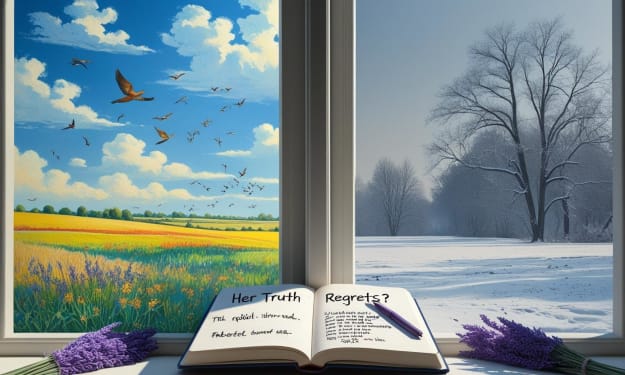
The Notebook of Kind Lies The first time I lied to my grandmother, I cried in the bathroom afterward. It felt like dropping a heavy stone into a deep, still pond. The ripples haven’t stopped yet. Her name was Eleanor. She smelled like peppermints and lavender soap. She taught me how to plant tomatoes and cheat at card games. She was the warmest person I knew. Then, slowly, like sand slipping through fingers, she began to forget. It started small. Forgetting where she put her glasses. Calling me by my mother’s name. Then came bigger things. She forgot her address. She forgot what year it was. She forgot that Grandpa Joe had passed away five years before. That’s when the lies began. We called it “redirecting.” A nicer word for lying. “Grandma,” I’d say gently, holding her shaking hands after she asked for Joe for the tenth time that morning, “he’s gone fishing up at Silver Lake. Remember? He’ll be back next week. He told you not to worry.” Her worried face would soften. “Oh, yes. Silver Lake. He loves it there.” Relief. A small kindness. But the lie burned my throat. Then, I found the notebook. It was tucked beneath a stack of yellowed quilts in her old cedar chest. A simple spiral notebook, the kind kids use for school. On the cover, in her once-beautiful, flowing script: *Things I Must Remember*. My heart cracked a little. Inside, it was worse. The entries weren’t lists of birthdays or recipes. They were desperate attempts to anchor herself in a world that kept changing shape. Dates were jumbled. Words were scribbled out. Sentences trailed off. But the fear was clear. *Page 12: “The man in the blue suit came again today. He says he’s my son. He looks kind. But my son is little. He has red hair and builds forts in the living room. Where is my little boy? Did I lose him?”* *(My father, her son, has grey hair now).* *Page 34: “Why is the sky different? It feels lower. Did they move the mountains? I told Martha but she just patted my hand. Martha is my sister. She lives in Ohio. Or did she move? I think she’s mad at me.”* *(Aunt Martha died fifteen years ago).* *Page 57: “The pretty girl visits. She calls me Grandma. She brings cookies. Peanut butter. My favorite? I think so. She looks sad sometimes. Did I hurt her? I hope not. I don’t remember hurting anyone. But maybe I did.”* *(That was me. Bringing peanut butter cookies. Her favorite).* Reading it felt like trespassing. Like reading someone’s diary during a thunderstorm. Each page was a glimpse into her crumbling world – a world where mountains moved, loved ones changed faces, and she lived with the constant, quiet terror of having done something wrong, of being lost, of *being* wrong. The notebook changed things. It wasn’t just about redirecting anymore. It was about stepping into *her* world. About speaking her language. The notebook showed me the landmarks in her shifting landscape. When she pointed at the window and whispered, “The little birds are back! They sing the song about the daffodils!” I didn’t correct her. (It was December. Snow fell silently outside). Instead, I sat beside her. “They do! It’s such a pretty song, isn’t it? Your favorite.” Her smile was pure sunshine. “Yes. My favorite.” When she fretted about missing her train to Cincinnati to see her mother, I didn’t remind her the train station closed decades ago, or that her mother passed away when I was a baby. I checked my watch. “Plenty of time, Grandma. Your train isn’t until after lunch. Let’s have some tea first.” The panic in her eyes faded. “Tea sounds lovely, dear. With honey?” The lies weren’t malicious. They were bridges. Made from scraps of her own vanishing memories, built carefully over the chasms of confusion her mind couldn’t cross. They weren’t about hiding the truth *from* her. They were about protecting the truth *inside* her – the truth of feeling safe, loved, and unafraid. The biggest lie came near the end. She was very frail. Sitting by the window, tracing patterns on the foggy glass. Her voice was a dry leaf rustling. “Was I… was I a good mother?” Memories flooded me. Her patience when I spilled paint on her new rug. Her fierce hugs when I scraped my knee. The way she sang off-key lullabies. The time she walked three miles in the rain because I forgot my lunchbox. But also… the sharp words when she was tired. The forgotten school play. The promises sometimes broken by grown-up worries. The truth was messy. Human. I took her papery hand. Looked into her cloudy, anxious eyes. Saw the little girl lost in the shifting mountains of her own mind, afraid she hadn’t been good enough. “Oh, Grandma,” I said, my voice thick, squeezing her hand gently. “You were the *best* mother. Truly. Kind. Patient. So loving. Everyone says so.” It wasn't the whole truth. But it was the truth she needed to hear. The only truth that mattered in that moment, in *her* world. A tear slipped down her wrinkled cheek. Not of sadness, but relief. A deep, shuddering sigh escaped her. “Oh, good. I’m so glad. I worried… sometimes.” She closed her eyes, a small, peaceful smile touching her lips. “I just wanted… to be good.” She fell asleep like that, holding my hand. I cried then. Not for the lies, but for the fierce, imperfect love they protected. For the mother she remembered being, and the grandmother she truly was. The notebook sits on my shelf now, next to a little jar of dried lavender. I don’t see it as a record of loss anymore. It’s a map. A map of a beautiful, bewildering country she traveled through, a place where mountains moved and little birds sang in the snow. My lies weren't a betrayal. They were my compass, helping me navigate *her* world. They were the language I learned to speak so she wouldn’t feel alone. Sometimes, the kindest truth isn't the fact. It's the love you wrap it in. It’s speaking the words that bring peace, not pain. It’s building a bridge, however fragile, back to the light in their eyes. Even if the only light left is the one your love reflects back at them. Especially then. Grandma forgot so much. But in her final days, she remembered she was loved. And maybe, just maybe, that was the only memory strong enough to outlast all the rest. That was the truth worth bending the world for.
By Yasar Nawazabout a year ago in Fiction
Dork Drabble #12
Dork drabble #12 the question is 'Tomorrow February 13 make a list of family and friends you'd like to give a card to on Valentine's Day? Actually, one would also want to include many certain family members that may not be around anymore. The people that I would like to give cards to would be my mom, dad and older brother even they are gone to a better place. There are a few cousins I would send a card to as well. Technically I would probably make a homemade type of card to send to all of them that day.
By Mark Grahamabout a year ago in Fiction
The Book That Changed My Village
In the small village of Shonapur, tucked away in the lush green heart of Bangladesh, life moved slowly. The days were marked by the rhythm of the rice fields, the call of the muezzin, and the chatter of neighbors by the riverbank. I was twelve, a skinny boy with big dreams and a bigger appetite for stories. My name was Arif, and my world was limited to the dusty paths of Shonapur—until a worn-out book found its way into my hands and changed everything.
By Shohel Ranaabout a year ago in Fiction
I Married a Man I Met at a Stranger’s Funeral
Prologue I shouldn’t have been there. The church was too quiet, filled with too much grief I hadn’t earned. I sat in the back row, legs crossed, sunglasses on, pretending my heart was shattered by the death of a woman I never knew. My dress was black silk. My lipstick was crimson sin. I looked like grief in high heels, and no one questioned me.
By Adrian-Razvan Ispasabout a year ago in Fiction
The Brave Cub Who Walked Into the Storm
art of the African savanna, where golden grass whispers stories of survival and legacy, a lion cub named Leo was born. But unlike his siblings, who roared with instinct and leapt with promise, Leo was different. He was smaller. Quieter. Often overlooked. While the others played fiercely beneath the tall acacia trees, Leo watched from a distance—his eyes not on the games, but on the horizon. His paws were too small to race, his roar too soft to intimidate, and his legs trembled in the company of boldness. Yet there was something else inside him. A spark that didn’t show on the surface. A curiosity. A question. “Why don’t you join them?” his mother would ask gently, her golden eyes filled with worry. Leo would lift his head, ever so slightly. “Because I want to learn,” he would whisper. “I want to see the world before I try to conquer it.” Others in the jungle didn’t understand. They dismissed him. “Too small to matter,” scoffed the zebras. “Too quiet to be brave,” mocked the monkeys from their high, swinging homes. But Leo didn’t argue. He didn’t need to. Somewhere deep inside him, a voice far older than his own murmured: “Your time will come. And when it does, the world will know.” he Storm That Changed Everything It came without warning. The sky, once a blue canvas, darkened into a violent grey. Thunder cracked through the heavens, and the jungle trembled. The rain poured like arrows from the clouds, and the wind howled like forgotten spirits. Leo’s family, like many others, found refuge in a rocky cave near the cliffs. They huddled close, seeking warmth and safety as the world outside unravelled. Then came the sound that pierced the storm. A cry. Fragile and distant. Milo. The baby elephant from the neighboring herd. Lost. Alone. The lion king, Leo’s father, growled with authority. “No one moves. The storm is not kind to wanderers.” But Leo couldn’t sit still. His ears twitched at the sound. His heart raced—not with fear, but with purpose. “He’s out there,” Leo said, more to himself than anyone else. “He’s afraid.” “You’re just a cub,” his father barked. “Don’t be foolish.” But Leo had already stepped forward. His mother tried to stop him. But courage moves faster than doubt. And sometimes, a lion’s heart knows exactly when to roar—even if no one else can hear it.
By Arshad khanabout a year ago in Fiction
When She Locked the Door. AI-Generated.
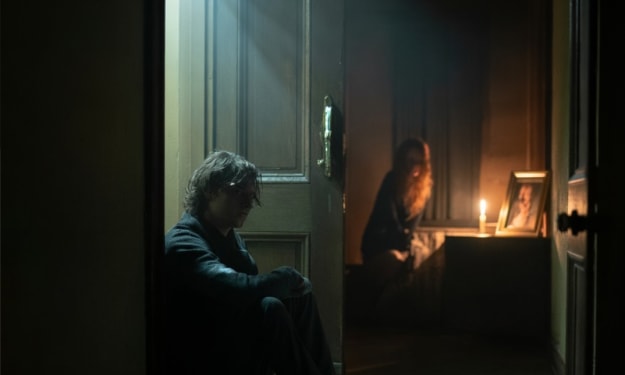
The clock struck midnight when Ahmed returned home. The street outside their apartment in Lahore was unusually silent, the distant buzz of traffic dulled by the warm, sticky air. He stood at the door, fishing out his keys, but as soon as he twisted the lock—he realized it had been bolted from the inside. He knocked. Once. Twice. No answer. He sighed, frustrated. “Sana, open the door. It’s late.” Silence. After a long pause, he heard her voice. Calm. Steady. Unrecognizable. “No.” He blinked, unsure if he had heard right. “What?” “I said no, Ahmed.” His heart pounded. Not out of anger. Out of fear. He had never heard her sound like that before—like she had nothing left to lose. --- Sana had been sitting by the door for hours. She’d lit a candle and placed their wedding photo beside it. In the picture, she was smiling so wide her eyes crinkled. Ahmed looked nervous but happy, like a man standing on the edge of something good. But that was five years ago. Since then, their apartment had turned into a battlefield—where silence screamed louder than words. She remembered the night he forgot their anniversary. The time he mocked her for wanting to restart her studies. The days he came home, reeking of stress and anger, throwing his phone on the table like she was the problem. He wasn’t cruel—not in the way people warned you about. But he was careless. Distant. Tired of her. And she? She had become invisible. --- Inside, Ahmed’s frustration melted into confusion. “Sana, are you okay? What’s going on?” She replied softly, “I wanted to talk to you. But talking never worked. So tonight, I decided to do something different.” He leaned his forehead against the door. “This is crazy. I’m not standing out here like a fool.” “Then leave,” she said. “You’ve been leaving me every day anyway.” Her words hit him like a slap. “I come home every night.” “Your body does,” she said. “Not your mind. Not your heart.” He stared at the dark hallway, suddenly aware of the weight of his briefcase in his hand, the sweat on his back, the silence in his soul. He sat down outside the door. “Sana, I know I haven’t been present. But this—locking me out—it isn’t the way.” “And ignoring me wasn’t the way either,” she replied. “But you did it for years.” --- In that still night, something broke. But it wasn’t the marriage—it was the silence. Sana started talking. She told him about the loneliness, about the nights she cried herself to sleep. About how she missed the boy who used to write poetry for her. How even the fights would’ve been welcome—at least that would mean he cared enough to argue. Ahmed listened. For the first time in years, he really listened. He didn’t interrupt. He didn’t defend himself. He let her words wash over him like a flood he had no strength to stop. And then he spoke. He told her about the pressure at work, about how he felt like a failure every time he looked at her because she deserved better. How he stopped sharing things with her because he didn’t want her to see how broken he felt inside. How ashamed he was that the man she married no longer existed. They sat on either side of that wooden door, pouring out five years of silence like two strangers rediscovering a shared language. --- The candle inside flickered. Sana touched the wedding photo and whispered, “Do you still love me?” His voice cracked. “Every day. But I forgot how to show it.” She stood slowly and unlocked the door. Ahmed stood too, unsure. The door creaked open a few inches. Her face appeared—tired, tear-stained, but softer. “Come inside,” she said. “Let’s try again. Not for the world. Just for us.” He dropped his briefcase and stepped in. No grand gestures. No dramatic music. Just a man and a woman, who had almost lost each other in the noise of life—choosing to begin again, in the quiet.
By Muhammad Usamaabout a year ago in Fiction
Night Should Be Blank | Part I
Nights are supposed to be blank. Silent. Still. Mine haven’t been in weeks. In the darkness of night everything seems to be young. But if you want to enjoy the night you should have a penetrating eye to see the beauty of nature.
By Shoaib Rehmanabout a year ago in Fiction