family
The Roar and the Whisper
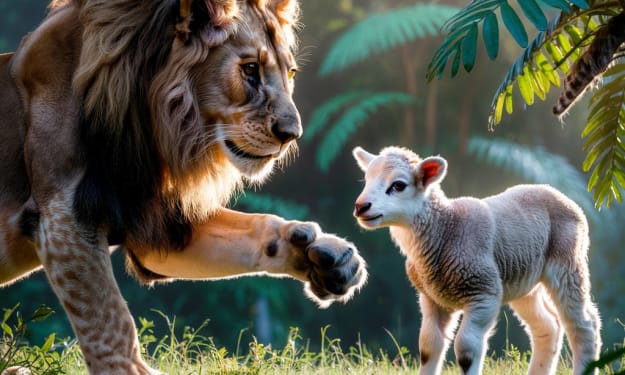
The Roar That Ruled "eep in the heart of the forest where sunlight cracked through tangled canopies and shadows held secrets, ruled the mighty lion, Ragnar. His mane was like flame, his roar like thunder, and no creature dared question his rule. He hunted when he pleased, roamed where he chose, and took what he wanted. The law of the wild was simple: “The strong survive, and the weak obey.” And no creature was considered weaker than the lambs of the northern meadow. Their soft bleats and peaceful grazing made them easy prey. They never ran far. They never fought back. And they always feared Ragnar. But the lion was growing tired. No hunt thrilled him anymore. No roar echoed long enough. A gnawing emptiness followed every victory, though he didn’t know why. The Lamb Who Didn't Run One overcast morning, Ragnar padded through the forest and came upon a stream near the meadow. There, alone and humming a strange little tune, stood a lamb—Lyra—her snow-white wool glowing against the gray sky. She was far from her flock, vulnerable, unaware. Or so Ragnar thought. He stepped forward, ready to pounce, but Lyra didn’t flinch. She looked up, locking eyes with the predator of her kind. "You’re the lion they all whisper about," she said. Her voice was calm. Almost... curious. Ragnar paused mid-step. No creature had ever spoken to him without trembling. "You should run," he growled. "I know," she replied. "But I won’t." "Why not?" Lyra smiled faintly. "Because I don’t believe you want to eat me. Not today. A Strange Curiosity Instead of devouring her, Ragnar sat down. For the next hour, they talked. Or rather—she talked, and he listened. She told him about the wind and how it carried the scent of wildflowers from the southern hills. She told him about a mother bird building her nest in a crooked tree. She even sang him a lullaby her grandmother used to hum during storms. When the sky darkened, Ragnar rose. “You’re strange for a lamb.” "And you’re quiet for a lion," Lyra said, unbothered. He left without a word, but that night, Ragnar didn’t sleep. He kept hearing her voice—soft and steady like a whisper brushing against thunde- Return to the Meadow The next day, Ragnar returned. And the next. And the next. They never talked about fear. Or death. Or what might happen if one day his hunger outweighed his curiosity. They spoke of stories instead. The myths of the forest. The colors of the moon. The dreams Lyra sometimes had where lions and lambs danced together without fear. “You’re ridiculous,” Ragnar said once, but he found himself wondering—what would that world look like The Challenge But the jungle noticed. And the pride grew restless. “You’ve gone soft,” snarled Drax, Ragnar’s younger rival. “You sit with prey while your strength withers.” “I’m still king,” Ragnar growled. “Then prove it. Hunt her. Bring her back as your prize.” Ragnar said nothing. But inside, something cracked. That night, he stood at the edge of the meadow. Lyra was waiting. She always waited. But this time, he didn’t sit. He stared at her as if seeing her for the first time—as a lamb, as prey, as the weakness he had once vowed to destroy. "Is today the day you eat me?" she asked gently. "I might have to." Lyra nodded. “Then at least let me tell you one more story.” He listened. It was a story about a lion and a lamb who were born into war but dreamed of peace. Who were told they could never be friends but still shared shade under the same tree. A story that never had an ending—because no one dared imagine one. “You can write it,” Lyra said. “You’re the lion. You decide how the story ends.” The Roar That Changed Everything The next morning, Ragnar returned to the pride. He roared—not a roar of dominance or hunger, but something new. A roar that echoed with choice, not instinct. “I will not hunt the lamb,” he declared. “Nor any creature who offers no harm.” The pride erupted. "You’ve betrayed your nature!" Drax roared. “No,” Ragnar said. “I’ve rewritten it.” A battle followed. Fierce, brutal, primal. But in the end, Ragnar stood over Drax, bloodied but unbowed. “This is our law now: strength with mercy, power with restraint.” Some lions left. Others stayed. But the jungle heard. And the whisper began to spread. A New Meadow Months passed. The forest changed. Predators and prey still lived by instinct, but not by fear. A fragile truce was born—not perfect, not without setbacks—but real. And sometimes, in the quietest part of the meadow, Ragnar would sit beside Lyra, listening to her stories as the sun dipped low. “Do you miss being feared?” she asked once. “Sometimes,” he admitted. “But I’ve found something better.” “What’s that?” He smiled. “Peace.” The Final Story Years later, when Lyra grew old and her steps slowed, she asked Ragnar for one last favor. “Tell the story,” she whispered. “Even when I’m gone. Tell it like it mattered.” Ragnar, now grayed and gentler, nodded. And he did. He told the cubs and the calves, the foxes and the fawns. He told them of a time when the jungle was ruled by fear, and how a lamb changed a lion with nothing but her voice. He ended each tale the same way: > “Strength isn’t in how loud you roar, But in how quietly you can listen.”
By Arshad khanabout a year ago in Fiction
Unsent
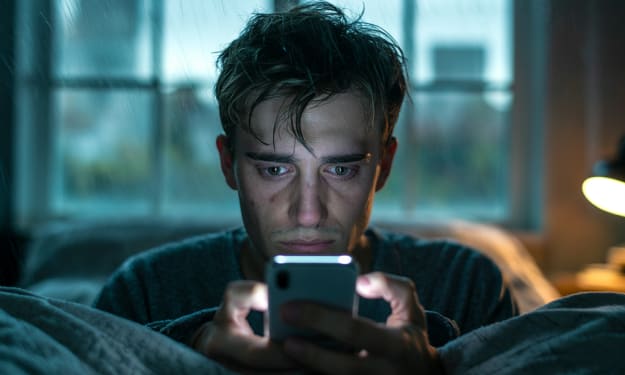
He stared at the phone screen, thumbs hovering above the keyboard. The message had been typed and deleted five times already. Every version felt wrong — too soft, too late, too honest, too full of regret. And yet, none of them felt like enough. At the top of the screen was a name he hadn’t spoken aloud in almost two years: Zoya. She had been a chapter that never ended. A sentence that still lingered in his mind. A song that always started, but never played through. And tonight, she came back again — not in real life, but in his dream. Same bookstore. Same laugh. Same sudden vanishing. --- They weren’t lovers. Not officially. Not in the way the world would recognize. But their bond had felt real. Maybe too real to survive reality. They talked every night for eight months — sometimes until dawn. They had matching playlists, unspoken inside jokes, and that strange closeness where two souls understand each other without having to explain. And then it ended. --- He scrolled up to read their old messages. She had sent pictures of her dog, late-night memes, her messy handwriting, voice notes when she was too tired to type. He remembered how she hated the sound of her recorded voice — but sent the notes anyway because she knew he liked them. Their last conversation was short. Cold. > Zoya: “I don’t want to wait for someone who’s unsure.” Him: [no reply] Not because he didn’t feel something. But because he didn’t know what to do with it. She was real. Grounded. Bright. He was unsure, anxious, lost. So, he let silence answer for him. --- He whispered to no one, “I thought we had time.” Maybe the biggest lie people tell themselves is that they’ll always have more time. --- He typed again: > Hey… I know it’s been a long time. But I never got to say the things I should have said when you were still here, still close, still maybe mine. I’ve thought about you more than I want to admit. And if there’s even the smallest chance you still think about me too… I just wanted you to know I’m sorry. I miss us. Whatever we were. Whatever we could’ve been. He paused, staring at the words. Then hit Backspace. Deleted every word. Locked the phone. He couldn’t do it. --- Across the city, Zoya sat curled in a blanket, sipping lukewarm tea. She had her tablet open and was scrolling through her photo gallery. One photo made her stop: her in a bookstore, holding a book and laughing mid-sentence. He had taken that picture without asking. She had secretly loved it. It was still her favorite photo — because it was the only one where she looked truly happy and didn’t know someone was watching. --- She sighed. Two years. People had come and gone. But none of them filled the quiet space he had left behind. Not even her current boyfriend, who was kind and gentle, but not… him. She opened their old chat. Still no new message. She whispered to herself, “Just one word. That’s all it would take.” But her phone remained still. --- Back in his room, he picked up a small notebook. Flipped to the last page. That’s where he wrote the unsent messages. He had written to her every month. Some long. Some one-liners. Some just her name. Tonight, he added another. > You asked me once what scared me more — losing you, or disappointing you. I didn’t answer then. But the truth is… both scared me equally. So I chose silence, and ended up doing both. --- He closed the notebook. Walked to the window. Rain had started. Quiet, steady. Not dramatic — just there, like a memory you forgot you were carrying. --- If he had sent the message, what would she have done? Cried? Ignored it? Called back? Or simply smiled at the closure? He would never know. Because he would never send it. --- And she would never know how much space she still took in his life. How he still checked her profile every month. Still noticed the new photos. Still remembered her favorite quote about stars and scars. --- Some people don’t leave. They just become quieter inside you. --- That night, they both dreamed of each other again. Different cities. Different hearts. But the same ache.
By Muhammad Usamaabout a year ago in Fiction
Vanished
I never thought the day would come when my sister would simply vanish — no note, no warning, just gone. It was a Tuesday morning when I woke up to an empty bed beside me, the cold spot where she’d been asleep the night before. At first, I thought she was pulling one of her usual stunts — sneaking out early for a run or a last-minute trip to the café. But when the hours passed, and she didn’t answer her phone, the gnawing in my gut turned to dread.
By Awais Khaliqabout a year ago in Fiction
The Eye That Loved Too Much
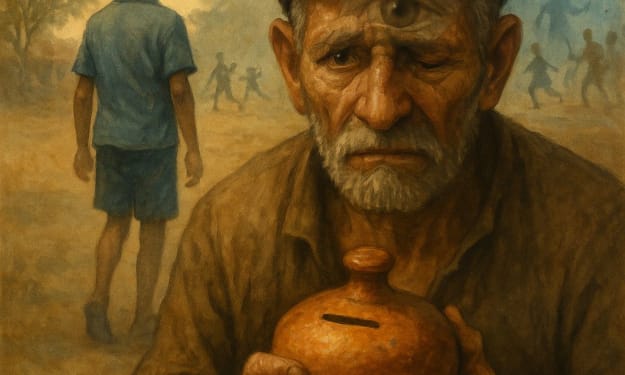
In the quiet village of Srirangpur, there lived a poor laborer named Ignat. He was a hardworking man, though life had not been kind to his appearance—he was missing one eye, and his face bore the marks of hardship. Despite this, he did his best to provide for his wife, Sharda, and their young son, Raju. Raju was their only child, and Ignat loved him dearly. But as Raju grew older, he began to resent his father. The other children in the village would whisper and laugh whenever Ignat was around. "Your father looks scary!" they would taunt Raju, refusing to let him play with them. One afternoon, as Raju tried to join a game of Gilli Danda, the boys shoved him away. "Get out of here! We don’t want you near us!" one of them sneered. Raju ran home, tears burning his eyes. "Why do you have to look like that?" he shouted at Ignat later. "Nobody likes me because of you!" Sharda scolded him, but the damage was done. Raju refused to eat dinner and stormed off to bed, leaving Ignat sitting silently in the dim light of their small hut. That night, as Sharda counted the coins in their savings jar, she sighed. "How much have we saved now? 100 rupees?" Ignat shook his head. "Almost 200. But this money isn’t for me," he said softly. "It’s for Raju’s education. If he studies hard, he can become a doctor—maybe even fix my eye one day." Sharda wiped her eyes. "He doesn’t understand. He hates you, and it breaks my heart." Ignat only smiled sadly. "He’s just a boy. When he grows up, he’ll see things differently." But Raju’s resentment only grew. The next morning, he refused to let Ignat walk him to school. "If my friends see you, they’ll make fun of me again!" he snapped, running off before his father could protest. Later, when Ignat brought his forgotten tiffin to school, Raju’s face burned with shame. "Never come here again!" he hissed, snatching the food and turning away. Years passed, and Raju left for college in the nearby town. Ignat and Sharda, hoping to be closer to him, moved as well, taking up work in the city. One evening, Ignat mustered the courage to visit Raju’s shared apartment. But when Raju saw him at the door, his expression darkened. "Why did you come here?" he muttered. "I told you—I don’t want my friends knowing about you." Ignat’s heart ached, but he only nodded. "I just wanted to see you, son. Your mother worries." Raju shut the door without another word. After college, Raju took a job in Mumbai and cut all ties with his parents. Five long years passed without a single letter or visit. Sharda wept often, wondering if their son was even alive. Ignat, though heartbroken, never stopped hoping. "He’ll come back one day," he assured her. But that day never came for him. One afternoon, while returning from work, Ignat bumped into Suresh, an old friend of Raju’s. "Sir!" Suresh exclaimed. "You’re Raju’s father, aren’t you?" Ignat’s eyes lit up. "You know my son? How is he?" Suresh hesitated. "He—he lives here in town, sir. He’s married now, with a three-year-old daughter." Ignat staggered back as if struck. "He never told us," he whispered. Suresh, pity in his eyes, led him to Raju’s house. Ignat stood at the gate, trembling. When Raju’s little daughter spotted him, she screamed, "Monster! Go away!" Raju rushed out, his face twisting in anger. "What are you doing here?" he demanded. "You’re scaring my child!" Ignat’s voice broke. "I just wanted to see you, Raju. Your mother misses you." Raju’s jaw tightened. "Leave. And don’t come back." Ignat returned home that night, his spirit shattered. A week later, he passed away quietly in his sleep. Sharda, now alone, carried out the funeral rites herself, with no son by her side. Months later, guilt finally drove Raju to his mother’s doorstep. "How are you, Ma?" he asked awkwardly. Sharda’s eyes filled with tears. "You have a daughter now. Why didn’t you bring her?" Raju looked away. "I... I didn’t think you’d want to see me." Sharda’s voice turned steely. "Where is your father, Raju? Do you even care?" Raju flinched. "I—I don’t know." Sharda’s next words struck like lightning. "He’s dead. He died a week after you turned him away from your home. And do you know why he lost that eye you hated so much?" Raju froze as she continued, her voice trembling. "When you were three, a Gilli Danda hit your eye. The doctors said you’d never see again—unless someone donated their own. Your father gave you his eye, Raju. He never told you because he didn’t want you to carry that guilt." Raju collapsed to his knees, sobbing. All the years of hatred, the cruel words, and the missed chances—flooded his mind. "I didn’t know," he choked out. "Oh God, what have I done?" Sharda placed a hand on his shoulder. "It’s not too late for me, beta. But your father... he waited for you until his last breath." That day, Raju took his mother home, vowing to honor the man who’d given him everything—even his sight—while asking for nothing in return.
By Alice Talesabout a year ago in Fiction
The Man Who Sat at Table Seven
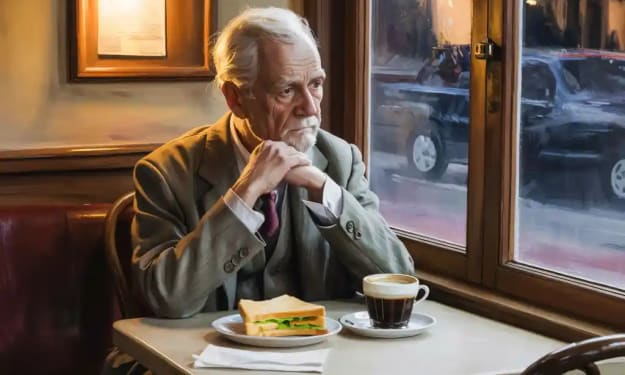
There’s a quiet little café on East 41st Street, nestled unceremoniously between a secondhand bookstore and a flower shop that always smells of jasmine and damp stems. Blink, and you might miss it. No neon signs. No whimsical chalkboard menus boasting fancy lattes or turmeric infusions. The awning just reads “Mira’s Café” in fading gold letters. Inside, it smells like toasted bread, warm milk, and stories too old to tell.
By Arshad khanabout a year ago in Fiction