Fable
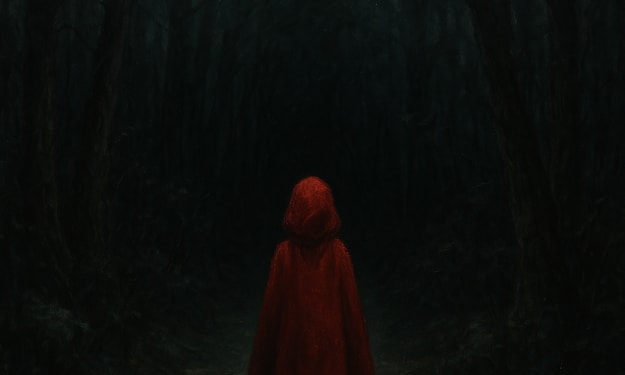
AI Retold: Little Red Riding Hood. AI-Generated.
[[ This is the first in a series of exploratory short stories where I've just asked an AI (Copilot, in this case) to retell a classic fairy tale, both out of curiosity and interest to see what tropes and details it retains and what it changes. Further works will possibly include analysis sections where I genuinely compare and contrast the AI-generated versus the original, but this one in particular was just a trial run to see how it would turn out. Not bad, overall, but we'll see in the future how it handles more complex stories and what results. ]]
By Taylor Inmanabout a year ago in Fiction
She Was Never Real
I met her on a rainy Tuesday. The kind of rain that doesn't just fall—it lingers in the air, heavy and cold, like the universe itself is pressing down on you. I was sitting alone in a bookstore café, sipping cheap coffee and pretending to read a book I’d already abandoned. She sat across from me without asking, as if we’d done it a thousand times before.
By Leah Brookeabout a year ago in Fiction
The Last Letter in the Bottle
The glass bottle glinted under the fading sun, half-buried in the damp sand of Crescent Beach. Its green curves caught the light like a winking eye, a secret washed ashore by the restless tide. I’d come here every summer since I was six, chasing waves and dreams with my sister, Lila. She’d sprint ahead, her laughter brighter than the gulls’ cries, her bare feet kicking up foam as she dared me to find treasures in the sea’s offerings. Shells, driftwood, once even a shark’s tooth—she called them gifts from the ocean. But Lila was gone now, stolen by a riptide last July, the kind that snatches breath and futures in seconds. I was sixteen, and the beach felt like a graveyard, each wave a reminder of her absence.
By Muhammad Abuzar Badshah about a year ago in Fiction
The Monkey and the Shark. Top Story - July 2025.
There was once a shark, that was born among the mangrove trees. She had many brothers and sisters and, while she knew she would have to return to the sea when she was old enough, she was enjoying her youth in the root pools.
By ThatWriterWomanabout a year ago in Fiction
The King's Night of Revelation**
**The King and the Woodcutter: A Lesson in Humility** In a quaint, serene kingdom, nestled amidst rolling hills and lush forests, there reigned a benevolent king. He was a monarch of many virtues, but among his deepest passions was the thrill of the hunt. It was a sport that allowed him to escape the confines of his opulent palace and connect with the raw, untamed beauty of his land.
By Muhammad Saeedabout a year ago in Fiction
Hymen. Winner in The Shape of the Thing Challenge.
They called it The Final Mercy. The books said it rose from the churning blue waters after the Great Flood. It rose up into the air with all the majesty of the humpback whale. The waves subsided and land formed once again. An island twenty-three kilometres wide, thirty-four long. The great Gententia Strip. The promised land. The Fishbone Crown of Mercy had stood on its own pedestal at the centre. Burnished wood a phoenix to a people that would not be subdued. The chosen.
By River and Celia in Underlandabout a year ago in Fiction
The Lion Who Lost His Roar
Once upon a time, in the heart of a dense, emerald-green jungle teeming with life, a hunter, known for his cunning and keen eyesight, managed to capture a lion cub. The cub was incredibly young, barely a few weeks old, and still entirely dependent on its mother's nourishing milk for survival. The hunter, envisioning a unique addition to his humble home, carefully brought the tiny, bewildered creature back with him. His own children, a playful and curious bunch, were utterly delighted to see the miniature king of the jungle. Their faces lit up with joy, and they immediately began to interact with the cub, giggling as it tentatively pawed at their fingers. They spent a considerable amount of time captivated by its innocent antics, their youthful energy mirroring the cub's own nascent liveliness.
By Muhammad Saeedabout a year ago in Fiction
The Letter She Never Opened
It had been ten years since Daniel’s name last appeared in Emily’s life. Ten years since he walked out the door with a look in his eyes that told her he had already left—emotionally, spiritually—long before his footsteps echoed down the hallway. He didn’t say goodbye. He didn’t leave a note on the fridge. No phone calls. No emails. Not even a blocked number. Emily had tried to hate him for it. And for a while, she succeeded. She told herself he was a coward, a selfish man who didn’t know how to stay when things got hard. But late at night, when the world was quiet and her hands wrapped around a chipped coffee mug, she remembered all the good things. The quiet way he used to brush hair behind her ear. The way he loved music like it was a religion. The morning he cried when she miscarried—and then didn’t cry again for three years. Some things you bury so deep, you forget where the shovel is. And then one day, a letter came. It wasn’t mailed. It wasn’t even recent. It was tucked inside an old shoebox in the attic, discovered when she was cleaning out her late mother’s house. The handwriting on the envelope stopped her heart. Daniel. --- The Envelope The letter wasn’t sealed. But it hadn’t been opened either. Her name was on the front, written in ink that had faded just slightly around the edges. It had been placed delicately between old love poems, dried rose petals, and photographs from a time that now felt like another lifetime. Emily stared at it for a long while, heart pounding. Why hadn’t she seen this before? Had her mother hidden it? Had Daniel dropped it off and her mother simply... kept it? Was it from after he left? The possibilities spun in her mind like a tornado. Her fingers grazed the flap of the envelope, ready to tear it open and read what had been left unsaid for a decade. But she stopped. Some part of her—wounded, fragile, wiser now—whispered: “Don’t.” So she didn’t. She placed the letter in her coat pocket and walked out into the autumn air. --- Memories That Never Fade Emily’s life had gone on. She eventually remarried. A good man. Steady. Kind. Predictable. They had a daughter named Sophie, who liked dinosaurs and blueberry waffles and always asked, “Mom, were you ever in love before Dad?” Emily would smile and say, “Once.” But now, walking along a leaf-strewn trail with Daniel’s letter burning a hole in her pocket, she wasn’t sure she’d ever really stopped loving him. They had been young. Too young, perhaps. Passionate, messy, and unprepared for the grief that followed losing a child. He became quiet. She became angry. And in the silence that followed, they drifted. When Daniel left, he didn’t slam the door. He simply disappeared. Now, he had reappeared. Quietly. Gently. In the form of this letter. And she couldn’t bring herself to read it. --- Choices For weeks, the envelope remained in her drawer. Sometimes she’d pull it out just to look at the handwriting. She memorized the curves of each letter, the way he still wrote her name the same way he used to say it: with care. She thought of burning it. She thought of giving it to her husband and saying, “Here. Read it. Tell me if I should care.” She thought of Daniel—where he was now, what he was doing, if he ever got married, if he ever forgave himself for walking away. One night, after Sophie had gone to bed and her husband was asleep, she sat on the kitchen floor and stared at the letter. Then, finally, she made a choice. She folded the letter into a new envelope, added a note of her own, and mailed it back to the return address on the shoebox: a PO Box in Chicago. She didn't know if Daniel still lived there. But she didn’t need answers anymore. She needed closure. --- Closure Isn’t Always a Destination Months passed. Then, one day in spring, Emily received another letter—this one from a woman named Mara Daniels. The handwriting was unfamiliar, soft and uneven. Inside was a brief note. > “Dear Emily, I’m Daniel’s sister. I found your letter in his things after he passed away last year. He had written to you, long ago, but never sent it. We don’t know why. He spoke of you often, even in his final months. I thought you might like to know that he never stopped loving you. With warmth, Mara” No return address. No copy of Daniel’s original letter. Just those few words. Emily sat with them for a long time. She still didn’t know what Daniel had written. Still didn’t know what he wanted to say. But maybe it didn’t matter. Maybe the real letter wasn’t on paper. Maybe it had always lived in the silence between them. In the eyes that didn’t look back. In the nights neither of them slept. She closed her eyes and whispered, “Goodbye.” --- Final Note There are some letters that never get written. Some that are never sent. And some—like Daniel’s—that are never opened. But maybe, just maybe, the real message was always in the space they left behind.
By Muhammad Usamaabout a year ago in Fiction
Thursdays Are for Ghosts
The first time I noticed her was the week after the funeral. A Thursday, to be exact. I was in the kitchen, stirring a cup of tea I hadn’t meant to make, in a house too quiet for comfort. The sugar clinked gently against the mug like footsteps on tile. I wasn’t thinking of her, not directly, not consciously. But there she was. A shape in the hallway mirror—quick, soft, and impossibly familiar.
By Jawad Khanabout a year ago in Fiction
The Clockmaker's Garden
There was a village at the edge of the world where time stood still—not metaphorically, but truly. The sun always hovered in the same place. The shadows never grew longer. The leaves on the trees were forever green, and not a single wrinkle ever touched the faces of the people who lived there. Some called it a paradise. But not Mira. Mira had lived her entire life in this frozen place, where no one aged and nothing ever changed. The village was clean and calm, the people kind and quiet, but it all felt... trapped. Like living inside a snow globe where someone forgot to shake the magic. You see, the village had once been ruled by time like anywhere else. Until the day the Clockmaker came. No one remembered where he came from, or how he had arrived. But he built a tower at the village center—a tall, spiraling thing made of stone and bronze, topped with a golden clock that ticked louder than the wind. Then, one day, he stopped the clock. And when the clock stopped, so did time. People were amazed. No one got older. No one died. Food never spoiled. Days were always sunny. And for a while, it truly was a paradise. But after years, something changed—not outside, but inside the people. They stopped dreaming of new things. They stopped planting new trees. They stopped falling in love. They stopped asking, "What if?" Mira was different. Even as a child, she asked questions no one liked answering. “Why don’t we celebrate birthdays?” “What happens if the clock breaks?” “What’s beyond the hills?” The villagers would smile politely and say, “Don’t worry, dear. Everything is exactly as it should be.” But Mira wasn’t convinced. Especially not after the day she found the seed. It was buried beneath the soil behind her grandmother’s cottage, wrapped in cloth and tied with red thread. The cloth was old—older than the village’s stillness. On it, written in fading ink, were five words: "Plant me when time aches." Mira didn’t know what it meant, but she kept the seed. Years passed—or they should have—and Mira grew older in her heart, even if her body never changed. She read every book the village had. She asked questions the elders refused to answer. She even climbed the clocktower once, but found the door bolted shut with a glowing blue lock she couldn’t break. Until one night, something happened that had never happened before. She saw a petal fall. A single pink petal, drifting down from a tree in the village square. It didn’t make sense. Nothing changed here. Nothing moved unless someone moved it. But that petal had fallen on its own. As if the tree had breathed. That night, she went to her grandmother’s garden with a lantern and trembling hands. She dug a small hole in the earth and placed the old seed in it. As soon as the dirt touched the seed, the ground shivered—just a little. Not enough for anyone else to notice. But Mira did. She watered it with tears. Not because she was sad, but because she suddenly felt something for the first time in a long, long while: hope. The next morning, a small green shoot had emerged. And the day after that, a bud. And a few days later, a flower bloomed—vibrant and golden, with petals that shimmered like sunlight. People began to whisper. Nothing had grown in the village since time stopped. No new flower had bloomed in decades. But there it was, glowing softly like a candle in the fog. When the elders saw it, they panicked. They tore it from the ground. They warned Mira not to interfere again. They told her she was risking everything. That peace must be protected. That the Clockmaker would not approve. But Mira didn’t stop. She remembered what the cloth had said. “Plant me when time aches.” And time was aching. The people were stuck. Their laughter was thin. Their eyes were dull. Peace without change had become a prison with invisible walls. So Mira planted more seeds—some from old apples, some from forgotten flower pots, some even stolen from the locked archives beneath the school. And each time, something bloomed. Small things at first: daisies, dandelions, bluebells. Then vines. Then fruit. Then trees with golden bark that hummed when the wind passed through. And slowly… people changed. Some cried without knowing why. Some remembered dreams they’d buried. Some started writing poems again. Children drew things they’d never seen—skies full of color, mountains beyond the village, oceans they only imagined. And then the unthinkable happened. The clock in the tower ticked. Just once. But loud enough that everyone heard it. That night, Mira returned to the tower. The door that had once been sealed was cracked open. Inside, the gears groaned, stiff from stillness. Dust floated in the beams of moonlight. At the top of the stairs stood the Clockmaker. But he wasn’t what she expected. He looked like an old man made of wood and brass, with eyes like candle flames. His hands were tools. His spine was a coil. And on his chest was a key, long since wound down. “You have brought time back,” he said, his voice the sound of creaking floorboards. “Why did you stop it?” Mira asked. “Because the world was full of pain,” he replied. “And I thought stillness would bring peace. But peace without change… is silence.” She stepped forward. “And silence without growth... is death.” The Clockmaker nodded. “Then finish what you’ve started.” He handed her the key from his chest. She placed it in the clock. And turned it. The clock roared to life. The gears spun. The bell rang. Time surged through the village like a warm wind. The sun moved for the first time in a hundred years. Shadows danced. Trees swayed. Children grew. Laughter returned—not the polite kind, but the wild, uncontrollable kind. People wept and hugged and aged. And in the middle of the village stood Mira, now older, a little grayer, but glowing with life. She never became queen. She didn’t want to. Instead, she planted more gardens. One for every lost year. One for every forgotten dream. And people joined her. Because now… time moved. But so did hope. The End.
By Lucien Hollow about a year ago in Fiction
The Lantern of Whispering Trees
by Yahya Asim In a remote village nestled between the emerald folds of two great hills, there stood a forest known as the Whispering Trees. Locals spoke of it with reverence and caution. They said the trees could talk—not with mouths, but with murmurs carried in the wind. Only those who truly listened could understand their secrets.
By Yahya Asimabout a year ago in Fiction