Fable
The Midnight Bargain: When My Brother's Voice Cracked a Decade of Silence. AI-Generated.
3:17 AM The phone’s vibration drilled into the silence like a bone saw. I fumbled blindly, squinting at the screen. The name flashing there—*Jake*—felt like a ghost punching me in the throat. Ten years. Three thousand six hundred fifty days of radio silence. And now this. 3 AM. The hour of emergencies and drunks. I almost silenced it. *Almost.* That old bitterness—thick as scar tissue—rose in my chest. The last time I’d heard his voice, he’d called me a "self-righteous parasite" before slamming the door so hard our dead mother’s photo rattled on the wall. Grief over her loss had twisted us into strangers, then enemies. We’d built walls with the bricks of her absence. But something in the *way* it rang… frantic. Relentless. A sound that bypassed my anger and hooked straight into my lizard brain. *Danger.* I swiped answer. Held my breath. *The Static and the Gasp* "E-Ellie?" His voice was shredded glass and static. Not drunk. *Terrified.* "Jake? What—" "They’re… inside the walls." A wet, ragged cough. "The bugs. Can you… *hear* them?" My blood froze. This wasn’t an apology. Wasn’t a reunion. This was a Code Red from a collapsing mind. The Unspoken War Our estrangement wasn’t simple. After Mom’s cancer won, Jake dove headfirst into conspiracy forums and cheap whiskey. I buried myself in spreadsheets and sterile relationships. We became caricatures: *The Crazy Brother. The Ice Sister.* The last fight was nuclear—him screaming about government trackers in his fillings, me hissing that he’d dishonored her memory. Truth? We were both drowning. Just in different oceans. Now, listening to him wheeze about "bioluminescent mites" chewing through his drywall, I faced the gut-punch truth: *He wasn’t calling for forgiveness.* **He was calling because I was still his emergency contact.** *Driving into the Storm* I broke every speed limit driving to his rust-belt apartment. Key still fit the lock (why did I keep it?). The smell hit first—sour milk, stale smoke, and something acrid. Ammonia? He was crouched behind a toppled bookshelf, face gaunt in the blue light of a dead laptop screen. A makeshift "weapon"—a fireplace poker wrapped in duct tape—clattered from his hand when he saw me. "Ellie?" He blinked, childlike. "The… the ventilation shafts. They’re laying eggs in—" "Shut up, Jake." My voice surprised me. Cold. Steady. *Nurse-mode activated.* "Where are your meds?" *The Diagnosis in the Debris* His lithium bottles were empty. Anti-psychotics, untouched since November. Piles of printed forum rants about "nano-parasites" covered the moldy carpet. This wasn’t just addiction. This was schizophrenia’s cruel masterpiece, painted over a decade of neglect. As I forced water into him, wiped grime from his forehead, the old rage flickered. *Why me? Why now?* Then I saw it. Taped to the fridge beneath a takeout menu: A faded Polaroid. Mom, laughing, arms around us at Coney Island. Age 12 and 14. Before the wars. *"My Keepers,"* she’d scribbled on the border. *The Bargain* Getting him committed wasn’t gentle. He fought, sobbing about "extraction teams." I signed papers with hands that didn’t feel like mine. In the sterile hospital hallway, a social worker asked, "Relationship to patient?" I opened my mouth. Closed it. The word *sister* felt foreign. Heavy. "Emergency contact," I finally said. *The Silence After the Storm
By Wondermindabout a year ago in Fiction
Artificial Intelligence
In the fast-paced digital age, artificial intelligence (AI) is reshaping how we live, work, and communicate. From chatbots like ChatGPT to powerful image generators and deepfake tools, AI is rapidly expanding its reach. However, behind the seamless digital interactions lies a hidden environmental cost — a rising threat to the world’s most precious resource: water.
By Ahmad shahabout a year ago in Fiction
The House That Waits at the Edge of the Fog
1. The Arrival Elena had seen the house in her dreams long before she ever found it. It sat quietly at the edge of a fading forest, shrouded in fog that moved like breath across the hills. Windows like closed eyes. A door like a secret no one wanted to tell. When she finally stood before it—real wood, real chill, real sky darkening—her bones knew it before her mind did. This was where the nightmares began. And now, maybe, where they would end. 2. The Whisper The key was already in the lock. Inside, the air smelled like time left alone. Not rotten—just forgotten. Dust floated like slow snow. The walls pulsed with stillness. The house didn’t groan or creak. It listened. That night, the whisper came. Not outside the room—but inside her head. Not words at first. Just… feeling. Like something was watching. Something waiting. Not cruel. Just patient. “Who’s there?” Elena whispered to the dark. The dark answered with a breath beneath her bed. 3. The History In town, no one would speak of the house. One woman, old and knotted like driftwood, told her: “That place doesn’t haunt you. It holds you.” “Why?” “Because it remembers.” Remembers what? Elena didn’t ask. She was starting to remember too. Flashes: A girl in the mirror who wasn’t her. A voice in the hallway calling a name she’d forgotten. A nursery with no toys. A crib that rocked by itself. 4. The Becoming The house didn’t hurt her. It fed her. Each night, the dreams grew stronger. She saw other versions of herself—crying, clawing, screaming. Not all were human anymore. And the voice—clearer now—said, “You’ve come back.” Elena didn’t run. She stayed. Because the truth was: she had been there before. Not in this life. But in another. And she had died in this house. More than once. 5. The Truth The house was alive. Not with wood and wires. With memory. It remembered every soul it held. Every scream. Every shadow pressed into its floorboards. It didn’t kill. It collected. Elena was its favorite kind of visitor—the ones who belonged to it before they were born. And now it wanted her back. 6. The Ending That Isn’t They found her car weeks later, engine cold, windshield dusted with fog. No footprints. No sign of struggle. Just a journal on the seat. Inside, only one sentence was written over and over again: “The house remembers me. And I remember it now.” The End? The House Doesn't Stay in One Place The house at the edge of the fog isn’t fixed to one location. It moves. Not quickly, and never when you look straight at it—but over time, it shifts. From one forgotten road to the next. From one dreaming mind to another. People don’t find the house. The house finds them—especially those who have a connection from another life, or a memory too buried to explain. Sometimes it appears in a photo you don’t remember taking. Sometimes in a sketch your child draws without knowing why. Sometimes in the background of a dream you swear you’ve had before. If you ever feel like a house is watching you… It probably is. And if you hear a whisper when no one else does, don’t answer. Because it might just be calling you home.
By Silas Blackwoodabout a year ago in Fiction
The Bench by the Lake
Every July 16th, at exactly 5 p.m., they met at the weathered wooden bench by the lake. She wore a yellow cardigan, even in the heat, and always carried a small notebook. He brought a thermos of tea and a pack of caramel biscuits he never offered but always ate slowly. They never exchanged names. That was the rule.
By Syed Haider Mehmoodabout a year ago in Fiction
The Agreement
Link to the original Challenge: The machine was humming under the dying fluorescent light. The cat was ready. “Hello.” The machine clicked and made noises as it focused on its visitor. The deal was that the cat would share what information it had from the neighbourhood and then it would get a treat. But tonight, Mr. Benjamin was waiting for its reward. The machine waited for a moment before it decided to break the silence.
By Kendall Defoe about a year ago in Fiction
The Last Message From Earth: A Time Capsule in the Stars
The Last Message From Earth The stars no longer blinked. From the observation dome of the Hera II, Captain Nara Myles stared into the dark ocean of space, where Earth once shimmered like a blue jewel. That jewel was now dust—swallowed by its own ignorance and fury.
By Waqar Khanabout a year ago in Fiction
The Sparrow and the Silence
In a city where car horns screamed louder than thoughts, and footsteps echoed without purpose, silence had become a stranger. Streets buzzed, shops roared with music, and people buried themselves in phones, unaware of the world around them. Even the birds — once singers of morning joy — had stopped singing. Except for one. A sparrow, small and brown like dust, sat on a power line each dawn. It sang not for attention, but because it remembered a time when listening mattered. When songs could stir a soul, and silence was sacred. Down below, a boy named Eli lived in a narrow apartment tucked between two grey buildings. He had no friends. His parents worked too much. His teachers barely noticed him. He felt like a whisper in a world shouting over itself. Every morning, while brushing his teeth, Eli heard something no one else did — the sparrow’s song. Faint, pure, and lonely. At first, he thought it was his imagination. But it happened every day, always at the same time. A note here, a pause there, like the bird was telling a secret no one else could understand. He started listening. --- One morning, Eli skipped the bus and climbed up the stairs to the rooftop. There, perched above the chaos, was the sparrow. It didn’t fly away. It looked at him. And then… it sang. Eli didn’t speak. He didn’t take a picture. He just sat and listened, his heart slowing, his breath softening. For the first time in months, the noise inside his head grew quiet. The next day, he returned. And the next. He began writing what he felt. Words poured from him like water breaking a dam: "Your wings cut through the noise. A single note becomes a door. I walked through, into peace." His poems weren't perfect. But they were real. --- In school, Eli shared his first poem. His classmates laughed at first. But then they heard the honesty in his voice. A teacher asked him to read more. A girl who always sat alone began sitting beside him. Eli didn’t change overnight. But something did. The sparrow kept singing. And now, Eli sang back — in words, in kindness, in stillness. One weekend, he asked his teacher if he could paint a mural on the back wall of the school. It was usually covered in graffiti, ignored like a forgotten thought. With permission and a few brushes, he painted the sparrow. Wings spread. Eyes closed. Singing. At the bottom, he wrote: > “In a world full of noise, I listened. Now I hear everything.” --- People began to notice. A neighbor who hadn’t spoken to anyone in years stood quietly before the wall every morning. A teenager with headphones always on removed them for the first time and just stood in silence. The mural became more than art. It became a message. One day, Eli returned to the rooftop. The sparrow wasn’t there. Days passed. Still no bird. He was heartbroken, but something inside him whispered: “It was never just about the bird. It was about the listening.” He picked up his notebook and began writing again. --- Years later, Eli became a poet. He traveled to schools, libraries, and parks, telling children about the sparrow who sang when no one else did. He told them the truth: That sound is not always noise, and silence is not always empty. Sometimes, silence carries the message you’ve been needing to hear. His message reached thousands. His mural stayed untouched. His poems were translated. His voice — once ignored — was now a soft power of change. --- But whenever he sat quietly in nature, on a rooftop or by a tree, Eli still listened. Sometimes, faintly in the distance, he swore he heard a single note — not loud, not demanding. Just present. The voice of a sparrow. The voice of a world remembering how to feel. ---
By The Pen of Farooq about a year ago in Fiction
1984
In Sector 7 of the Unified Republic, Winston Hale blinked away the sting of fluorescent light as the surveillance drone buzzed past his workstation. He kept his hands moving—filing data, erasing old entries, rewriting history. Truth was fluid here. And Winston, like everyone else, was expected to drown in it. It was the year 2084, but they still called it 1984, in tribute to the “Founding Vision.” The Party had long since digitized Orwell’s prophecy, weaponizing fiction into a blueprint. Every citizen wore their compliance like a second skin, and every screen whispered the same mantra: “Freedom is Obedience. Obedience is Peace.” Winston didn’t believe it. Not anymore. --- He first saw her in the corridor outside Archive Room Delta. Dark curls. Grey jumpsuit. Eyes too awake. Julia. Their first conversation was risky—a whispered joke about the food. The second was dangerous—a shared memory of the stars beyond the city domes. By the third, they were in love. And in rebellion. --- They met in abandoned metro tunnels, long forgotten by the city above. Julia brought old books salvaged from black market trades. Winston brought questions. "Why do they erase everything?" he asked once, flipping through a banned copy of History of the World Before Unity. "Because control," Julia whispered, “requires amnesia.” “They’ve made lies feel like truth,” Winston muttered. “No,” she said. “They’ve made truth illegal.” --- Hope, however, is combustible. And surveillance never sleeps. The morning the Thought Police came, Winston was already waiting. He didn’t resist as they dragged him from his apartment. He only asked one question: “Is she safe?” They didn’t answer. --- Room 101 was colder than he imagined. Not in temperature—but in silence. A single chair. A single screen. And behind the screen: Authority. Not a man. A voice. A system. “Winston Hale,” the voice echoed, “you are guilty of independent thought, emotional deviation, and unsanctioned intimacy.” “I know,” he said quietly. “Why?” He didn’t speak. “Why, Winston?” At last, he whispered, “Because I remembered who I was before I feared you.” --- Reeducation began with isolation. Then deprivation. Then immersion. For weeks, they fed him Party broadcasts until his dreams bled into propaganda. They made him watch videos of Julia’s arrest—real or fake, he couldn’t tell. In his final session, they presented him with a choice. A lever. A screen. One would spare Julia. The other, himself. “Choose,” the voice commanded. His hand trembled. Tears welled in his eyes. And then— He stepped back. “I will not.” Alarms blared. But Winston smiled. --- They released him. Broken, perhaps. Or maybe they thought he was. He returned to his job. Typed the lies. Filed the past. Wore the mask. But behind his eyes—still, a spark. Because rebellion isn’t always loud. Sometimes, it’s a memory. Sometimes, it’s the refusal to forget. --- Years later, children would find a scratched phrase hidden behind an old databank wall: “2 + 2 = 4” And though they didn’t understand it, they whispered it anyway. Like prayer. Like prophecy. Like truth.
By Shah Nawazabout a year ago in Fiction
The Garden That Forgot to Bloom
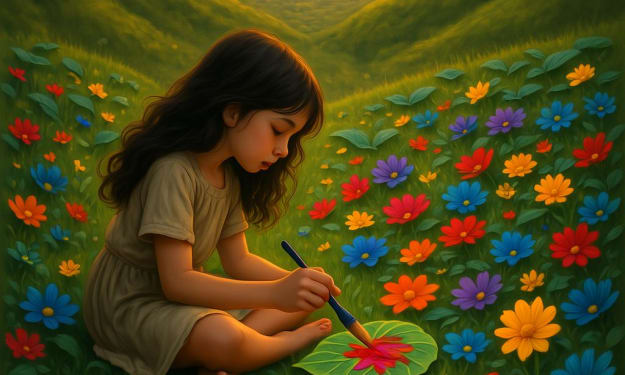
There was once a garden where no flower ever bloomed. It lay between two quiet hills, wrapped in the arms of a forgotten valley. The earth was not dead, and the sun did not hide. Rain visited kindly, and the wind whispered lullabies across its skin. Yet, no color ever rose from the ground. Only leaves. Only stems. Only green—and nothing else. The villagers called it the Hollow Garden. Many believed it was cursed. Some blamed the seeds. Others whispered that the soil was jealous of the bright meadows blooming beyond the hills. But whatever the reason, the garden remained mute in its silence. Year after year. Season after season. Then one day, a girl arrived. Her name was Lila. She was not from the village, and nobody knew why she came. Her eyes looked like they had once held entire storms. Her hands were small, but they carried the quiet weight of something she never spoke about. When she first walked into the Hollow Garden, she did not dig, she did not plant, and she did not water. She sat. Right in the center of the garden, among the stems and silent soil, she simply sat. And she listened. Not with her ears, but with her silence. She listened with her breath, with her stillness, with her open palms resting softly against the earth. It was as though she was listening not for sound, but for feeling. The villagers watched from afar. Some laughed. Some shook their heads. Some whispered that she must be broken too, just like the garden. But Lila kept coming back. She did not speak. She did not try to change the garden. But over time, she began to hum. Softly. Gently. The kind of humming that sounded like a lullaby only the soul could hear. Her voice was cracked, like a dried riverbed after a cruel summer, but it carried warmth. A warmth that filled the empty space without asking anything in return. Days passed. Then weeks. The garden remained green. Only green. But something had shifted. The wind began to circle the valley more often. It carried her hums like invisible threads through the leaves. Birds started to visit again, resting on bent branches. Even the rain lingered longer, as if curious to watch. Then one morning, Lila brought a basket. It was not filled with seeds or tools, but with paintbrushes. Dozens of them, and pots of paint in every color the eye could imagine. She sat in the garden and began to paint the leaves. Red, blue, yellow, orange—petal colors blooming on plain green leaves. The garden, surprisingly, allowed it. It let her color its silence without resistance. By evening, it looked as though the valley had finally bloomed. “It is only paint,” the villagers said. But still, they came. One by one. Some brought food. Some brought stories. Others brought songs. The garden became a place not of flowers, but of people. They laughed. They wept. They sat. They listened. And then, something unexpected happened. A single flower bloomed. A pale yellow daisy, hidden near a rock. So quiet and soft, it could have been mistaken for memory. Nobody noticed it the first day. Or the second. But on the third, a small boy pointed and shouted, “Look! It is real!” Lila smiled. Not because a flower had finally bloomed, but because someone had finally seen it. By the end of the season, ten more had bloomed. Quietly. Naturally. Not because of magic, or perfect soil, or any special method. But because something inside the garden had healed. Lila never said goodbye. One morning, she simply left—with the same silence with which she had arrived. The villagers kept visiting the garden. They stopped calling it Hollow. They gave it a new name. The Listening Garden.
By Muhammad Abuzar Badshah about a year ago in Fiction
CHEL'a
Is it so hard to believe that there are worlds beyond our own planets? Inhabited worlds, lost worlds, worlds of water with different life. worlds just born and worlds at their end. How many have precipitated their own demise through hubris or belief in infallibility of Gods or Goddesses.
By Victor Mendezabout a year ago in Fiction
The Diamond Treasure in the Depth of the Sea
Long ago, beneath the surface of the Southern Sea, there existed a hidden underwater kingdom known as Sirena. Protected by glowing coral walls and ancient sea magic, Sirena thrived in silence, unknown to the surface world. At the heart of its power was a legendary jewel called The Heart of the Abyss—a massive diamond that pulsed with light, magic, and life.
By Engr. Mansoor Ahmadabout a year ago in Fiction