Fable
Little Texts, Big Love: How Tiny Messages Saved Our Spark
I used to think that keeping the spark alive meant surprise trips, fancy candlelit dinners, or expensive gifts. But I learned something extraordinary from the person I love: sometimes it’s the tiniest, cutest texts that keep the fire burning even brighter. It all started during a phase of our relationship when routine was threatening to slip in like a silent thief. We had been together for three years, living in different cities because of work. The calls were still there, the occasional weekend visits still happened, but the excitement—the giddy rush I’d felt in the first few months—had begun to fade into comfortable calm. Sweet, yes, but also a little scary. I didn’t want our love to settle into something that felt ordinary. One evening, while sipping my coffee and scrolling through old chats, I came across a random message from her. Just a simple line she’d sent almost two years ago: “Hey handsome, hope your smile is bigger than the sun today.” It was silly. Flirty. Utterly simple. But it made my chest tighten with something warm, something electric. Right then, I decided to bring that playfulness back, one tiny text at a time. So I texted her: “I hope your heart is dancing today. If not, send it over—I’ll teach it a move or two.” She sent back a laughing emoji, then: “Deal. But you’ll have to hold it forever.” That night, I lay in bed thinking about how easy it was to make her smile. No need for plane tickets or grand gestures—just a handful of words sent at the right moment. From then on, it became our little ritual. Each day, one of us would send a random, cute, and sometimes downright ridiculous text. Like: “Quick question: how did I get so lucky to be loved by a dream in human form?” “If kisses were raindrops, I’d send you a storm.” “Can you stop being so amazing? It’s making it really hard to focus on work.” Sometimes we’d turn it into games. I’d text: “Guess how many times I thought about you today?” She’d reply: “At least 5,000. Am I wrong?” “Totally wrong. It’s been 12,476. I’ve been keeping count.” Even on bad days—especially on bad days—these cute little texts stitched us together. Once she was stuck in a horrible traffic jam, frustrated and close to tears. I sent: “Sending you an army of invisible kisses to fight off the traffic blues. Check your shoulder—one just landed there.” She texted back a photo of her smile, slightly teary but brighter than anything else I’d seen all day. Over time, these tiny messages became more than just a way to flirt. They became reminders of why we chose each other, over and over again. A cute text could chase away the gloom of a hard week. A silly line could turn an ordinary Tuesday into something special. And when distance or routine threatened to dim our spark, these tiny digital notes fanned it right back into a roaring flame. I once asked her, jokingly, what her favorite of all my texts was. She surprised me by scrolling back months in our chat and screenshotting this: “I don’t just love you. I like you. I like the way you look at me when I talk about dumb things. I like how your laugh changes when you’re truly happy. I like the way you exist in this world—messy, gorgeous, and absolutely mine.” She said that line felt like I was seeing her, really seeing her, in all her messy, beautiful glory. That’s when I realized these small messages weren’t small at all. They were tiny keys unlocking doors inside her heart that might have otherwise stayed closed. So yes, I still plan surprises. I still want to buy her flowers and book those plane tickets. But I’ve learned that sometimes, the best way to keep the spark alive isn’t with fireworks. It’s with tiny, playful flames—each word a matchstick striking softly, beautifully, again and again.
By Aman Ullahabout a year ago in Fiction
Animal Farm — Chapter 3 (George Orwell)
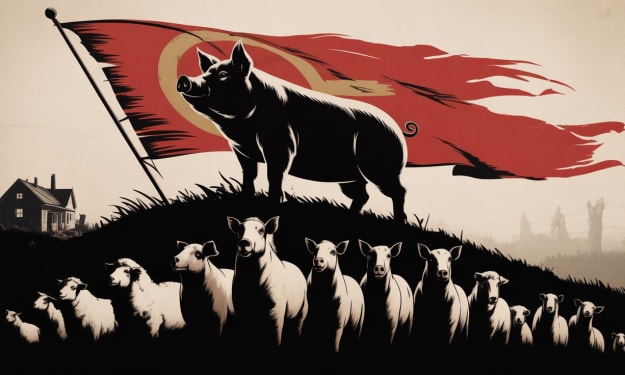
With Manor Farm now transformed into Animal Farm, the animals waste no time in putting their new society into practice. They begin working enthusiastically in the fields, more motivated than ever under Mr. Jones. The pigs, thanks to their superior intelligence, take on leadership and planning roles, while the other animals throw themselves into physical labor. Boxer, a huge cart horse, becomes the farm's workhorse in both name and spirit. His personal motto - "I will work harder" - inspires everyone around him. Even the ducks and chickens do their best, picking up stray kernels of corn to ensure that nothing goes to waste. Although harvesting is difficult without human tools and skills, they manage better than expected, with greater success than ever before. There is a sense of pride and ownership in every mouthful of food they produce, which drives them to work harder and cooperate more willingly. The animals, for the first time, feel that their labor is truly for their own benefit, not for some master who steals the fruits of their labor.
By Echoes of Lifeabout a year ago in Fiction
Animal Farm — Chapter 2 (George Orwell)
After the powerful barn meeting where Old Major sows the seeds of revolution, the animals of Manor Farm find themselves transformed. Although Old Major dies peacefully in his sleep just three nights later, his ideas flash through their minds. The pigs, being the most intelligent of the animals, quickly take on the task of spreading his vision. Of these, three stand out: Napoleon, Snowball, and Squealer. Napoleon is a large, fierce-looking Berkshire boar with a reputation for getting his own way. Snowball is more lively, quick-witted, and inventive, while Squealer is a brilliant talker who can twist any argument to convince others.
By Echoes of Lifeabout a year ago in Fiction
Animal Farm (George Orwell) - Chapter- 1 (Novel)
The story begins at Manor Farm, owned by Mr. Jones, a carefree and often drunk farmer. One evening, Old Major, a highly respected 12-year-old middle-white boar, calls a meeting of all the animals in the large barn. Old Major has had a strange dream and wants to share it with everyone. News of the meeting spreads quickly through the farm, and the animals gather eagerly to hear what Old Major has to say.
By Echoes of Lifeabout a year ago in Fiction
The Sky and the Fang
In the heart of a dense, untamed valley surrounded by cliffs and whispering winds, lived an eagle known as Rael. With feathers the color of burnished gold and eyes that could pierce through fog, Rael was not just any eagle—he was the silent ruler of the skies, feared and revered by creatures across the mountains. Far below, slithering through shadows and beneath sun-warmed rocks, lived Sereth, a massive serpent whose skin shimmered like oil and whose venom could kill in minutes. Unlike Rael, Sereth ruled the underworld of the wild—not through flight, but through fear. For years, the eagle and the snake lived separate lives. One ruled above, the other below. They never crossed paths. Nature had drawn invisible lines between them—until the day a drought fell upon the valley. Water became scarce. Ponds dried into cracked mud, and prey became rare. The eagle soared farther each day, and the snake slithered longer through the brittle grass in search of food. Desperation pushed both predators closer to the riverbed that remained as the valley's last source of life. One morning, Rael circled the riverbed, his shadow gliding across the dry stones. His sharp eyes caught sight of a small hare drinking near the water. Just as he tucked his wings and dived, something else moved. Fast. Silent. Deadly. Sereth had also found the hare. As Rael extended his talons, Sereth struck upward from the underbrush, fangs flashing. Their bodies collided mid-attack, the hare escaping in a blur of fur. For a moment, time stood still. Talons met scales. Wings beat against coils. The wild held its breath. Rael managed to break free, rising high with the snake’s venom barely grazing his feathers. But the encounter had ignited something deeper: a rivalry, a war between sky and soil. Over the next few weeks, the eagle and the snake clashed more than once. Rael attacked from the sky, swift and silent. But Sereth had learned to read the shadows. He would flatten himself against the stones, wait patiently, then strike with terrifying precision. It became more than survival. It became pride. Rael, the eagle, began training differently. He practiced mid-air stops, sharper dives, more agile maneuvers. In the wind tunnels near the cliffs, he honed his wings like a warrior polishing his sword. Sereth adapted as well. He began using tree roots for cover, learning to anticipate the eagle's patterns. He would leave decoy movements to mislead his aerial rival. The valley turned into a war zone. Smaller animals avoided the riverbed, afraid to be caught between the two. Even the wind seemed to whisper their names—Rael and Sereth—like ancient spirits caught in an eternal duel. Then came the final day. The sun hung low and red like a blood moon. The riverbed shimmered faintly, reflecting the tension in the air. Rael flew above, scanning the terrain. Below, Sereth lay coiled near a boulder, motionless. Rael dove with unmatched speed, faster than ever before. Sereth did not move. Not an inch. Just as Rael stretched his talons, Sereth uncoiled in a blur, his mouth open, fangs ready. But this time, Rael had learned. At the last second, he twisted mid-air, dodging the strike, grabbing Sereth not from above, but from behind—talons locking onto the serpent's midsection. The snake twisted violently, wrapping around Rael’s legs. The eagle screamed, wings thrashing, trying to rise. The two wrestled mid-air—a knot of feathers and scales—until, with all his might, Rael flung himself higher. The struggle rose above the treetops. Snakes are not meant for the sky. As altitude increased, Sereth’s grip weakened. Air thinned. The eagle climbed with pure defiance, dragging his foe higher. Finally, above the highest peak, with clouds brushing their bodies, Rael let go. Sereth plummeted. The snake twisted, turned, hissed—until he vanished into the canopy below. Rael landed on a cliff edge, exhausted and bleeding. One leg wounded, wings trembling, but alive. Victorious. The valley returned to silence. Weeks passed. The river returned. So did the prey. The drought ended. Rael healed slowly, now limping slightly when he perched, but his wings remained mighty. No one saw Sereth again. But the legend remained. The animals whispered it in their nests and burrows. The eagle who took the sky and the snake who dared challenge it. A story not just of survival, but of adaptation, honor, and knowing when to rise and when to let go. In time, younger eagles would ask Rael why he fought. Was it for food? Territory? Glory? He would simply answer, “Because the sky must always remember what the ground can never understand.” And then he would soar—his wings stretched, the horizon endless—over a valley that once burned with battle, and now breathed peace.
By Muhammad Usamaabout a year ago in Fiction
As If Time Were Waiting
The balcony opened onto the bay, wide and motionless, bathed in a golden light that made everything feel softer than it had any right to be. In the distance came the faint clinking of cutlery, the occasional murmur of laughter, and the patient lapping of waves below. It was the kind of view one would pay dearly for — postcard-perfect, touched by nothing but the passing wind.
By Alain SUPPINIabout a year ago in Fiction
Collateral
Collateral | currently draft one is sitting pretty at twenty two chapters. Yet to expand further from multiple sides, which are currently dormant in the story arc. I also need add the court scenes and press packages. That’s going to take a wee bit of technical research. I know what I want to say but I want to sell it.
By Scott Catheryabout a year ago in Fiction
The Last Light
The Last Light – A Story of “Luminous” There was once a village wrapped in quiet hills and thick, whispering woods. It was a place time had mostly forgotten. The world beyond it rushed ahead with noise and invention, but the people of Velden lived slowly, holding onto rhythms older than clocks.
By Terence Lisherabout a year ago in Fiction
The Tale os the cat and the Lion
In the heart of the Whispering Woods, where sunlight danced lazily through thick canopies and rivers hummed soft lullabies, lived a proud old fox named Thorne. With fur the color of embers and eyes sharp as winter frost, Thorne considered himself the cleverest creature in the forest.
By Atif Badshahabout a year ago in Fiction
ATale of Friendship, Jealousy, and Justice--
Once upon a time, in a forest, lived a mynah and a sparrow. They were very good friends. They played and worked together. One day, the sparrow flew far away. When she felt thirsty, she drank cold water from a spring flowing from a mountain. A few drops from the mountain fell on her beak. She felt her beak getting heavy. She shook her head here and there, but the weight on her beak wouldn't lessen. She asked the mountain, "Oh Mountain, why is there so much weight on my beak?" The mountain replied, "Little sparrow, I cry once a year. My tears are made of gold. When you drank the water, by chance, a few drops of my tears fell on your beak, and a golden shell formed over it." The sparrow returned home.
By Muhammad Saeedabout a year ago in Fiction