Excerpt
The Warple Wurcus of Thussleberry Circus
I couldn’t believe my destiny. The colours, the motion, the sentiment. I’m older now, nearing death; a great time to write a memoir. But this is no ordinary memoir, for I was the first Warple-Wurcus. I was Scrimitass Sagorious.
By Adz Robinson about a year ago in Fiction
Red Spindle, Burning Blue
The rebels moved like ghosts they were silent, pale shapes swallowed by the smoke-stained corridors of the Red Spindle. Their boots barely touched the scorched floor, gliding through flickering light and digital dust, remnants of a world that once pulsed with power. Faces masked, eyes sharp, they slipped between the skeletal remains of machines like whispers through a dying network. Fear kept them fluid. Training kept them quiet. But it was the hope, the fragile kind that clings to the edges of impossible missions that made them relentless. They had come for the myth at the core of the ruin. And every breath they took felt like it might be their last. Silent, fast, afraid. It was the year 2999 and they had survived. The Fold. The famine. The Kinetic Plague.
By Toni Du Plooyabout a year ago in Fiction
The Bench on Sixth Street
I saw her again today. Not her, exactly. Just someone who looked like her — same dark curls tied in a loose knot, same way she tucked her coat around herself like the world was colder than it actually was. She sat down on the bench across from the bookstore on Sixth Street.Our bench. I hadn’t walked this way in months. Not since last November, when I left her standing there with tears she wouldn’t let fall. She had that look — the one that screamed, “Don’t let me go,” even while she stayed silent. And I had that arrogance — the kind that thinks walking away is strength when it's actually fear. But today, I stopped. The woman who looked like her had a red scarf. Ella never wore red. Said it made her feel like she was shouting in a room full of whispers. She liked soft things. Lavender tea, poetry books with cracked spines, and music that sounded like rain. God, she loved the rain. Used to say it washed everything except memory. I watched from across the street. The fake-Ella checked her phone, sighed, and eventually walked off. I stood frozen, my hands deep in my coat pockets, heart punching through years of pride and regret. That bench was still hers. Still ours. I remember the first time we sat there. Summer, sticky heat, iced coffee in hand. She had just found out her mother was sick, and instead of crying, she talked about constellations and how stars die slowly, beautifully. I didn't understand it then — how people grieve sideways, avoiding the heart of the thing. But I understand now. We sat there on birthdays, after fights, between classes. Sometimes in silence, sometimes with laughter. Sometimes pretending we were fine when we were anything but. It became the only place where honesty didn’t feel dangerous. One evening, she asked, “If we ever lose this… promise me you’ll come back here someday.” “Why?” I laughed. “So I can haunt you, obviously,” she smirked, nudging my arm. “Also… so you’ll remember.” I didn’t ask what she meant. Maybe I didn’t want to know. It’s been 412 days. I counted. I’ve replayed that last conversation like a song with lyrics I keep trying to change. We both made mistakes — sharp ones, stupid ones. But mine was worse. Mine was final. She texted me once after. Just one line. “Do benches remember the people who break promises on them?” I never replied. Not because I didn’t care, but because I did. Too much. I didn’t know how to answer a question like that with a yes. But now, standing here, hands trembling slightly in the cold, I realize what she really meant. The bench isn’t wood and metal. It’s a museum of moments. A witness. A monument to what was — and maybe what could’ve been. And the truth is… I came back because part of me hoped she would too. I sit down slowly, like I’m afraid it might reject me. The air still smells like city dust and faint espresso. I close my eyes. For a second, I pretend she’s sitting beside me again. That her laugh still echoes here. That I can turn to her and say all the words I never found in time. I whisper them anyway, to no one. “I’m sorry. I should’ve stayed. I should’ve listened.” And then… I feel it. A tap on my shoulder. I open my eyes. She's standing there. Different scarf. Same eyes. "Hey," she says, softly. I don’t speak. I can’t. She sits down beside me. We don’t hug. We don’t cry. We just sit — like we used to. Like nothing’s broken, even though we both know it is. And maybe… that’s enough. Maybe some places don’t just remember us. Maybe they forgive us, too.
By Firdos Jamalabout a year ago in Fiction
The Cartographer
Amelia’s life was a meticulously organized map, every street, every landmark, precisely placed. As a cartographer, she thrived on order, on the certainty of lines and labels. Yet, lately, her own internal map felt increasingly blank, particularly the regions marked "childhood" and "family." A vague, persistent ache resided where memories should have been, a blank space she couldn't fill. Her grandmother, the last living link to her past, had recently passed, leaving behind a house filled with echoes and a single, enigmatic inheritance: a worn leather-bound journal.
By Momin Shahabout a year ago in Fiction
Love and Pride
It was an old street in Lahore, lined with dusty rose-colored bricks and narrow lanes that seemed to whisper stories of years gone by. In a modest house on that street lived Zimal, a beautiful, headstrong, and stubborn girl. Her greatest flaw was her pride. Since childhood, she had been taught never to bow her head before anyone — no matter how close, no matter how dear. Not far from her house lived Arham. Arham was a calm, thoughtful young man, known for his soft smile and kind heart. He had loved Zimal for as long as he could remember. Their story had begun like countless others — as childhood friends chasing kites on rooftops, sharing secrets under neem trees, laughing over stolen mangoes in summer. As they grew, so did the feelings they had for each other, changing from innocent childhood companionship into something far deeper. They never needed to say it aloud. It was there in every glance, every accidental brush of hands, every time Zimal saved a sweet for Arham or he carried her books home from college. The whole neighborhood whispered about them. It was only a matter of time before they would be married — everyone was sure of it. --- The Seeds of Pride But pride has a way of poisoning even the sweetest love. One evening, under the same old neem tree, Arham finally decided to speak. He brought a small silver ring, simple yet sincere. His hands trembled as he held it out to her. “Zimal, you know me better than anyone. I want you with me — forever. Will you marry me?” For a moment, a shy smile danced on her lips. Her heart screamed “yes,” but her mind held her back. What if people thought she was too eager? What if they thought she had no self-respect? Instead of answering, she teased, “So soon? Maybe you should prove your love a bit more. Besides, I don’t like simple rings.” Arham was startled. “It’s not about the ring, Zimal. It’s about us.” “But it is about these things too. Why hurry? Let’s wait. Let’s see how serious you are.” Hurt flickered in Arham’s eyes, but he nodded. “Alright, if that’s what you want.” --- The Growing Distance Days turned into weeks, and weeks into months. Zimal waited for Arham to come again with a grander proposal, perhaps something flashy, something that would satisfy her pride. Arham, on the other hand, felt humiliated. His heart broke a little every day, thinking that the girl he loved cared more for show than his sincere feelings. Their meetings became fewer. Conversations, once filled with laughter, were now edged with irritation. Neither was willing to take the first step back. Pride stood like an iron wall between them. One afternoon, Arham saw Zimal at the market. He smiled and walked toward her, hoping to mend things. But Zimal turned away, pretending to fix her dupatta, too proud to greet him first. Arham stopped in his tracks, his smile fading. If she couldn’t even acknowledge him in public, what was left? He decided then that he would no longer chase her. His love was deep, but his dignity was deeper. --- Love Lost to Ego Months later, news spread through the street that Arham’s family had finalized his engagement to a distant cousin. It was a quiet affair, arranged by elders who thought it best to help him move on. Zimal heard the news from a neighbor. Her hands trembled, the cup of tea she held slipped and shattered on the floor. That night, she lay awake, staring at the ceiling, her mind echoing with “What if…?” What if she had just said yes that evening? What if she had swallowed her pride for the sake of love? But pride is a cruel companion. Even now, her heart ached to run to Arham, to tell him how deeply she loved him — yet her stubbornness chained her tongue. Arham, too, spent countless sleepless nights. His heart still longed for Zimal, but his wounds were too raw, his humiliation too fresh. Both of them loved fiercely, yet neither could humble themselves enough to save that love. --- The Silent End Years passed. Zimal remained unmarried, living with memories of laughter under neem trees and hands brushing by accident. Often she stood by her window, watching children fly kites in the street below, wondering how her life might have been if she had simply listened to her heart. Arham had a family of his own now, a wife who cared for him and children who laughed in his lap. Yet every time he passed that neem tree, something deep inside him twisted with an old, unhealed ache. Thus ended a love that could have been beautiful — ruined not by time, not by fate, but by two hearts too proud to bend for each other.
By Aman Ullahabout a year ago in Fiction
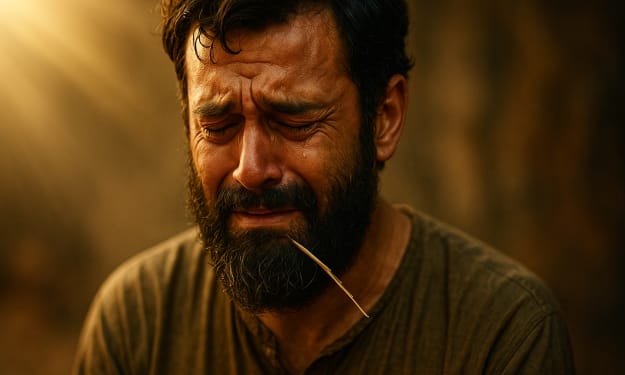
❤rian’s Night: When the Dark Almost Won❤
It was late at night. The wind whispered through the cracked window of a small room, lit only by a dying bulb. Arian sat on the edge of his bed, his hands gripping his face, his shoulders trembling — not from cold, but from the weight of everything he had tried to carry for too long.
By Abdulmusawerabout a year ago in Fiction
Smiles on the Lips, Deceit in the Heart . AI-Generated.
Story: It all started on an ordinary morning when Sara first saw Ali at the college library. Between shelves lined with dusty books, her eyes caught a glimpse of him. Just a brief glance, but her heart skipped a beat. Sara silently promised herself she would never speak to him, but fate had already written a different story.
By Saeedullah Shanabout a year ago in Fiction