
The Meal That Was Never Meant to Be: A Taste I Still Remember
It wasn't fancy, planned, or even particularly beautiful—but one improvised meal became something I would remember for the rest of my life

The best meal I ever ate was made from things nobody wanted.
There was no recipe.
No tablecloth.
No reservation.
There wasn't even enough food for everyone at first.
It happened one summer evening in my grandmother's kitchen, when I was twelve years old and convinced that memorable meals were supposed to look like the ones in magazines.
My grandmother disagreed.
“Food doesn't have to look beautiful,” she used to say. “It only has to make someone want another bite.”
That evening, the refrigerator was almost empty.
My grandmother had been planning to make dinner, but a storm had delayed the delivery from the village market. The cupboard contained half a loaf of bread, three tomatoes, some onions, a little cheese, and a jar of olives.
There were six of us.
My grandmother looked at the ingredients.
Then she looked at us.
“Well,” she said, “we're going to have an interesting dinner.”
My cousin laughed.
“What are we having?”
“Everything.”
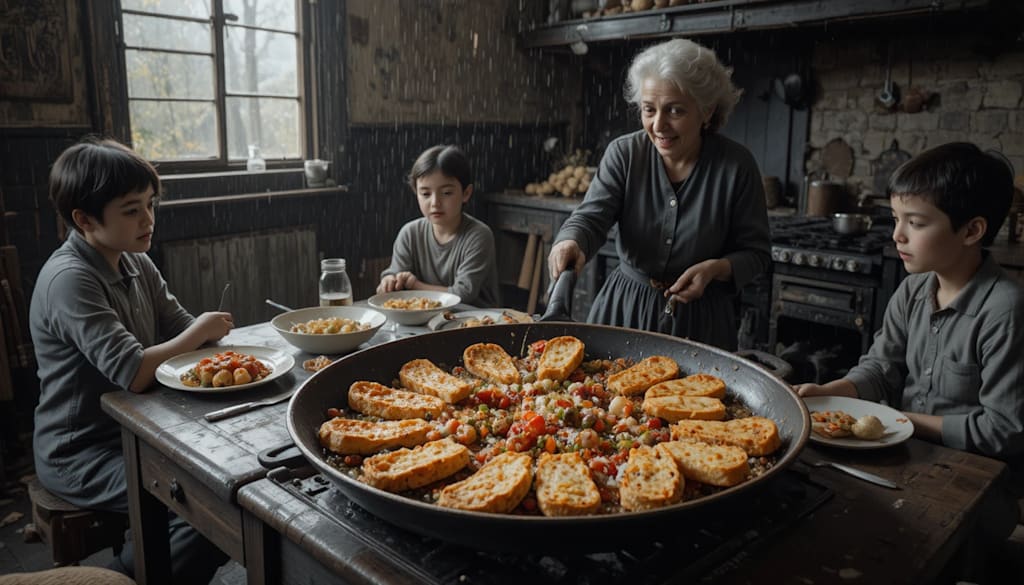
She put a large frying pan on the stove.
First came the onions.
They hissed in the oil.
Then the tomatoes.
Then the olives.
She tore the bread into pieces with her hands and dropped them into the pan.
The smell changed immediately.
The bread absorbed the oil and tomato juice. The edges became crisp while the middle softened.
My cousin leaned over the stove.
“That actually smells good.”
My grandmother pretended to be offended.
“Actually?”
“I mean, it smells very good.”
“Better.”
She added the cheese at the end.
There wasn't enough to cover everything, so she grated it over the top in a thin layer.
Then she turned off the stove.
We stood around the pan.
Nobody moved.
My grandmother looked at us.
“What are you waiting for?”
“Plates,” my mother said.
“Why?”
We laughed.
So we ate directly from the pan.
That was the first unusual thing about the meal.
The second was that everyone had to compete for the crispy pieces.
My grandmother noticed immediately.
She took the largest piece for herself.
“That one is mine.”
“You can't do that,” my cousin protested.
“I made it.”
“That isn't fair.”
“Life isn't fair.”
She ate the piece.
We laughed so loudly that the dog came running into the kitchen.
My grandmother gave him a small piece of bread.
Then another.
Then another.
Soon he was sitting beneath the table, staring at all of us as if he had been invited to the finest restaurant in the country.
We kept eating.
Someone brought out pickles.
Someone else found a jar of mustard.
My mother added fresh herbs from the garden.
My uncle opened a bottle of lemonade.
The meal kept changing.
Every person added something.
Every addition made it less like a recipe and more like a conversation.
By the time the pan was empty, nobody could remember what we had originally called it.
My grandmother simply called it “the kitchen dinner.”
I thought we would make it again.
We didn't.
The next summer, my grandmother became ill.
The summer after that, she was gone.
For years, I remembered the meal as something wonderful.
But when I tried to recreate it, I couldn't.
I knew the ingredients.
Bread.
Tomatoes.
Onions.
Olives.
Cheese.
Oil.
Herbs.
It should have been simple.
I tried making it in my own kitchen.
The first attempt was too salty.
The second was too wet.
The third tasted fine but somehow felt completely wrong.
I changed the bread.
I changed the cheese.
I changed the amount of oil.
I even found the same kind of olives my grandmother used.
Nothing worked.
Eventually, I stopped trying.
Years passed.
I moved away.
I learned to cook properly.
I bought cookbooks.
I learned how to make sauces and bread and complicated dishes that required ingredients I'd never heard of as a child.
Friends complimented my cooking.
But whenever someone asked me what my favorite meal was, I never mentioned any of those dishes.
I remembered the pan.
The torn bread.
The smell of tomatoes.
My grandmother stealing the crispiest piece.
The dog waiting beneath the table.
The laughter.
I remembered everything except the exact taste.
Then, one autumn afternoon, I found myself standing in my kitchen with a nearly empty refrigerator.
There was half a loaf of bread.
Two tomatoes.
An onion.
Some leftover cheese.
A few olives.
I smiled.
I knew what I was going to make.
I didn't measure anything.
I didn't look up a recipe.
I sliced the onion and put it in a pan.
Then the tomatoes.
Then the bread.
Then the olives.
I added the cheese at the end.
When it was ready, I carried the pan to the table.
I took one bite.
For a moment, I was twelve years old again.
I could hear my cousin laughing.
I could smell the rain outside.
I could see my grandmother standing at the stove.
And then I understood something.
I had been trying to recreate the food.
But the food had never been the thing I was trying to remember.
It was the evening.
It was being twelve.
It was having six people crowded into a kitchen and somehow believing that there would always be another summer.
It was my grandmother turning almost nothing into enough.
I finished the meal slowly.
Then I called my mother.
“Do you remember the kitchen dinner?”
There was a pause.
Then she laughed.
“The bread and tomato thing?”
“Yes.”
“I remember.”
“Do you remember what was in it?”
Another pause.
“Not really.”
Neither did I.
We tried to reconstruct it over the phone.
She remembered the olives.
I remembered the cheese.
She thought there had been peppers.
I was certain there hadn't.
We disagreed about whether my uncle had added mustard.
Eventually, my mother said, “Does it matter?”
I looked at the empty pan.
“No,” I said.
It didn't.
Some meals are recipes.
Some are traditions.
Some are carefully prepared and beautifully presented.
And some exist only once.
They happen because the refrigerator is almost empty, the weather changes, somebody is hungry, and someone decides to improvise.
You can't order them in a restaurant.
You can't find them on a menu.
You can't even make them exactly the same way twice.
Because the secret ingredient isn't something you can buy.
It is the person standing beside the stove.
The people sitting around the table.
The year you were living in.
The things you didn't yet know you were going to lose.
That night, I saved the recipe.
Not on paper.
I simply wrote six words in the margin of an old notebook:
Make enough for everyone. Then laugh.
It was the only recipe I needed.
About the Creator
Algieba
Curious observer of the world, exploring the latest ideas, trends, and stories that shape our lives. A thoughtful writer who seeks to make sense of complex topics and share insights that inform, inspire, and engage readers.
Enjoyed the story? Support the Creator.
Subscribe for free to receive all their stories in your feed. You could also become a paid subscriber, letting them know you appreciate their work.
Comments
There are no comments for this story
Be the first to respond and start the conversation.