
Millets Market to Reach US$ 18.67 Billion by 2034 as Demand for Nutritious and Climate-Resilient Grains Accelerates
The global millets market is witnessing strong momentum as consumers increasingly shift toward healthy, gluten-free, and sustainable grain alternatives. The market is projected to grow from US$ 11.82 billion in 2025 to US$ 18.67 billion by 2034, expanding at a CAGR of 5.21% from 2026 to 2034. Rising health awareness, government-backed millet promotion programs, sustainable farming initiatives, and growing demand for clean-label foods are driving global market expansion.

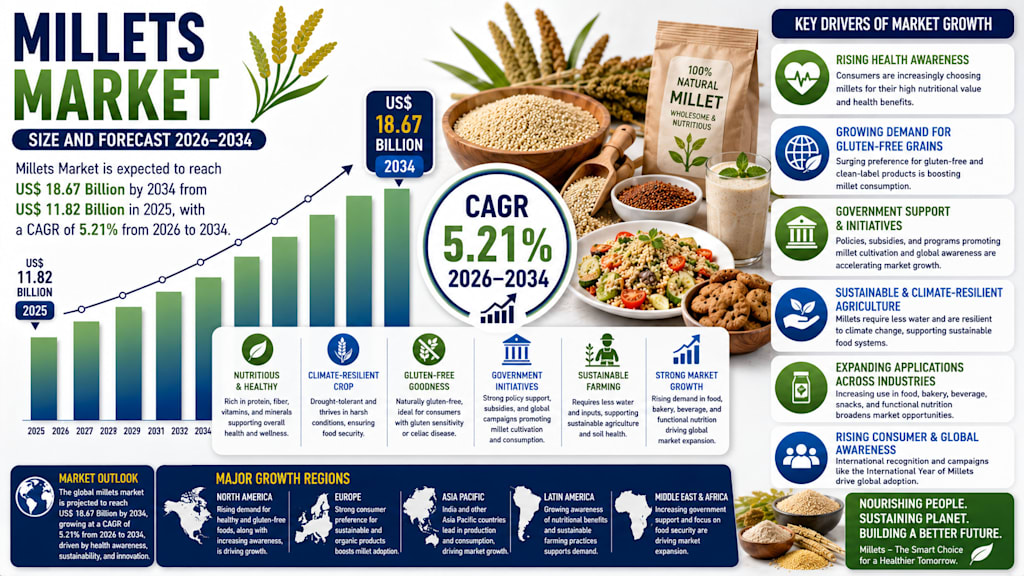
Millets Market Overview
Millets are ancient grains recognized for their rich nutritional profile, climate resilience, and versatility across modern food applications. Popular millet varieties include pearl millet (bajra), finger millet (ragi), sorghum (jowar), and several smaller millet grains. Naturally gluten-free and low in glycemic index, millets are increasingly valued for supporting digestive health, blood sugar management, and weight control. Their drought-resistant nature and low water requirements also make them highly sustainable crops, particularly suitable for semi-arid and climate-sensitive regions.
The market is expanding rapidly because consumers are searching for healthier alternatives to refined grains like wheat and rice. Food manufacturers are incorporating millets into bakery products, breakfast cereals, ready-to-eat snacks, beverages, and functional nutrition products. Global initiatives, including the UN-designated International Year of Millets 2023, have further strengthened awareness and accelerated millet-focused innovation worldwide. Governments across Asia, Africa, Europe, and North America are also promoting millet cultivation to improve food security and support sustainable agriculture.
Growing Health Awareness Driving Millet Consumption
One of the strongest growth drivers for the millets market is rising awareness regarding healthy eating habits. Consumers increasingly prefer nutrient-dense, high-fiber, and plant-based foods that support long-term wellness. Millets fit well into modern dietary trends because they are naturally gluten-free, rich in protein and micronutrients, and suitable for diabetic-friendly and weight-management diets.
This health-driven demand is pushing major food brands to launch millet-based products across multiple categories. In September 2023, Nestlé India introduced Nestlé a+ Masala Millet porridges made with bajra, barley, vegetables, and spices. Available in convenient ready-to-cook formats, these products highlight how mainstream food companies are investing in millet-based meal solutions for urban consumers seeking healthier convenience foods.
Consumers are also becoming more interested in clean-label and minimally processed foods. This trend is helping millets move beyond traditional rural consumption and into premium health-food categories globally. As plant-based nutrition and whole-grain diets continue gaining popularity, millet-based foods are expected to see broader adoption across international markets.
Government Support and Sustainability Benefits Strengthening the Market
Government initiatives and sustainability policies are playing a major role in expanding millet cultivation and consumption. Millets are increasingly viewed as climate-smart crops because they require less water, tolerate harsh weather conditions, and support soil health. These environmental advantages make them highly important in a world facing climate change and food security challenges.
The International Year of Millets 2023 created global momentum for millet promotion, encouraging research, public awareness campaigns, and industry participation. In May 2023, Bonn Group launched millet-based bakery products such as Millet Pizza, Millet Bread, and Millet Burger products using jowar, bajra, and ragi. The launch reflected how government-backed millet missions are influencing food industry innovation and encouraging manufacturers to experiment with alternative grains.
India continues to lead global millet promotion through policy support and public nutrition programs. In August 2024, India unveiled 109 improved and hybrid crop varieties, including upgraded millet seeds aimed at improving productivity and nutritional quality. Such initiatives strengthen farmer income while helping build a more resilient agricultural ecosystem.
Expansion of Millet-Based Packaged Foods and Snacks
Urbanization, changing lifestyles, and modern retail expansion are accelerating the demand for packaged millet products. Consumers increasingly want healthy snacks, ready-to-eat meals, breakfast mixes, and bakery items that combine convenience with nutrition. This shift is creating major opportunities for millet-based packaged foods.
In May 2023, ITC launched Sunfeast Farmlite Super Millets Cookies in multi-millet and choco-chip variants. Made with jowar and ragi and without maida, these products demonstrate how companies are blending health benefits with taste and convenience to attract urban consumers. Millet-based cookies, breads, cereals, crackers, snack bars, and beverages are now becoming increasingly common across supermarkets and e-commerce platforms.
The rise of vegan diets, allergen-free foods, and functional nutrition products is also helping millets gain stronger commercial traction. Food brands are positioning millet products as premium alternatives to traditional refined-grain snacks, supporting wider market penetration among younger and health-conscious buyers.
Challenges in the Millets Market
Despite strong growth potential, the market still faces several structural challenges. One major issue is fragmented supply chains and limited processing infrastructure. In many developing regions, millet cultivation is still dominated by smallholder farmers who lack access to modern harvesting, storage, grading, and milling technologies. This results in inconsistent quality and limits the scalability of value-added millet products.
Processing limitations also increase costs for millet-based flours, snacks, and ready-to-eat foods compared to wheat or rice products. Companies often struggle to maintain standardized quality and long shelf life across product categories. As a result, pricing and availability remain inconsistent across markets.
Consumer awareness is another challenge, especially outside Asia and Africa. Many consumers in Western and Middle Eastern markets are unfamiliar with millet recipes, textures, and cooking methods. Since millets have a distinct taste profile compared to wheat or rice, brands must invest heavily in education, sampling campaigns, and product innovation to encourage mainstream adoption.
United States Millets Market
The United States millets market is growing steadily as consumers seek gluten-free, whole-grain, and environmentally sustainable food options. Millets are increasingly used in granola bars, breakfast cereals, health snacks, bakery flours, and functional food products. Health-conscious consumers, fitness communities, and diabetic populations are contributing to rising demand.
A notable development occurred in January 2024 through the Indo-US Millets Initiative, a collaboration involving organizations such as Sorghum United and the India Millet Initiative. The partnership focuses on research, awareness campaigns, and policy development to expand millet adoption and strengthen international collaboration around sustainable grains.
Germany Millets Market
Germany’s millets market is benefiting from strong consumer demand for organic, functional, and gluten-free food ingredients. Millets are increasingly appearing in breakfast porridges, muesli blends, bakery products, and healthy snacks as German consumers embrace whole-grain nutrition trends.
In October 2023, German brand Bauckhof introduced an organic Millet Breakfast Porridge Mix combining hulled millet with fruit blends. This launch reflects rising demand for convenient, nutrient-rich breakfast options in Europe’s growing health-food sector.
India Millets Market
India remains the world’s largest producer and consumer of millets and continues to lead global market expansion. Millets are increasingly integrated into public food programs, school nutrition initiatives, and mainstream packaged food innovation. Government support, farmer programs, and strong cultural familiarity with millet consumption continue to strengthen India’s market leadership.
In April 2025, the Odisha Government launched a school nutrition initiative distributing Mandia millet ladoos to students to improve nutrition and learning outcomes. Additionally, Gujarat organized Millet Mahotsav 2025 to promote millet consumption and sustainable farming practices through exhibitions and public awareness activities.
Saudi Arabia Millets Market
Saudi Arabia’s millets market is gradually expanding as consumers show greater interest in healthier diets and food security initiatives under Vision 2030. Millet flours, healthy snacks, and ready-to-cook mixes are gaining visibility in retail channels as food manufacturers diversify product offerings.
Saudi Vision 2030 also prioritizes agricultural diversification and sustainable food production. The Ministry of Environment, Water, and Agriculture is encouraging cultivation of climate-resilient crops, including millets, to strengthen national food security and reduce dependence on imports. These initiatives are expected to support long-term millet market growth across the Kingdom.
Organic Millets Market
The organic millets segment is witnessing rapid growth as consumers increasingly demand chemical-free, pesticide-free, and non-GMO foods. Organic millets such as ragi, jowar, foxtail millet, and bajra are gaining popularity across supermarkets, specialty health stores, and online platforms.
Rising awareness of clean-label products and sustainable agriculture is supporting premium pricing for organic millet products. Governments and agricultural organizations are also encouraging organic farming practices to improve soil health and environmental sustainability. As consumers continue shifting toward healthier whole-grain diets, organic millets are expected to see significant long-term demand growth.
Millet-Based Bakery Products Market
Millet-based bakery products are becoming increasingly popular among health-conscious consumers looking for alternatives to refined wheat flour. Millets such as jowar, bajra, and ragi are now widely used in breads, cookies, cakes, pizza bases, and crackers because of their high fiber and nutrient content.
Companies are actively introducing millet bakery innovations to capitalize on changing dietary habits. Bonn Group’s millet breads and pizza products, along with ITC’s millet cookies, highlight growing industry confidence in this category. As bakery brands increasingly focus on whole grains, clean labels, and functional ingredients, millet-based bakery products are expected to gain wider mainstream acceptance globally.
Recent Developments in the Millets Market
In June 2025, Hyderabad hosted Millet Udyami Bharath 2025, training entrepreneurs from 25 Indian states in millet business development and sustainable farming.
In August 2024, India launched 109 upgraded crop varieties, including improved millet seeds for higher productivity and nutrition.
In June 2025, the Jindal Foundation launched the Jindal Krishi Seva initiative to support natural farming and millet cultivation in Odisha.
In September 2023, Nestlé India introduced Nestlé a+ Masala Millet porridges in ready-to-cook formats.
In May 2023, Bonn Group launched millet-based bakery products including millet pizza and burger breads.
In May 2023, ITC launched Sunfeast Farmlite Super Millets Cookies made with jowar and ragi.
In January 2024, the Indo-US Millets Initiative strengthened international collaboration on millet research and awareness.
In October 2023, Germany’s Bauckhof introduced an organic Millet Breakfast Porridge Mix.
In April 2025, Odisha introduced Mandia millet ladoos in school nutrition programs.
In February 2025, Gujarat organized Millet Mahotsav 2025 to promote millet adoption and natural farming practices.
Competitive Landscape
Key companies and organizations operating within the broader millets ecosystem are investing in product innovation, health-focused food development, and sustainable agriculture initiatives. Companies mentioned in the report include Amgen Inc., AstraZeneca, Bayer AG, Bristol-Myers Squibb Company, Pfizer Inc., Novartis AG, Johnson & Johnson, Eli Lilly Company, and Seattle Genetics Inc.
Final Thoughts
The global millets market is transitioning from a traditional grain segment into a modern health-food and sustainability-driven industry. Growing awareness of nutrition, climate resilience, and functional foods is positioning millets as one of the most promising grain categories worldwide. With strong support from governments, food manufacturers, and health-conscious consumers, the market is expected to continue expanding steadily through 2034.
About the Creator
Enjoyed the story? Support the Creator.
Subscribe for free to receive all their stories in your feed.
Comments
There are no comments for this story
Be the first to respond and start the conversation.