
Hydroponics Market Forecast 2026–2034: Sustainable Farming and Urban Agriculture Drive Rapid Global Expansion
Rising Demand for Water-Efficient Farming, Controlled Environment Agriculture, and Local Food Production Is Reshaping the Future of Agriculture

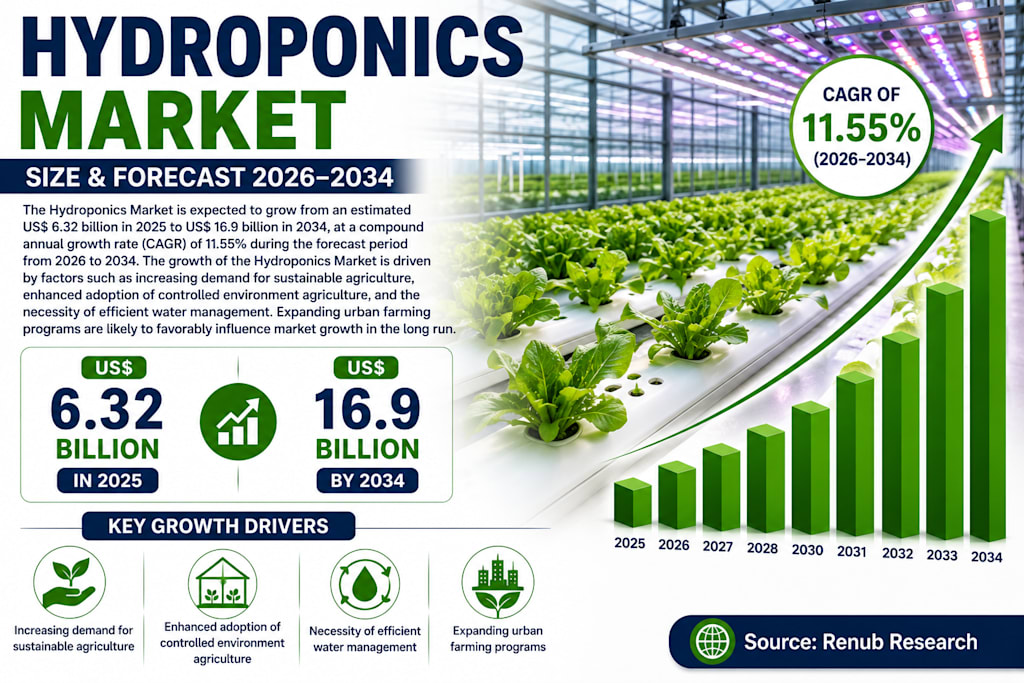
The global hydroponics market is entering a period of rapid transformation as governments, agritech companies, and commercial growers increasingly prioritize sustainable food production and resource-efficient agriculture. As climate change, urbanization, water scarcity, and food security concerns intensify worldwide, hydroponics is emerging as one of the most promising solutions for modern agriculture.
According to Renub Research, the Hydroponics Market is projected to grow from US$ 6.32 billion in 2025 to US$ 16.9 billion by 2034, registering a strong compound annual growth rate (CAGR) of 11.55% from 2026 to 2034.
This remarkable growth is being fueled by rising demand for sustainable farming methods, rapid adoption of controlled environment agriculture (CEA), technological innovation in indoor farming systems, and increasing consumer preference for fresh, pesticide-free produce.
From urban vertical farms and smart greenhouses to advanced irrigation systems and AI-powered nutrient management, hydroponics is steadily transforming the way food is produced around the world.
What Is Hydroponics and Why Is It Growing So Rapidly?
Hydroponics is an advanced agricultural technique that allows plants to grow without soil. Instead of relying on traditional soil-based farming, hydroponic systems supply nutrients directly to plant roots through water-based nutrient solutions.
Plants are supported using inert growing media such as coco coir, rockwool, perlite, or expanded clay pellets. In some hydroponic systems, plant roots are directly submerged in nutrient-rich water.
This method offers several major advantages compared with conventional farming:
- Faster plant growth
- Higher crop yields
- Reduced water usage
- Minimal pesticide dependency
- Efficient nutrient control
- Year-round cultivation capability
Hydroponics is widely used for cultivating vegetables, herbs, fruits, lettuce, cucumbers, peppers, and tomatoes. Because hydroponic systems operate within controlled environments, farmers can optimize temperature, humidity, lighting, and nutrient delivery regardless of outdoor climate conditions.
The growing pressure on global food systems, shrinking arable land availability, and increasing water shortages are making hydroponics an increasingly attractive alternative to traditional agriculture.
Sustainable and Water-Efficient Agriculture Is a Major Growth Driver
One of the biggest drivers of the hydroponics market is the urgent global need for sustainable farming practices.
Traditional agriculture consumes enormous quantities of water, land, fertilizers, and chemicals. Hydroponics, by contrast, can reduce water consumption by up to 90% while producing significantly higher yields per square meter.
As climate change intensifies drought conditions and soil degradation, governments and agricultural organizations are increasingly supporting water-efficient cultivation systems. Hydroponics offers a compelling solution because it minimizes water waste and reduces nutrient runoff into the environment.
Urbanization is also contributing to reduced farmland availability worldwide. Hydroponics enables food production in urban environments where soil quality or land access is limited. Rooftops, warehouses, shipping containers, and indoor facilities are increasingly being converted into productive hydroponic farms.
The emphasis on sustainability is becoming central to global agricultural policy and food security planning.
In April 2025, the Ministry of Tourism, Economic Affairs, Transport, and Telecommunications (TEATT) launched the Hydroponics Train the Trainers Pilot Project in schools across Sint Maarten. The initiative aims to strengthen food security and climate resilience through hydroponics education and local food production systems.
Such programs highlight how hydroponics is increasingly viewed as a strategic agricultural solution for the future.
Urban Farming and Controlled Environment Agriculture Are Expanding Rapidly
Rapid urbanization is creating a growing disconnect between food production and consumption. As cities expand, demand for locally produced fresh food is increasing dramatically.
Hydroponics plays a central role in controlled environment agriculture (CEA), which includes indoor farming, greenhouse production, and vertical farming systems. These technologies allow crops to be cultivated in highly controlled conditions close to urban consumers.
Controlled environment farming offers several important benefits:
- Stable crop quality
- Reduced transportation costs
- Lower exposure to weather disruptions
- Year-round production
- Reduced pesticide use
- Faster crop cycles
Consumers in urban areas increasingly prefer fresh, locally grown, and pesticide-free produce. Hydroponic systems can efficiently meet this demand while reducing supply chain dependence on distant agricultural regions.
The integration of hydroponics with vertical farming and smart greenhouse technologies is further accelerating adoption globally.
As cities continue growing and climate uncertainty increases, hydroponics is becoming a foundational component of modern urban agriculture systems.
Technology and Automation Are Revolutionizing Hydroponic Farming
Technological innovation is significantly improving the efficiency, scalability, and profitability of hydroponic farming.
Modern hydroponic systems now incorporate advanced technologies such as:
- LED grow lighting
- Automated irrigation systems
- Climate control systems
- Nutrient monitoring sensors
- Artificial intelligence (AI)
- Internet of Things (IoT) monitoring
- Real-time crop analytics
These technologies help farmers optimize environmental conditions, reduce labor costs, and improve crop consistency. Automation also minimizes human error while allowing precise control over nutrient concentration, pH levels, humidity, and temperature.
AI-powered monitoring systems are increasingly helping growers maximize yields and predict crop performance more accurately.
In January 2025, Aerospring Hydroponics launched its second commercial farming project in Sharjah, UAE. The project aims to increase agricultural productivity by 400% per square meter while improving water efficiency under arid climate conditions.
Such innovations demonstrate how smart farming technologies are making hydroponics more commercially viable and scalable worldwide.
Aggregate Hydroponic Systems Continue to Gain Popularity
Aggregate hydroponic systems are becoming one of the most widely adopted hydroponic methods globally.
These systems use inert growing media such as:
- Coco coir
- Perlite
- Vermiculite
- Expanded clay pellets
The media provide root support while allowing precise nutrient and water management.
Aggregate systems are especially popular for crops such as tomatoes, cucumbers, peppers, and strawberries because they provide excellent oxygen availability and plant stability.
The growing demand for environmentally friendly growing substrates such as coco coir is further supporting this segment’s expansion. Reusable and sustainable growing materials are becoming increasingly important as hydroponic farming scales globally.
Tomatoes Lead Commercial Hydroponic Crop Production
Tomatoes remain one of the most commercially significant hydroponic crops worldwide.
Hydroponic tomato farming offers several advantages over traditional cultivation methods, including:
- Higher productivity
- Reduced pest damage
- Better water efficiency
- Stable crop quality
- Year-round production capability
Because tomatoes have strong global demand and relatively high commercial value, many greenhouse and vertical farming operations prioritize hydroponic tomato cultivation.
Consumers are also increasingly attracted to hydroponically grown tomatoes because they are associated with pesticide-free and sustainable production methods.
As controlled environment agriculture expands, hydroponic tomato production is expected to remain one of the industry’s strongest growth segments.
HVAC and Irrigation Systems Are Becoming Critical Components
Hydroponic farming depends heavily on environmental control systems, making HVAC and irrigation technologies essential parts of the market.
Hydroponics HVAC Equipment
HVAC systems help maintain optimal growing conditions by controlling:
- Temperature
- Humidity
- Air circulation
- Ventilation
Even small climate fluctuations can significantly affect crop growth and yield quality in hydroponic systems.
The expansion of indoor farming and vertical farming is increasing demand for energy-efficient HVAC technologies, climate sensors, and smart environmental controls.
Hydroponics Irrigation Systems
Efficient irrigation systems are equally important because they deliver nutrients directly to plant roots while minimizing water waste.
Automated irrigation technologies improve nutrient distribution, maintain crop consistency, and support higher yields. As water scarcity concerns continue increasing globally, advanced irrigation systems are becoming a critical focus area for hydroponic farming expansion.
The U.S. Hydroponics Market Is Scaling Rapidly
The United States hydroponics market is growing rapidly as commercial growers, retailers, and foodservice companies expand indoor farming operations.
Large investments in vertical farms, smart greenhouses, and automation technologies are increasing production capacity and improving efficiency. Consumers increasingly prefer locally grown, pesticide-free produce with transparent supply chains.
Advanced LED systems, nutrient delivery technologies, and climate control solutions are helping reduce per-unit production costs while improving yields.
In November 2024, GrowGeneration Corp launched three new premium product lines supporting indoor growing and greenhouse hydroponics applications.
Although energy costs and financing challenges remain concerns, the long-term trajectory of the U.S. market remains strongly positive.
The United Kingdom Market Reflects Food Security Priorities
The United Kingdom hydroponics market is increasingly influenced by food security concerns, import dependency, and consumer demand for locally produced vegetables.
Hydroponic systems enable year-round production of lettuce, herbs, and vegetables despite seasonal climate variability. Urban farming initiatives and greenhouse projects are becoming more important as consumers seek reliable access to fresh produce.
In February 2025, the European Union approved hydroponic farming methods for use in organic product certification. This policy shift created major opportunities for hydroponic technology companies within the sustainable agriculture sector.
India’s Hydroponics Industry Is Emerging Quickly
India’s hydroponics market remains at an early stage but is growing rapidly due to urbanization, shrinking farmland, and water scarcity.
Startups, schools, and government-supported projects are increasingly experimenting with hydroponic farming for vegetable cultivation and urban agriculture. While high setup costs and limited technical expertise remain barriers, the long-term growth potential is substantial.
In December 2024, the Indian government announced plans to include hydroponics, aquaponics, vertical farming, and precision farming under the Mission for Integrated Development of Horticulture (MIDH) framework.
This policy support could significantly accelerate adoption across the country.
Saudi Arabia Is Investing Heavily in Hydroponics
Saudi Arabia’s hydroponics market is expanding rapidly due to national food security strategies and water conservation priorities.
The country’s harsh climate and limited arable land make traditional agriculture difficult, increasing the attractiveness of controlled-environment hydroponic farming systems. The government and private sector are investing heavily in greenhouse technologies and urban farming initiatives.
In May 2025, Saudi agritech startup Arable secured US$ 2.55 million in seed funding to expand hydroponic farming systems designed specifically for arid climates and efficient water usage.
These investments reflect the growing strategic importance of hydroponics within the Middle East.
High Costs and Technical Complexity Remain Challenges
Despite strong growth prospects, the hydroponics industry still faces several significant challenges.
The initial capital investment required for hydroponic systems remains high. Setting up commercial-scale hydroponic farms often requires expensive infrastructure, lighting systems, climate controls, and automation technologies. Energy costs can also be substantial, especially for indoor operations.
Technical complexity represents another major challenge. Successful hydroponic farming requires specialized knowledge related to nutrient management, pH control, irrigation systems, and environmental monitoring.
The shortage of skilled hydroponics professionals and training programs remains a barrier, particularly in developing markets where traditional farming methods still dominate.
Addressing these issues will be essential for ensuring broader industry adoption and long-term scalability.
Final Thoughts
The global hydroponics market is rapidly evolving into one of the most important sectors within modern agriculture.
Driven by sustainability concerns, water scarcity, urbanization, technological innovation, and food security priorities, hydroponics is redefining how crops are grown around the world.
According to Renub Research, the market’s projected expansion from US$ 6.32 billion in 2025 to US$ 16.9 billion by 2034 highlights the enormous long-term potential of hydroponic farming systems.
As governments, agritech companies, and consumers continue prioritizing efficient and environmentally responsible food production, hydroponics is likely to become a cornerstone of the future global agricultural system.
About the Creator
Enjoyed the story? Support the Creator.
Subscribe for free to receive all their stories in your feed.
Comments
There are no comments for this story
Be the first to respond and start the conversation.