
Australia Fertilizer Market Set for Sustainable Growth as Precision Farming and Green Ammonia Investments Accelerate
Rising agricultural productivity, advanced nutrient management, and sustainability-focused farming practices are transforming Australia’s fertilizer industry through 2034.

Australia Fertilizer Market Overview
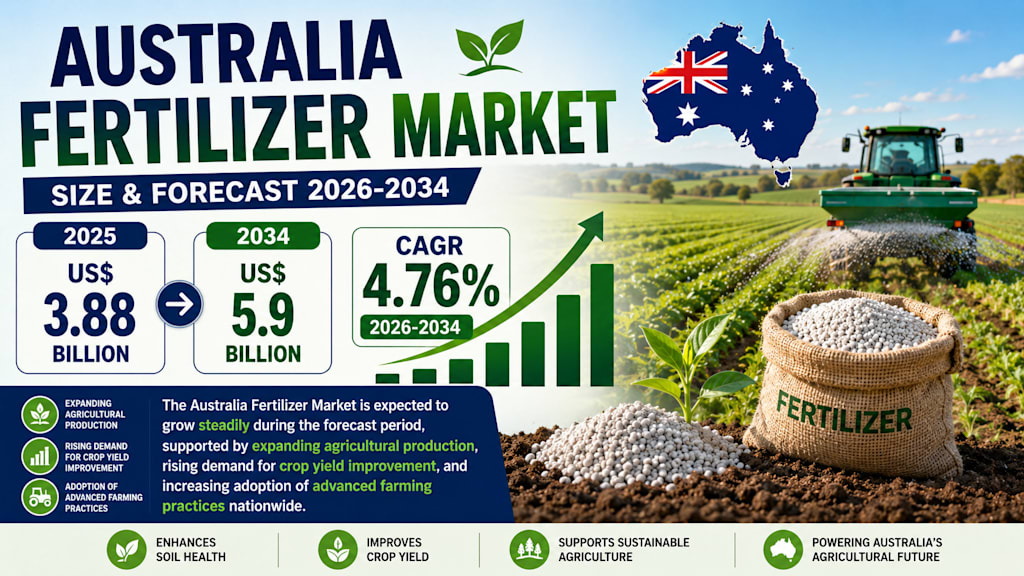
Australia’s fertilizer industry is entering a new phase of growth driven by increasing agricultural productivity, precision farming technologies, and rising awareness regarding sustainable nutrient management. According to the uploaded report, the Australia Fertilizer Market is projected to grow from US$ 3.88 billion in 2025 to US$ 5.9 billion by 2034, expanding at a CAGR of 4.76% during 2026–2034.
The market plays a central role in supporting Australia’s agricultural economy, which depends heavily on high crop yields, efficient soil management, and export-oriented farming systems. Fertilizers are essential across cereals, oilseeds, sugarcane, fruits, vegetables, horticulture, and livestock feed production. As climate uncertainty and soil degradation concerns increase, Australian farmers are placing greater emphasis on balanced nutrient strategies and advanced fertilizer solutions that improve productivity while minimizing environmental impact.
The market includes nitrogen fertilizers, phosphate fertilizers, potash fertilizers, micronutrients, specialty fertilizers, and biofertilizers tailored to different crops and regional farming conditions. Modern technologies such as GPS-enabled farming systems, drones, digital soil monitoring, and precision nutrient application are rapidly changing the way fertilizers are used across the country.
Technology Is Reshaping the Fertilizer Industry
Australia’s fertilizer market is no longer dependent solely on traditional nutrient supply. Innovation has become a defining trend. Companies are increasingly developing controlled-release fertilizers, water-soluble nutrients, customized blends, and bio-based alternatives designed to improve nutrient efficiency and reduce wastage.
Precision agriculture is playing a major role in this transformation. GPS-guided spreaders, yield-monitoring systems, and digital mapping tools are helping farmers apply nutrients more accurately based on soil and crop conditions. This reduces unnecessary fertilizer usage while improving crop performance and farm profitability.
The report highlights that more than 35% of grain farms now use variable-rate technology, compared with 22% in 2022. Depending on paddock variability, financial returns can range between USD 0.65 and USD 14.30 per hectare, making precision nutrient management increasingly attractive for Australian growers.
This shift is also benefiting fertilizer manufacturers and suppliers, who are moving beyond commodity products and offering higher-margin services such as prescription nutrient programs, digital farm analytics, and customized fertilizer solutions.
Green Ammonia Investments Are Creating New Opportunities
One of the biggest long-term growth drivers is Australia’s investment in green ammonia and hydrogen-based fertilizer production. Federal support programs are encouraging companies to transition toward lower-carbon fertilizer manufacturing systems, helping reduce dependence on fossil fuel feedstocks.
According to the report, the Australian government’s support for hydrogen production is helping narrow the cost gap between conventional and green ammonia production. Large-scale electrolysis projects in regions such as Pilbara and Central Queensland are already attracting private investment and accelerating research into scalable hydrogen generation systems.
This matters because ammonia is a key building block for nitrogen fertilizers. Greener ammonia production not only reduces emissions but also strengthens supply security for Australian agriculture. It also improves opportunities for growers seeking lower-carbon supply chains and sustainability-linked agricultural exports.
Rising Domestic Production Strengthens the Market
Australia is also expanding its domestic fertilizer manufacturing capacity. The report notes that regional annual nitrogen capacity now exceeds 590,000 metric tons of ammonia, supported by major facilities including Incitec Pivot’s Gibson Island complex and CSBP’s Kwinana facility.
Local production is important because it reduces exposure to international freight disruptions and volatile global fertilizer prices. Shorter supply chains help farmers secure more predictable fertilizer pricing during key planting seasons.
The report also mentions that integrating renewable feedstocks into fertilizer production could shield domestic markets from natural gas price shocks that have historically increased urea costs.
Challenges Facing the Australia Fertilizer Market
Despite strong growth prospects, the industry continues to face several important challenges.
Volatile Raw Material Prices
Fertilizer manufacturing depends heavily on raw materials such as natural gas, phosphate rock, ammonia, and potash. Global commodity fluctuations, geopolitical tensions, trade restrictions, and shipping disruptions can significantly impact fertilizer pricing and availability within Australia.
The country also remains dependent on imports for several nutrient categories, making the market vulnerable to supply-chain interruptions. Rising freight costs and logistics challenges continue to pressure distributors and farmers, particularly during difficult weather cycles or periods of weak agricultural commodity prices.
Environmental and Sustainability Pressures
Environmental concerns are becoming increasingly important across Australian agriculture. Excessive fertilizer use can contribute to water pollution, greenhouse gas emissions, nutrient runoff, and soil degradation. Regulatory authorities are therefore encouraging sustainable nutrient management practices and greater use of environmentally friendly fertilizer products.
Farmers are under pressure to balance productivity goals with environmental compliance. This is accelerating adoption of controlled-release fertilizers, biofertilizers, and precision application technologies that improve nutrient efficiency and reduce environmental impact.
Regional Market Highlights
New South Wales
New South Wales remains one of Australia’s most important fertilizer markets due to its large-scale production of wheat, cotton, fruits, vegetables, and livestock feed crops. Farmers across the state are increasingly adopting precision farming systems, soil testing, and specialty fertilizers to improve crop productivity and maintain soil health.
Victoria
Victoria’s diversified farming industry, including dairy, grains, wine grapes, and horticulture, is supporting strong fertilizer demand. Greenhouse farming expansion and sustainable agriculture initiatives are driving increased use of water-soluble and customized fertilizer products across the state.
Queensland
Queensland’s fertilizer market is benefiting from large-scale sugarcane cultivation alongside fruits, vegetables, cotton, and grain farming. Farmers are increasingly using precision nutrient management techniques to improve yields while addressing water conservation and environmental sustainability concerns.
Western Australia
Western Australia remains heavily dependent on fertilizers due to its export-focused grain farming sector. Wheat, barley, canola, and pulses require efficient nutrient management strategies, especially as farmers adopt digital agriculture systems to optimize fertilizer use and reduce operational costs.
10 Recent Developments in Australia Fertilizer Market
Dyno Nobel Limited officially rebranded from Incitec Pivot Limited in March 2025 while continuing fertilizer operations through Incitec Pivot Fertilisers, signaling a strategic shift in portfolio management.
Orica secured USD 432 million from Australia’s Hydrogen Headstart program in October 2024 to convert its Gibson Island ammonia plant toward green hydrogen feedstock production.
Incitec Pivot Fertilisers announced plans to integrate green hydrogen systems into the Gibson Island facility by 2027 to support lower-carbon ammonia production.
CSBP Fertilisers continued expansion efforts at its Kwinana nitrogen production operations to strengthen domestic fertilizer supply reliability.
Yara International ASA increased focus on low-emission crop nutrition technologies and sustainable fertilizer distribution programs across Australia.
BASF accelerated development of specialty crop nutrition products designed to improve nutrient uptake efficiency under challenging climate conditions.
ICL Group expanded precision agriculture partnerships focused on controlled-release fertilizers and water-efficient nutrient management systems.
CF Industries Holdings continued strengthening global ammonia and nitrogen supply capabilities to support international agricultural markets, including Australia.
PhosAgro increased global emphasis on environmentally safer phosphate-based fertilizers and premium nutrient products.
K+S AG continued investment in specialty potash and magnesium-based fertilizers supporting sustainable crop production and soil health improvement.
Competitive Landscape
The Australian fertilizer market remains highly competitive, with both domestic manufacturers and international suppliers competing across traditional and specialty nutrient segments. Key companies mentioned in the report include:
- Yara International ASA
- K+S AG
- CF Industries Holdings
- Grupa Azoty S.A.
- ICL Group
- OCI NV
- Sociedad Quimica y Minera de Chile SA
- BASF
- PhosAgro
These companies are focusing heavily on precision nutrition, sustainable fertilizers, controlled-release technologies, and environmentally responsible production systems to strengthen market positioning.
Final Thoughts
Australia’s fertilizer industry is evolving from a traditional input-driven sector into a more technology-focused and sustainability-oriented market. Precision agriculture, green ammonia investments, customized nutrient solutions, and environmentally responsible farming practices are becoming central to future growth.
While supply-chain volatility and environmental regulations remain key challenges, the long-term outlook remains positive due to rising agricultural exports, increasing demand for crop productivity, and continued modernization across Australian farming operations.
The next decade will likely favor companies capable of balancing productivity, sustainability, and technological innovation. As Australian agriculture becomes more data-driven and climate-conscious, fertilizer providers that deliver efficiency alongside environmental responsibility are expected to lead the market forward.
About the Creator
Enjoyed the story? Support the Creator.
Subscribe for free to receive all their stories in your feed.
Comments
There are no comments for this story
Be the first to respond and start the conversation.