
Asia Pacific Ginger Market Outlook 2025–2033: Health Awareness and Functional Food Trends Fuel Strong Growth
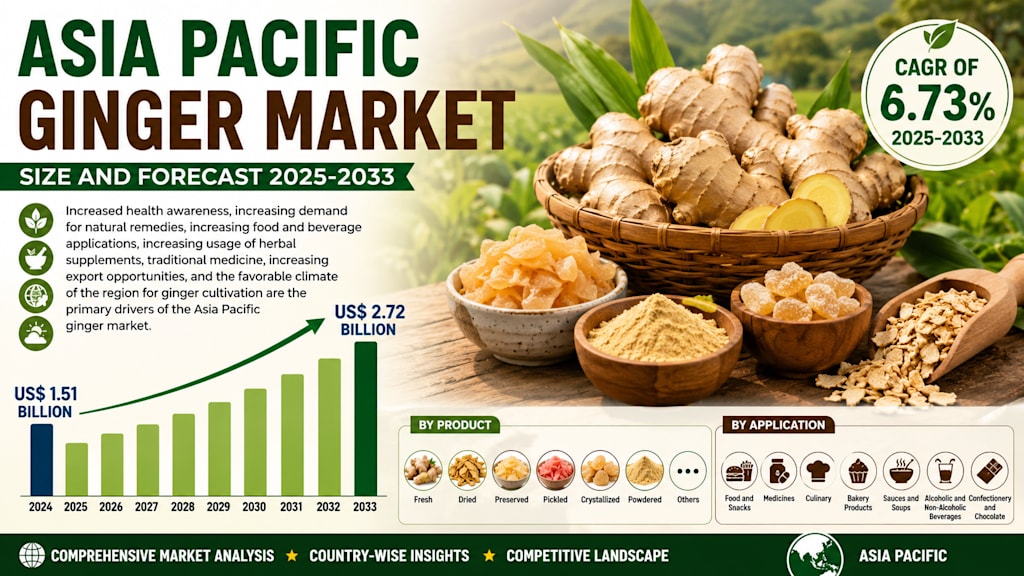
Renub Research forecasts the Asia Pacific Ginger Market to grow from US$ 1.51 billion in 2024 to US$ 2.72 billion by 2033, driven by rising demand for natural remedies, food innovation, herbal wellness products, and expanding exports across regional economies.

Asia Pacific Ginger Market Enters a New Phase of Growth
The Asia Pacific ginger market is gaining strong momentum as consumers increasingly turn toward natural health products, clean-label ingredients, and traditional wellness solutions. Ginger, scientifically known as Zingiber officinale, has long been used in Asian households as both a culinary ingredient and a medicinal herb. Today, its relevance has expanded far beyond kitchens and traditional medicine cabinets. From functional beverages and herbal supplements to bakery products and pharmaceutical applications, ginger is becoming one of the region’s most versatile agricultural commodities.
According to Renub Research, the Asia Pacific Ginger Market is expected to reach US$ 2.72 billion by 2033 from US$ 1.51 billion in 2024, growing at a CAGR of 6.73% during 2025–2033. The report highlights increasing health awareness, growing food and beverage applications, rising use of herbal medicine, stronger export opportunities, and favorable agricultural conditions as major factors supporting the market’s growth trajectory.
The market’s transformation reflects larger shifts happening across Asia Pacific economies. Consumers are now prioritizing immunity, digestive wellness, and plant-based nutrition more than ever before. This change is pushing food companies, beverage manufacturers, pharmaceutical brands, and spice exporters to expand their ginger-based product portfolios.
Rising Health Awareness Is Strengthening Demand for Ginger
One of the biggest drivers of the Asia Pacific ginger market is the sharp rise in consumer awareness surrounding health and wellness. Across countries like China, India, Japan, South Korea, and Australia, people are actively searching for ingredients that offer natural therapeutic value without relying heavily on synthetic chemicals.
Ginger is widely recognized for its anti-inflammatory, antioxidant, and digestive properties. It has traditionally been used to treat nausea, cold symptoms, indigestion, and inflammation. During the COVID-19 pandemic, ginger consumption increased significantly as consumers adopted immunity-focused dietary habits. Ginger tea, herbal kadha, wellness shots, and natural supplements became common products in many households across Asia.
The popularity of Ayurveda in India and Traditional Chinese Medicine in China has also strengthened ginger’s market position. Consumers increasingly prefer ingredients with centuries of medicinal history, and ginger perfectly fits that preference. As a result, ginger is no longer seen as just a spice but as a functional ingredient linked to preventive healthcare.
The report notes that this rising health awareness continues to encourage higher demand for herbal beverages, natural remedies, and wellness supplements across Asia Pacific markets.
Expanding Food and Beverage Industry Is Creating New Opportunities
The food and beverage industry remains one of the strongest pillars supporting ginger market growth. Ginger’s unique flavor profile makes it highly adaptable across multiple food categories. It is widely used in teas, soups, sauces, bakery products, confectionery items, snacks, ready-to-eat meals, alcoholic beverages, and health drinks.
Modern consumers are increasingly choosing products that combine taste with nutritional value. This trend is encouraging food manufacturers to use ginger as both a flavor enhancer and a functional ingredient. Ginger-flavored sparkling beverages, immunity drinks, kombucha products, wellness teas, and plant-based snacks are becoming increasingly popular among younger consumers.
The bakery and confectionery industries are also experimenting with ginger-infused products. Ginger cookies, chocolates, candies, and baked snacks are attracting health-conscious buyers looking for alternative flavor experiences.
Another important factor is the clean-label movement. Consumers prefer products made with recognizable natural ingredients rather than artificial additives. Ginger’s natural appeal aligns perfectly with this trend, making it an attractive ingredient for food and beverage brands across the region.
Renub Research highlights that ginger’s growing application in food, beverages, and medicines is significantly contributing to market expansion.
Government Support Is Helping Farmers and Production Networks
Government initiatives are also playing a major role in supporting the Asia Pacific ginger market. Several regional governments are investing in agricultural modernization, farmer support programs, export promotion strategies, and supply chain development.
India’s Meghalaya Ginger Mission is one notable example mentioned in the report. Introduced in April 2022, the initiative aims to boost ginger production in the Garo Hills region through improved farming practices, better ginger varieties, processing infrastructure, and stronger market linkages. The three-year project supports around 40,000 farmers and includes an investment of approximately ₹121 crore.
Such initiatives are important because they help farmers improve productivity while also reducing post-harvest losses. Governments across Asia Pacific are increasingly recognizing ginger as a high-potential export crop capable of generating rural income and strengthening agricultural exports.
Trade agreements and export incentives are also opening international opportunities for regional producers. Countries like India and China continue expanding ginger exports to Europe, North America, and the Middle East, where demand for natural wellness products remains strong.
China Continues to Dominate Global Ginger Production
China remains one of the world’s largest producers and exporters of ginger. The country’s favorable climate, large agricultural base, and advanced logistics systems allow it to maintain strong control over global ginger supply chains.
Chinese ginger is exported to numerous international markets, and the country continues to benefit from growing worldwide demand for natural ingredients and herbal products. Strong transportation infrastructure and large-scale cultivation capabilities further strengthen China’s competitive position.
The domestic Chinese market is also growing steadily as ginger remains deeply integrated into local cuisine and traditional medicine practices. Consumers use ginger extensively in soups, herbal beverages, sauces, and medicinal preparations.
Despite facing challenges such as price fluctuations and supply chain pressures, China continues to dominate the international ginger trade due to its scale, efficiency, and export capabilities.
India Emerges as a Strong Consumption and Export Hub
India plays a dual role in the ginger market as both a major producer and a large consumer. States such as Kerala, Meghalaya, Andhra Pradesh, and Karnataka are among the leading ginger-producing regions in the country.
Indian cuisine heavily relies on ginger for cooking, beverages, and spice blends. In addition, Ayurveda and herbal medicine systems continue driving domestic demand for ginger-based remedies.
The pharmaceutical sector is becoming another important demand source. According to the report, formulations containing ginger are increasingly used for digestive disorders, arthritis, nausea management, and immunity support. The India Brand Equity Foundation estimates that India’s pharmaceutical and medicine sectors received foreign direct investment equity inflows of approximately US$ 22.52 billion between April 2000 and March 2024.
This growing pharmaceutical ecosystem creates additional opportunities for ginger-based medicinal products and herbal supplements. Research into ginger’s role in metabolic health and immune support is also expanding.
India’s export potential remains strong as international buyers continue looking for reliable spice suppliers capable of meeting large-scale demand.
Japan’s Demand for Premium Ginger Products Continues to Rise
Japan represents an important consumption market within Asia Pacific. Ginger is widely used in Japanese cuisine, packaged foods, beverages, traditional medicines, and even cosmetics.
Japanese consumers value high-quality fresh and processed ginger products, including preserved ginger, ginger oils, and dried ginger products. Ginger-flavored sweets and specialty products are also popular in regional markets.
However, Japan depends heavily on imports to meet domestic demand. China, Thailand, and Taiwan remain among its key ginger suppliers. The country’s emphasis on quality, packaging, and product consistency creates opportunities for premium ginger exporters capable of meeting strict standards.
Supply Chain Inefficiencies Remain a Major Challenge
Despite strong growth potential, the Asia Pacific ginger market continues to face important operational challenges. Supply chain inefficiencies remain one of the biggest concerns for producers, exporters, and distributors.
Poor transportation infrastructure, insufficient cold storage facilities, and fragmented supply networks contribute to high post-harvest losses in several producing regions. Ginger is highly sensitive to storage conditions, and quality deterioration during transportation can reduce export value significantly.
The report also highlights issues related to inconsistent grading, packaging, and traceability systems. These problems affect international competitiveness, especially in premium export markets where buyers expect uniform quality standards.
Small farmers are especially vulnerable because they often lack access to storage systems and market intelligence. As a result, many producers are forced to sell quickly during periods of oversupply, leading to lower profit margins.
Improving logistics infrastructure and strengthening farmer-to-market connectivity will be essential for long-term market stability.
Price Volatility Continues to Affect the Industry
Price volatility remains another major issue across the Asia Pacific ginger market. Ginger prices are heavily influenced by weather conditions, seasonal output fluctuations, pest outbreaks, and export demand.
Unexpected climate events can significantly reduce production levels, while shifts in international trade policies can affect export pricing. These fluctuations create uncertainty for farmers, processors, and exporters alike.
For small-scale producers, unstable prices can discourage long-term investment in ginger farming. Limited access to storage and financial support further increases vulnerability during weak market cycles.
To improve industry resilience, governments and private players are increasingly investing in supply chain modernization, contract farming, and processing infrastructure.
Competitive Landscape Reflects Strong Industry Interest
The competitive landscape of the Asia Pacific ginger market includes major global ingredient companies as well as regional spice and food manufacturers. Companies covered in the Renub Research report include Archer Daniels Midland Company, Kerry Group, Olam International Limited, CHS Inc., Nestlé SA, McCormick & Co. Inc., ITC Ltd., and Madhusudan Masala Ltd.
These companies are focusing on product innovation, supply chain strengthening, clean-label ingredients, flavor development, and agricultural sourcing improvements. Their growing interest reflects ginger’s expanding importance across food, beverage, and wellness industries.
Recent Developments by Leading Companies
ADM reported stronger operational expectations for 2026 while continuing to strengthen its agricultural ingredient business.
Kerry Group expanded its innovation capabilities with new taste and nutrition solutions designed for modern food and beverage manufacturers.
Olam International strengthened its agricultural financing structure to support long-term ingredient and food supply operations.
Nestlé continued investing in functional nutrition, wellness-focused food products, and advanced ingredient technologies.
McCormick reinforced its flavor innovation strategy through consumer insights and seasoning product development.
ITC strengthened food safety and traceability systems for spice operations through its SpiceSecure initiative.
CHS Inc. maintained focus on agricultural efficiency and stable supply operations across its global business network.
Several regional spice manufacturers increased investment in ginger processing, packaging, and export-focused production.
Beverage companies across Asia Pacific introduced more ginger-based immunity drinks and wellness beverages.
Food brands accelerated clean-label product launches featuring natural ingredients like ginger and turmeric.
Future Outlook Remains Positive for the Asia Pacific Ginger Market
The future outlook for the Asia Pacific ginger market remains highly positive as consumers continue prioritizing health, natural ingredients, and preventive wellness solutions. Ginger’s flexibility across food, beverage, medicinal, and cosmetic applications gives the market long-term resilience.
Rising urbanization, changing dietary habits, growing herbal supplement consumption, and expanding export opportunities are expected to support continuous market growth over the next decade.
At the same time, investments in logistics, processing infrastructure, farmer training, and quality control will become increasingly important for improving competitiveness and reducing supply chain inefficiencies.
With strong demand fundamentals and increasing industry participation, the Asia Pacific ginger market is expected to remain one of the region’s most promising agricultural and functional ingredient sectors through 2033.
About the Creator
Enjoyed the story? Support the Creator.
Subscribe for free to receive all their stories in your feed.
Comments
There are no comments for this story
Be the first to respond and start the conversation.