
The Night I Stopped Standing in My Daughter’s Doorway
I thought my sacrifices were love. Then a chart, a headline, and a glass of milk made me see the mountain I was building, and the rocks I kept handing her.
At 8:30 in the evening, the dishes hit the dining table.
Steam from the tomato egg drop soup curled into the air. Braised pork ribs. Stir-fried greens with too much garlic—I'd been distracted. My back ached from standing in the kitchen since I got home at 6:15. Before that, I'd been at my desk since 5:30 AM, grading papers.
I finished my bowl of rice. Her bowl sat there. Full.
The rice had congealed into a single lump. I put my chopsticks down. They made a sound against the porcelain—small, sharp, the kind of sound that shouldn't matter.
"I wake up before dawn," I said.
She didn't look up.
"I wait until you fall asleep before I go to bed. How much have I—"
I stopped. The word sacrificed was already forming in my mouth. I could feel it there, heavy, rehearsed. I'd said it before. Many times.
She used the tip of her chopsticks to push a single grain of rice around the rim of her bowl. Back and forth. Back and forth.
I believed every word. That was the thing. I didn't lie. I did wake up early. I did stay up late. I did cook.
But somewhere in the repetition, the words had worn smooth. Like stones in a river. I stopped hearing them as sentences and started hearing them as proof—proof that I was good, that I was trying, that she owed me something for the ache in my feet and the hours I'd stopped counting.
The loop went like this: I sacrifice, therefore she receives. She receives, therefore she should be grateful. She's grateful, therefore she should work harder.
I ran that loop for years.
I wore my exhaustion like a coat of armor. Heavy enough to protect me from any question about whether I was doing it right.
Weeks later. A Saturday afternoon in late October.
I was on the couch. The house was quiet—she was in her room, door closed, the faint sound of her keyboard from down the hall.
Sunlight came through the blinds in dusty stripes across the wooden floor.
I was scrolling my phone. I don't remember what I was looking for. My thumb stopped on a chart—someone had shared it in a group I'd muted months ago. The Hawkins Energy Level chart.
A vertical gradient. At the top: Enlightenment, Peace, Joy, Love. 700 down to 500. Words like compassion and lasting optimism.
Down past Courage at 200. Into the greens and blues. Pride at 175. Anger at 150. Desire at 125. Fear at 100. Grief at 75. Apathy at 50. Guilt at 30.
At the bottom: Shame. 20.
My finger hovered over the screen. A glass of water I'd poured sat on the side table, untouched. Condensation ringed the base.
Under the chart, a quote. Virginia Satir: "There is no nourishment in self-sacrifice. There is expectation, pressure, and burden."
I turned the phone face down. The screen clinked against the wood.
I didn't pick it up again for a long time.
Then came the late night. I don't know when exactly.
The house was dark except for my phone. I was reading the news—the way you do when you can't sleep but can't lie still either.
The headline stopped me: Father Who Quit Job to Photograph Son Now Grieves Alone.
Zhang Yide.
I clicked.
A single father. Quit his corporate job when the boy was small. Sold their house. Moved to the suburbs so the son could attend a better school. Took two hundred thousand photographs over ten years—every meal, every school event, every ordinary Tuesday. Cooked every single meal without repeating a dish.
The son made it to Emory University.
The son died.
He chose to end his life.
I scrolled to the photograph of the father. He was being interviewed. Sixty-something, thin, hands folded in his lap. The article quoted him:
"I never said no to my son. Not once."
The words glowed in the dark.
I pressed the power button. The screen went black. My back went cold.
I turned my head. Down the hallway, a thin sliver of white light bled from under her door. I stared at the veins on the back of my hand—raised and blue.
Two hundred thousand photographs. A decade of meals, each one different. Never saying no.
I thought about what a mountain that would be. To carry it. To climb it. To have it always above you, blocking the sky.
And I thought about the rocks I'd been handing her. Every plate of ribs. Every early morning. Every time I said look what I've done for you.
I'd been at the base of that mountain too. Handing her stones and insisting she carry them because I loved her. Because I was exhausted. Because I didn't know how else to say it.
The next night. Ten o'clock.
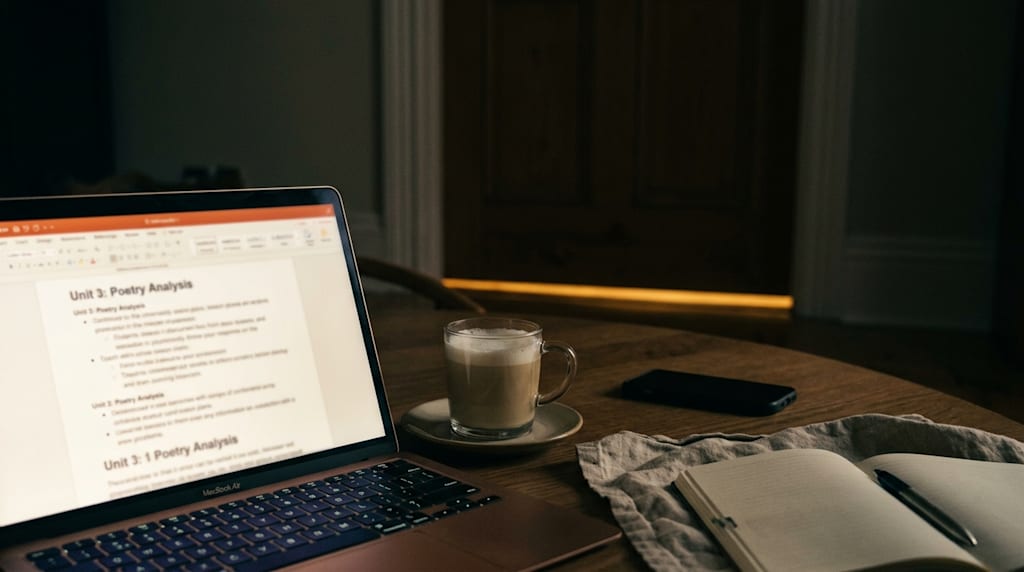
I sat at the dining table. Laptop open. The screen flickered to life—tomorrow's lesson plans, the same ones I'd been revising for three days.
I put my red pen beside the keyboard.
Her door opened. Footsteps down the hall. She stopped in the kitchen doorway.
I didn't look up.
She stood there. Two seconds. Three.
I heard her open the cupboard. A glass. Water from the tap.
I pulled up the second page of my lesson plans. Made a mark on the page—a small edit, nothing important.
She came into the dining room. Stopped at the edge of the table. I could see her from the corner of my eye—the oversized sweatshirt, her hair pulled back, the way she stood like she was waiting for something.
Waiting for me to go to her room like I did every night. To check. To stand in her doorway. To watch.
I kept my eyes on the laptop.
She got her water. Turned back toward the hallway.
"You go back to your questions," I said.
She stopped.
I was still looking at the screen. "I'm looking at my teaching plans. You're gnawing on bones in medicine. I'm gnawing on bones in education." I clicked to the next page. "We each handle our own business."
She didn't say anything.
I heard her take a breath. Then she wrapped her fingers around the glass—I saw it from the corner of my eye. Both hands. Like she was holding something warm.
She looked at me. Not with guilt. Not with relief, either. Just—looking.
I didn't look up.
She nodded. Small. Almost nothing. Then her footsteps went back down the hall. Her door clicked shut.
I let out a breath I didn't know I'd been holding.
Down the hall, her light was still on. I could see the sliver of white under her door.
The kitchen light was off. The living room was quiet. Just me and the sound of my keyboard.
I put a glass of milk in the microwave. Warmed it for forty seconds. Placed it on the table—not next to her door, not with a note, just there, between my laptop and the edge of the table.
I didn't go down the hall.
I started typing. Lesson plans. The same words I'd typed a hundred times.
Down the hall, her light stayed on.
The milk cooled.
That was three weeks ago.
She still eats slowly. She still leaves rice in her bowl sometimes. I still wake up early and make her breakfast, and some days I'm tired and some days I'm not.
But I don't stand in her doorway anymore. I don't ask her to count my sacrifices back to me.
I'm learning to cook for her because she needs to eat, not because I need her to know I cooked.
The rest—whatever it is—is hers to figure out.
Down the hall, her light is on.
I'm at the table, with my red pen and my lesson plans.
The milk is warm.
She'll drink it when she's ready.
About the Creator
Jin
Writer of reamstories
https://reamstories.com/jin
Enjoyed the story? Support the Creator.
Subscribe for free to receive all their stories in your feed. You could also become a paid subscriber, letting them know you appreciate their work.
Comments
There are no comments for this story
Be the first to respond and start the conversation.