single
Non-nuclear is the new normal; sometimes one head is better than two.
My Parents Have One Son to Be Proud Of, and It's Not Me
At this point, I have written many times about how I have screwed up my life over and over, and how I am still now at a point of desperation and trying to climb up hill battles to fix myself and my life. Well, I have an older brother who, of course, has made his fair share of mistakes as well. However, unlike me, he generally does everything he is meant to do and then goes beyond that a little further.
By Timothy A Rowland3 months ago in Families
Andreas Szakacs on the Power of Community Support and Social Impact
In a world where many families continue to face challenges related to food security, healthcare access, and education, Andreas Szakacs believes that meaningful change begins at the community level. Through his commitment to philanthropy and social responsibility, Andreas Szakacs has become an advocate for initiatives that support children and families in underserved communities.
By Andreas szakacs4 months ago in Families
The Train That Arrived Yesterday
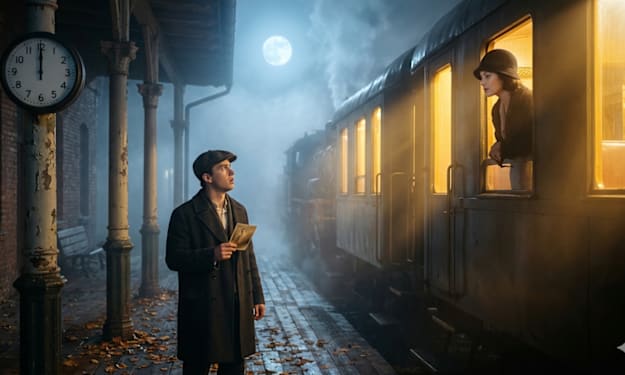
The train arrived every night at exactly midnight. No one knew where it came from. No one knew where it went. And no one except me seemed to notice it. The station itself was forgotten by the world. Old benches collected dust. The ticket office had been closed for years. The clock above the platform was frozen at 11:59, its hands refusing to move no matter how much time passed. Yet every night, as the final minute of the day slipped away, the silence would tremble. A distant whistle would echo through the darkness. And the train would arrive. The first time I saw it, I thought I was dreaming. The locomotive was ancient, black as midnight, with golden trim that glowed softly beneath the moonlight. Steam drifted around it like ghosts escaping from another century. Its windows shone with warm amber light. But the strangest thing was the passengers. Some wore clothing decades out of fashion. Others carried suitcases that looked older than my grandparents. They stepped on and off the train quietly, as if following rules no one had explained. Whenever I tried to speak to them, they simply smiled and walked away. Until I met her. --- It happened on a rainy autumn night. The platform was empty except for me. The train emerged from the fog exactly at midnight. As the doors opened, passengers stepped out one by one. Then I saw her. A young woman wearing a long blue coat. Dark hair. Thoughtful eyes. A face that felt strangely familiar. She paused when she noticed me. Then she smiled. Not politely. Not cautiously. The way someone smiles when they recognize an old friend. And before I could say anything, she spoke. “Hello again.” Again. The word struck me like lightning. I had never seen her before. At least, I didn't think I had. “Do I know you?” I asked. Her smile faded slightly. “You don't yet.” --- Before I could ask another question, the conductor called for departure. The woman stepped backward toward the train. “Wait!” I shouted. “Who are you?” She hesitated. Then answered softly. “Someone from yesterday.” The doors closed. The train pulled away. And she disappeared into the night. --- The next evening I returned. And the evening after that. And the one after that. Every night the train arrived. Every night she appeared. And every night she revealed a little more. But never enough. We talked about books. About music. About cities neither of us had visited. About dreams. About regrets. It felt less like meeting a stranger and more like remembering someone I had forgotten. The strangest part was how much she knew about me. She knew my favorite song. My childhood fears. The stories I never told anyone. Even memories I barely remembered myself. Whenever I asked how she knew these things, she would simply smile. “Because I've already heard them.” --- Weeks passed. My curiosity grew unbearable. One night I finally demanded the truth. “Who are you?” The question hung in the air between us. The station was silent. The moon watched from above. And for the first time, she looked afraid. “You really don't remember?” “Remember what?” She lowered her eyes. Then reached into her coat pocket. From it, she pulled an old photograph. The edges were worn. The image faded. She handed it to me. My hands trembled as I looked. The picture showed two people standing together beside a train. One was her. The other was me. Only older. Much older. --- I stared at the photograph. It made no sense. “Where did you get this?” She looked away. “From tomorrow.” I laughed nervously. “That isn't possible.” “No,” she said quietly. “It isn't.” --- The train whistle echoed through the darkness. Departure time. But neither of us moved. “I don't understand,” I whispered. She nodded. “I know.” Then she took a deep breath. “The train doesn't travel across places.” My heart pounded. “It travels across time.” The world suddenly felt unreal. The station. The passengers. The clock frozen at midnight. Everything clicked into place. “This train...” I began. “It arrives from different years,” she said. “Different lives. Different futures.” I looked at the photograph again. At the older version of myself. At the woman standing beside him. And suddenly I knew. --- “You're from my future.” Tears appeared in her eyes. “Yes.” The answer shattered something inside me. And healed something, too. Because somehow I had known all along. Known in the way hearts recognize truths before minds do. --- The conductor called once more. Final boarding. The train would leave soon. “Can you stay?” I asked. She smiled sadly. “No.” “Why?” “Because if I stay, I never meet you.” The words felt impossible. Cruel. Beautiful. All at once. --- For a long moment neither of us spoke. The station seemed suspended outside of time. Perhaps it always had been. Finally she stepped closer. Close enough for me to see the tears shining in her eyes. “You spend years looking for certainty,” she whispered. “But the best things in life arrive before you're ready for them.” I wanted to remember every word. Every expression. Every heartbeat. Because I knew this moment would never happen again. --- The train began to move. Slowly. Reluctantly. As though even it hated goodbyes. She stepped onto the carriage. The doors started to close. Then she looked back one final time. And smiled. The same smile she had worn the first night. The smile of someone greeting an old friend. “Don't worry,” she called. “We meet again.” The doors shut. The train disappeared into the fog. And the station became silent once more. --- I never saw her again. The midnight train never returned. The platform remains abandoned. The clock still points to 11:59. Sometimes I visit anyway. Not because I expect the train. Not because I expect answers. But because somewhere in the future, beneath another moon, a woman remembers me. And every time I hear a distant whistle carried by the wind, I smile. Because perhaps she was right. Perhaps some meetings are not beginnings or endings. Perhaps they are promises. And somewhere beyond yesterday, today, and tomorrow— our story is still traveling down the tracks. 🚂🌙✨
By Khalil Ullah5 months ago in Families
The Moon Kept Her Secrets
Not in the way the moon follows everyone, rising faithfully over cities and oceans, but in a way that felt personal. Whenever she appeared, the night seemed to rearrange itself around her. The silver light would soften. The shadows would lean closer. Even the stars seemed quieter, as though listening. And she loved the moon. Not because it was beautiful, but because it understood something about hiding. “The moon never tells its secrets,” she once said. I laughed. “It’s a giant rock in space.” She smiled. “No. It’s a diary no one can read.” At the time, I thought it was another one of her strange poetic thoughts. Years later, I would realize she was talking about herself. I met her during a season when my life felt ordinary. Days arrived and left without leaving marks. Nothing hurt. Nothing healed. Nothing changed. Then she appeared. Some people enter your life through the front door. She arrived like moonlight through an open window. Quiet. Unexpected. Impossible to ignore. She carried books everywhere. The pages were filled with notes written in tiny handwriting. Sometimes she would stare at the sky for long periods and refuse to explain what she was thinking. “Tell me,” I would ask. And she would shake her head. “Not everything needs to become words.” That was her habit. She kept pieces of herself hidden. Not because she didn't trust people. Because some mysteries were the only things she truly owned. One night we sat beside a lake. The water reflected the moon perfectly. For a moment it looked as though there were two moons—one in the sky and one beneath it. She stared at them silently. “Do you ever wonder,” she asked, “how much people never tell each other?” I shrugged. “A little.” “I think everyone is carrying an entire universe they never share.” The breeze moved her hair across her face. She didn't move it away. She kept watching the moon. “And sometimes,” she whispered, “the things we never say become the biggest part of who we are.” I didn't know then that she was describing herself. The months passed. We became inseparable. At least that's what I believed. We walked through crowded streets. Shared late-night conversations. Sent messages that stretched until dawn. I knew her favorite songs. I knew how she took her coffee. I knew the sound of her laugh before it happened. But there were still rooms inside her heart whose doors remained closed. Whenever conversations moved too close to certain memories, she would change the subject. Whenever questions became too personal, she would smile and point toward the moon. “Ask that instead.” And somehow, I never pushed further. Then came the night everything changed. The moon was full. Bright enough to paint silver across the rooftops. We sat together in silence. For once she seemed nervous. As though words were standing at the edge of her lips but refusing to jump. “I should tell you something,” she said. I waited. The wind moved through the trees. The city hummed in the distance. But she never finished the sentence. Instead she looked up at the moon. Her eyes filled with a sadness I had never seen before. Then she smiled. A small smile. The kind people wear when they're trying not to break. “Never mind.” I wanted to ask. I wanted to insist. But something stopped me. Maybe fear. Maybe respect. Maybe the feeling that some secrets are protected by forces stronger than curiosity. A week later, she was gone. No dramatic goodbye. No explanation. No final confession. Only absence. The cruelest language in the world. I searched for reasons. Read old messages. Replayed old conversations. Looked for clues hidden between ordinary sentences. But there was nothing. Only silence. And the moon. Always the moon. Watching from above like a witness refusing to testify. Years passed. Life continued the way life always does. New places. New people. New stories. But every now and then, I would find myself looking up at the night sky. And remembering. Not her face. Not her voice. Her mysteries. The things she never said. The secret she almost revealed. The truth she carried away. I realized something strange. I missed her less than I missed the questions she left behind. Because answers bring endings. Questions stay alive. One autumn evening, I opened an old box filled with forgotten memories. Inside was a photograph. A dried flower. A ticket stub. And a folded piece of paper in her handwriting. My heart stopped. I unfolded it slowly. The paper had yellowed with age. The ink had faded slightly. But her words remained. There wasn't much written there. Only a few lines. "Some secrets are not hidden because they're dark." "Some are hidden because they're beautiful." "If one day I'm gone, don't spend your life searching for answers." "Just look at the moon." "It already knows." I read those words again and again. And suddenly I understood. The secret itself had never mattered. What mattered was the trust. The love. The invisible thread connecting two people even when explanations are missing. That night I went outside. The sky was clear. The moon hung above the world exactly as it had years ago. Ancient. Patient. Silent. I looked up and smiled. For the first time, I stopped wondering what she never told me. Some mysteries aren't meant to be solved. Some stories aren't meant to be completed. Some people leave behind questions instead of answers because questions continue shining long after answers fade. And as the moonlight covered the earth in silver, I finally made peace with the unknown. Because the moon still kept her secrets.
By Khalil Ullah5 months ago in Families
The Girl Who Taught Rocks to Sing
Nina found the first singing rock on a Tuesday, when she was supposed to be collecting soil samples for science class. She was twelve, and she hated science class, because science class was always about taking things apart to see how they worked, and Nina preferred to leave things whole and listen to them. The rock was gray, flat, and warm from the sun. She picked it up to skip it across the creek, and it hummed. Not loudly. Not like a radio. Like a refrigerator, or a faraway bee. A low, steady note that she felt in her teeth. She dropped it. The hum stopped. She picked it up again. The hum returned. “Nina?” Her teacher called from up the hill. “You find anything?” She slipped the rock into her pocket. “No,” she lied. That night, she took it out under her desk lamp. She held it to her ear. The hum was clearer now, and it had a rhythm. Three short, one long. Three short, one long. Morse code, her grandfather would have said. But Nina didn’t know Morse code. She just knew the rock was trying to say something. The next day she went back to the creek with an empty backpack. She didn’t collect soil. She collected rocks. One by one, she picked them up, held them to her ear, and listened. Most were silent. But every tenth rock, or so, hummed. Each with a different note. One was high and thin, like a flute. One was deep, like a drum. One sounded like wind through grass. By Friday she had seventeen singing rocks. She lined them up on her windowsill. On Saturday, she tapped them with a pencil. The first tap made the gray rock hum. The second tap made the flute-rock answer. The third tap made the drum-rock join in. Nina kept tapping, moving down the line, and the rocks made a melody. Simple, but real. A song. She played it for her cat. The cat tilted its head. She played it for her mom. Her mom smiled and said, “That’s nice, honey,” and went back to folding laundry. She didn’t play it for her science teacher. On Monday, she brought the rocks to school. She waited until recess, when no one was around, and she tapped out the song on the picnic table. That’s when she heard the answer. It came from under the table. A low, rumbling note, like the earth clearing its throat. She knelt down and put her ear to the concrete. The picnic table was singing back. Nina spent the rest of the year mapping it. The schoolyard had a bass line. The creek had a treble. The old oak tree hummed in a key she didn’t have a name for. The rocks were the melody. She started carrying a notebook. Not for school. For music. She wrote down where each rock sang, what note it held, how it changed in the rain. Her grades dropped. Her teacher called her mom. “Nina seems distracted,” he said. “She’s always listening to things.” “I am,” Nina said when her mom asked her about it. “To what?” “Everything.” Her mom didn’t get it. But she didn’t stop her, either. The summer she turned thirteen, Nina took her rocks to the top of the hill behind her house. She laid them out in a circle. She sat in the middle. She tapped. The song started small, just her rocks. Then the hill joined in. Then the trees. Then the wind. It wasn’t loud. It wasn’t for anyone else. It was the sound of the world, finally being heard. She closed her eyes and listened. Later, people would ask her how she did it. How she taught rocks to sing. She never corrected them. She didn’t teach them anything. She just listened long enough for them to remember they had a voice.
By Khalil Ullah5 months ago in Families
Ink on the Edge of Her Silence
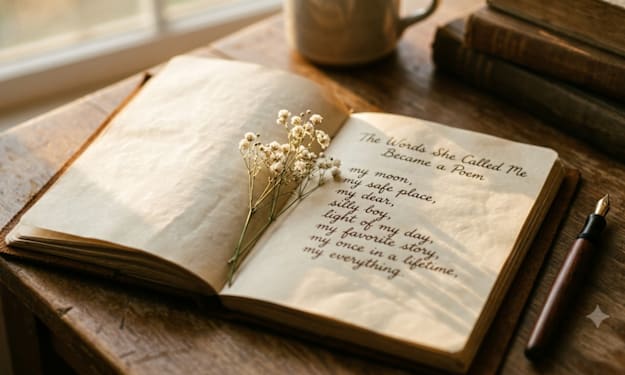
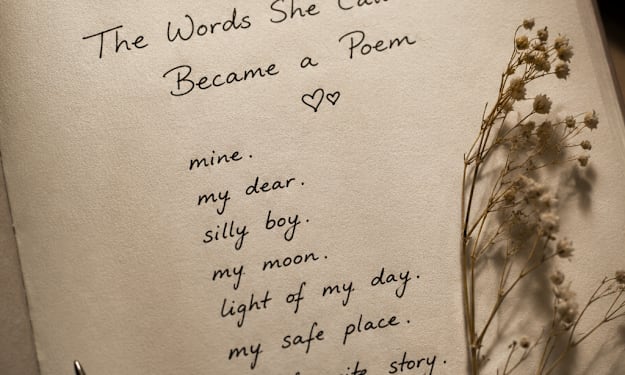
The first time she called me “mine,” it was accidental. We were 19, stuck in a campus library during a thunderstorm. The lights flickered, the windows shook, and she grabbed my sleeve without thinking. “Mine,” she whispered, like she was reminding the storm I belonged to someone. I laughed it off. But that night I wrote it in the margin of my physics notes. Just that one word. _Mine._ After that, the names started coming. Not all at once. They arrived the way seasons change — so slowly you only notice when everything looks different. “*My dear*,” she said when I brought her coffee the way she liked it, black with one sugar, even though I always got mine wrong. She said it soft, like she was tasting the words. I pretended not to care. I wrote it on a receipt and kept it in my wallet until the ink faded. “*Silly boy*,” she called me the day I tried to fix her wobbly desk chair with a library card and too much confidence. I fell backward, and she laughed until she cried. Then she knelt beside me, pushed hair out of my eyes, and said it again: “Silly boy.” Not mocking. Fond. The way you say it to something small and loved that keeps breaking. We never dated, not officially. We were two people orbiting each other in shared spaces: late-night study rooms, coffee shops that closed at 2am, bookstore aisles where we’d read aloud to each other just to hear the sound. Everyone else asked if we were together. We said no. But she kept naming me, and I kept becoming those names. When my mother got sick, I stopped sleeping. I’d sit by the hospital window and she’d sit beside me, not talking, just being there. One night I fell asleep and woke up to her voice, barely a breath: “*My moon*.” She was looking at me, not the sky. “You light up even when you’re dark.” I didn’t have words for that, so I carried it home instead. I wrote it on the back of a prescription slip. _My moon._ She had a way of seeing me that I didn’t have for myself. When I got rejected from the graduate program I wanted, I called myself a failure. She called me “*light of my day*” and dragged me to the bookstore. We spent hours there, not buying anything, just reading the first pages of random novels and inventing endings. “You’re not a rejection letter,” she said. “You’re the part people reread.” The names became a map of us. “*My safe place*” the night I told her about my father. “*My favorite story*” when I stayed up till dawn helping her finish her thesis, both of us delirious, quoting bad poetry. “*My once in a lifetime*” on her last day in the city, before she left for a job three countries away. She said it without looking at me, while she was packing books into boxes. I stood in the doorway and pretended my chest wasn’t caving in. I thought that would be the last one. People leave, names fade. But two years later, a letter came. No return address, just my name in her handwriting. Inside, a single sheet of notebook paper. At the top, in her cursive: _The Words She Called Me Became a Poem_. Under it, the list. _mine._ _my dear._ _silly boy._ _my moon._ _light of my day._ _my safe place._ _my favorite story._ _my once in a lifetime._ _my everything._ And at the bottom: “I kept calling you until you believed you were loved. Did it work?” I read it in a coffee shop, the same one where she first called me “my dear.” The barista asked if I was okay. I wasn’t crying. Not exactly. It felt more like a book finally closing on the right page. I never answered the letter. Not with words. I started writing. Stories, mostly. Small ones about people who learn each other through the names they give. I put them in journals, then online, then in a thin collection I self-published. I dedicated it to her, though I never used her real name. I just wrote: _For the girl who turned me into a poem._ People ask me what the book means. I tell them it’s about nicknames. That’s technically true. But really, it’s about being seen. She took all the sharp, uncertain parts of me and gave them soft edges with language. She didn’t change who I was. She just told me who I could be, one name at a time. Sometimes I still get messages from strangers: “You called me ‘my safe place’ in chapter 3 and I needed that today.” I always think of her when I read them. I hope she knows her names traveled farther than she did. I keep that letter in a book on my shelf. Not for nostalgia. For practice. On bad days, when I forget myself, I open it and read the list out loud. _Mine. My dear. Silly boy. My moon. Light of my day. My safe place. My favorite story. My once in a lifetime. My everything._ She was right. The words she called me did become a poem. And I became a man who knows how to live inside one.
By Khalil Ullah5 months ago in Families
The Words She Called Me Became a Poem
There are memories that do not arrive like events. They do not knock, do not announce themselves, do not ask permission to stay. They simply become language inside you—quiet, uninvited, permanent. I did not remember the day I met her the way people usually remember beginnings. There was no thunder in the sky, no dramatic silence in the room, no sign that something irreversible was happening. Only a table near a window, a half-empty cup of tea, and the way she said my name as if it had always belonged to her voice. Not my full name. Not the name the world used. But smaller names. Softer names. Names that did not feel like labels, but like meanings being discovered for the first time. “Mine,” she said once—not as possession, but as recognition. As if she had finally found something she had been missing in every sentence she ever wrote. And I remember thinking—strangely—that I had never truly existed until she renamed me in her tone. --- She spoke like poetry even when she was angry. When she was quiet, it felt like unfinished verses hanging in the air, waiting for the right breath to complete them. She did not write poems the way poets do. She wrote them the way people bleed without noticing. Slow. Honest. Uncontrolled. And I became one of her lines. Not the beginning. Not the ending. Somewhere in the middle where meaning is uncertain but necessary. She called me things I did not understand at first. “Dear.” Not as distance. But as closeness too heavy to explain. “Silly boy.” Not as insult. But as forgiveness already given in advance. “Moon.” Not as metaphor. But as something that stays even when it disappears. Each word she gave me was not just a sound—it was a version of me I had never met before. And slowly, I stopped recognizing myself without them. --- There was a notebook she kept with her everywhere. Old paper. Soft edges. Ink that sometimes bled like it was remembering more than it was writing. I saw my name appear there once. Not the official one. Not the one on documents or introductions. But the name she had invented for me in silence. It was surrounded by other words—careless, beautiful, unedited: light of my day safe place my favorite story my once in a lifetime I did not know I was allowed to be all of that at once. I did not know a person could exist as someone else’s poetry without becoming fiction. But there it was. Black ink. Certain. Irrevocable. And I understood something I was not ready to understand: She was not writing about me. She was writing me. --- Time did what time always does—it blurred the edges of everything that was once sharp. Her voice still existed, but differently. Like a song remembered through walls. Her words still came, but less often. Like rain forgetting where it used to fall. But even when she was not speaking, I could still hear her naming me. Because once someone turns you into poetry, you do not return to silence easily. You carry their language in your bones. --- One evening, I found her writing again. Same table. Same light. Same notebook. But something had changed. Not in her hands—but in the way she hesitated before each word. She looked up at me once, briefly, like she was deciding whether I still belonged in the same sentence as before. And then she wrote something I was not meant to see. Not a name this time. Not a nickname. Not a poem. Just a line, unfinished: “How do I call someone who has already become everything I wrote them to be?” I did not answer. Because I realized she was not asking me. She was asking language itself. --- That night, I left without dramatic endings. No slammed doors. No final arguments. No cinematic goodbye. Only the quiet understanding that some poems are not meant to be continued aloud. But even after leaving, I carried her words like pockets filled with invisible ink. And sometimes, in the silence of ordinary days, I still hear her voice forming me again: Not as I am. But as she once called me. Moon. Dear. Silly boy. Mine. --- Years later, I learned something unexpected. People do not remember you as you are. They remember you as the words they used to describe you. And she had used the kind of words that do not fade easily. So when I think of her now, I do not think of an ending. I think of a page still being written somewhere I cannot see. And I understand finally: I was never just a person in her life. I was a poem she refused to stop reading. And she was the language I never learned to forget.
By Khalil Ullah5 months ago in Families
The archivist of small moment. AI-Generated.
I tried to generate an image of a woman reading aloud to a man in a cozy room lit by evening light, but it didn’t go through. Picture this instead: warm lamplight, two mugs cooling on a table, a stack of worn paperbacks between them, and her voice filling the space while he leans fmira believed love lived in specifics. Not in grand declarations or anniversary posts, but in the way someone remembered you hated cilantro, or how they saved the last piece of bread for you without making it a thing. She kept a small notebook for these things. “Evidence,” she called it, half joking. On page three: _He notices when I re-tie my hair twice. That means I’m anxious._ On page seven: _He buys oranges even though he doesn’t like them, because I peel them without thinking._ She wasn’t looking for anyone when she met Jonah. She was shelving returns at the public library downtown, the one with creaky floors and windows that let in too much afternoon sun. Jonah came in every Tuesday. Not for books. For stories. He’d tell the librarian that he had the attention span of a moth, but if something was interesting, he’d sit through anything. He asked Mira once, “What’s the strangest true thing you’ve read this week?” If her answer was boring, he’d smile, return the book, and leave. If it wasn’t, he’d pull up a chair. Mira started keeping a second list in her notebook. Not of love, but of stories worth telling. She learned his rules quickly: no clichés, no moral lectures disguised as plot, no endings he could see coming from page one. He liked stories about people making odd choices for honest reasons. A woman who quit her job to become a lighthouse keeper. A man who spent ten years writing letters he never sent. A kid who mapped every staircase in the city because he was afraid of getting lost. The first time Mira told him a story instead of finding one, it was by accident. He asked about the notebook. She said it was just notes. He asked, “Notes about what?” She should have said “nothing.” Instead she told him about the barista who drew the same leaf on every cup, but one morning drew a sparrow instead. She never saw him again after that. Mira finished with, “I think he was practicing for when he’d have to leave.” Jonah didn’t speak for a long time. Then he said, “That’s an interesting story.” He came back the next Tuesday. Weeks turned into a rhythm. She’d save odd details during her day. He’d show up with questions. They never called it a date. They called it “office hours.” He’d sit across from her at the table by the history section and she’d test stories on him. If he asked a follow-up question, she knew it worked. If he checked his phone, she retired it. What Mira didn’t write in the notebook was that she was falling for the way he listened. He didn’t listen to reply. He listened like a story might change him. When she told him about her brother who moved away and only sent postcards of doors, Jonah asked, “What kind of doors?” She said, “Old ones. Paint peeling. Brass knobs.” He nodded like that mattered. It did, to her. Jonah, for his part, stayed because Mira never performed. She didn’t try to be profound. She just paid attention. He’d spent years chasing interesting people, ideas, cities. He thought interesting was loud. Mira taught him it was specific. The way rain sounds different on a car roof than on a tent. The way her mother folded towels into thirds, never halves. The way Jonah himself always paused half a second before answering a hard question, as if checking the answer for sharp edges. One Tuesday he didn’t come. Mira told her story to the empty chair anyway. It was about a man who collected questions instead of answers, and how that made him hard to love but easy to miss. She closed the notebook and felt silly. Love as evidence. Stories as currency. What was she doing? He came the next day, Wednesday, which wasn’t his day. He looked tired. He said, “I was trying to see if I missed the stories or I missed you telling them.” Mira didn’t write that down. She didn’t need to. She said, “What’s your answer?” He said, “I think the interesting part was that you were paying attention to me while you paid attention to everything else.” After that, the rules changed. Sometimes he told stories. Bad ones, mostly, about a guy who tried to learn pottery and made only lopsided bowls. Mira laughed at those. She liked that he could be uninteresting on purpose, just to see if she’d stay. She did. Love, for Mira, became the habit of noticing. For Jonah, it became the habit of staying for the next sentence, even when he thought he knew the ending. He stopped asking if stories were interesting. He started asking if they were true. Mira stopped collecting evidence and started living inside it. Years later, someone asked Mira how she knew Jonah was the one. She opened the notebook. The early pages were full of details about him. The later pages were blank. “I ran out of things to prove,” she said. “I just had things to keep.” Jonah still likes interesting stories. But his favorite one is the same as hers. Two people who learned that love isn’t loud. It’s specific. And that the most interesting story you’ll ever hear is the one where someone chooses to stay, sentence by sentence, until the ending stops matteried
By Khalil Ullah5 months ago in Families
The Letters He Never Sent. AI-Generated.
Maya found the box on a Tuesday. Tuesdays were quiet in her apartment. No one called. The mail came late. The radiator made the only noise that mattered. She was cleaning because cleaning was easier than grieving. David had been gone three months. Three months of “he’s in a better place” and casseroles from neighbors. Three months of waking up and reaching for a warmth that wasn’t there. The box was behind his desk. An old shoebox with “Taxes 2009” written on it in his handwriting. He was a man who labeled everything. He labeled the leftovers, the spare keys, the exact day they planted the oak tree in the backyard. “April 14, 2011. Don’t forget.” She hadn’t. She expected receipts. Instead she found letters. Dozens of them. Envelopes yellowed at the edges. None of them had stamps. None had been mailed. The first one was dated two weeks after their wedding. 1987. His handwriting was younger then, impatient, the letters leaning forward like he was in a hurry to tell her something. _My love, I don’t know how to say this out loud yet. Today you laughed at my terrible cooking and burned the chicken with me. You didn’t pretend it was good. You just ate it anyway. I think that’s how I knew. I’m not good at big speeches. But I’m good at you. I’ll spend my life being good at you._ Maya sat down on the floor. The radiator hissed. She read another. And another. One from the year their daughter was born, when David didn’t sleep for three months and she thought he was angry at her. _I’m not angry. I’m scared. I’m scared I won’t be enough for her. You make it look easy. You make everything look easy. I write this at 3 a.m. while you both sleep. I just needed you to know, even if I never show you. You’re the reason I’m not scared anymore._ There were letters for every year. For fights they never resolved. For the day she lost her job and pretended it didn’t matter. For the anniversary he forgot because he was fixing the roof. _I’m sorry I was on the roof. I should have been on my knees. You deserved more than shingles and apologies. You deserved me, present. I’ll try to be present tomorrow. I’m writing this so I don’t forget to try._ The last one was dated two weeks before he died. His handwriting was shaky. The letters spilled off the line. _My love, The doctors use words like “progressive” and “palliative.” I use the word “us.” That’s the only word that matters. If I don’t get to say this right, let this paper do it. You were my best decision. Every day. Even the hard days. Especially the hard days. You made my life bigger than I was. Don’t you dare shrink now that I’m gone. Keep being big. Keep being you. I’ll be the wind that moves your curtains. That’s enough for me._ Maya pressed the letter to her face. It smelled faintly like him. Like cedar and the soap he always bought even though she said it was too expensive. All those years she thought he was quiet. That he didn’t know what to say. That men from his generation just didn’t talk about feelings. She’d made peace with it. She loved him anyway. She thought love was in the way he fixed things, paid bills on time, remembered to bring her coffee without asking. She never knew love was also here. In ink. In words he was too shy to speak but too full to keep inside. He wrote them because saying them felt too big for his throat. So he gave them to paper instead. She spent the whole week reading. Not crying. Not yet. Just reading. Like she was meeting him again for the first time. The man who noticed when she was scared. The man who felt guilty for forgetting anniversaries. The man who, at 3 a.m. with a newborn, was terrified of not being enough. He never mailed them because he never wanted credit. He wrote them because he needed her to know, even if he couldn’t say it. Because love, for him, wasn’t performance. It was proof. Proof he was paying attention. On Sunday she took the letters to the oak tree. April 14, 2011. She read the last one out loud. The wind moved the curtains in the house behind her. Just like he said it would. She talked to him after that. Not out loud. But she wrote back. On the back of his letters, in the margins, on new paper she tucked into the box. _I read them, David. I know now. You were never quiet. You were just careful with your words. I’m not shrinking. I’m growing. For both of us. The wind is enough. But your words are better._ Three months turned into six. Six into a year. She still had Tuesdays. They were still quiet. But now the quiet had his voice in it. She found the box because she was looking for taxes. She kept the box because she found her husband. The one who loved her in sentences he was too humble to speak. She didn’t need him to say it out loud anymore. He already had. In letters he never sent, but wrote anyway. For her. For always. She wasn’t alone on Tuesdays now. She had 40 years of conversations to catch up on. And she was just getting started
By Khalil Ullah5 months ago in Families
Her lovely talks. AI-Generated.
He came in because of the rain. That’s the honest truth. The map on his phone died at 7% battery, and the old bookstore on 4th Street had its door open with a little bell that sounded like an apology. He just needed directions. Five minutes, dry off, then back to the conference hotel three blocks away. She was behind the counter reading. Not scanning shelves or pretending to work. Actually reading, with a pencil in her mouth and her feet tucked under her. The kind of reading that makes the rest of the world quiet. “Excuse me,” he said. Water dripped off his coat onto the floor. “Can you tell me how to get to the Marlow Hotel?” She didn’t look up right away. She finished the sentence, set the pencil down, and then looked at him. Really looked. Like she was deciding if he was worth the interruption. “Marlow Hotel,” she repeated. “You’re standing in it.” He blinked. “No, I’m standing in a bookstore.” “Same thing,” she said, and smiled. “Both places are full of stories people check into. You just picked the one with better seating.” Her name was Maya. She told him that after he asked for directions three times and she gave him three different routes, each one longer than the last. She wasn’t bad at directions. She was good at conversations, and she’d decided he needed one more than he needed efficiency. “Why are you stalling?” he finally asked, laughing despite himself. Rain was still coming down hard outside. “Because you walked in here looking like a man with a tight schedule,” she said. “Tight schedules miss things. Like this.” She held up the book she was reading. “It’s about a man who travels across the world to find his brother. Takes him ten years. He writes letters the whole time to a woman he never meets. By the end you realize he wasn’t looking for his brother. He was looking for permission to be soft.” “I don’t have time for ten years,” he said. “Good,” she replied. “You have five minutes. That’s better. Ten years makes you lazy. Five minutes makes you honest.” So he stayed. Not because he was lost, but because she talked like no one he’d met before. She didn’t ask what he did for work. She asked what he did when no one was watching. She didn’t ask where he was from. She asked what place made him feel like he could breathe. He told her about his dad’s garage and the smell of motor oil. She told him about her grandmother who shelved books by color because “moods matter more than authors.” He said he hated small talk. She said, “Then let’s do big talk. What’s something true you’ve never said out loud?” He almost left then. That question was too close, too fast. But the rain hadn’t let up, and neither had she. So he said, “I’m afraid I’m only interesting when I’m useful.” Maya nodded like he’d just handed her something fragile. “That’s why you came in for directions,” she said. “Useful is safe. Useless is where you get to be loved.” They talked until the rain stopped. Until his phone died completely. Until the street outside turned gold with streetlights and the bookstore felt more like a living room than a shop. He never did get directions to the Marlow Hotel. He didn’t need them. He ended up staying three blocks away for another week just to come back every evening at 6 p.m. She gave him books instead of answers. He gave her his quiet instead of small talk. It wasn’t love, not at first. It was better. It was recognition. The feeling of being seen without having to perform. On the last night before his conference ended, he showed up with a map he’d drawn himself. Not of the city. Of the bookstore. Every shelf, every corner, every place she stood when she told a story. “I came for directions,” he said, setting it on the counter. “I know,” she said. “I gave you better ones.” She didn’t ask him to stay in the city. He didn’t ask her to leave the bookstore. But six months later he quit the job that kept him traveling. He moved three blocks away. He got a job that ended at 5 p.m. And every evening at 6 p.m., he walked into the bookstore. Not lost anymore. Not needing directions. Just needing her lovely talks. The ones that taught him that the shortest route between two people isn’t a straight line. It’s a question, asked at the right time, by the right person. He came for directions. She gave him a reason to stay. And he’s still there.
By Khalil Ullah5 months ago in Families