
Ink on the Edge of Her Silence
He learned her quiet, one unsent letter at a time

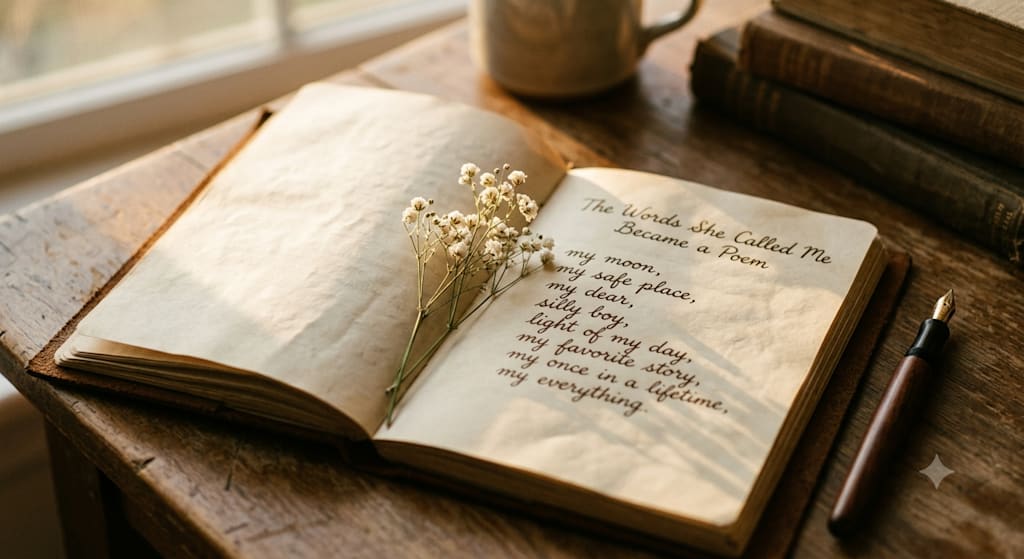
The first time she called me “mine,” it was accidental. We were 19, stuck in a campus library during a thunderstorm. The lights flickered, the windows shook, and she grabbed my sleeve without thinking. “Mine,” she whispered, like she was reminding the storm I belonged to someone. I laughed it off. But that night I wrote it in the margin of my physics notes. Just that one word. _Mine._ After that, the names started coming. Not all at once. They arrived the way seasons change — so slowly you only notice when everything looks different. “*My dear*,” she said when I brought her coffee the way she liked it, black with one sugar, even though I always got mine wrong. She said it soft, like she was tasting the words. I pretended not to care. I wrote it on a receipt and kept it in my wallet until the ink faded. “*Silly boy*,” she called me the day I tried to fix her wobbly desk chair with a library card and too much confidence. I fell backward, and she laughed until she cried. Then she knelt beside me, pushed hair out of my eyes, and said it again: “Silly boy.” Not mocking. Fond. The way you say it to something small and loved that keeps breaking. We never dated, not officially. We were two people orbiting each other in shared spaces: late-night study rooms, coffee shops that closed at 2am, bookstore aisles where we’d read aloud to each other just to hear the sound. Everyone else asked if we were together. We said no. But she kept naming me, and I kept becoming those names. When my mother got sick, I stopped sleeping. I’d sit by the hospital window and she’d sit beside me, not talking, just being there. One night I fell asleep and woke up to her voice, barely a breath: “*My moon*.” She was looking at me, not the sky. “You light up even when you’re dark.” I didn’t have words for that, so I carried it home instead. I wrote it on the back of a prescription slip. _My moon._ She had a way of seeing me that I didn’t have for myself. When I got rejected from the graduate program I wanted, I called myself a failure. She called me “*light of my day*” and dragged me to the bookstore. We spent hours there, not buying anything, just reading the first pages of random novels and inventing endings. “You’re not a rejection letter,” she said. “You’re the part people reread.” The names became a map of us. “*My safe place*” the night I told her about my father. “*My favorite story*” when I stayed up till dawn helping her finish her thesis, both of us delirious, quoting bad poetry. “*My once in a lifetime*” on her last day in the city, before she left for a job three countries away. She said it without looking at me, while she was packing books into boxes. I stood in the doorway and pretended my chest wasn’t caving in. I thought that would be the last one. People leave, names fade. But two years later, a letter came. No return address, just my name in her handwriting. Inside, a single sheet of notebook paper. At the top, in her cursive: _The Words She Called Me Became a Poem_. Under it, the list. _mine._ _my dear._ _silly boy._ _my moon._ _light of my day._ _my safe place._ _my favorite story._ _my once in a lifetime._ _my everything._ And at the bottom: “I kept calling you until you believed you were loved. Did it work?” I read it in a coffee shop, the same one where she first called me “my dear.” The barista asked if I was okay. I wasn’t crying. Not exactly. It felt more like a book finally closing on the right page. I never answered the letter. Not with words. I started writing. Stories, mostly. Small ones about people who learn each other through the names they give. I put them in journals, then online, then in a thin collection I self-published. I dedicated it to her, though I never used her real name. I just wrote: _For the girl who turned me into a poem._ People ask me what the book means. I tell them it’s about nicknames. That’s technically true. But really, it’s about being seen. She took all the sharp, uncertain parts of me and gave them soft edges with language. She didn’t change who I was. She just told me who I could be, one name at a time. Sometimes I still get messages from strangers: “You called me ‘my safe place’ in chapter 3 and I needed that today.” I always think of her when I read them. I hope she knows her names traveled farther than she did. I keep that letter in a book on my shelf. Not for nostalgia. For practice. On bad days, when I forget myself, I open it and read the list out loud. _Mine. My dear. Silly boy. My moon. Light of my day. My safe place. My favorite story. My once in a lifetime. My everything._ She was right. The words she called me did become a poem. And I became a man who knows how to live inside one.
About the Creator
Enjoyed the story? Support the Creator.
Subscribe for free to receive all their stories in your feed.
Comments
There are no comments for this story
Be the first to respond and start the conversation.