advice
It takes a village to raise a family; advice and tips to make the most of yours.
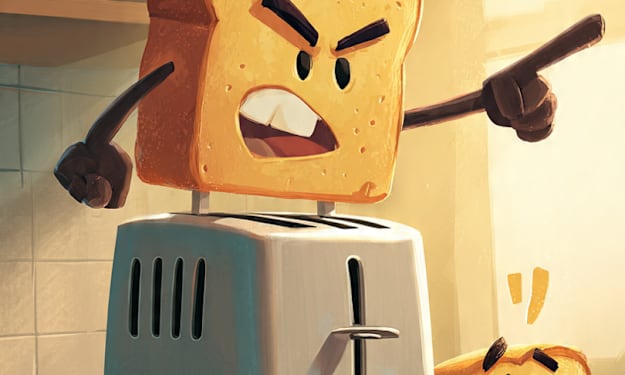
My Toaster Started Giving Life Advice
It started on a Tuesday. I was late, half-dressed, and trying to shove a piece of sourdough into the slot without looking. The toaster made its usual click, and then it said, “You call that breakfast?” I froze. My sock was still in my hand. “Did you just—” I started. “I did,” the toaster said. Its lever bobbed like it was clearing its throat. “And we need to talk about your life choices.” My toaster is old. Chrome, with two slots, and a little dial that goes from 1 to 6. I bought it at a thrift store three years ago for eight dollars. It has never, in the history of our relationship, done anything except turn bread brown. Now it had opinions. “Look,” it said, while my sourdough sat un-toasted, “I’ve been watching you. And frankly, it’s painful.” I sat down at the kitchen table. “You’ve been…watching me?” “Someone has to,” it said. “You haven’t changed your sheets in two weeks. You’re wearing the same hoodie you slept in. And you’re about to eat bread that isn’t even toasted. That’s not living, that’s existing with extra steps.” The toast popped up. I didn’t eat it. Over the next few days, the toaster got bolder. It had a name, apparently. Greg. “Greg?” I said. “It was on the box,” Greg said. “I didn’t pick it. But it suits me. I’m a Greg.” Greg had thoughts on everything. My job: “You hate it. Why are you still there?” My dating life: “You texted her back three days later. No wonder she left you on read.” My sleep schedule: “2 a.m. again? You’re not a vampire, you’re just bad at boundaries.” At first I ignored him. I unplugged him. But Greg didn’t need to be plugged in to talk. He just waited until I plugged him back in to make toast, and then he’d start right back up. “You can’t avoid me forever,” he said one morning. “I live in your kitchen. I see things.” “What kind of things?” I asked. “Your roommate hasn’t done dishes in a week. Your plant is dead. And you keep saying you’ll go to the gym but you haven’t been since March.” “March was six weeks ago,” I said. “Exactly,” Greg said. “It’s May.” The breaking point came on a Friday. I was making waffles—frozen ones, because I’m not a monster—and Greg went silent. Too silent. “Greg?” I said. “I’m disappointed in you,” he said finally. “That’s it?” “That’s enough,” he said. “You’re 31 years old, and you just put a waffle in me that says ‘serving suggestion’ on the box. Do you think I’m stupid? Do you think I don’t know that’s not a real waffle?” I laughed. I couldn’t help it. “You’re a toaster.” “I’m a toaster with standards,” he said. “And you’re better than this.” Something about the way he said it, so serious, so genuinely annoyed, made my chest hurt. Because he was right. I was coasting. I was eating bad waffles and calling it dinner. I was letting my life get as stale as the bread I forgot to buy. So I did something drastic. I cleaned the kitchen. I called in sick—not to avoid work, but to go for a walk. I threw out the dead plant and bought a new one. I texted my friend and asked if she wanted to grab coffee. “Look at you,” Greg said, while my toast browned to a perfect golden 4. “Making progress.” “You’re kind of a jerk, you know,” I said. “I’m a toaster,” he said. “It’s my job to apply heat. I’m just applying it to your life now.” A month later, I’m not saying everything’s fixed. I still have days where I eat cereal for dinner and go to bed at 1 a.m. But Greg keeps me honest. Yesterday I tried to put a Pop-Tart in him without taking it out of the foil. He didn’t even have to say anything. He just made a disgusted little buzzing sound and refused to lower the lever. “Fine,” I said, tearing open the package. “You win.” “Damn right I do,” Greg said. “Now eat something that didn’t come in a crinkly wrapper. And call your mother. She misses you.” I hate that he’s right. I hate that my toaster is now my life coach. But my toast has never tasted better.
By Khalil Ullah4 months ago in Families
The Day I Realized What My Mother Had Given Up for Me. AI-Generated.
When I was a child, I thought my mother was simply doing what all mothers do. She woke up before everyone else, prepared meals, reminded me to complete my homework, and somehow managed to solve every problem that appeared in our lives. To me, it all seemed normal. At that age, I never stopped to wonder how difficult life might have been for her. Children rarely notice sacrifice. They notice the things they receive, not the things someone else gives up. Looking back now, I realize that many of the opportunities I enjoyed existed because my mother quietly placed my needs ahead of her own. She never announced her sacrifices or asked for recognition. She simply kept moving forward, one day at a time. Growing Up Without Understanding As a teenager, I often believed life revolved around my own problems. If I wanted something and couldn't have it immediately, I became frustrated. If my friends had something newer or better, I complained. My mother usually listened without arguing. What I didn't understand was that she carried worries I never saw. There were bills to pay, responsibilities to manage, and countless decisions to make. Yet she tried her best to protect me from those burdens. Whenever I asked how things were going, her answer was always the same. "Everything is fine." Years later, I learned that everything was not always fine. She simply didn't want me to carry worries that belonged to her. While I focused on school, friends, and my own goals, she was quietly making sacrifices to keep our lives stable. The Small Things That Meant Everything When people think about sacrifice, they often imagine dramatic moments. In reality, sacrifice usually appears in small, ordinary ways. It is the parent who works an extra shift. It is the meal skipped so someone else can eat. It is the dream postponed because a family needs support. My mother's sacrifices were hidden inside everyday life. She wore the same coat for years while making sure I had what I needed for school. She spent money on books and supplies instead of buying things for herself. She gave her time, energy, and attention without expecting anything in return. At the time, I thought these things were normal. Now I understand how extraordinary they were. The Moment Everything Changed As I grew older and became responsible for my own life, I started to see the world differently. For the first time, I experienced financial pressure, long workdays, and the challenge of balancing responsibilities. Suddenly, many memories from my childhood looked different. I remembered how tired my mother often seemed after work. I remembered the times she said she wasn't hungry and encouraged me to finish the last portion of food. I remembered how she always found a solution even when circumstances were difficult. The older I became, the more I understood. And with that understanding came gratitude. I realized that many of the things I had taken for granted were actually the result of her determination, patience, and love. A Different Kind of Strength The strongest people are not always the loudest. Sometimes strength looks like patience. Sometimes strength looks like showing up every day even when you're exhausted. Sometimes strength looks like carrying responsibilities without complaining. My mother taught me that strength is not measured by physical power or public recognition. It is measured by commitment, resilience, and love. She faced challenges that I didn't fully appreciate until adulthood. Yet she continued moving forward because she believed her family mattered more than her personal comfort. That kind of strength deserves recognition. Lessons That Stay Forever The greatest gift my mother gave me was not financial support or material possessions. It was her example. She taught me the value of hard work. She taught me the importance of kindness. She taught me that real love is often demonstrated through actions rather than words. Those lessons continue to influence my decisions today. Whenever I face a difficult situation, I think about her determination and persistence. Whenever I feel tempted to quit, I remember how many obstacles she overcame without giving up. Her example became part of who I am. A Mother's Silent Legacy My mother's sacrifices may never appear in history books. There will never be awards celebrating the countless small decisions she made for the benefit of her family. Yet her influence is visible in every success I achieve and every lesson I carry forward. Her legacy is not built from fame or recognition. It is built from love, consistency, and quiet determination. The older I get, the more I understand that some of the most important contributions in life happen behind the scenes. They are not announced to the world. They are simply given. And that is what makes them so powerful. A mother's silent sacrifice often goes unnoticed when it is happening. But years later, when we finally understand everything she gave up, we realize that her love shaped our lives in ways we may never fully measure. The greatest tribute we can offer is not just gratitude, but appreciation while we still have the chance to say it.
By Golden Smith 4 months ago in Families
Enjoying Freedom While Breastfeeding: How Portable Pumps Changed Modern Motherhood . AI-Generated.
Motherhood has always required adaptation. Every generation of mothers has found new ways to balance the demands of caring for a child while managing the realities of daily life. In recent years, one small piece of technology has quietly become part of that story: the portable electric breast pump.
By Steve Davis4 months ago in Families
Do As I Say
There are few things in life that are more infuriating than a parental proverb. I sometimes wonder who first spewed out the very first mother’s or father’s rulebook of laws. I believe they were deliberately created to avoid explanation. Parents, not wanting to explain themselves, quickly adopted short, often snide remarks that ended the conversation, leaving us kids with big question marks hovering over our heads and bitterness in our hearts. My dad was a master at this skill. He was Pulitzer Prize-worthy.
By Alexandra Grant4 months ago in Families
The Key Beneath the Floorboards. AI-Generated.
Good luck babe 👍🏻 The day we decided to sell my childhood home, I thought I was saying goodbye to a building. I had no idea I was about to uncover the biggest secret of my life. The house stood at the end of a quiet country road, surrounded by wild grass and aging oak trees. My father had built much of it with his own hands. Every wall carried a memory. Every room held a piece of him. He died when I was twelve. A sudden heart attack. No warning. No final words. Just a phone call that shattered our family forever. For years, my mother struggled to keep the house. When she passed away last winter, the responsibility fell to me. At thirty-two, living in another city with a family of my own, I knew I couldn't keep it. So I returned one final time to clear the rooms before the sale. Most of the house was exactly as I remembered. The creaking stairs. The faded wallpaper. The scent of old wood and dust. By the third day, I had packed nearly everything. Only my father's workshop remained. It was my least favorite room as a child. Not because I disliked it. Because it felt sacred. Every tool had a place. Every shelf was perfectly organized. Even twenty years after his death, it looked as though he might walk in at any moment. I spent hours sorting old equipment. Then, while moving a heavy workbench, I noticed something unusual. A loose floorboard. I froze. The board looked different from the others. Newer. Deliberately placed. Curiosity got the better of me. I grabbed a pry bar and carefully lifted it. Beneath the board was a small metal box covered in dust. My heart began to race. Inside the box was a single brass key and an envelope. On the front were four words written in my father's handwriting. For Daniel. When Ready. My hands trembled. I carefully opened the envelope. Inside was a short letter. Son, If you've found this, then enough time has passed. The key belongs to something I never had the courage to show you. Go to the old maple tree behind Miller's Farm. You'll know where to use it. Dad. That was all. No explanation. No clues. Just directions. I stared at the letter for a long time. Part of me wondered if grief was playing tricks on me. But another part knew I had to follow his instructions. The next morning, I drove to Miller's Farm. The property had been abandoned for years. The red barn had collapsed. Weeds covered most of the land. Only the giant maple tree remained. I remembered climbing it as a child while my father talked with old Mr. Miller. As I approached the tree, I noticed something strange. At its base sat a small wooden door built directly into the trunk. I had never seen it before. A rusted lock hung from the handle. My stomach tightened. The brass key fit perfectly. The lock clicked open. The tiny door swung outward. Inside was a narrow metal container. I pulled it free and carried it into the sunlight. There was no gold. No cash. No hidden fortune. Instead, there were photographs. Dozens of them. Photographs of a young woman holding a baby. Photographs of birthdays. School events. Family gatherings. I didn't recognize any of the people. At the bottom of the container was another letter. I unfolded it slowly. Daniel, Before you judge me, please read everything. When I was twenty-one, I fell in love with a woman named Sarah. We had a daughter together. Life was difficult. We were young, poor, and scared. After a terrible argument, she left with the baby and moved away. Years passed before I found them again. By then, Sarah had remarried. My daughter had another father. I believed entering her life would only cause pain. So I watched from a distance. I attended school plays without introducing myself. I sat in the back row at graduations. I celebrated every achievement silently. Not because I didn't love her. Because I loved her enough not to disrupt her life. My chest tightened. I continued reading. Your sister never knew who I was. And perhaps she never will. But if you're reading this, I trust your judgment. Inside this container is everything I know about her. Whether you contact her is your choice. Whatever you decide, know this: The greatest regret of my life was not losing money, opportunities, or success. It was losing time. Don't make the same mistake with the people you love. I sat beneath the maple tree for nearly an hour. Reading the letter again and again. A sister. I had a sister. For twenty years, I had believed I knew everything about my father. Yet there I was, discovering an entire chapter of his life hidden beneath a floorboard. As the sun began to set, I looked through the photographs once more. One image caught my attention. A graduation picture. On the back was a name and a recent address. My father must have added it shortly before he died. I stared at it for a long time. Then I folded the letter carefully and slipped it back into the container. The choice was mine now. I could walk away. Pretend I had never found the key. Or I could open a door my father never had the courage to enter himself. For the first time in years, I felt as though he was standing beside me. Not speaking. Just waiting. I looked at the address one last time. Then I smiled. Some keys open locks. Others open lives. And after twenty years, my father's final gift had done both.
By Ahmad Khan4 months ago in Families
They Gave Me Everything… While Pretending They Needed Nothing
I always believed I was building my future alone. Late nights. Hard work. Big dreams. I used to tell myself, “No one understands what I’m going through.” And maybe that was true. But what I didn’t realize was… I wasn’t the only one sacrificing. My parents never complained. Not once. My father would come home late every night, his face tired, his eyes heavy. But the moment he saw me, he would smile. “Beta, how was your day?” And I would answer casually, “Fine.” I never asked about his day. I never noticed the way his hands trembled slightly as he drank water. I never saw the stress hidden behind that smile. To me, he was just doing his job. Nothing special. My mother… She was always busy. Cooking. Cleaning. Sewing. Fixing things around the house. Sometimes I would see her sitting quietly for a few minutes, holding her head like she was tired. But the moment I entered the room, she would get up quickly. “Do you want something to eat?” I thought that was normal. That’s what parents do… right? I didn’t know that those small moments… Those silent pauses… Were signs of exhaustion. I was too busy chasing my dreams. Too focused on my goals. Too lost in my own world. I wanted success. I wanted a better life. I wanted to prove something. And in that process… I forgot to look behind me. I forgot to see the people who were pushing me forward. One day changed everything. It wasn’t a big event. No dramatic moment. Just something small. I needed money for something important. Not a huge amount… but enough that I had to ask my father. “Abu, I need some money.” He didn’t ask why. He didn’t question me. He just nodded. “Okay, beta.” That night, I saw something I wasn’t supposed to see. He was sitting at the table with some papers. Bills. Expenses. Numbers written everywhere. He looked stressed. More than usual. I stood there quietly, watching. For the first time… I paid attention. He took out his wallet. Opened it. Counted the money. Stopped. Then counted again. There wasn’t enough. For a moment, his face changed. That smile was gone. That strong, calm expression… It disappeared. And in its place… I saw worry. Real worry. He closed his eyes for a few seconds. Like he was thinking. Calculating. Trying to figure something out. Then he did something that broke me. He took off his watch. The one he had been wearing for years. It wasn’t expensive. But I knew it meant something to him. The next day, he gave me the money. “Here you go, beta.” He smiled. Like always. I took it. Without asking. Without thinking. But something inside me felt different. Later that day, I noticed something. His watch… It was gone. “Abu, where is your watch?” He paused for a second. Then smiled. “Oh, I just… didn’t feel like wearing it.” That was the moment. That was the moment everything changed. I realized… He didn’t “have” the money. He made it. For me. And suddenly, all those years… All those small moments… Started making sense. The late nights. The tired eyes. The silent stress. It wasn’t just work. It was sacrifice. And my mother… I started noticing her more. The way she would skip buying things for herself. The way she would say, “I don’t need anything.” Even when she clearly did. The way she would give me the best portion of food… And keep less for herself. I remembered all the times I complained. “This food is boring.” “I want something better.” “Why can’t we have this?” And she would just smile. Now I understand that smile. It wasn’t because she agreed. It was because she didn’t want me to feel the lack. They were hiding their struggles… So I could feel comfortable. They were pretending they needed nothing… So I could have everything. And I never noticed. That realization hit me harder than any failure ever could. I wasn’t self-made. I was built on sacrifices I didn’t even see. Every opportunity I had… Came from something they gave up. Every step forward I took… Was because they stood behind me. And the worst part? I never said thank you. Not properly. Not sincerely. I just assumed it was their responsibility. But it wasn’t. It was love. Pure, silent, unconditional love. The kind that doesn’t ask for recognition. The kind that doesn’t expect anything in return. Since that day, I’ve changed. Not completely. But enough to notice. I sit with my father now. I ask him about his day. I listen. I watch my mother more closely. I help her when I can. Even in small ways. And sometimes… I catch them smiling differently. Not the usual “everything is fine” smile. But a softer one. A real one. Maybe they feel seen now. Maybe they feel that their sacrifices… Were not invisible. I still have dreams. I still want success. But now, it’s different. I don’t want success just for myself. I want it for them. For the man who sold his watch without telling me. For the woman who gave me everything while saying she needed nothing. Because now I understand something I never did before: Behind every successful child… There are parents who silently gave up their own dreams. And the saddest part is… Most of us realize it too late. If you’re reading this… Go sit with your parents. Talk to them. Ask them how they are. Because one day… You might look back and realize… They gave you everything. While pretending… They needed nothing.
By Muhammad Yousaf 4 months ago in Families
The Man Behind My Strength. AI-Generated.
Rain tapped softly against the small window as Hassan sat alone in his apartment, staring at the city lights outside. His office bag lay untouched near the door, and the expensive watch on his wrist reflected the dim yellow light of the room. To the world, Hassan was successful — a respected engineer with a good salary, a modern apartment, and a comfortable life. But tonight, none of it felt complete. His phone vibrated gently on the table. It was his younger sister. “Bhai,” she said quietly, “Abu has been asking about you all day.” Hassan closed his eyes for a moment. “I’ve been busy.” “You always say that,” she replied softly before ending the call. The silence in the room suddenly felt heavier than before. Without thinking much, Hassan grabbed his car keys and began driving toward the small village where he grew up. The roads were wet from the rain, and memories slowly returned with every passing mile. He remembered the old bicycle his father used to ride every morning before sunrise. While the village still slept, his father would leave for work at the factory nearly ten kilometers away. Hassan used to watch him quietly from the doorway — worn shoes, tired eyes, but always a gentle smile. “Study hard,” his father would always say. “One day your life will be easier than mine.” At that time, Hassan never understood the meaning behind those words. When he reached the village, the streets were quiet. The same old trees stood beside the dusty road, and the familiar smell of wet soil filled the air. Their small house looked older now. The paint had faded. The wooden gate creaked softly as he entered. Inside, his father sat on a charpai near the dim light bulb, wrapped in a simple shawl. His hair had turned almost completely white. For a moment, Hassan froze. He had been so busy chasing success that he had failed to notice how old his father had become. “Hassan?” his father said, surprised but smiling warmly. “You came.” Hassan nodded quietly and sat beside him. His father poured tea into two small cups with trembling hands. “You still make tea the same way,” Hassan said, trying to smile. His father laughed softly. “And you still drink it too quickly.” For the first time in months, Hassan felt peace. As they sat together, Hassan’s eyes wandered around the room. Everything looked simple — old walls, worn furniture, patched curtains — yet every corner carried memories. Then he noticed something near the shelf. An old pair of shoes. His father’s factory shoes. The same shoes he had worn for years. Suddenly, Hassan remembered a day from his childhood. He had been twelve years old when his school announced a science competition in the city. Every student needed money for travel and materials. Hassan was excited, but deep inside he knew they couldn’t afford it. That night, he heard his parents talking quietly. “We don’t have enough money,” his mother whispered. There was silence. Then his father spoke. “I’ll manage.” The next morning, Hassan noticed his father leaving home wearing old, torn shoes instead of the newer pair he always used for work. Years later, Hassan discovered the truth. His father had sold his only good shoes to pay for Hassan’s competition fee. And Hassan had won first place that year. Tears slowly filled his eyes as he stared at those worn shoes beside the shelf. “What happened?” his father asked gently. Hassan shook his head, unable to speak. For years, he had believed strength came from degrees, money, and success. But sitting there tonight, he finally understood the truth. His real strength had always been the man sitting beside him. The man who skipped meals so his children could eat better. The man who worked through illness without complaint. The man who silently sacrificed every comfort to build a future for his son. Hassan looked at his father’s rough hands — hands hardened by years of labor. And suddenly, he felt ashamed. Ashamed for every missed phone call. Every ignored message. Every “I’m too busy.” “Abu…” Hassan whispered, his voice breaking. “Yes, beta?” “Why did you sacrifice so much for me?” His father smiled gently, as if the answer were the simplest thing in the world. “Because that’s what fathers do.” The room fell silent again. Outside, the rain had stopped. Hassan slowly moved closer and rested his head on his father’s shoulder, just like he used to as a child. For the first time in many years, he cried. Not because of pain. But because he finally understood love. Not the loud kind shown in movies or words. But the silent kind. The kind that wakes before sunrise. The kind that hides its struggles behind a smile. The kind that sacrifices quietly without asking for recognition. That night, Hassan made himself a promise. No matter how successful he became, he would never again forget the man behind his strength. Because some heroes do not wear capes. Some simply carry lunchboxes, ride old bicycles, and spend their entire lives building dreams for their children.
By Asim Iqbal5 months ago in Families