
My 4 Year Old Doesn't Know Letters or Numbers: Should I Be Worried?
I spent weeks wondering if my daughter was falling behind before I learned what actually matters at this age.

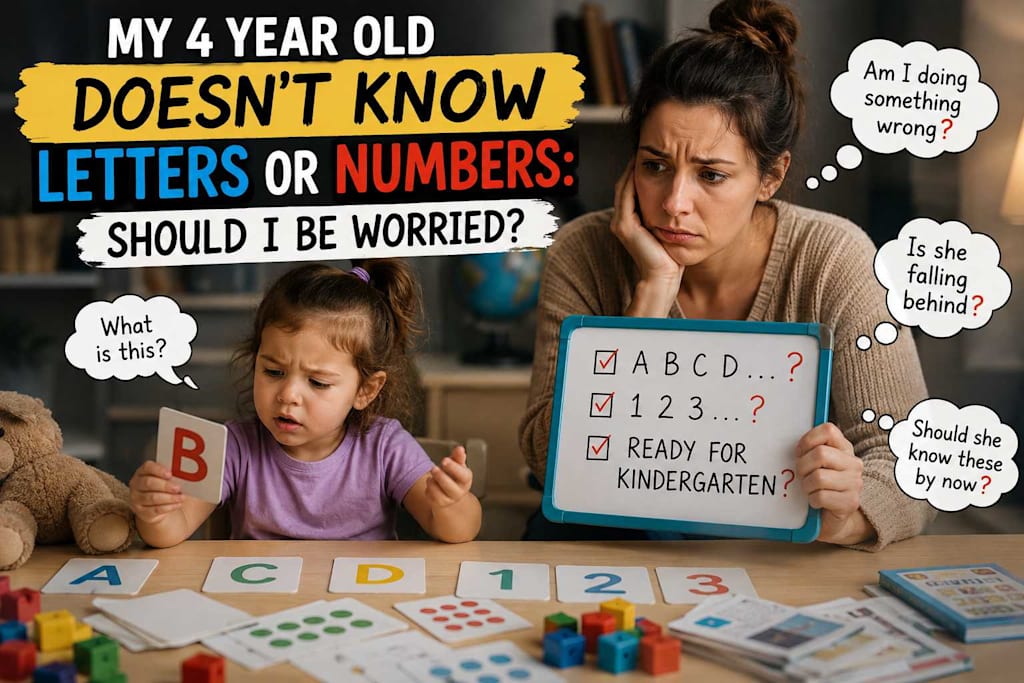
My daughter sang the ABC song at two. Full song. Loud. Off-key. Proud.
At four, she still couldn't point to the letter B on a page. She'd stare at it. Tilt her head. Then point to the dog in the picture instead.
I googled "my 4 year old can't recognize letters" at 11 PM on a Tuesday. The screen lit up my face in the dark. I felt like I was doing something wrong. Like every other parent had this figured out except me.
My wife and I sat at the kitchen table the next morning. Coffee going cold. We had flashcards. We had alphabet books. We had that foam puzzle mat with letters that pop out. She'd played with all of it. None of it stuck.
I started asking around. Not in a formal way. Just casual. At the playground. At preschool pickup. At a birthday party where I cornered another dad near the snack table.
"So your kid knows letters?" I asked.
He laughed. "Barely. She's four. She's supposed to barely know them."
That didn't make me feel better. But it made me stop panicking long enough to actually think.
Why Some Children Learn Letters Later Than Others
I spent a week reading everything I could find. Not product pages. Actual research. Parenting forums where real people talked. Books from the library that smelled like old paper.
Here's what I learned.
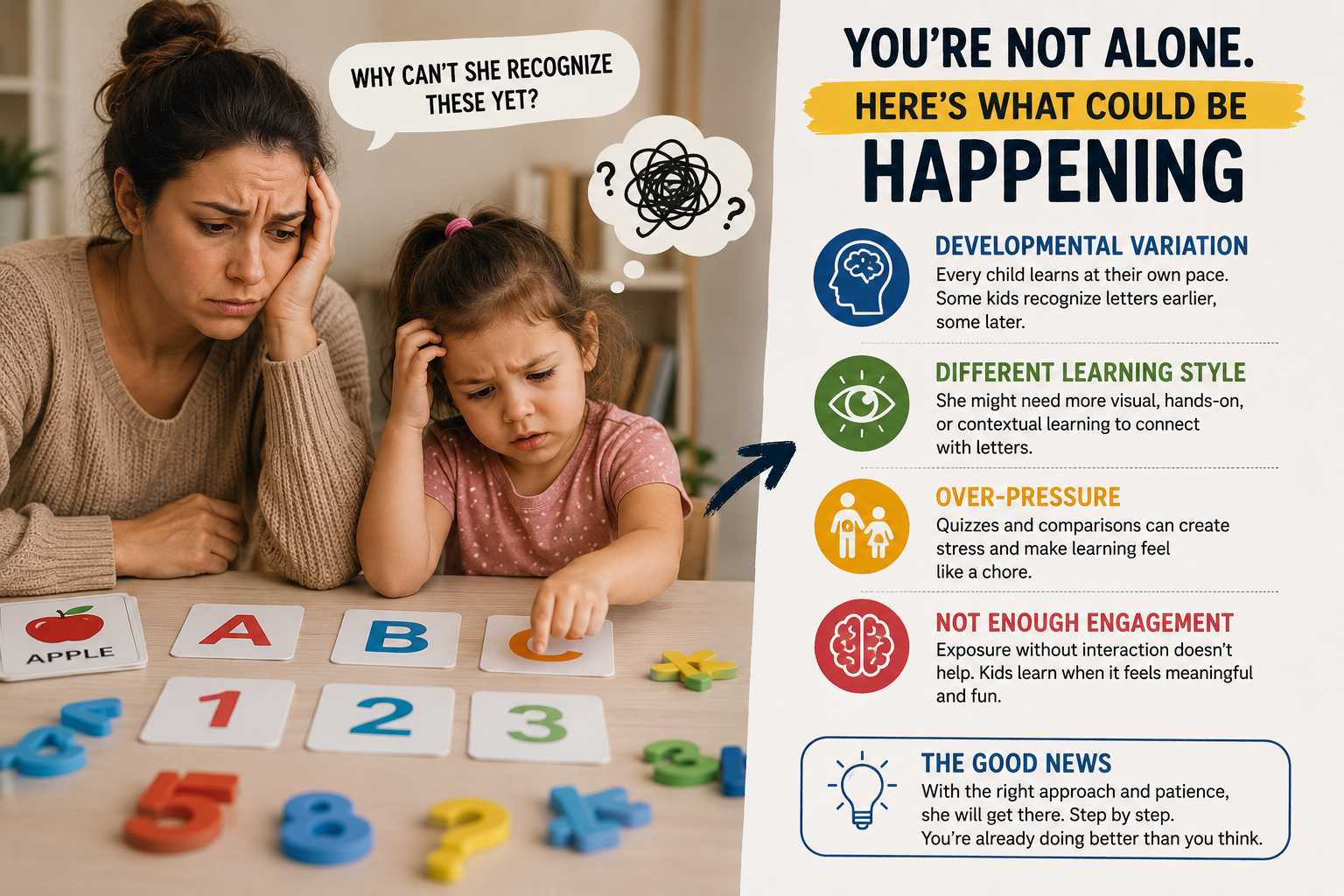
Letter recognition isn't a switch that flips at a certain age. It's a slow build. Some kids get it at three. Some at five. Some recognize a few letters, forget them for a month, then suddenly know them all. The range of normal is wider than I thought.
My daughter's brain was busy with other things. She could name every dinosaur species. She remembered the names of all her stuffed animals, which was like thirty of them. She noticed when I changed my shirt. She was absorbing information constantly. Just not the information I was testing her on.
That was the first real shift in my thinking. She wasn't failing. She was learning differently.
Some kids are visual learners. Some need to touch things. Some need to hear the sound first before the shape makes sense. My daughter seemed to need context. The letter M meant nothing to her. But the M in "Mama" on a birthday card? That she noticed.
I also learned that pushing too hard can backfire. The more I quizzed her, the more she shut down. She'd start playing with her hair. Looking at the ceiling. Finding any excuse to leave the table. I was turning letters into a chore before she even got to kindergarten.
That was on me.
Mistakes I Realized I Was Making
I made a list in my phone. Not to beat myself up. Just to see the pattern.
First mistake: I was treating letter recognition like a test. I'd hold up a card and wait for her to perform. She felt the pressure. Kids feel pressure. They just can't name it yet.
Second mistake: I was comparing her to other kids. The neighbor's son who could read at four. The kid in her class who pointed to letters on a poster like it was nothing. I was measuring her against a standard that didn't exist.
Third mistake: I assumed more exposure meant more learning. We had letters everywhere. Magnets on the fridge. Posters on the wall. Foam letters in the bath. But exposure without engagement is just background noise. She tuned it out the same way she tuned out the radio.
Fourth mistake: I got frustrated. Not at her. At the situation. At myself. She picked up on it. Kids are emotional sponges. She started avoiding anything with letters because she associated it with my disappointment.
That one hurt to admit.
I stopped the flashcards. I stopped the quizzes. I stopped asking her to "show me the A" like she was a trained seal. I needed a different approach.
Simple Things That Helped Me Think Differently
I started small. Really small.
I stopped saying "what letter is this?" and started saying "look, that sign says STOP. S-T-O-P. That's the word stop." She didn't care about the individual letters. But she cared that the sign meant something. She wanted to know what signs said. That was her entry point.
We started pointing out letters in real life. The M on the McDonald's bag. The B on the bus stop. The P on the parking sign. Not as a lesson. Just as something we noticed together. Like pointing out a bird.
I let her draw letters in shaving cream on the bathroom mirror. She made a mess. She wrote them backwards. She drew squiggles and called them letters. I didn't correct her. I just said "cool, that's your letter." The goal wasn't accuracy. The goal was comfort.
We read the same books over and over. Not to teach letters. Just because she liked them. After the twentieth reading of "The Very Hungry Caterpillar," she started pointing to the C on the cover. Not because I taught her. Because she'd seen it enough times that it became familiar.
I also stopped worrying about her confusing p and q. Or b and d. That's normal. Those letters are mirror images. Adults mix them up. The fact that she noticed they looked similar meant she was actually paying attention to shape. That was progress. I just didn't recognize it as progress at the time.
The biggest change was my attitude. I stopped treating letter recognition like a race. I started treating it like walking. She'd get there. She was getting there. I just needed to stop measuring her against a calendar.
When I Started Looking For More Structure
After a few months of this relaxed approach, I saw some improvement. She knew a handful of letters. She'd point them out unprompted. She'd spell her name with magnetic letters, sometimes getting them in the right order.
But I also saw gaps. She knew some letters really well. Others she never seemed to retain. I wasn't sure if I was missing something. If there was a better way to connect the dots for her.
I started looking into structured reading programs. Not because I thought she was behind. Because I wanted to understand how the process was supposed to work. What order letters should be introduced. How phonics connected to recognition. What activities actually built the skill instead of just practicing it.
I read about a bunch of different programs. Some were apps. Some were book-based. Some were full curriculums with workbooks and lesson plans. I wasn't looking for a magic solution. I was looking for a map.
While comparing structured reading programs, Reading Head Start was one option that kept appearing. The curriculum seemed designed for parents who wanted more structure rather than guessing what to teach next. That observation made me spend more time looking through how the lessons were organized.
I liked that it broke things down into small steps. I liked that it focused on phonics alongside letter recognition, not just memorizing shapes. I wasn't sure if the digital format would work for my daughter, since she did better with hands-on activities. But I appreciated having a clear sequence to follow instead of making it up as I went.
I didn't buy it right away. I kept researching. I kept doing our casual at-home activities. But having that framework in my back pocket made me feel less like I was winging it.
Who May Benefit From A Structured Reading Program
I want to be clear about this. Not every kid needs a program. Not every parent needs to spend money. A lot of kids learn letters naturally through books, conversations, and everyday life.
But some situations make structure more useful.
If your child seems frustrated with casual learning. If they shut down when you try to teach them anything. If they know some letters but can't seem to retain others. If you're a parent who feels anxious without a plan. If you want to make sure you're not missing foundational skills before kindergarten.
In those cases, a structured program can help. Not because it fixes the child. Because it gives the parent a roadmap. It removes the guesswork. It turns "am I doing this right?" into "we're on step three of twelve."
I also think structured programs work best when combined with real-world practice. The program teaches the concept. The world gives the context. You need both.
For parents who want to understand how a structured curriculum approaches early reading, I found these resources useful for understanding how the curriculum is organized and what it includes.
Readers can look through them if they want more background before deciding which learning approach fits their family.
Final Thoughts
My daughter is five now. She recognizes most of her letters. Not all. She still mixes up b and d sometimes. She still writes her name with the N backwards about half the time.
But she points to words in books and tries to sound them out. She writes notes to her mom that are mostly scribbles with a few real letters mixed in. She sees letters as something that belongs to her now. Not something she's being tested on.
That took longer than I wanted. Longer than I expected. Longer than the internet told me it should take.
But it happened. And it happened because I stopped treating her like a problem to solve and started treating her like a kid who was learning in her own way.
If you're googling "my 4 year old can't recognize letters" at 11 PM, I get it. I've been there. The worry is real. The fear that you're missing something, that you're failing them, that everyone else has this figured out.
You're not failing. Your kid isn't broken. The timeline in your head is probably wrong. Most timelines in our heads are wrong.
Some kids sing the ABC song at two and know every letter by three. Some kids sing it for years before the shapes make sense. Both paths lead to the same place.
The goal isn't to hit a benchmark. The goal is to understand your kid. To figure out how they learn. To give them space to get there without making them feel like they're falling behind.
My daughter taught me that. Took me a while to listen. But she got there. And so will yours.
About the Creator
Understandshe
I write about healing, self-growth, and the messy but beautiful journey of becoming. Honest lessons, real stories, and gentle insights you’ll also find on UnderstandShe.
Enjoyed the story? Support the Creator.
Subscribe for free to receive all their stories in your feed.
Comments
There are no comments for this story
Be the first to respond and start the conversation.