
I Stopped Saying “Everything’s Fine” to My Parents. Then I Asked My Dad About a Leaky Pipe.
The small, specific questions that let them back into my life without handing them the whole thing.
1
The call came at eight in the evening. My mother answered. Her first sentence was always the same: “Have you eaten?”
I said I had. She asked what I ate. I said tomato and egg noodles. She said, “Oh, that’s all right. Don’t keep ordering takeout.” I said okay.
Then came the silence. I knew that silence too well. When I was little, I’d talk at the dinner table about something that happened at school, and halfway through I’d realize no one was picking up the thread. I’d look up and see my father reaching for food and my mother watching TV. I knew it was time to shut up. Now it was the other way around. I was on one end of the phone, they were on the other, four hundred kilometers and twenty years of not knowing how to talk in between.
At times like that my mother would find a safe topic. The weather. It’s getting colder, wear more. Your father moved the plants on the balcony inside yesterday. I said okay. She said, “Then get some rest early.” I said okay. We hung up.
Four minutes altogether. I checked the call log. Last time was five minutes. The time before that, three and a half. The trend was stable.
I had tried to say more. Last month I told her the project at work was busy and I’d been working until ten every night. She said, “Then quit. Come back and take the civil service exam.” I said, “Mom, that’s not what I meant.” She said, “Then what did you mean?” I said, “I just wanted to tell you.” She said, “Telling me doesn’t help. You just take care of yourself.” Then she added, “Your cousin got into the establishment this year. If you’d listened to me back then…”
I said, “Mom, I have a meeting.” I hung up.
After that I learned to be good. When she asked how things were, I said fine. When she asked whether work was going smoothly, I said smoothly. When she asked about my health, I said all good. There would be a few seconds of quiet on the other end, and then she’d say, “That’s good. Go do your work.” She didn’t sound angry. She didn’t sound disappointed. She sounded like she was standing in front of a closed door, lifting her hand, and then putting it down again.
2
My father was more direct. He never asked “How are things?” He just shouted from the side, “Do you have enough money?” I said I did, and he left. My mother would hand him the phone and say, “Say a few words to your daughter.” He’d take it, go silent for three seconds, and say, “All right, hang up, phone calls are expensive.” I said calls don’t cost anything now. He said, “Then hang up anyway.”
For a while I thought they didn’t care. Then one New Year, when I was home, my mother was going through photo albums. She came to a picture from my primary school years and said, “Your father took this one. You got full marks on both exams that day. He was so happy he ran to the shop by the school gate and bought a roll of film.” I said he never told me that. She said, “Why would he tell you that? He’s clumsy with words.”
My father heard her from the kitchen and called out, “Why bring up all that old stuff?” Then he brought out a plate of steamed pork with rice flour and said, “Eat it while it’s hot.”
The pork was dry. My mother took one bite and said he’d bought the wrong cut; he should have bought the front leg. My father said the butcher told him the hind leg was better. My mother said, “He says it’s good and you believe him?” My father said, “Well, why didn’t you say earlier which one to buy?” They bickered for a couple of sentences, and then my mother turned to me and asked, “Does your market over there sell front leg?” I said yes. She said, “Then buy front leg. Ask the butcher to slice it thin for you. Put sweet potato underneath and steam it for forty minutes.”
I said okay. She said, “Write it down. Don’t come asking me again later.” I said okay. She laughed and said, “You’ve been like this since you were little. You say okay to my face and then come back with questions.”
3
Last year I moved into a new apartment. The drain in the kitchen kept giving off a smell. I had the property management come look. They said there was nothing wrong with the pipes and told me to ventilate more. I ventilated for days and it still smelled. I called my father and said, “Dad, the kitchen drain smells. Property management says there’s no problem, but I don’t think that’s right.”
He said, “First look at the trap under the sink. Is the water seal gone?” I said, “What’s a water seal?” He said, “Take a photo and send it to me.” I took one and sent it. He looked at it for half a minute and said, “The joint is loose. Just tighten it with a wrench.” I said I didn’t have a wrench. He said, “Go downstairs to the hardware store and buy one. Ten yuan.” I said okay. He said, “Put a cloth over it when you tighten it. Don’t crack the pipe.”
I tightened it. I took a photo and sent it to him. I said it was fixed. He said, “Mm, that’s fine.” Five minutes later he sent another message: “If it still leaks, wrap some Teflon tape around it twice.” I said okay.
That night my mother called and said, “Your father asked me to ask you whether the pipe still leaks.” I said it didn’t. She said, “That’s good. He’s been muttering about it all evening. He said don’t buy the wrong thing at the hardware store. I told him she’s not a child.” I said, “Mom, is Dad there?” She said he was. I said, “Put him on.”
My father took the phone and said, “What else?” I said, “Dad, what’s the principle behind that water seal?” He paused for a second, and then he started from the trap and went on to air pressure, to why upper floors are more likely to get the smell back, and talked for ten minutes. I listened and murmured “mm” twice. At the end he said, “Your building is tall. You need to be careful. Don’t keep the windows shut all the time.” I said okay. He said, “All right, hang up.”
After we hung up, my mother sent me a WeChat message: “Your father is thrilled. He says you finally know to ask him about proper things.”
4
Later I figured out a pattern. With my mother, I ask about food. With my father, I ask how to fix things.
When I ask my mother, I have to be specific. I can’t ask, “Mom, how do you cook?” I have to ask, “Mom, for the rice flour in the steamed pork, do you fry the rice yourself or buy the ready-made kind?” She’ll start with choosing the rice, go on to how many star anise to put in, and whether to leave a gap when steaming. When she talks about this, she speeds up, as if she’s memorized half a lifetime of lines and finally has someone to say them to.
When I ask my father, I have to give him a problem he can get his hands on. I can’t ask, “Dad, what’s going on with this?” I have to ask, “Dad, does this screw turn left or right?” He’ll correct me first and say it’s not left or right, it’s clockwise or counterclockwise. Then he’ll teach me. And as he teaches, he’ll bring out things from when he was young. Which factory, which master taught him, what he fixed in which year and month. He doesn’t usually talk about those things, but if you ask about a socket, he can go from the socket to the rules of the workshop back then.
Once I asked him, “Dad, were you pretty good at the factory back then?” He said, “Good at what? I was just an electrician.” Two seconds later he added, “The year they overhauled the whole factory’s wiring, I was the only one who saw it through from beginning to end.” Then he laughed at himself and said, “I can’t do it now. My eyes are going.”
I said, “Then teach me how to read a wiring diagram.” He said, “What do you want to learn that for?” I said, “In case I need it someday.” He said, “All right. I’ll look for my old notes and send you photos.”
Three days later he sent seventeen photos. Handwritten, some with ink smudged, some with lines drawn and redrawn. On the back of the last one he’d written: “If you can’t understand it, forget it. Don’t wear yourself out.”
I replied: “I understand it. It’s just the three-phase part I need to look at again.” He replied instantly: “I’ll draw you a clearer one for the three-phase part tomorrow.”
5
But I’ve stepped in holes with this “show weakness” thing.
Once I made a big mistake at work and got chewed out in front of everyone by my boss. That night I called my mother and started crying before I’d said two sentences. I said, “Mom, I don’t think I can do this anymore. Am I completely useless?”
She was silent for two seconds and then said, “How could you be so careless? Why did your boss only criticize you and not anyone else? If you’d listened to me and taken the civil service exam…”
I said, “Mom, stop.” She said, “Am I wrong? You just won’t take advice.” I said, “I’m hanging up.” She said, “Go ahead.”
After I hung up, I sat on the sofa and felt more and more wronged. Half an hour later my father sent a text: “Your mother’s words are harsh. Don’t take them to heart. After your call she stood in the kitchen for a long time. The food burned.”
I looked at that text and didn’t know what to reply.
Later I understood. My mother wanted to comfort me. She couldn’t find the words. All her life, when something happened, she just toughed it out. She has no phrase for “there, there.” All the language she can call on is “How could you be so careless?” “Why didn’t you listen to me?” She thinks she’s helping. She’s panicking.
My father could send that text probably because he was panicking too, but at least he knew what my mother said was wrong.
6
Now I don’t pour out my troubles to them anymore. I trust them. They still can’t catch everything.
Work stuff I talk about with colleagues, or if it’s really bad, I find a friend and have a drink. Health stuff I go to the hospital first and decide later whether to tell them. Relationship stuff even less. The moment my mother hears I’m seeing someone, her first reaction is “What does the person do, how many apartments does the family have, do the parents have pensions?” I say, “Mom, can you first ask whether he’s a good person?” She says, “Can being a good person fill your stomach?”
But I regularly give them small things.
With my mother, I ask about one dish every week. Last week it was how to caramelize sugar for red-braised pork without it turning bitter. She said, “Turn the heat down. As soon as the rock sugar goes in, stir it with the spatula. Don’t wait for big bubbles.” I did it and sent her a photo. She said the color was all right, but I’d reduced the sauce too early. “Next time wait until the skin shines and I’ll tell you to turn it off.”
With my father, I send a photo of something in the house from time to time. A socket, a faucet, the plug of the rice cooker. Last month the rice cooker kept tripping the switch. He told me to unplug it and take a photo. After looking, he said the plug was fine, it might be the socket. I said I’d get an electrician. He said don’t waste the money, use a multimeter to measure it. I said I didn’t have a multimeter. He said, “Go buy one. You’ll need it later.”
I bought a multimeter. He taught me over video how to measure voltage. I measured for a while and said it seemed to have power. He asked how many volts. I said 220. He said, “Then that’s right. It might be the rice cooker.” I said the rice cooker was broken? He said, “Buy a new one. Don’t fix it.”
The next day I bought a new one. I sent a photo to the family group. My father replied with a thumbs-up. My mother replied: “How much did it cost?” I said a little over two hundred. She said, “Your father says the old one could actually be fixed. He’s just too lazy to fix it.”
My father replied below: “I didn’t say that.”
7
Last month I went home for three days. The first night my mother made a tableful of food. My father helped in the kitchen, handing her salt, getting soy sauce. At the table my mother asked how work was. I said it was all right, not too busy lately. She looked at me and said, “Not too busy is good. Don’t wear yourself out.”
I said, “Mom, your steamed pork with rice flour isn’t dry this time.” She said, “Of course not. I bought front leg.” My father said, “I bought the front leg.” My mother said, “You bought it, but why did you let them cut it so thick?” My father said, “The butcher cut it. What was I supposed to do?”
I laughed and said, “Dad, I left the multimeter at home. Next time I come back, teach me how to test for a short circuit.” He said, “What do you want to learn that for?” I said, “In case the power trips at home, I can fix it myself.” He said, “All right. Read the manual first.”
My mother cut in: “Your father lost that manual who knows when.” My father said, “I don’t need a manual. My brain is the manual.”
Then my mother started talking about how Auntie Wang downstairs’ son got married this year and how much bride price they gave. I said, “Mom, if you want to hurry me into marriage, just say so.” She said, “I’m not hurrying you. I’m just saying.” My father said, “All right, eat.”
After dinner I washed the dishes. My mother wiped the stove beside me and lowered her voice: “Your father had a checkup last month. The doctor said his blood sugar is a little high. He told me not to tell you.” I said, “Then why are you telling me?” She said, “I’m telling you, but don’t tell him I told you.”
I washed the dishes and said, “Okay.”
8
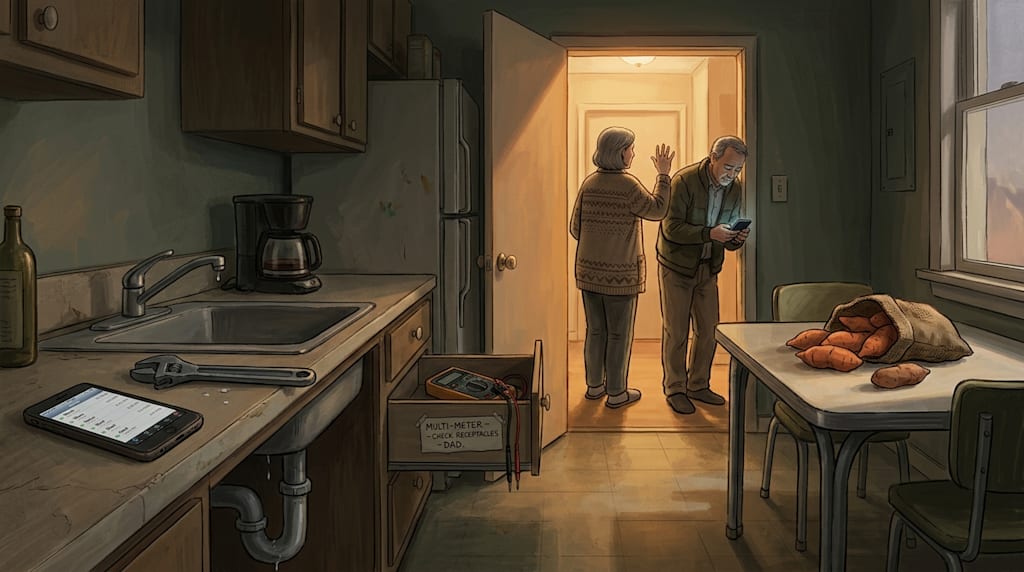
The morning I left, my mother stuffed a bag of sweet potatoes into my bag. She said, “Take these back and use them for the steamed pork. The sweet potatoes here are better than the ones over there.” I said okay. My father stood at the door and said, “Take the multimeter back with you.” I said no, leave it at home. He said, “Take it. I’ll buy another one.”
I said okay. He put the multimeter in its box and handed it to me. There was a label on the box: “Voltage setting is V, resistance setting is Ω. Don’t mix them up.” The writing was large and crooked.
I took it and said, “Dad, did you write that label?” He said, “Mm.” My mother said beside him, “He wrote it several times. He said he was afraid you wouldn’t be able to read it.” My father said, “All right, all right, go now. There’ll be traffic later.”
I got in the car. In the rearview mirror I saw them still standing at the door. My mother was waving. My father wasn’t waving. He was looking down at his phone. A while later my phone buzzed. It was a WeChat message from him: “Drive slowly.”
I replied okay. He sent another: “If you understand that label, tear it off. Don’t let anyone see it.”
I didn’t tear it off. The multimeter is still in my drawer. The writing on the label has curled a little at the edges. Sometimes when I open the drawer and see it, I think of my father standing at the door looking down at his phone. He was waiting for me to drive away, and he didn’t want me to see him watching me drive away.
As for my mother, I still ask her about one dish every week. Last week it was how to caramelize sugar for red-braised pork without it turning bitter. She said, “Turn the heat down. As soon as the rock sugar goes in, stir it with the spatula. Don’t wait for big bubbles.”
I did it. I didn’t send a photo.
About the Creator
Jin
Writer of reamstories
https://reamstories.com/jin
Enjoyed the story? Support the Creator.
Subscribe for free to receive all their stories in your feed. You could also become a paid subscriber, letting them know you appreciate their work.
Comments
There are no comments for this story
Be the first to respond and start the conversation.