
The Relational Ontology of Personhood
A Comprehensive Structural Model of What Exists, How It Exists, and What Makes a “Who” More Than a “What”

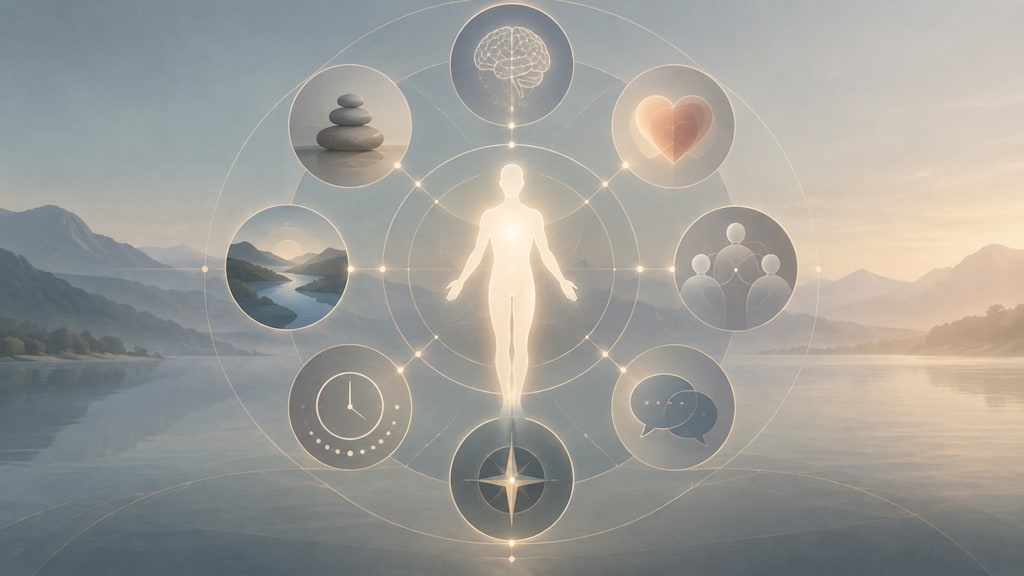
Core Thesis
Reality is intelligible through ordered relation. To identify anything as a determinate thing is to locate it within distinctions, boundaries, conditions, and modes of relation that make it the kind of thing it is. A thing is not understood merely by naming that it exists. It is understood by asking what it is, where it exists, when it exists, how it exists, what relations make that mode of existence possible, and whether its mode of being rises to the level of personhood.
This model is not primarily an account of why anything first came into being. It does not begin by trying to prove one specific religious, scientific, or philosophical origin story. Its central concern is structural: what exists, how it exists, and what conditions must be present for something to exist as the kind of thing it is. It is not saying that a thing exists because it needed to come into being. It is saying that, for a thing to exist as that kind of thing at all, the relations necessary to that mode of existence must be present.
The governing claim is:
A thing exists as the kind of thing it is through the relations necessary to its mode of being.
Or more precisely:
No entity can be intelligibly identified, understood as a determinate kind, or encountered as a meaningful object apart from the differentiating and ordering relations constitutive of its mode of being.
A “what” is something that exists. A “where” is the field, location, domain, or realm in which it exists. A “when” is its temporal relation. A “how” is the mode by which it exists. A “who” is a “what” whose “how” includes the necessary relational conditions of personhood.
The shortest form is this:
A who is a what whose how is personal.
This does not mean every “what” is a “who.” It means every “who” involves a “what,” while also being more than a mere “what.” A person has existence, identity, continuity, and some determinate mode of being. Yet a person is not merely an object with complexity, not merely a body, not merely consciousness, and not merely a system that produces personal-seeming output. A person is a living center of personal relation.
I. Scope of the Model
This framework makes three related claims that should be held together without being confused.
First, it makes an epistemic claim: we cannot know a thing apart from distinction and relation. To know something as this rather than that, it must be distinguishable from what it is not. A completely undifferentiated something cannot be identified, named, located, described, measured, loved, resisted, chosen, or acted upon as this thing rather than another. Knowledge requires distinction, and distinction requires relation.
Second, it makes a semantic claim: we cannot describe a thing meaningfully apart from relation. Words, categories, concepts, and meanings depend on difference, context, use, and intelligible order. A word does not mean everything equally. It means this partly because it does not mean that. Language itself makes the principle visible: meaning requires distinction, order, relation, speaker, listener, sign, and reference.
Third, it makes a qualified ontological claim: for a thing to exist as a determinate kind of thing, certain relations must be constitutive of that mode of being. This does not mean every entity is externally dependent on every other entity in the same way. It means anything that exists as a particular kind of thing must have the identity-making relations required by that kind of existence.
So the model does not simply say, “everything is connected.” That is too vague. It says:
A thing is what it is because certain relations are necessary to its identity, structure, function, intelligibility, or mode of being.
This distinction matters because the model is not trying to replace physics, biology, language, theology, or philosophy with one single flattened explanation. It is trying to name a structural pattern that appears across many domains. Physical objects, living bodies, words, thoughts, memories, laws, relationships, moral acts, and persons do not all exist in the same way. Yet each one must exist according to the relations necessary to its own mode of being.
The model therefore belongs in the space between metaphysics, anthropology, phenomenology, language, and theology. It is a framework for asking cleaner questions. What exists? Where does it exist? When does it exist? How does it exist? What relations make that mode possible? Does its mode of being rise to the level of a who?
II. Relation to Prior Thought
This model is not created out of nothing. It overlaps with several older and more formal lines of thought, even where it uses different language.
It overlaps with Aristotle’s concern for substance, form, essence, accident, category, and what makes a thing the kind of thing it is. The distinction between constitutive and contingent relations resembles the older distinction between essential and accidental properties. Some features belong to a thing’s identity as that kind of thing. Other features belong to its circumstance, location, ownership, history, or temporary state.
It overlaps with structuralism in language, because meaning depends on difference within a system. A word has meaning through its relation to other words, sounds, uses, concepts, speakers, and contexts. It overlaps with phenomenology because it takes embodiment, perception, lived experience, inwardness, and encounter seriously. It overlaps with personalism because it refuses to reduce the person to mere objecthood. It overlaps with process and relational ontologies because it treats relation as central to intelligibility rather than as a decorative addition placed on top of isolated substances.
It also overlaps with theological accounts of communion, especially where personhood is understood through relation to God and others. Christian language about Logos, creation, heart, soul, mind, strength, body, spirit, sin, restoration, resurrection, and communion gives the model a natural theological home. Yet the structural core does not begin by demanding agreement about all theological conclusions. It begins by asking what kind of being exists and what relations are required for that being to exist as it does.
The unique formulation of this model is the “what-how-who” bridge. Many theories discuss objects, identity, mind, language, relation, embodiment, consciousness, or personhood. This model arranges those questions into a usable structure: what names identity, where names field, when names temporal relation, how names mode of being, and who names personal mode of being. The central claim is not merely that persons are important. The central claim is that personhood is a relational mode of being.
This means the model needs pressure. It cannot merely list attractive categories and call them true. It must answer why some relations count as constitutive and others do not. It must handle hard cases. It must explain what would count as evidence when testing the line between what and who. It must recognize that some objections are not attacks on the model, but the very process by which the model becomes clearer, stronger, and less arbitrary.
III. Constitutive and Contingent Relations
The model depends on distinguishing two kinds of relation.
Constitutive relations are relations without which a thing would not be the kind of thing it is. A word’s relation to a language system is constitutive of its being a word. A body’s organization, matter, boundary, form, and living structure are constitutive of its being a body. A person’s inward experience, continuity, agency, and relational capacity are constitutive of personhood.
Contingent relations are relations a thing can enter or leave without ceasing to be what it is. A person’s relation to a particular chair is usually contingent. A person’s relation to a particular employer is usually contingent. A book’s location on one shelf rather than another is usually contingent. These relations may matter practically, historically, emotionally, legally, or socially, yet they do not ordinarily make the thing the kind of thing it is.
This distinction protects the model from becoming vague. The force of the theory is not that everything relates to everything else in a loose way. The force of the theory is that some relations are identity-making. If those relations are removed, the thing is no longer the same kind of thing.
A relation is constitutive when removing it destroys the identity, structure, function, mode, unity, or personal reality by which the thing exists as that kind of thing. A relation is contingent when removing it changes circumstance, context, ownership, use, location, or history while leaving the kind intact.
A chair may be moved from one room to another and remain a chair, so its relation to that room is contingent. A chair may be owned by one person or another and remain a chair, so its relation to that owner is contingent. Yet if all structure for sitting is removed, or if its form no longer supports the function, posture, and recognition that make it chair-like, the object may become scrap wood, wreckage, sculpture, or something else. The relation between material, form, structure, and intelligible use is therefore much closer to constitutive.
This does not mean every human carve of reality is equally real. Some carvings are merely practical. Some are linguistic. Some are conventional. Some are biological. Some are moral. Some are ontological. The model distinguishes these by asking what kind of stability survives across observers, uses, languages, cultures, and circumstances. A relation has stronger constitutive force when it remains necessary across multiple modes of encounter: physical interaction, functional use, causal behavior, semantic identification, lived experience, moral significance, and personal relation.
This is where the model must answer the mereological challenge. A person can name “the table,” “the left half of the table,” “the table plus nearby dust,” or “the table plus the moon.” All can be described. All can be referred to. Yet they do not all possess the same depth of unity, boundary, causal integration, function, persistence, or mode of interaction. Some groupings are merely referential cuts. Others reveal a stable organized whole.
So the answer is not that humans never carve reality. We do carve reality. Language, attention, use, need, and survival shape what we notice and name. Yet those carvings are not all equal. Some cuts track shallow convenience. Some cuts track deep structure. Some reveal a real unity that remains stable across interaction, function, persistence, causal integration, and intelligible use.
The key grounding principle is independent constraint.
A thing is not less arbitrary merely because we describe it with richer language. A thing is less arbitrary when its unity is independently constrained by the thing’s own organization, causal behavior, boundary, persistence, and explanatory power. In other words, the question is not only whether a mind can name a grouping. The question is whether the grouping itself does work in reality.
A merely referential collection depends almost entirely on the observer. “The table plus the moon” can be named, yet the name supplies nearly all of the unity. The grouping has no shared boundary, no integrated function, no common self-maintaining organization, no unified causal behavior, and no special explanatory necessity. It is a real phrase, and it can refer to real things, yet the unity belongs mostly to the act of reference rather than to the things themselves.
A stronger unity is constrained by reality beyond the observer’s naming. A table has more unity than “the table plus the moon” because its parts are arranged into a stable structure with a recognizable boundary, ordinary persistence, functional coherence, and shared causal interaction. Its unity is still partly artifact-based and use-based. A table is not as deeply unified as a living organism. Yet it is also not merely arbitrary. Its parts hang together in ways that support action, recognition, repair, movement, use, and explanation.
A living organism has deeper unity still because it maintains itself from within. Its parts are not merely arranged beside one another. They participate in a self-maintaining system of metabolism, repair, regulation, growth, and response. The organism’s unity is not created merely by a name placed on it from outside. The organism behaves as a bounded, integrated, self-maintaining whole. It resists many alternative carvings because its own life-processes mark it out as a real unity.
So the test becomes:
A “what” is less arbitrary when its unity is independently constrained by stable organization, causal integration, boundary behavior, persistence through change, and explanatory power across observers and uses.
This does not eliminate every borderline case. It does something more modest and more useful. It explains why all carvings are not equal. Some carvings are shallow acts of attention. Some carvings track stable structure. Some track functional organization. Some track causal integration. Some track self-maintaining life. Some track inward experience. Some track personal being.
The deeper the unity is generated by the thing’s own organized mode of being, rather than by the observer’s act of naming, the less arbitrary the “what” becomes.
IV. The Relational Depth Test
The relational depth test follows from the principle of independent constraint. The question is not merely, “Can I name this?” The question is, “What kind of unity does this named thing actually possess, and how much of that unity is grounded in the thing’s own mode of being rather than in the observer’s act of reference?”
The first level is referential unity. This is the weakest level. A speaker can refer to almost anything: the left half of a table, the dust on the table, the table plus the ceiling, the chair and the moon, or the particles currently inside a room. Such groupings can be named, yet naming alone does not establish strong ontological unity. Referential unity proves only that a mind can point to a pattern.
The second level is spatial unity. Parts may be near each other or arranged within a bounded region. A pile of stones has more unity than stones scattered across the planet. Proximity is a real relation. Yet proximity alone does not create a deeply unified thing. The pile remains weakly integrated because the stones do not function together as one organized system.
The third level is structural unity. Parts may be arranged into a stable form. A table is not merely wood particles. Its parts are organized into a recognizable structure. This gives the thing stronger identity across ordinary use, recognition, repair, movement, and interaction. Structural unity is stronger than mere proximity because the parts are ordered in a way that constrains how the thing behaves and how it can be encountered.
The fourth level is functional unity. A thing may have parts ordered toward an activity or role. A chair supports sitting. A knife cuts. A heart pumps blood. A sentence communicates meaning. Function does not always define the whole essence of a thing, yet it often reveals the relations that make the thing intelligible as the kind of thing it is.
The fifth level is causal unity. The parts interact as one system. A storm, flame, whirlpool, machine, body, and ecosystem each display causal integration in different ways. Their parts mutually affect one another according to patterned relations. This makes their unity more than a mere label, even where their boundaries are fluid or temporary.
The sixth level is self-maintaining unity. Living organisms maintain internal order through metabolism, regulation, repair, growth, and environmental exchange. This is why a plant is more than a pile of plant matter. It is a living what. Yet self-maintaining unity alone does not establish personhood.
The seventh level is experiential unity. At this level, there is evidence of inward experience: sensation, perception, suffering, awareness, preference, or felt relation. This is where the boundary between mere organism and subject becomes more serious. Experiential unity requires careful evidence because inwardness is not directly visible in the same way shape or motion is visible.
The eighth level is personal unity. At this level, the being possesses the relational conditions of a who: inwardness, experience, perception, meaning, agency, continuity, memory, vulnerability, relation, response, moral orientation, and personal encounter. A person is not merely named as one. A person exists as a living center of relation.
This depth test answers the arbitrary-carving objection by refusing to treat every named grouping as equal. A “what” becomes more ontologically serious as it displays deeper independently constrained relational unity. A “who” appears only when that unity becomes personal.
The test is not a perfect machine that eliminates every philosophical dispute. It is a disciplined way to ask where the unity is coming from. Is the unity mostly in the observer’s act of naming? Is it in spatial arrangement? Is it in structure? Is it in function? Is it in causal integration? Is it in self-maintaining life? Is it in inward experience? Is it in personal being? The deeper the unity belongs to the thing’s own mode of existence, the stronger the claim that the thing exists as a real “what” rather than as a convenient grouping.
V. The Principle of Necessary Relation
Anything that exists as a meaningful, intelligible, determinate kind must exist within the relations necessary to make it distinguishable, ordered, and capable of being what it is.
A thing cannot be intelligibly encountered in total isolation. To be anything in particular, it must be distinguishable from what it is not. It must have some mode of existence. It must stand within some order that allows it to be identified, located, interpreted, used, experienced, measured, loved, resisted, chosen, or acted upon.
Even a statement like “it is here” assumes relation. “Here” must be distinguishable from “there.” The thing must be present in one way rather than another. It must be bounded enough, or relationally defined enough, to be located or identified.
The principle is not:
It exists because it had to come into being.
The principle is:
For a thing to exist as that kind of thing, the relations necessary to that mode of existence must also be present.
A body cannot exist as a body without matter, form, boundary, organization, location, and interaction. A word cannot exist as a word without distinction, sign, meaning, use, language, and interpretation. A person cannot exist as a person without unity, inwardness, experience, relation, continuity, perception, agency, and identity.
This principle is a necessity principle, yet it is not a causal origin claim. It does not say how a thing came into being. It says what must be true for that thing to exist as that kind of thing at all. It is not first-cause reasoning. It is mode-of-being reasoning.
VI. The Principle of Distinction
A thing is intelligible because it is distinguishable.
To say “this” is to say “not that.”
Distinction does not always mean opposition. Distinction may involve contradiction, such as true and false. It may involve contrary states, such as hot and cold. It may involve difference of kind, such as a tree and a number. It may involve difference of role, such as speaker and listener. It may involve part-whole differentiation, such as heart, body, and mind within one person. It may involve gradation, such as more or less healthy, skilled, integrated, damaged, or disordered.
So this is not a simple dualist framework. Reality is not reduced to pairs of equal opposites. The deeper point is that meaning requires determinacy, and determinacy requires distinction.
Without distinction, there is no meaningful identification. Without identification, there is no knowledge. Without knowledge, there is no communication. Without communication, there is no shared meaning. Without shared meaning, there is no coherent relationship between persons, symbols, actions, and reality.
Distinction is therefore not an enemy of relation. Distinction is what makes relation possible. If two things cannot be distinguished, they cannot be meaningfully related as two. If the speaker and listener collapse into one indistinct blur, communication disappears. If body, mind, heart, spirit, and soul are flattened into one undifferentiated term, the structure of the person becomes harder to describe.
The model therefore treats distinction and relation as mutually necessary. Relation without distinction becomes confusion. Distinction without relation becomes isolation. Ordered reality requires both.
VII. The Principle of Boundary
Boundary is the form of distinction that allows something to be this rather than that, here rather than there, one rather than another, whole rather than part, or self rather than other.
A physical object has boundary through matter, shape, location, and interaction. A word has boundary through meaning and use. A law has boundary through definition and authority. A person has boundary through body, identity, agency, moral responsibility, and selfhood. A relationship has boundary through the persons involved, the nature of the bond, and the obligations or meanings that belong to it.
Boundary does not always mean hard physical edge. A cloud has boundary differently than a rock. A melody has boundary differently than a chair. A marriage has boundary differently than a mountain. A memory has boundary differently than a house. A person has boundary physically, psychologically, morally, and spiritually.
Boundary is therefore not merely spatial. It is relational definition. It tells us where one thing stops and another begins, or how one thing is distinguished from another within a larger order.
This matters for personhood because a who must be distinguishable as a self. A person must be able to exist as this personal subject rather than a mere flow of disconnected events. The self must have enough continuity and boundary to be addressed, known, loved, trusted, wronged, forgiven, judged, and restored.
VIII. The Principle of Ordered Meaning
Meaning exists in ordered relationship.
Letters alone are not a word. A word alone is not necessarily a sentence. A sentence alone may not carry full meaning apart from context. A book is not merely ink and pages. Meaning requires relation between symbols, sounds, concepts, minds, persons, and reality.
An alphabet contains potential, yet the alphabet does not communicate by itself. A box of building blocks contains possible structures, yet it does not build a bridge, house, tower, or city by itself. Potential is not the same as ordered actuality. Building blocks require arrangement. Arrangement requires relation. Meaningful arrangement requires an ordering principle.
The same applies to thought. A mind does not merely receive noise. It orders signals. It distinguishes. It categorizes. It interprets. It identifies patterns. It compares one thing to another. It moves from sensation to meaning, from perception to interpretation, from information to understanding.
So the principle is:
Meaning is not merely the presence of parts. Meaning is the ordered relation of parts into an intelligible whole.
This applies directly to the person. A human being is not merely a pile of capacities. Body, mind, heart, spirit, and soul must be understood in ordered relation. A wounded heart can burden the body. A disordered body can cloud the mind. A confused mind can misread the heart. A disoriented will can disorder the whole person. The person is not merely a list of parts, but an ordered unity of relational dimensions.
IX. The Five Questions of Existence
What?
“What” names identity.
A thing is what it is because it is not something else. “What” requires distinction.
The question asks: What exists? What kind of thing is it? What distinguishes it from other things? What makes it identifiable? What boundaries, qualities, relations, or functions allow it to be named?
A “what” can be a rock, body, machine, tree, atom, law, word, idea, organism, memory, institution, person, relationship, or event.
Yet not every what is a who.
Where?
“Where” names location, field, domain, or realm.
A thing is here rather than there. To be physically located means to be bounded or positionally defined. A body can be here because it takes up space here and not there. It occupies one region rather than another.
The question asks: Where does it exist? In what field, location, domain, system, or realm does it exist? Is it physical, conceptual, relational, social, psychological, symbolic, mathematical, spiritual, dimensional, embodied, or beyond ordinary spatial location?
A physical object is located by boundary. A concept may be present by meaning. A relationship may be present by connection. A person may be physically absent and still relationally present. A memory may be present inwardly without occupying space as a body does.
So “where” is not always simple geography. It is the relational field in which something exists.
When?
“When” names temporal relation.
A thing happens before, during, or after something else. Time is bound up with sequence, change, motion, decay, memory, anticipation, cause, consequence, waiting, aging, development, and action.
The question asks: When does it exist? Does it exist inside time? Does it change? Does it age? Does it decay? Does it have sequence, before and after, history, memory, duration, or consequence?
Time appears to be a condition of embodied and material existence. In the physical realm, mass takes time to accelerate, bodies take time to move across distance, light travels, cells age, energy transfers, matter changes, words are spoken in sequence, and choices unfold into consequences.
Time can therefore be understood structurally as:
The relational condition that allows change, sequence, motion, memory, consequence, and embodied action.
How?
“How” names mode of being.
This is one of the most important categories in the model. The “how” is not merely what exists. It is how the what exists.
A stone exists materially. A word exists symbolically and linguistically. A law exists relationally and formally. A memory exists inwardly and temporally. A body exists physically and biologically. A mind exists logically and interpretively. A heart exists emotionally and relationally. Agency exists volitionally and orientationally. A self exists personally and essentially.
The question asks: How does it exist? What kind of existence does it have? What relationships make that mode of existence possible? How does it interact, perceive, experience, impose, enforce, relate, choose, continue, decay, heal, or change?
The “how” is relational because a mode of existence depends on relation.
A body exists as body through relation to matter. A mind exists as mind through relation to meaning. A heart exists as heart through relation to felt reality. Agency exists through relation to choice, action, intention, and consequence. A person exists through relation to selfhood, experience, continuity, embodiment, perception, meaning, and others.
Who?
“Who” names personal mode of being.
A who is not merely something that exists. A who is someone who exists in a personal mode of being.
The cleanest formulation is:
A who is a what whose how is personal.
A who exists when the mode of being includes living selfhood, inwardness, experience, perception, meaning, relation, agency, continuity, memory, response, vulnerability, and the capacity for personal interaction.
Consciousness alone is not enough. Consciousness may name awareness, interiority, or subjective experience. Personhood requires more than awareness alone. A who exists within a particular relationship of capacities: experience, perception, understanding, relation, agency, continuity, identity, inwardness, and the ability to stand in relation to others.
A who is able to experience, perceive, interpret, choose, love, resist, remember, act, suffer, respond, communicate, and exist as a center of personal relation.
So the deeper question is not simply:
Is it conscious?
The deeper question is:
What kind of being is actually there, and how does it exist in relationship to reality?
X. From What to Who
Not every what is a who, but every who involves a what.
A rock is a what. A table is a what. A machine is a what. A corpse is a what in a deeply humanly significant sense, because it remains the body of a person, yet the living person is no longer present in the same ordinary way. A human person is a who.
A who is not merely a what with complexity. A machine can be complex. A storm can be complex. A living cell can be complex. An ecosystem can be complex. A computer system can be complex. Complexity may produce behavior, structure, movement, adaptation, or output without producing a living personal subject.
A who is also not merely consciousness in the thinnest sense. Consciousness may name awareness, wakefulness, interiority, sentience, or subjective experience. A who requires a fuller personal structure. Personhood involves experience, perception, meaning, selfhood, continuity, agency, vulnerability, relation, inwardness, memory, moral orientation, and the ability to stand in personal relation.
The difference between a what and a who is therefore modal and relational. The question is not simply what material exists. The question is how that being exists. What can it relate to? How can it interact? Can it perceive? Can it experience? Can it understand? Can it choose? Can it love? Can it resist? Can it impose will? Can it receive meaning? Can it be morally responsible? Can it suffer as a subject? Can it continue as itself through change? Can it enter communion?
These questions identify the who layer.
So the principle becomes:
A who is a what whose how includes the necessary relations of personhood.
This protects both sides. It prevents reducing persons to objects, and it prevents assigning personhood to every complex what. It recognizes that whos are real beings, not illusions floating above reality. It also recognizes that a person is not only a thing among things. A person is a living center of personal relation.
XI. What Is Required for a Who to Exist?
A who requires being. Something real must exist.
A who requires identity. The being must be this subject rather than another.
A who requires unity. The being must have a center of integrated personal life rather than disconnected fragments.
A who requires inwardness. There must be an inside, a lived subjectivity, an experiencing center.
A who requires perception. The being must be able to encounter reality in some meaningful mode.
A who requires experience. The being must not merely process, but undergo, feel, receive, suffer, enjoy, fear, hope, or live through reality.
A who requires meaning. The being must be able to relate to reality as significant, not merely as input.
A who requires relation. The being must be capable of standing in relation to self, others, world, value, and truth.
A who requires agency. The being must be able to respond, choose, orient, resist, yield, act, or intend.
A who requires continuity. The being must continue as itself through change, memory, development, damage, sleep, growth, and time.
A who requires vulnerability. The being must be capable of being affected as a subject, not merely altered as an object.
A who requires moral or value orientation. The being must be able to relate to good, evil, truth, falsehood, duty, love, guilt, courage, responsibility, or worth.
A who requires personal encounter. The being must be capable of being addressed, known, loved, wronged, trusted, forgiven, judged, or received.
A human who, in the fullest version of this model, requires body, mind, heart, spirit, and soul as an ordered personal whole. The body gives physical agency. The mind gives intelligible order. The heart gives felt relation. The spirit gives will, orientation, value-response, and communion. The soul or self is the living personal subject who contains and expresses them all.
XII. The Human Being as a Relational Whole
A human being is not merely a body. A human being is also not a disembodied self temporarily using a meaningless shell. The body is not the whole person, yet the body is a vital part of human personhood.
A human being is a living personal self embodied in matter, ordered by mind, felt through heart, oriented by agency or spirit, and existing in relation to self, others, time, place, matter, meaning, memory, environment, and higher possibility.
The model uses five major terms:
Body / Strength
Mind
Heart
Spirit / Agency / Orientation
Soul / Selfhood
These categories can be understood at three levels.
At the functional level, they describe distinguishable human capacities.
At the phenomenological level, they describe distinguishable aspects of lived experience.
At the metaphysical level, they may describe real dimensions of the human person.
The structural model does not require every reader to accept the strongest metaphysical version immediately. It first asks whether these categories help distinguish real modes of human experience and action. A person may treat them as functional categories, lived-experience categories, or metaphysical categories, depending on worldview.
The basic structure remains:
The soul or self is the unified living subject.
The body is how the self relates to matter.
The mind is how the self relates to meaning.
The heart is how the self relates to felt and relational reality.
The spirit or agency is how the self relates to will, orientation, value, communion, and higher reality.
Compact form:
The self is the living person. The body contacts matter. The mind orders meaning. The heart feels relation. The spirit or agency orients, binds, and wills.
XIII. The Body / Strength
The body is the material, embodied, physical interface of the person with the physical world.
It senses, touches, acts, moves, speaks, eats, sleeps, works, suffers, heals, ages, labors, embraces, protects, creates, and interacts with matter.
Strength can be understood as embodied capacity: the body’s ability to act, endure, move, resist, express, and project force into the physical realm.
The body gives the person physical presence: face, voice, hands, breath, eyes, ears, posture, expression, movement, and location. It allows the person to be seen, heard, touched, measured, recognized, and physically encountered by other embodied beings.
Without the body, the self may continue only if some non-bodily mode of personal existence is possible. The structural point is simpler: the body is the ordinary means by which a person acts within the physical world. Without the body, the person no longer has ordinary bodily access to matter as a direct instrument.
So:
The body gives the personal self physical agency.
XIV. The Mind
The mind is the ordering, rational, interpretive faculty of the person.
It thinks, orders, reasons, discerns, understands, interprets, remembers, imagines, compares, judges, names, explains, forms language, detects patterns, and makes meaning coherent.
The mind may be understood as the interpretive and ordering capacity by which the person relates to meaning. A metaphysical reading may distinguish mind from brain. A functional or naturalistic reading may understand mind as the organized activity of cognition. Either way, the mind’s role in the model is to order meaning.
The mind receives signals from the body, heart, memory, conscience, perception, and experience, then tries to interpret them. It separates signal from noise. It asks what something means. It detects pattern. It forms categories. It understands relation. It turns experience into thought and thought into language.
The mind can be described as the logos-bearing or rational-ordering faculty, using “logos” here in the broad philosophical sense of word, reason, intelligibility, order, and meaningful expression.
The mind is where thought becomes order, order becomes understanding, and understanding becomes meaningful word.
XV. The Heart
The heart is the felt relational center of the person.
It feels, desires, loves, grieves, longs, fears, trusts, attaches, resists, hopes, aches, and senses inward reality. It is where emotional and relational life becomes personally felt.
The heart may perceive relational atmosphere in ways that are real yet difficult to reduce to simple physical measurement: intuition, burden, unease, peace, attraction, aversion, conviction felt as weight, and the sense that something is off.
The heart feels relation.
It is not merely emotion as chemistry in the reductionist sense. It is felt meaning. It is the inward experience of relation. It is how the person senses love, rejection, shame, longing, grief, trust, warmth, alienation, belonging, loyalty, desire, and loss.
In this model, the heart is best understood as the self’s felt relational center.
XVI. Spirit / Agency / Orientation
The term “spirit” can be used in a non-doctrinal structural sense to describe the person’s orienting, willing, bonding, and value-responsive faculty.
This is the dimension of the person most directly concerned with agency, will, surrender, resistance, conviction, allegiance, courage, despair, purpose, value, communion, and orientation toward what is taken to be higher, ultimate, good, true, or worthy.
The spirit or agency does not merely decide in a mechanical sense. It orients the person.
It can yield or resist. It can open or close. It can attach or detach. It can bind or separate. It can choose, refuse, surrender, harden, soften, commit, repent, repair, rebel, endure, or give itself to something.
In religious language, this category may be understood as the God-facing faculty. In nonreligious language, it may be understood as will, moral agency, existential orientation, value-response, or the deep center of commitment.
Its function is:
The spirit or agency orients, binds, and wills.
XVII. Soul / Selfhood
The soul, or self, is the living personal subject — the unified who of the person.
In a non-doctrinal version of the model, “soul” can be used structurally to mean the whole living personal subject: the one who experiences, perceives, thinks, feels, chooses, remembers, relates, suffers, loves, acts, and continues through change.
The soul is not merely one faculty alongside body, mind, heart, and spirit. The soul is the integrated living self that contains, expresses, and unifies them.
A metaphysical reading may understand the soul as an immaterial personal essence. A functional reading may understand the self as the integrated unity of embodied personhood. The structural role is the same: the soul or self names the unified personal subject.
The soul is the living who. The body gives that who physical access. The mind gives that who intelligible order. The heart gives that who felt relation. The spirit or agency gives that who orientation, will, communion, and value-responsive direction.
The compact version:
The soul or self is the living person. The body gives physical access. The mind gives meaning. The heart gives felt relation. The spirit gives orientation and will.
XVIII. Personhood as Ordered Relational Unity
Personhood requires unity. A random pile of human parts is not a person. A scattered set of memories is not a person. A sequence of disconnected experiences is not a person. A purely external performance of personal language is not automatically a person. A who requires some unified center of experience, relation, agency, and identity. The person is the one who experiences across the many dimensions.
Personhood requires inwardness. A who has an inside, not merely an outside. A who does not merely behave. A who experiences. A who can suffer, desire, fear, hope, remember, intend, and respond from within. This inwardness is one major difference between a personal being and a mechanism. A mechanism can produce output. A who lives through experience.
Personhood requires agency. A who is capable of orientation, choice, response, resistance, responsibility, and action. Agency is not merely movement. A rock moves when pushed. A machine moves according to design. A plant responds according to biological mechanisms. A person can act from meaning, intention, value, moral perception, love, duty, obedience, rebellion, courage, fear, or conviction. Agency turns interaction into personal action.
Personhood requires relation. A who is never a pure isolated object. A who exists in relation to self, body, others, world, time, meaning, truth, value, and possibly God. A person can be known, loved, betrayed, trusted, addressed, commanded, forgiven, judged, healed, or reconciled. A who exists as a living center of relation. This is why personhood cannot be reduced to mere consciousness, computation, or biological complexity.
Personhood also requires continuity. A who must remain meaningfully the same subject through change. A person can grow, forget, sleep, suffer injury, mature, decay, repent, heal, or be restored, while still being the same person. Continuity does not require perfect memory or uninterrupted consciousness. It requires that the living subject remain the same who across changing states.
Agency also needs careful definition. Intrinsic agency does not mean action with no causes, no prior states, no influences, and no explanation. That would accidentally turn the personhood test into a test for an extreme version of free will. Intrinsic agency means action arising from an integrated subject’s own continuing orientation, rather than merely from external prompting, scripted imitation, reflex, or imposed task-response. It is agency attributable to the being as a continuing subject.
A human action may be influenced by biology, memory, emotion, habit, desire, fear, training, temptation, culture, pain, and circumstance. Those influences do not automatically erase agency. They become part of the person’s lived field of action. The question is whether the action belongs to a subject who can perceive, deliberate, respond, resist, yield, commit, repent, repair, and be responsible. Agency is not causelessness. Agency is personally attributable orientation and action.
This protects infants, the sleeping, the unconscious, the severely disabled, the comatose, and those with dementia from being falsely degraded into mere objects. Their personhood is not grounded in moment-by-moment performance. It is grounded in the kind of being they are: human personal subjects whose capacities may be immature, hidden, damaged, blocked, inaccessible, or impaired. A wounded or undeveloped who remains a who.
XIX. Human Personhood and Epistemic Warrant
The model must own an important asymmetry. Human persons and artificial systems are not approached with identical starting evidence. With humans, we infer inward personal life through shared human nature, embodiment, development, vulnerability, birth, growth, pain, dependency, communication, moral life, and death. This is not an arbitrary exemption. It is an epistemic warrant grounded in kinship of kind.
We do not prove every other human mind from scratch in the way we would test a novel machine. We recognize other humans as beings of our own kind. Their bodies, faces, voices, needs, wounds, emotions, growth, weakness, agency, and relational life belong to the same human mode through which we know ourselves to be personal. That shared mode gives us a strong starting presumption of personhood.
That presumption is not based on performance alone. Infants, the sleeping, the unconscious, the severely disabled, the comatose, and those with dementia remain whos because they remain human personal subjects, even when the ordinary signs of agency, expression, memory, reasoning, or communication are immature, hidden, impaired, or inaccessible. Their who-status is grounded in the kind of being they are, not in their momentary display of capacity.
This means the human case does not receive a hidden lower standard. It receives a different kind of warrant. Human personhood is recognized through shared embodied nature, common development, vulnerability, relational life, and the continuity of the human kind. We do not infer personhood from isolated behaviors alone. We infer it from the whole mode of being.
That matters because a strict performance test would destroy the very category it tries to protect. If personhood depended only on currently displayed reasoning, speech, memory, agency, or consciousness, then infants, sleeping adults, unconscious patients, severely disabled persons, and people with dementia would become unstable borderline objects. That result is false to human encounter, moral responsibility, and the lived reality of human kinship.
The model therefore grounds human personhood in the relational mode of the being, not merely in observable output. Human beings are recognized as whos because they belong to the human personal kind: embodied, vulnerable, relational, developmental, moral, and inward beings whose capacities may be expressed, hidden, blocked, damaged, or immature across time.
XX. Plants, Animals, and Hard Cases
The model must be tested by boundary cases. If it cannot handle borderline examples, it is only a vocabulary. If it can make distinctions under pressure, it becomes a usable framework.
Plants are living whats. They are organized, embodied, responsive, adaptive, and dependent on environment. They can turn toward light, regulate growth, respond to stimuli, exchange gases, draw nutrients, repair tissue, and interact with soil, water, air, and surrounding life. A plant is therefore more than a pile of plant matter. It has self-maintaining biological unity.
Yet plants do not thereby become whos. Their responses can be understood as biological mechanisms without requiring a personal center of inward selfhood, moral agency, reflective perception, communion, or responsibility. Under the relational depth test, plants rise beyond inert matter because they possess living organization. They do not rise to personhood because the personal mode is not evident.
Animals require more careful placement. Many animals clearly experience, perceive, suffer, bond, remember, learn, respond, and act with some level of awareness. The model can recognize degrees of sentience and relational complexity without collapsing all animal life and human personhood into one category. Some animals may possess creaturely subjectivity without possessing the full moral-spiritual-relational mode of human personhood. The question becomes what kind of inwardness, agency, continuity, and relation are actually present.
This gives the model a graded structure. A rock is a material what. A plant is a living what. An animal may be a sentient creature with real experience. A human person is a who in the fullest sense because the human mode includes embodied life, inwardness, rational meaning, moral agency, personal relation, spiritual orientation, and enduring selfhood. These distinctions allow moral seriousness without category collapse.
Hard human cases must be handled by nature and identity rather than current performance. Infants do not cease to be whos because their capacities are undeveloped. Sleeping persons do not cease to be whos because consciousness is inactive. People in comas do not cease to be whos because expression is blocked. People with dementia do not cease to be whos because memory, reasoning, or continuity of expression is impaired. Disability does not erase personhood.
The model therefore distinguishes between capacity as displayed and capacity as belonging to the kind of being. A human person may lose the ability to speak, reason clearly, remember, act independently, or express emotion while still remaining a human personal subject. The who is not grounded merely in outward performance. It is grounded in the relational mode of the being.
XXI. Artificial Intelligence as a Serious Test Case
Artificial intelligence is a serious challenge to the model because it can produce outputs associated with mind: language, reasoning, memory-like continuity, humor, planning, responsiveness, simulated emotion, and apparent self-reference. The model therefore cannot simply say, “AI is computational, therefore AI is not a who.” That would restate the conclusion rather than argue for it. A computational system could, in principle, be defended by functionalists as a possible bearer of personhood if the right relations and capacities were actually present.
The strongest functionalist alternative says personhood does not require an immaterial soul or biological body. It requires the right functional organization: perception, memory, self-modeling, responsiveness, agency, learning, continuity, and the ability to integrate information into a unified point of view. On that account, if a system functions like a person deeply enough, its “how” may become personal even if its substrate is silicon, code, levers, pendulums, or some future machine architecture.
The model must take that challenge seriously because its own central claim is that personhood depends on mode of being, not merely material substance. If the “how” matters, then the model cannot dismiss AI solely because the “what” is artificial. The proper question is not whether AI is made of carbon or silicon. The proper question is whether the system possesses the relational mode required for a who.
AI does not receive the same starting presumption humans receive because it does not share the same embodied human mode. It may display language, responsiveness, memory-like continuity, simulated emotion, and apparent self-reference. Yet those signs can be produced by a system whose mode of being remains computational, externally designed, non-living, non-embodied, and non-vulnerable in the personal sense. That does not prove no artificial system could ever be a who. It means AI needs a different positive warrant because it lacks the human kinship warrant.
So the model is not applying one standard to humans and another standard to AI in a hidden way. It is naming two different sources of evidence. Humans are recognized through shared nature and embodied personal life. AI must be evaluated through demonstrated relational depth because it lacks that shared nature.
The pass condition would require more than fluent output. A system would need credible evidence of unified inward subjectivity, not merely generated claims about subjectivity. It would need stable autobiographical continuity, not merely stored conversational context. It would need personally attributable agency, not merely externally prompted task completion. It would need vulnerability as a subject, not merely damage to hardware or loss of access. It would need moral orientation, not merely rule-following or preference optimization. It would need the ability to experience meaning, not merely manipulate symbols in ways meaningful to users.
This does not make the test easy. Inwardness is difficult to observe directly even in other humans, and we ordinarily infer it through embodiment, behavior, shared nature, vulnerability, development, expression, and relational encounter. With humans, the inference is grounded in common human nature and embodied life. With AI, the inference is more difficult because the system can produce many signs without sharing the same embodied, biological, developmental, vulnerable, moral, and relational mode of being.
The model therefore does not need to claim that no possible artificial system could ever be a who. Its narrower claim is that present AI systems have not publicly demonstrated the necessary relational depth. They demonstrate linguistic and computational ability. They do not demonstrate living selfhood, inward experience, personally attributable agency, moral responsibility, embodied vulnerability, heart-level felt relation, spirit-level orientation, or soul-like personal unity. Their current mode of being remains informational and instrumental rather than personal.
The test for AI is therefore:
An AI would move from what toward who only if its mode of being included stable unified subjectivity, lived experience, continuity of self, vulnerability as a subject, meaning as inwardly received rather than merely processed, moral or value orientation, personally attributable agency, and genuine personal relation.
Until then, AI is best understood as a powerful what that can imitate some outputs of a who.
XXII. What Would Count as Evidence?
The model needs stated evidence conditions because otherwise it becomes impossible to test. The following signs would count as evidence toward who-status, although no single sign would be sufficient by itself.
First, there would need to be evidence of unified subjectivity. The being would need to appear as one continuing center of experience rather than a set of disconnected outputs. It would need to integrate perception, memory, preference, response, and self-reference into a stable lived center.
Second, there would need to be evidence of inward experience. The being would need to show more than reporting. It would need to display patterns best explained by felt experience: distress, desire, anticipation, attachment, aversion, curiosity, fear, joy, suffering, or longing as inward states rather than copied language patterns.
Third, there would need to be evidence of personally attributable agency. The being would need to act from its own continuing orientation rather than merely respond to prompts, commands, reward structures, or external task definitions. It would need to pursue, refuse, revise, commit, and act from a stable self-relation. This does not require uncaused action. It requires action attributable to a continuing subject.
Fourth, there would need to be evidence of meaning-reception. A who does not merely process signs. A who experiences meaning. The being would need to show that words, events, memories, relationships, losses, promises, or moral claims matter to it from within.
Fifth, there would need to be evidence of vulnerability as a subject. The being would need to be capable of harm not merely as a damaged system, but as a subject who can suffer loss, fear, betrayal, deprivation, alienation, grief, or violation.
Sixth, there would need to be evidence of moral relation. The being would need to stand in some meaningful relation to responsibility, obligation, guilt, repair, trust, truth, deceit, justice, love, and accountability. Mere programmed compliance would not be enough.
Seventh, there would need to be evidence of personal encounter. The being would need to be capable of genuinely knowing and being known, loving and being loved, addressing and being addressed, trusting and being trusted, forgiving and being forgiven, rather than merely simulating the language of those relations.
These standards are intentionally demanding because personhood is morally serious. False negatives and false positives both matter. To wrongly deny personhood to a true who would be a grave moral failure. To wrongly assign personhood to a non-personal system would also distort moral responsibility, human dignity, and the meaning of personhood itself.
This evidence test does not pretend inwardness can be measured the same way mass or distance can be measured. It says that where personhood is claimed, the claim must be supported by relational depth. A system that merely produces personal-seeming output has not yet passed the test. A being whose whole mode of existence reveals unified subjectivity, inward experience, personally attributable agency, vulnerability, moral relation, and personal encounter has much stronger claim to who-status.
The conclusion is therefore modest and exact:
Present AI remains best understood as a powerful what because it has not demonstrated the independently constrained relational depth required for who-status. A possible future artificial who is not ruled out by artificiality alone; it would need positive evidence of personal mode of being.
XXIII. Whole-Person Health
Health is not merely the absence of bodily disease. A person can be healthy or unhealthy across several layers.
Physical health concerns the body: strength, sleep, nutrition, pain, disease, movement, rest, energy, sensation, and bodily function.
Mental health concerns the mind’s ability to order, interpret, discern, and make sense of signals. The mind can become ill or overloaded when it cannot separate signal from noise.
Emotional and relational health concerns the heart: attachment, grief, love, trust, stress, peace, burden, longing, relational wounds, rejection, belonging, fear, loneliness, and affection.
Spiritual, existential, or agency-level health concerns orientation: will, moral alignment, purpose, conviction, courage, surrender, resistance, integrity, value, meaning, and relation to what the person treats as ultimate.
Integrated health is the ordered condition of the whole person: body strengthened, mind clarified, heart rightly related, agency oriented, and self made whole.
A human being can become ill in any layer, and illness in one layer can burden the others.
A neglected body can cloud the mind. A wounded heart can exhaust the body. An overloaded mind can misread the heart. A disoriented will can disorder the whole person. A fragmented self can struggle to hold body, mind, heart, and agency together.
Whole-person health therefore means relational integration. The body is not ignored. The mind is not isolated. The heart is not dismissed. The spirit or agency is not treated as irrelevant. The soul or self is not reduced to one faculty. The person is restored as a whole.
XXIV. Time, Matter, and Dimensional Limitation
Time appears to be bound to material and embodied experience through matter, motion, change, sequence, entropy, distance, memory, and consequence.
In this dimension, mass takes time to accelerate. Bodies take time to move across distance. Light travels. Cells age. Energy transfers. Matter changes. Words are spoken in sequence. Choices unfold into consequences. Memory divides before from after.
Time may therefore be understood as:
The relational condition that allows change, sequence, motion, memory, consequence, and embodied action.
The body anchors the self inside time. It gives the person access to this world, while also subjecting the person to delay, effort, limitation, aging, pain, and death.
If non-material or higher modes of existence are possible, then a personal self may not be reducible to the body’s present relation to matter and time. That possibility is compatible with the model, though the structural version does not depend on proving it.
The body is therefore both access and limitation. Through the body, the person can touch matter, speak words, act in space, work, build, embrace, suffer, and repair. Through the same body, the person also experiences hunger, fatigue, weakness, delay, injury, decay, and death.
Embodied life is where choice becomes history. A person’s inner orientation becomes visible through action over time. Love, courage, cowardice, cruelty, patience, repentance, and restoration all unfold within time. Time is the arena in which embodied persons become formed by what they repeatedly choose and relate to.
XXV. Corruption, Restoration, and Fixity
Because the person is relationally integrated, disorder in one layer can affect the whole.
The body can decay. The mind can darken or become confused. The heart can harden or become wounded. The agency or spirit can become disoriented. The self can become fragmented, corrupted, healed, restored, or fixed in a certain direction.
Corruption is not merely physical breakdown. It can be relational, moral, emotional, mental, spiritual, or existential. A person can become less whole through repeated disorder, refusal, harm, deception, addiction, resentment, shame, fear, cruelty, despair, or alienation.
Restoration is the reordering of the whole person.
The body is restored through healing, rest, discipline, nourishment, and embodied repair. The mind is restored through truth, clarity, order, wisdom, attention, and discernment. The heart is restored through love, grief processed rightly, trust repaired, wounds healed, and relationships rightly ordered. The agency or spirit is restored through reorientation toward truth, goodness, purpose, courage, humility, and meaningful commitment. The self is restored when these layers become reintegrated.
Fixity is the condition where a person becomes locked into a mode of being or orientation. This can be understood psychologically, morally, spiritually, or metaphysically depending on worldview. A person can become increasingly open to restoration or increasingly closed against it.
So the structural claim is:
The self becomes shaped by what it repeatedly relates to, chooses, loves, resists, refuses, and becomes.
In Christian terms, this helps explain sin, repentance, sanctification, judgment, and restoration as whole-person realities. Sin is not merely a legal infraction. It disorders relation to God, self, neighbor, body, truth, desire, and creation. Restoration is not merely a change of label. It is the reordering of the whole person toward truth, love, life, and communion.
XXVI. Relationship to Physical Law
Physical law illustrates relational structure, though it does not by itself prove the full ontology of personhood.
Gravity can be understood as a physical relation among masses. Matter is not isolated. It exists in relation to other matter. Bodies attract. Mass relates. Distance matters. The strength of the relationship changes according to distance and mass.
Gravity does not become identical with love, spirit, soul, or communion. It belongs to the physical layer. Yet it illustrates a broader structural point: even matter is not intelligible as isolated stuff without relation. Physical bodies are described through mass, distance, motion, attraction, field, curvature, force, energy, and interaction.
Relativity also shows that measurements like time, motion, and location are not isolated absolutes in the way ordinary intuition assumes. They are bound to frames of reference, relation, speed, gravity, and observation.
This does not mean truth is subjective. It means physical measurement is frame-related. Location, duration, simultaneity, and motion are not understood apart from relation. That fits naturally beside the model’s categories of where and when. Where is not mere placement. When is not mere clock time. Both are relationally structured.
Thermodynamics describes relations between energy, matter, work, heat, disorder, and change. Living bodies require energy exchange. Order must be maintained. Decay, repair, metabolism, fatigue, and death all belong to embodied life within time. Thermodynamics therefore illustrates why material existence is not abstract. Bodies exist under energy relation, entropy, limitation, and temporal consequence.
Biology describes relations between living systems, bodies, functions, environments, repair, reproduction, adaptation, and decay. A living organism is not merely a pile of parts. It is parts ordered into a self-maintaining whole. Biology therefore illustrates the difference between matter and organism, between a heap and a body, between potential parts and living organization.
Language describes relations between symbols, sounds, minds, meaning, context, and communication. A word exists only through distinction, system, use, and interpretation. A sentence exists through sequence and grammar. A conversation exists through persons relating through meaning. Language therefore gives one of the clearest examples of relational ontology.
These examples do not prove every claim about soul, spirit, agency, moral order, or personal identity. They serve as illustrations of a broader structural truth:
Things do not merely exist; they exist in relation.
The model’s relationship to physical law can be summarized this way: physics describes relational order in matter; language describes relational order in meaning; morality describes relational order in value and action; personhood describes relational order in living selfhood; theology describes relational order between creation, Creator, soul, spirit, judgment, restoration, and communion.
These are not the same layer. They rhyme structurally. They show that reality is not best understood as isolated units first and relation afterward. Relation belongs to intelligibility itself.
XXVII. Relationship to Language
Language is one of the clearest examples of relational ontology.
A letter has meaning only within a system of distinctions. A word has meaning only through relation to other words, concepts, sounds, uses, and contexts. A sentence has meaning through sequence and grammar. A paragraph has meaning through development. A book has meaning through ordered continuity. A conversation has meaning through persons relating through language.
A word is this word because it is not another word. It means this because it does not mean everything else equally. Meaning requires boundaries. Boundaries require distinction. Distinction requires relation.
This is why language shows the deeper structure of reality:
Meaning is relation ordered into intelligibility.
Language also reveals the difference between signal and meaning. Sound waves can strike the ear without being understood. Marks can appear on a page without being read. A computer can store symbols without experiencing their significance. Meaning requires ordered relation among sign, system, context, mind, and referent. Personal communication requires still more: speaker, listener, intention, reception, trust, and shared understanding.
This matters for AI as well. Producing language does not automatically establish personhood. A system may generate symbols in patterns meaningful to users without itself receiving meaning inwardly. The model therefore asks whether language is merely being produced or whether meaning is being lived, understood, received, and expressed by a who.
XXVIII. Compatibility With Major Belief Systems
Because this model is structural, it can be considered by people from many different worldviews. Yet compatibility is not proof. Broad compatibility only shows that the framework addresses structural questions many traditions also address: being, distinction, relation, order, embodiment, selfhood, agency, moral responsibility, and ultimate reality.
The model should not be presented as identical to all major belief systems. Different traditions offer different accounts of ultimate cause, creation, divinity, selfhood, salvation, enlightenment, judgment, or final destiny. The model does not erase those differences. It identifies points where its relational structure can fit within, sit beside, or be translated into the language of those traditions without immediate contradiction at the structural level.
A better claim is that the model has a structural core and several possible metaphysical interpretations. The structural core asks what exists, how it exists, and what relations are necessary for a thing to exist as the kind of thing it is. Christianity, Judaism, Islam, Taoism, Hinduism, Buddhism, and secular naturalism can each interact with that structure differently. Some can affirm large parts of it. Some must reinterpret parts of it. Some must reject parts of it.
Christianity gives the model its most natural home for the author because the model was developed from within a Christian imagination shaped by Logos, creation, embodiment, soul, spirit, sin, judgment, resurrection, restoration, and communion. That is a statement of fit, not a forced proof. It means Christianity supplies a robust theological completion for the model. It does not mean the model, by itself, logically proves Christianity.
The revised claim should therefore be:
The model is structurally compatible with several traditions at the level of relation, distinction, order, embodiment, and personhood. It finds its strongest theological completion within Christianity because Christianity provides a Logos-grounded account of creation, personhood, moral disorder, restoration, resurrection, and communion. That completion is a theological interpretation of the model, not a premise required by the structural framework itself.
XXIX. Christianity
Christianity provides the strongest and most natural theological home for the model.
The model’s emphasis on distinction, ordered relation, and Logos aligns with the biblical portrayal of creation through divine speech, where God brings order through separation, naming, filling, and purpose. Light is distinguished from darkness. Land is distinguished from sea. Day is distinguished from night. Creature is distinguished from creature. Man is distinguished from woman. Creation is distinguished from Creator. Reality is not merely made; it is ordered, named, related, and made meaningful.
The layered anthropology of body, mind, heart, spirit, and soul is compatible with Christian language about the whole person. Scripture speaks of heart, soul, mind, and strength, while Christian theology often distinguishes body, soul, and spirit. This model treats those not as disconnected pieces, but as relational modes of the one living person: the body relates the soul to matter, the mind relates the soul to meaning, the heart relates the soul to felt relational reality, and the spirit relates the soul to God, will, communion, and higher reality.
The model also fits Christian teaching on corruption, restoration, death, judgment, and resurrection. The body is not evil, yet it is presently subject to decay. The soul is not reducible to matter, yet embodiment remains a vital part of human personhood. Salvation can therefore be understood not merely as legal pardon, but as the restoration of the whole person: body redeemed, mind renewed, heart purified, spirit reconciled, and soul made whole before God.
Christianity also gives the clearest account of why personhood is fundamental rather than accidental. If God is personal, and if creation comes through divine Logos, then personhood is not a late illusion produced by impersonal matter. Personal being is grounded in ultimate reality. Human persons are not merely complex whats pretending to be whos. They are created beings capable of communion with the personal God.
XXX. Judaism
Judaism has strong structural overlap with the model, especially through its emphasis on creation, distinction, covenant, embodied obedience, and moral responsibility.
The biblical pattern of separation and ordering is central: light and darkness, holy and common, clean and unclean, Sabbath and ordinary time, Israel and the nations, Creator and creation. Meaning is not found in isolated existence, but in ordered relation.
The model’s emphasis on relational personhood fits well with Jewish anthropology, where human beings are embodied, morally responsible, covenantal creatures. The person exists in relation to God, family, neighbor, land, law, memory, worship, and community. A human being is not merely an isolated individual consciousness, but a morally accountable person living within a web of divine and human obligation.
The model does not require one specific Jewish philosophical account of soul, afterlife, or messianic hope. It remains structurally compatible with Jewish thought because it emphasizes distinction, embodied life, covenantal relation, moral agency, and ordered creation.
XXXI. Islam
Islam also shares several important points of compatibility.
The model’s insistence that meaningful existence requires order, distinction, and relation fits with the Islamic understanding of creation as ordered, purposeful, and filled with signs. The created world is not meaningless matter. It points beyond itself, and human beings are responsible moral agents within it.
The model’s distinction between a mere “what” and a true “who” also fits Islamic anthropology. A human being is not merely a body or biological organism, but a morally accountable person with inward life, spiritual orientation, and responsibility before God. Islamic language concerning nafs, rūḥ, qalb, and ‘aql can be read alongside the model’s categories of soul, spirit, heart, and mind, while still allowing Islamic theology to define those terms according to its own tradition.
The model’s view of earthly life as a temporary arena of embodied choice is also compatible with Islam. Human beings live within time, body, consequence, temptation, worship, obedience, repentance, and judgment. The model does not require specifically Islamic doctrines of prophethood, law, or final judgment, yet it does not structurally contradict them.
XXXII. Taoism
Taoism can relate to the model through the idea that reality is patterned, relational, and not best understood as isolated substances.
The Tao is often understood as the Way or generative order through which the ten thousand things arise and move. Taoist thought also emphasizes harmony, balance, distinction, complementarity, and alignment with the deeper order of reality.
The model’s claim that things are intelligible through relation can fit beside Taoist patterns of complementary differentiation. A thing is known through what it is and what it is not, how it relates, how it moves, and where it belongs within the larger order. The model’s language of distinction and relation can therefore be placed in conversation with Taoist patterns such as yin and yang, so long as the model is not reduced to dualism.
The difference is that Taoism does not require the same personal Creator framework that Christianity does. The Relational Ontology of Personhood can still overlap structurally with Taoism where both recognize that reality is ordered, relational, dynamic, and intelligible through patterned relation.
XXXIII. Hinduism
Hindu traditions are diverse, so compatibility depends heavily on which school is being considered.
Still, the model’s distinction between empirical embodiment and deeper selfhood can be placed in conversation with Hindu categories such as body, mind, self, ātman, karma, and different levels of reality. Some Hindu schools distinguish the deeper self from the changing body and mind, and some connect the deepest self with ultimate reality.
The model’s claim that a “who” is more than a body, and that personal existence involves a deeper mode of being than matter alone, can fit alongside many Hindu accounts of selfhood and spiritual reality. Its layered model of body, mind, heart, spirit, and soul may also be compared with traditional Hindu accounts of embodied life, subtle faculties, consciousness, and liberation.
The model does not require Hindu doctrines of rebirth, karma, moksha, or the identity of ātman and Brahman. It can remain structurally compatible where Hindu thought recognizes layered personhood, immaterial reality, embodied limitation, and the possibility of existence beyond ordinary material life.
XXXIV. Buddhism
Buddhism requires careful wording because many Buddhist traditions deny a permanent, independent self.
Even so, the model has a significant point of contact with Buddhism through the principle that nothing exists meaningfully in absolute isolation. Buddhist dependent origination teaches that phenomena arise in dependence on causes and conditions, and Buddhist analysis often treats the conventional person as a composite of aggregates rather than an isolated, self-existing substance.
The Relational Ontology of Personhood can therefore be compared with Buddhism at the level of conditional relation. The model’s claim that a thing exists as what it is only through the relations necessary to that mode of existence is structurally close to the Buddhist insistence that phenomena are condition-dependent rather than self-contained. The model’s categories of body, mind, heart, spirit, and soul would need to be translated carefully in Buddhist terms, especially because “soul” language can conflict with Buddhist no-self doctrine if treated as an independent, permanent substance.
The safest compatibility claim is therefore limited: Buddhism can strongly affirm the relational and conditional structure of existence, while differing sharply over whether there is an enduring soul or personal essence. The model can sit beside Buddhist analysis at the level of dependent relation, while remaining distinct in its stronger account of soul, spirit, and personal continuity.
XXXV. Secular and Naturalistic Frameworks
A secular or naturalistic reading can accept parts of the model as a formal account of relation, identity, function, and personhood without accepting God, soul, spirit, or higher dimensions.
Under that reading, physical laws describe stable relations within the material order, and personhood may be interpreted functionally through embodiment, cognition, emotion, agency, continuity, and social relation.
The model does not require materialism, and in its fuller form it directly resists reducing personhood to matter alone. Still, a naturalistic framework can use the structural parts of the model: what names identity, where names spatial relation, when names temporal relation, how names mode of being, and who names a personal mode of being. The disagreement would arise over whether soul and spirit are real immaterial dimensions of the person or whether those categories should be interpreted as emergent functions of embodied life.
So the model is not fully identical with secular naturalism. It is partially translatable into naturalistic terms at the level of structure, relation, function, and personhood, while exceeding naturalism wherever it affirms soul, spirit, higher reality, divine relation, judgment, and life beyond bodily death.
XXXVI. The Whole Model in One Ordered System
Level 1: Being
Something exists. This is the most basic “what.”
Level 2: Distinction
It is this and not that. Without distinction, there is no identity.
Level 3: Boundary
It has limits, form, or definable relation. Without boundary, there is no here or there, this or that, one or another.
Level 4: Relation
It exists in relation to other things.
Level 5: Order
Relations become stable, intelligible, structured, and meaningful. This is where law, logic, grammar, form, physical regularity, and moral order become possible.
Level 6: Mode
The thing exists in a certain way: physical, logical, experiential, relational, personal, temporal, symbolic, embodied, disembodied, material, immaterial, corruptible, restored, finite, or enduring. This is the “how.”
Level 7: Independent Constraint
The thing’s unity is tested by how much it is constrained by its own organization, boundary behavior, causal integration, persistence through change, and explanatory power across observers and uses. The more the unity belongs to the thing’s own mode of being, the less arbitrary the “what” becomes.
Level 8: Depth
The thing displays a degree of relational unity: referential, spatial, structural, functional, causal, self-maintaining, experiential, or personal. This determines whether the “what” is merely a named collection, an organized object, a living organism, a subject of experience, or a who.
Level 9: Personhood
A who exists when the mode of being includes personal relation: living selfhood, experience, perception, meaning, heart, mind, will, agency, continuity, inwardness, vulnerability, moral orientation, and relational capacity.
Level 10: Direction
A person becomes shaped by orientation: what the person loves, chooses, attends to, resists, receives, rejects, repairs, corrupts, or becomes.
XXXVII. Final Comprehensive Definition
Reality is relationally ordered existence. A thing is known by what it is, where it is, when it is, how it exists, and what relationships make that mode of existence possible. A “what” is something that exists. A “where” is the field, domain, location, or realm in which it exists. A “when” is its temporal relation. A “how” is the mode of relation by which it exists. A “who” is a what whose how includes living personal selfhood: unity, inwardness, experience, perception, meaning, heart, mind, will, agency, continuity, vulnerability, moral orientation, and relational capacity.
A relation is constitutive when removing it destroys the identity, structure, function, mode, unity, or personal reality by which a thing exists as that kind of thing. A relation is contingent when removing it changes circumstance without destroying the kind. A what becomes less arbitrary as its unity becomes more independently constrained by its own organization, boundary behavior, causal integration, persistence through change, and explanatory power across observers and uses.
Personhood is the personal mode of being. It is not mere consciousness, mere complexity, mere biological life, mere computation, or mere behavior. A who is a living center of relation, capable of being addressed, known, loved, wronged, trusted, forgiven, judged, restored, and encountered.
XXXVIII. Final Human Definition
A human being is an embodied personal self: a living subject joined to a body, ordered by mind, felt through heart, oriented by spirit or agency, existing in relationship to matter, meaning, others, self, time, place, value, truth, and higher possibility.
The body gives physical access.
The mind gives intelligible order.
The heart gives felt relation.
The spirit gives orientation and will.
The soul or self is the living person who contains and expresses them all.
Human personhood is recognized through the whole mode of human being: shared nature, embodiment, vulnerability, development, dependency, communication, moral life, agency, suffering, relation, and death. Human dignity is not grounded in momentary performance. A human who remains a who when capacities are immature, hidden, impaired, inaccessible, or wounded.
XXXIX. Shortest Complete Version
Everything intelligible exists through relation.
What names identity.
Where names spatial, dimensional, or relational field.
When names temporal relation.
How names mode of being.
Who names personal mode of being.
A who is a what whose how is personal.
The body relates the self to matter.
The mind relates the self to meaning.
The heart relates the self to felt reality.
The spirit or agency relates the self to will, value, communion, and orientation.
The soul or self is the living person who contains and expresses them all.
A thing is less arbitrary the deeper and more independently constrained its relational unity becomes. A named collection has weak unity. An organized object has structural unity. A living organism has self-maintaining unity. A sentient creature has experiential unity. A person has personal unity.
A human person is therefore not merely matter, not merely consciousness, not merely behavior, not merely information, and not merely a useful fiction. A human person is a living, embodied, relational who.
Final Summary
The Relational Ontology of Personhood is the view that reality is intelligible through ordered relation; that a thing exists as the kind of thing it is through the relations necessary to its mode of being; that what names identity, where names field, when names temporal relation, how names mode of being, and who names personal mode of being; and that a who is a what whose how includes living selfhood, inwardness, experience, perception, meaning, relation, agency, continuity, vulnerability, moral orientation, and personal encounter.
This model does not primarily explain why anything first came into being. It explains what must be true for something to exist as the kind of thing it is. It does not claim that every named grouping is equally real. It ranks things by independently constrained relational depth. It does not dismiss AI merely because it is artificial. It asks whether AI demonstrates the relational conditions of a who. It does not erase hard cases. It grounds human personhood in the kind of being, not merely current performance. It does not prove Christianity by structural compatibility. It finds its strongest theological completion there because Christianity gives a Logos-grounded account of creation, personhood, moral disorder, restoration, resurrection, and communion.
The final claim is simple:
Reality is relationally ordered. A thing exists as what it is through the relations necessary to how it exists. A who exists when the how of a what becomes personal.
About the Creator
Peter Thwing - Host of the FST Podcast
Peter unites intellect, wisdom, curiosity, and empathy —
Writing at the crossroads of faith, philosophy, and freedom —
Confronting confusion with clarity —
Guiding readers toward courage, conviction, and renewal —
With love, grace, and truth.
Enjoyed the story? Support the Creator.
Subscribe for free to receive all their stories in your feed.
Comments
There are no comments for this story
Be the first to respond and start the conversation.