vintage
Vintage education shows us that elevating our level of comprehension has been beneficial to humanity's growth and success.
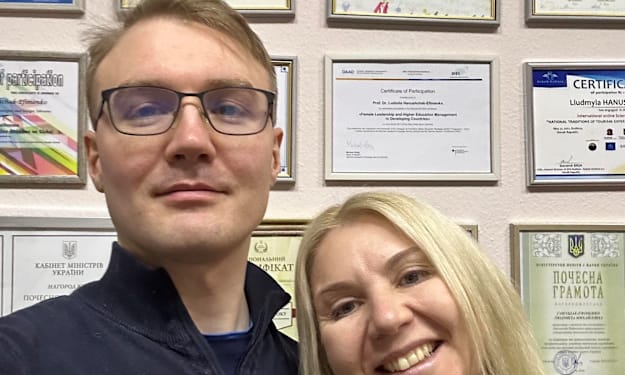
Ljydmila Ganushchak, Ph.D. on Ukrainian Higher Education, War, and European Integration
Dr. Ljydmila Ganushchak-Yefimenko is a Ukrainian academic leader associated with Kyiv National University of Technologies and Design. Her work focuses on educational modernization, research development, international cooperation, and student resilience during crisis. Through roles in faculty leadership, research, and innovation, Ganushchak has helped strengthen partnerships with European institutions, expand applied learning, and support Ukraine’s creative industries, including fashion, design, technology, and interdisciplinary education during wartime and post-Soviet transformation.
By Scott Douglas Jacobsen6 months ago in Education
Why You Feel Like Everyone Is Watching You . AI-Generated.
Have you ever walked into a room and instantly felt like all eyes were on you? Maybe you spilled coffee on your shirt, said something awkward in a meeting, or showed up five minutes late. Your heart races. Your cheeks flush. You're certain everyone noticed — and worse, they're judging you.
By Soul Scribe6 months ago in Education
Why So Many People Feel Emotionally Drained. AI-Generated.
In today’s fast-paced world, many people often feel emotionally exhausted without truly understanding why. They may blame stress, work pressure, financial concerns, or relationship problems. While these factors can certainly contribute, psychology suggests that the deeper issue is often not the events themselves, but the way we interpret and respond to them. Our minds can become the biggest source of our emotional burden.
By Soul Scribe6 months ago in Education
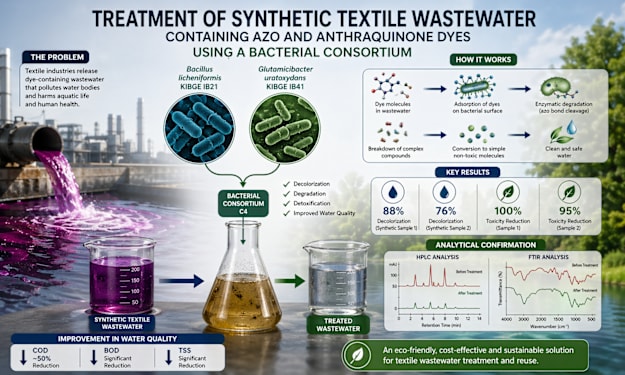
Treatment of Synthetic Textile Wastewater Containing Azo and Anthraquinone Dyes Using a Bacterial Consortium
Abstract The discharge of untreated industrial wastewater containing synthetic dyes poses serious environmental and health challenges. These pollutants can accumulate in ecosystems, disrupt biological processes, and threaten both aquatic life and human health. Therefore, it is essential to develop efficient, sustainable, and cost-effective treatment strategies. In this study, a bacterial consortium was developed to treat synthetic textile wastewater containing toxic azo-based and anthraquinone-based disperse dyes. Two bacterial strains, Bacillus licheniformis KIBGE IB21 and Glutamicibacter uratoxydans KIBGE IB41, were combined to form consortium C4. The consortium demonstrated high efficiency, achieving 88% and 76% decolorization of two synthetic wastewater samples within 18 hours at 35°C. Advanced analytical techniques, including High-Performance Liquid Chromatography (HPLC) and Fourier Transform Infrared Spectroscopy (FTIR), confirmed the degradation of dye molecules. Water quality parameters such as Total Suspended Solids (TSS), Biological Oxygen Demand (BOD), and Chemical Oxygen Demand (COD) were significantly reduced after treatment. Detoxification analysis using MTS assay revealed 100% and 95% reduction in toxicity for the two samples, respectively. Furthermore, the consortium showed strong performance when applied to real textile effluent. This study highlights the potential of bacterial consortia as an eco-friendly and effective approach for industrial wastewater treatment and reuse. Introduction Industrialization has significantly contributed to economic development worldwide, but it has also led to severe environmental pollution. Among various industrial sectors, the textile industry is one of the largest contributors to water pollution due to the discharge of untreated wastewater. Textile wastewater contains a complex mixture of dyes, salts, heavy metals, and other toxic compounds. During the dyeing process, a wide range of synthetic dyes is used to produce vibrant and durable colors. However, a significant portion of these dyes is released into wastewater, making it highly polluted. These dyes, particularly azo and anthraquinone dyes, are chemically stable and resistant to degradation. Their presence in water bodies reduces light penetration, disrupts photosynthesis, and decreases dissolved oxygen levels, negatively affecting aquatic ecosystems. Moreover, many dyes are toxic, mutagenic, and carcinogenic, posing serious risks to human health. Although physical and chemical treatment methods such as filtration, adsorption, precipitation, and reverse osmosis are available, they are often expensive and less effective in completely removing complex dye molecules. In contrast, biological treatment methods offer a more sustainable and economical solution. Bioremediation, which involves the use of microorganisms to degrade pollutants, has gained significant attention in recent years. Among biological approaches, the use of microbial consortia is particularly effective, as multiple microorganisms work together to degrade complex compounds more efficiently than individual strains. The objective of this study was to develop a bacterial consortium capable of decolorizing, degrading, and detoxifying synthetic textile wastewater containing multiple dyes, and to evaluate its effectiveness under laboratory and real-world conditions. Materials and Methods Bacterial Strains and Chemicals The bacterial strains used in this study were obtained from the Karachi Institute of Biotechnology and Genetic Engineering (KIBGE) and the American Type Culture Collection (ATCC). All chemicals and reagents used were of analytical grade. The two primary bacterial strains selected were: Bacillus licheniformis KIBGE IB21 Glutamicibacter uratoxydans KIBGE IB41 These strains were chosen based on their previously reported ability to degrade textile dyes. Preparation of Synthetic Textile Wastewater Two types of synthetic textile wastewater were prepared to simulate real industrial effluent. These samples contained a mixture of salts, trace metals, and disperse dyes, including blue, red, and violet dyes. The mixtures were prepared by continuous stirring at 30°C and adjusted to a pH of approximately 7.8. The prepared wastewater was sterilized through autoclaving at 121°C for 15 minutes. Development and Optimization of Bacterial Consortium Initially, three bacterial strains were tested in different combinations to develop four consortia. Among these, consortium C4, consisting of Bacillus licheniformis and Glutamicibacter uratoxydans, showed the highest decolorization efficiency and was selected for further experiments. The growth pattern of the consortium was monitored by measuring optical density at 600 nm. The consortium reached its logarithmic growth phase after approximately 4 hours. Cell viability was confirmed using the spread plate method, which showed that both bacterial strains could grow together without inhibiting each other, indicating a stable and cooperative relationship. Treatment of Synthetic Wastewater The optimized consortium was inoculated into synthetic wastewater and incubated at 35°C under aerobic conditions with continuous agitation. Decolorization was monitored at regular intervals using spectrophotometry. Significant color removal was observed within 18 hours. Results and Discussion Decolorization Efficiency The bacterial consortium demonstrated remarkable decolorization performance: 88% removal for synthetic sewage sample 1 76% removal for synthetic sewage sample 2 This rapid decolorization is attributed to the production of oxidoreductase enzymes by the bacteria, which break down dye molecules by cleaving their chromophore structures. Mechanism of Dye Degradation The degradation process involves both adsorption and enzymatic breakdown. Dye molecules first attach to the bacterial cell surface and are then degraded by intracellular and extracellular enzymes. These enzymes break the azo bonds (–N=N–) present in dyes, leading to the formation of simpler compounds, which are further degraded into non-toxic substances such as carbon dioxide and water. HPLC Analysis HPLC analysis confirmed the degradation of dyes by showing the disappearance of characteristic peaks corresponding to dye compounds after treatment. FTIR Analysis FTIR results revealed significant changes in functional groups, confirming the breakdown of dye chromophores. The disappearance of peaks corresponding to azo bonds further verified the degradation process. Detoxification Analysis The toxicity of treated and untreated wastewater was evaluated using MTS assay on NIH/3T3 mouse fibroblast cells. Results showed: Untreated wastewater reduced cell viability significantly Treated wastewater showed up to 100% cell viability This indicates that the bacterial consortium not only removed color but also detoxified harmful compounds. Water Quality Improvement Significant improvements were observed in water quality parameters: COD reduced by approximately 50% BOD showed noticeable reduction TSS decreased significantly These improvements demonstrate the effectiveness of the treatment process. Application to Real Textile Effluent The bacterial consortium was also tested on real textile wastewater collected from industry. Results showed: 86% decolorization Significant reduction in toxicity Although real wastewater contained additional chemicals, the consortium maintained high efficiency, proving its potential for practical applications. Conclusion This study demonstrates that a bacterial consortium can effectively treat synthetic and real textile wastewater by: Removing color Degrading complex dye molecules Reducing toxicity Improving water quality The process is environmentally friendly, cost-effective, and suitable for large-scale applications. It offers a promising alternative to traditional treatment methods and supports sustainable wastewater management.
By Ikram Ullah6 months ago in Education
Lab-Grown vs. Natural Diamonds
Diamonds have long been seen as symbols of love, wealth, and timeless beauty. But today, buyers have more choices than ever—especially with the rise of lab-grown diamonds. If you’ve ever wondered what the difference is between lab-made and natural diamonds (and whether one is “better”), you’re not alone.
By AnthonyBTV6 months ago in Education
Two Letters on a Chart That Changed Everything
They had written all of this right on the chart . Two letters. Decades of loss. And a system that had never apologized. There are moments in history when it does not make itself known through explosions or speeches. Sometimes it hides quietly—in a document, a record, or an ordinary chart. And that was the place where it existed. Two letters. Small, insignificant, almost easily overlooked. But once noticed, they would not leave the mind.
By Mohib Ullah 6 months ago in Education
How Bitcoin is Changing the Way We Buy Homes
For decades, buying a home has followed a familiar script: save cash, secure a mortgage, and hand over a sizable down payment. But in today’s evolving financial landscape, a new player is reshaping that process—decentralized finance (DeFi) combined with Bitcoin. What once sounded futuristic is quickly becoming reality, as lenders and fintech platforms begin accepting cryptocurrency as part of the homebuying journey.
By AnthonyBTV7 months ago in Education