student
From balancing your course load to forging relationships with classmates to extracurricular involvement, these are the tried and true methods to nail your career as a student.
From Diploma to Dream Job: Translating Education Credentials
Landing a job abroad rarely depends only on what you studied or how well you performed. In many cases, the way your education is presented matters just as much as the education itself. Degrees, transcripts, and certifications that carry clear meaning in one country can become confusing, undervalued, or even misleading when translated poorly into another system. This creates a hidden barrier for qualified professionals who expect their achievements to speak for themselves but instead find that small linguistic or formatting details reshape how employers perceive them. As a result, translating education credentials becomes not just a technical step, but a critical part of positioning your experience in a way that makes sense, builds trust, and opens real opportunities in competitive international job markets
By Molly Gibson6 months ago in Education
Best Free AI Tools for Content Creators
Content creation is growing very fast. Today, creators are not only making simple posts or videos; they are creating YouTube Shorts, Instagram Reels, TikTok videos, blogs, thumbnails, captions, voiceovers, and full content plans. Doing all of this manually can take a lot of time.
By Hassan Jan6 months ago in Education
How to Automate Your Phone to Silence Itself at School or Work. AI-Generated.
There is a small problem almost everyone has faced at least once. You walk into a quiet classroom, a meeting, or even a church service. Everything is calm. Then suddenly, your phone rings at full volume. Everyone looks at you. You rush to silence it.
By Stephano kambeta6 months ago in Education
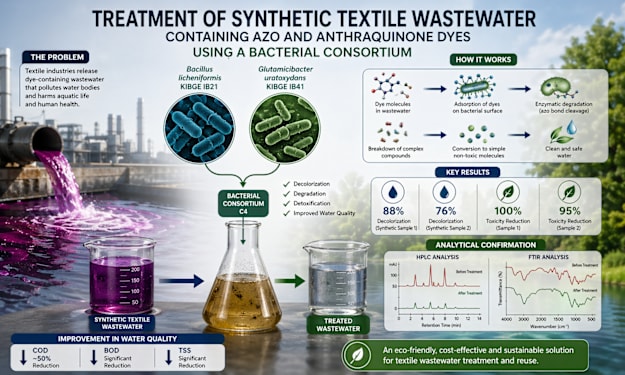
Treatment of Synthetic Textile Wastewater Containing Azo and Anthraquinone Dyes Using a Bacterial Consortium
Abstract The discharge of untreated industrial wastewater containing synthetic dyes poses serious environmental and health challenges. These pollutants can accumulate in ecosystems, disrupt biological processes, and threaten both aquatic life and human health. Therefore, it is essential to develop efficient, sustainable, and cost-effective treatment strategies. In this study, a bacterial consortium was developed to treat synthetic textile wastewater containing toxic azo-based and anthraquinone-based disperse dyes. Two bacterial strains, Bacillus licheniformis KIBGE IB21 and Glutamicibacter uratoxydans KIBGE IB41, were combined to form consortium C4. The consortium demonstrated high efficiency, achieving 88% and 76% decolorization of two synthetic wastewater samples within 18 hours at 35°C. Advanced analytical techniques, including High-Performance Liquid Chromatography (HPLC) and Fourier Transform Infrared Spectroscopy (FTIR), confirmed the degradation of dye molecules. Water quality parameters such as Total Suspended Solids (TSS), Biological Oxygen Demand (BOD), and Chemical Oxygen Demand (COD) were significantly reduced after treatment. Detoxification analysis using MTS assay revealed 100% and 95% reduction in toxicity for the two samples, respectively. Furthermore, the consortium showed strong performance when applied to real textile effluent. This study highlights the potential of bacterial consortia as an eco-friendly and effective approach for industrial wastewater treatment and reuse. Introduction Industrialization has significantly contributed to economic development worldwide, but it has also led to severe environmental pollution. Among various industrial sectors, the textile industry is one of the largest contributors to water pollution due to the discharge of untreated wastewater. Textile wastewater contains a complex mixture of dyes, salts, heavy metals, and other toxic compounds. During the dyeing process, a wide range of synthetic dyes is used to produce vibrant and durable colors. However, a significant portion of these dyes is released into wastewater, making it highly polluted. These dyes, particularly azo and anthraquinone dyes, are chemically stable and resistant to degradation. Their presence in water bodies reduces light penetration, disrupts photosynthesis, and decreases dissolved oxygen levels, negatively affecting aquatic ecosystems. Moreover, many dyes are toxic, mutagenic, and carcinogenic, posing serious risks to human health. Although physical and chemical treatment methods such as filtration, adsorption, precipitation, and reverse osmosis are available, they are often expensive and less effective in completely removing complex dye molecules. In contrast, biological treatment methods offer a more sustainable and economical solution. Bioremediation, which involves the use of microorganisms to degrade pollutants, has gained significant attention in recent years. Among biological approaches, the use of microbial consortia is particularly effective, as multiple microorganisms work together to degrade complex compounds more efficiently than individual strains. The objective of this study was to develop a bacterial consortium capable of decolorizing, degrading, and detoxifying synthetic textile wastewater containing multiple dyes, and to evaluate its effectiveness under laboratory and real-world conditions. Materials and Methods Bacterial Strains and Chemicals The bacterial strains used in this study were obtained from the Karachi Institute of Biotechnology and Genetic Engineering (KIBGE) and the American Type Culture Collection (ATCC). All chemicals and reagents used were of analytical grade. The two primary bacterial strains selected were: Bacillus licheniformis KIBGE IB21 Glutamicibacter uratoxydans KIBGE IB41 These strains were chosen based on their previously reported ability to degrade textile dyes. Preparation of Synthetic Textile Wastewater Two types of synthetic textile wastewater were prepared to simulate real industrial effluent. These samples contained a mixture of salts, trace metals, and disperse dyes, including blue, red, and violet dyes. The mixtures were prepared by continuous stirring at 30°C and adjusted to a pH of approximately 7.8. The prepared wastewater was sterilized through autoclaving at 121°C for 15 minutes. Development and Optimization of Bacterial Consortium Initially, three bacterial strains were tested in different combinations to develop four consortia. Among these, consortium C4, consisting of Bacillus licheniformis and Glutamicibacter uratoxydans, showed the highest decolorization efficiency and was selected for further experiments. The growth pattern of the consortium was monitored by measuring optical density at 600 nm. The consortium reached its logarithmic growth phase after approximately 4 hours. Cell viability was confirmed using the spread plate method, which showed that both bacterial strains could grow together without inhibiting each other, indicating a stable and cooperative relationship. Treatment of Synthetic Wastewater The optimized consortium was inoculated into synthetic wastewater and incubated at 35°C under aerobic conditions with continuous agitation. Decolorization was monitored at regular intervals using spectrophotometry. Significant color removal was observed within 18 hours. Results and Discussion Decolorization Efficiency The bacterial consortium demonstrated remarkable decolorization performance: 88% removal for synthetic sewage sample 1 76% removal for synthetic sewage sample 2 This rapid decolorization is attributed to the production of oxidoreductase enzymes by the bacteria, which break down dye molecules by cleaving their chromophore structures. Mechanism of Dye Degradation The degradation process involves both adsorption and enzymatic breakdown. Dye molecules first attach to the bacterial cell surface and are then degraded by intracellular and extracellular enzymes. These enzymes break the azo bonds (–N=N–) present in dyes, leading to the formation of simpler compounds, which are further degraded into non-toxic substances such as carbon dioxide and water. HPLC Analysis HPLC analysis confirmed the degradation of dyes by showing the disappearance of characteristic peaks corresponding to dye compounds after treatment. FTIR Analysis FTIR results revealed significant changes in functional groups, confirming the breakdown of dye chromophores. The disappearance of peaks corresponding to azo bonds further verified the degradation process. Detoxification Analysis The toxicity of treated and untreated wastewater was evaluated using MTS assay on NIH/3T3 mouse fibroblast cells. Results showed: Untreated wastewater reduced cell viability significantly Treated wastewater showed up to 100% cell viability This indicates that the bacterial consortium not only removed color but also detoxified harmful compounds. Water Quality Improvement Significant improvements were observed in water quality parameters: COD reduced by approximately 50% BOD showed noticeable reduction TSS decreased significantly These improvements demonstrate the effectiveness of the treatment process. Application to Real Textile Effluent The bacterial consortium was also tested on real textile wastewater collected from industry. Results showed: 86% decolorization Significant reduction in toxicity Although real wastewater contained additional chemicals, the consortium maintained high efficiency, proving its potential for practical applications. Conclusion This study demonstrates that a bacterial consortium can effectively treat synthetic and real textile wastewater by: Removing color Degrading complex dye molecules Reducing toxicity Improving water quality The process is environmentally friendly, cost-effective, and suitable for large-scale applications. It offers a promising alternative to traditional treatment methods and supports sustainable wastewater management.
By Ikram Ullah6 months ago in Education
The Day Everything Went Wrong… and Taught Me Everything.
Written by (Matiullah) Once there was a young boy named Sameer who lived in a small town with his family. He was a simple and hardworking student who always tried his best in everything he did. Sameer had big dreams. He wanted to succeed in life, make his parents proud, and change his future. He believed that if he worked hard, everything would go right. But life does not always go as planned. One day, everything started going wrong. That morning, Sameer woke up late. He had an important exam that day, but his alarm didn’t ring. In a hurry, he got ready without eating breakfast and rushed to school. On the way, his bicycle got a flat tire. Now he had no option but to run. He reached the exam hall late and was not allowed extra time. Because of this, he could not complete his paper properly. He felt stressed and disappointed. After the exam, he checked his phone and saw multiple missed calls from his father. When he called back, he got shocking news—his father had met with a minor accident. Sameer rushed to the hospital. Thankfully, his father was safe, but he was injured and needed rest. Sameer’s mind was already full of stress, and now this situation made it worse. He returned home late in the evening, tired and mentally broken. But the day was still not over. When he checked his email, he saw that he had been rejected from a scholarship he was hoping for. That scholarship was very important for his future studies. Now Sameer couldn’t hold his emotions anymore. He sat alone in his room and started thinking, “Why is everything going wrong today?” “Did I do something wrong?” It felt like the worst day of his life. That night, he couldn’t sleep. His mind was full of negative thoughts. The next morning, Sameer woke up feeling heavy and hopeless. But when he saw his father resting peacefully, something changed inside him. He realized that despite everything going wrong, some things were still right. His father was safe. His family was with him. He still had time to improve. Later that day, Sameer went outside to get some fresh air. He saw an old man sitting near a tree. The old man looked at him and said, “You look worried, my son.” Sameer shared everything about his bad day. The old man listened and then said, “Sometimes life gives you a day where everything goes wrong—not to break you, but to wake you up.” Sameer asked, “What do you mean?” The old man replied, “You were depending too much on everything going perfectly. But life is not perfect. Real strength comes when things go wrong, and you still stand strong.” These words hit Sameer deeply. He realized that he was not prepared for failure. He only believed in success. That day changed his mindset. Sameer decided that instead of complaining, he would learn from his bad day. He started preparing better for exams. He kept backup plans. He became more responsible and mentally strong. He also understood the importance of patience and acceptance. Days passed, and Sameer slowly recovered from that difficult phase. When the results came, he did not score very high, but he passed. More importantly, he had changed as a person. He was now stronger, calmer, and more prepared for life. Years later, Sameer became successful. But he never forgot that one day—the day everything went wrong. Because that was the day that taught him everything about life. In life, there will always be days when nothing goes your way. Everything may feel broken, confusing, and painful. But those days are not the end. They are lessons in disguise. They teach you patience, strength, and how to handle real life. So, never be afraid of bad days. Because sometimes, your worst day becomes your greatest teacher. Moral: “Bad days are not the end—they are the lessons that prepare you for a better future.”
By Matiullah k6 months ago in Education