interview
Interviews with educators, innovative graduate students and individuals who've devoted their lives to the development of the world's youth.
Output vs Oversaturation
The Fear of Adding to the Noise The modern anxiety around oversaturation is not unfounded. People are surrounded by more words, videos, opinions, explanations, reactions, and interpretations than they can meaningfully absorb. In that environment, producing more content can feel irresponsible or self-defeating, as though adding anything further only contributes to the noise. This concern often causes thoughtful people to hesitate. They hold back ideas, not because the ideas lack value, but because they fear that volume itself will devalue what they have to say.
By Peter Thwing - Host of the FST Podcast6 months ago in Education
What the Unseen Realms Might Actually Be
When people hear talk of “unseen realms,” the mind often jumps immediately to the abstract or the speculative. It can sound mystical, distant, or untethered from ordinary life, as though it refers to something separate from daily experience rather than something embedded within it. That reaction is understandable. The unseen, by definition, resists direct inspection. But it may be worth asking whether what we call unseen is actually less real, or whether it is simply less acknowledged.
By Peter Thwing - Host of the FST Podcast6 months ago in Education
Maria Butyrina on Media, War Narratives, and National Identity: Ukrainian Journalism in Wartime
By Scott Douglas Jacobsen and Liana Okhrymenko (Translator, English-Ukrainian) Maria Butyrina is a Ukrainian journalist whose work reflects the evolving realities of her country amid political upheaval and war. Motivated by both creativity and self-realization, she uses journalism to shape public understanding and social consciousness. Her reporting focuses on war, displacement, and human resilience, particularly following the Revolution of Dignity and the full-scale invasion. Butyrina represents a generation of journalists committed to truth, national solidarity, and responsible storytelling during crisis.
By Scott Douglas Jacobsen6 months ago in Education
You Have Been Saying “I Like” in Italian Wrong Your Entire Life
I grew up in Veneto, in the northeast of Italy, where food is serious, silence is meaningful, and politeness is an art form. I remember the first time a foreign friend said io piaccio la pasta at my grandmother's table. My grandmother kept a perfectly straight face, passed the bread, and moved on. That is Italian politeness at its finest. She understood what he meant. She simply chose not to embarrass him.
By Andrea Zanon6 months ago in Education
Serhii Huliienko, Ph.D. on Ukrainian Science, Membrane Research, and Wartime Academic Life
Dr. Serhii Huliienko is an associate professor at the National Technical University of Ukraine “Igor Sikorsky Kyiv Polytechnic Institute,” specializing in membrane separation, reverse osmosis, nanofiltration, and process simulation. His research examines fouling, regeneration of spiral-wound modules, concentration polarization, mass-transfer resistance, BaCl₂ separation, CFD analysis, spacer design, and channel-curvature effects. Across experimental and mathematical studies, he contributes to optimizing pressure-driven membrane technologies for chemical engineering, wastewater treatment, separation-equipment design, and industrial applications worldwide more broadly.
By Scott Douglas Jacobsen6 months ago in Education
Abdul Rafay Gadit, Bitcoin as Digital Gold or Macro Asset: Inflation, Liquidity, and Market Reality
Abdul Rafay Gadit is Co-Founder of ZIGChain, where he works at the intersection of blockchain infrastructure, digital assets, and market strategy. His recent public commentary reflects a broad macro perspective spanning commodities, startups, and crypto markets. He has argued that a dramatic rise in silver would require sustained inflation, low real interest rates, and weakening confidence in monetary systems. He has also assessed the EU Inc proposal through the practical lens of startup formation, capital structures, tax, and labor constraints. On digital assets, Gadit has emphasized selectivity, suggesting that durable altcoin success depends on real utility, sustainable economics, and regulatory clarity.
By Scott Douglas Jacobsen6 months ago in Education
How to Prepare for Your First Internship Interview
Introduction Getting your first internship interview is an exciting moment. It means a company, organization, or professional team has noticed your application and wants to know more about you. For many students, this is the first real step toward professional life.
By Hassan Jan6 months ago in Education
“Why Is My Autistic Employee So Lazy?”
As a manager working with autistic employees, you may have found yourself getting frustrated and thinking, “Why is my autistic employee so lazy?” If you’re unfamiliar with the autistic neurotype, it’s easy to misinterpret some of our traits.
By The Articulate Autistic6 months ago in Education
Digital Learning Making Kids Less Intelligent?
In today’s hyper-connected world, digital learning has become the norm rather than the exception. Tablets in classrooms, educational apps at home, and online lessons everywhere—on the surface, it looks like a revolution in how children learn. But beneath the convenience and innovation lies a more complicated question: is heavy reliance on digital learning actually making kids less intelligent?
By AnthonyBTV6 months ago in Education
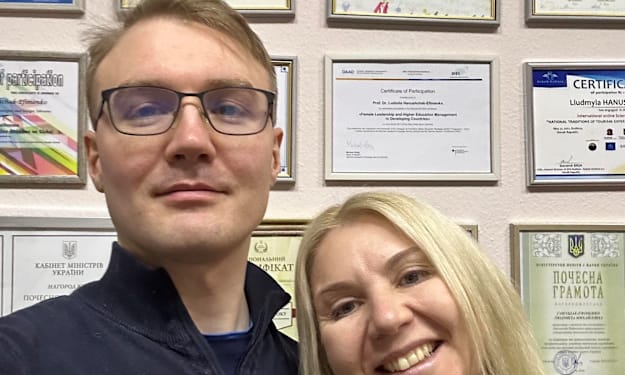
Ljydmila Ganushchak, Ph.D. on Ukrainian Higher Education, War, and European Integration
Dr. Ljydmila Ganushchak-Yefimenko is a Ukrainian academic leader associated with Kyiv National University of Technologies and Design. Her work focuses on educational modernization, research development, international cooperation, and student resilience during crisis. Through roles in faculty leadership, research, and innovation, Ganushchak has helped strengthen partnerships with European institutions, expand applied learning, and support Ukraine’s creative industries, including fashion, design, technology, and interdisciplinary education during wartime and post-Soviet transformation.
By Scott Douglas Jacobsen6 months ago in Education