
Maria Butyrina on Media, War Narratives, and National Identity: Ukrainian Journalism in Wartime
How has Ukrainian journalism evolved from the Revolution of Dignity to the full-scale invasion in shaping public understanding and national consciousness?

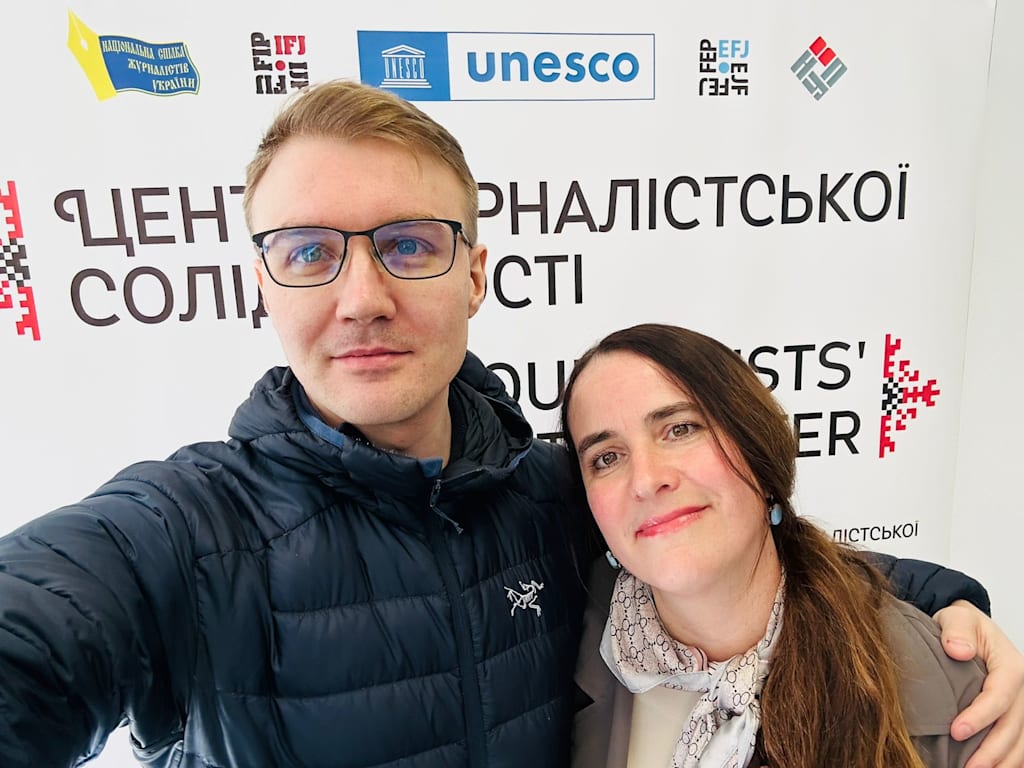
By Scott Douglas Jacobsen and Liana Okhrymenko (Translator, English-Ukrainian)
Maria Butyrina is a Ukrainian journalist whose work reflects the evolving realities of her country amid political upheaval and war. Motivated by both creativity and self-realization, she uses journalism to shape public understanding and social consciousness. Her reporting focuses on war, displacement, and human resilience, particularly following the Revolution of Dignity and the full-scale invasion. Butyrina represents a generation of journalists committed to truth, national solidarity, and responsible storytelling during crisis.
In this interview, Scott Douglas Jacobsen and Liana Okhrymenko speak with Maria Butyrina about her motivations and the transformation of Ukrainian journalism. She explains how war became the dominant theme after 2014 and intensified following the 2022 invasion, shifting attention toward displacement, loss, and survival. Despite regional differences in danger, Butyrina emphasizes a unified national media approach focused on accuracy, resilience, and informing both citizens and international partners about Ukraine’s ongoing struggle.
Scott Douglas Jacobsen: Was journalism your original dream?
Maria Butyrina: Journalism gave me the opportunity to work not only with creativity, but also with self-realization. Thanks to my journalistic work, I was able to achieve a higher level of self-realization. I also wanted to have some impact on society, because journalism gives me the opportunity to form opinion, to place certain emphases, and to offer interpretations of what is happening.
This is a good opportunity to influence how people understand events and, to some extent, human behavior and consciousness.
Jacobsen: How would you characterize the themes of journalism before the Revolution of Dignity, during 2014–2021, and after the full-scale invasion?
Butyrina: First of all, after the Revolution of Dignity, the annexation of Crimea and the war in eastern Ukraine became central themes. Military issues moved to the forefront, which is understandable, and there was less space for other thematic blocks in the media.
The daily news agenda began to form around these military narratives. After February 24, 2022, many more war-related topics emerged: internal displacement, relocated enterprises, and a significant number of sensitive issues connected to the full-scale invasion.
There was also strong attention to people who survived occupation, lost property, or lost loved ones. Of course, the thematic spectrum changed a lot. Even after 2014, we could already see this shift, because Crimea was occupied and the war in the east had begun.
After the full-scale invasion, we have even more problems here. Before that, there was already less attention to other topics. Right now, there is even less, because the war dominates the news, along with destruction and everything connected to it. We also have a huge focus on people who suffered because of the war—people who relocated, who need help with housing, with family, and with many other things.
That is why, right now, I would say that we still have other topics, but this is the primary one.
Jacobsen: Are you noticing any nuances in the tone of reporting between the frontline and the far west, for instance?
Butyrina: I do not see major differences in the presentation of military issues. Ukraine is one country living through the same war, even if the intensity differs by region. It does not matter where the journalist is from.
We all work in the same mode. We support our country, and we pay attention to our Western partners and to the people who make decisions about helping us. That is why international broadcasting and media diplomacy are so important for us right now. The world needs to see and understand what is happening in Ukraine. It is important to report on what is happening in our country objectively and truthfully.
Unfortunately, even western regions are affected by missile strikes and destruction, so there is no regional gap. Of course, people living closer to the frontline face more immediate danger, which can influence journalistic emphasis, but overall we operate within a shared national information reality.
Jacobsen: Thank you very much for the opportunity and your time, Maria.
Scott Douglas Jacobsen is a blogger on Vocal with over 170 posts on the platform. He is the Founder and Publisher of In-Sight Publishing (ISBN: 978–1–0692343; 978–1–0673505) and Editor-in-Chief of In-Sight: Interviews (ISSN: 2369–6885). He writes for International Policy Digest (ISSN: 2332–9416), The Humanist (Print: ISSN, 0018–7399; Online: ISSN, 2163–3576), Basic Income Earth Network (UK Registered Charity 1177066), Humanist Perspectives (ISSN: 1719–6337), A Further Inquiry (SubStack), Vocal, Medium, The Good Men Project, The New Enlightenment Project, The Washington Outsider, rabble.ca, and other media. His bibliography index can be found via the Jacobsen Bank at In-Sight Publishing, comprising more than 10,000 articles, interviews, and republications across more than 200 outlets. He has served in national and international leadership roles within humanist and media organizations, held several academic fellowships, and currently serves on several boards. He is a member in good standing in numerous media organizations, including the Canadian Association of Journalists, PEN Canada (CRA: 88916 2541 RR0001), Reporters Without Borders (SIREN: 343 684 221/SIRET: 343 684 221 00041/EIN: 20–0708028), and others.
Image Credit: Scott Douglas Jacobsen.
About the Creator
Scott Douglas Jacobsen
Scott Douglas Jacobsen is the publisher of In-Sight Publishing (ISBN: 978-1-0692343) and Editor-in-Chief of In-Sight: Interviews (ISSN: 2369-6885). He is a member in good standing of numerous media organizations.
Enjoyed the story? Support the Creator.
Subscribe for free to receive all their stories in your feed.
Comments
There are no comments for this story
Be the first to respond and start the conversation.