
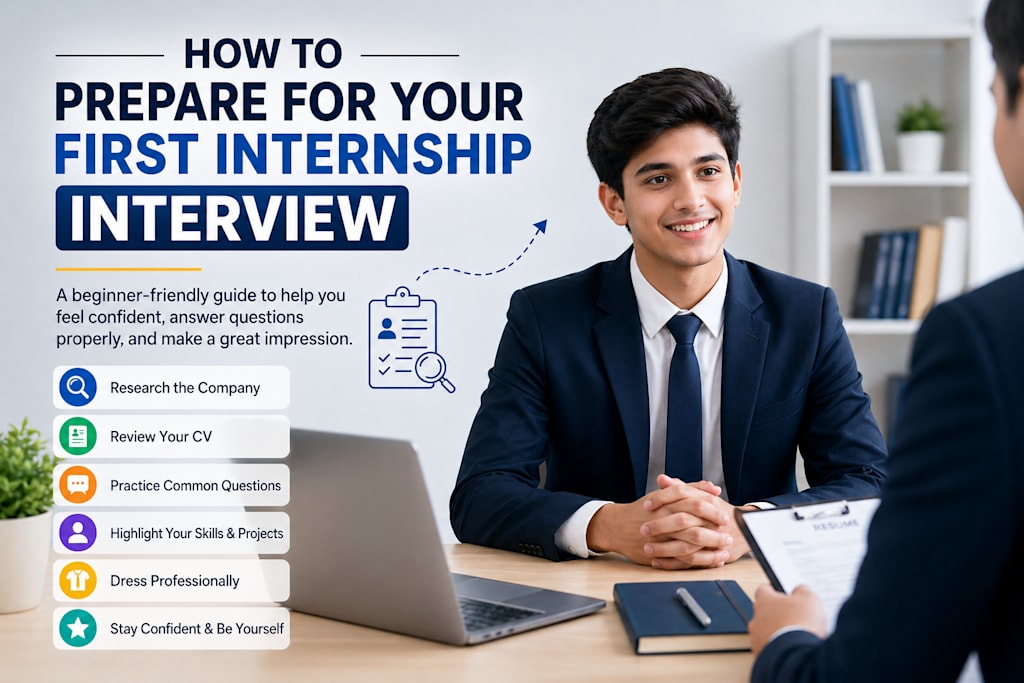
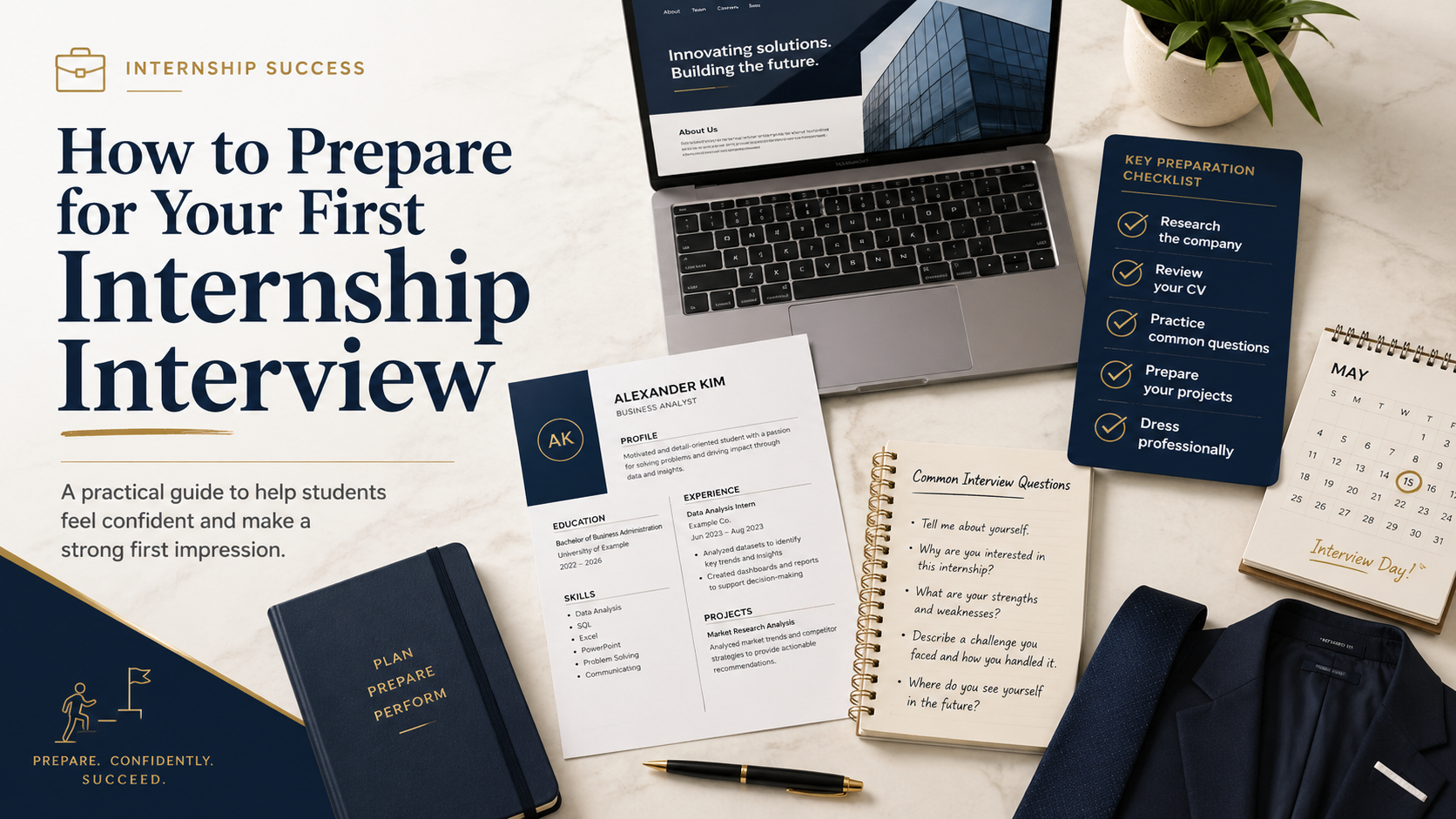
How to Prepare for Your First Internship Interview
A beginner-friendly guide for students who want to feel confident, answer questions properly, and make a good first impression.

Introduction
Getting your first internship interview is an exciting moment. It means a company, organization, or professional team has noticed your application and wants to know more about you. For many students, this is the first real step toward professional life.
But at the same time, internship interviews can feel stressful. You may start thinking:
What questions will they ask?
What should I say about myself?
What if I do not know the answer?
What should I wear?
How can I look confident if I have no experience?
These feelings are completely normal. Most students feel nervous before their first interview. The good news is that you do not need to be perfect. You only need to prepare properly, understand your own skills, and show a positive learning attitude.
An internship interview is not only about testing your knowledge. It is also about checking your communication skills, confidence, interest, honesty, and willingness to learn. Companies know that interns are students or beginners. They do not expect you to know everything.
In this article, we will discuss how students can prepare for their first internship interview step by step.
Why Internship Interviews Are Important
An internship interview is important because it gives you a chance to present yourself beyond your CV. Your CV shows your education, skills, and projects, but the interview shows your personality, communication style, confidence, and attitude.
A good interview can help you:
Get your first professional experience
Learn how companies work
Build your confidence
Improve communication skills
Understand your career direction
Create professional connections
Add real experience to your CV
Prepare for future jobs
Even if you do not get selected, the interview experience is still valuable. Every interview teaches you something new and makes you better for the next one.
1. Understand the Internship Role
Before going to any interview, first understand the internship role properly. Many students apply for internships without reading the job description carefully. This is a mistake.
Read the internship post and understand:
What is the role?
What skills are required?
What tasks will you perform?
Is it remote, hybrid, or onsite?
What tools or technologies are mentioned?
What kind of student are they looking for?
For example, if you applied for a web development internship, the company may expect basic knowledge of HTML, CSS, JavaScript, React, databases, or Git.
If you applied for a marketing internship, they may expect communication skills, social media knowledge, content writing, or basic research skills.
When you understand the role, you can prepare better answers.
Example
If the internship says:
“Looking for a frontend development intern with basic knowledge of HTML, CSS, JavaScript, and React.”
Then you should revise:
HTML structure
CSS styling
JavaScript basics
React components
Props and state
Simple projects you have built
Understanding the role helps you avoid random preparation.
2. Research the Company
Before the interview, always research the company. This shows that you are serious and interested.
You do not need to study everything about the company, but you should know the basics.
Check:
Company website
LinkedIn page
Services or products
Industry
Recent posts
Mission or values
Type of clients or projects
This research helps you answer questions like:
“Why do you want to join our company?”
“What do you know about us?”
“Why are you interested in this internship?”
Example Answer
“I read about your company and saw that you work on digital solutions for businesses. I am interested in web development, and I believe this internship can help me learn from real projects and improve my practical skills.”
This answer is simple but shows preparation.
3. Review Your CV
Your CV is usually the main document interviewers use during the interview. They may ask questions from your education, skills, projects, certificates, or experience.
Before the interview, read your own CV carefully.
Make sure you can explain everything written in it.
If you mentioned a skill, be ready to answer questions about it.
If you added a project, be ready to explain how you built it.
If you listed a certificate, be ready to discuss what you learned from it.
Very Important Tip
Do not write fake skills or fake experience on your CV. If the interviewer asks about something you do not know, it can create a bad impression.
It is better to write fewer real skills than many fake skills.
4. Prepare Your Self-Introduction
The most common interview question is:
“Tell me about yourself.”
This question looks simple, but many students struggle with it because they do not prepare.
Your answer should be short, clear, and professional. Do not tell your full life story. Focus on your education, skills, interests, and internship goal.
Simple Structure
Your self-introduction can follow this structure:
Your name and education
Your field of interest
Skills you are learning
Projects or experience
Why you are interested in the internship
Example Answer for a Computer Science Student
“My name is your name. I am a Computer Science student with an interest in web development and software engineering. I have been learning HTML, CSS, JavaScript, React, Node.js, and MongoDB. I have also worked on some academic and personal projects where I practiced frontend and backend development. I am looking for an internship where I can improve my practical skills, learn from experienced developers, and contribute to real projects.”
This answer is professional and not too long.
Example Answer for a Business Student
“My name is Ali Khan. I am a Business Administration student with an interest in marketing and brand management. I have worked on university projects related to market research and digital campaigns. I am comfortable with teamwork, communication, and basic social media planning. I am looking for an internship where I can learn from professionals and gain practical business experience.”
Your introduction should sound natural. Practice it, but do not memorize it like a robot.
5. Prepare Common Interview Questions
Most internship interviews include common questions. If you prepare these in advance, you will feel more confident.
Common Internship Interview Questions
Tell me about yourself.
Why do you want this internship?
What do you know about our company?
What are your strengths?
What are your weaknesses?
What skills do you have for this role?
Tell us about a project you worked on.
How do you manage deadlines?
How do you handle feedback?
Where do you see yourself in the future?
Why should we select you?
Do you have any questions for us?
You do not need to memorize exact answers. Just prepare the main points.
6. Learn How to Talk About Your Strengths
Interviewers often ask:
“What are your strengths?”
Your answer should be honest and connected to the internship.
Good strengths for students include:
Quick learning
Communication skills
Teamwork
Problem-solving
Time management
Creativity
Responsibility
Consistency
Curiosity
Adaptability
Example Answer
“One of my strengths is that I am a quick learner. Whenever I find something difficult, I try to understand it step by step and practice it until I improve. During my university projects, this helped me learn new tools and complete tasks on time.”
This answer is strong because it includes a short explanation.
7. Answer Weakness Questions Smartly
Another common question is:
“What is your weakness?”
Do not say:
“I have no weakness.”
Everyone has weaknesses. The best way is to mention a real but manageable weakness and explain how you are improving it.
Example Answer
“One weakness I am working on is that sometimes I take extra time to make my work perfect. I am learning to manage time better by setting deadlines and focusing on completing tasks with good quality within the available time.”
This answer sounds honest and mature.
Another Example
“I used to feel nervous while speaking in front of new people, but I am improving by participating more in class discussions and practicing professional communication.”
This shows self-awareness and improvement.
8. Prepare Your Projects
For students, projects are very important. If you do not have job experience, projects can show your practical skills.
Before the interview, choose 1 or 2 projects you can explain clearly.
For each project, prepare these points:
Project name
Purpose of the project
Tools or technologies used
Your role
Main features
Challenges you faced
What you learned
Example Project Explanation
“I worked on a tourism management website as part of my academic project. The project allowed users to view travel packages, book tours, and manage their bookings. I worked on the frontend using React and also connected it with backend APIs. This project helped me understand routing, components, API integration, and user interface design.”
This explanation is simple and professional.
9. Practice Technical Basics
If your internship is technical, you should revise the basics before the interview.
For example, for a web development internship, revise:
HTML tags
CSS box model
Flexbox and grid
JavaScript variables, loops, arrays, functions
DOM basics
React components
Props and state
API calls
Git basics
Database basics
For a data analyst internship, revise:
Excel basics
SQL queries
Data cleaning
Charts and dashboards
Basic statistics
Power BI or Tableau basics
For a marketing internship, revise:
Digital marketing basics
Social media platforms
Content strategy
Branding
Target audience
Market research
You do not need advanced knowledge for most internships, but your basics should be clear.
10. Improve Your Communication Skills
Good communication can make a big difference in interviews. You may know many things, but if you cannot explain them clearly, the interviewer may not understand your ability.
Speak slowly and clearly. Do not rush. If you do not understand a question, politely ask the interviewer to repeat it.
Useful Phrases
“I would like to explain it with an example.”
“That is a good question.”
“I have basic knowledge of this, and I am currently improving it.”
“I have not worked on this deeply yet, but I am willing to learn.”
“Can you please repeat the question?”
“Can I take a moment to think?”
These phrases help you sound professional and calm.
11. Dress Properly
Your dressing should match the interview environment. You do not always need a full suit, but you should look neat and professional.
For an internship interview, wear clean and decent clothes.
For Boys
Formal shirt or neat polo
Clean pants
Simple shoes
Tidy hair
Avoid too much perfume
For Girls
Professional and modest outfit
Simple colors
Comfortable shoes
Neat appearance
Avoid too much jewelry or makeup
The goal is not to look fancy. The goal is to look serious and professional.
12. Prepare for Online Interviews
Many internship interviews are now online through Zoom, Google Meet, or Microsoft Teams. Online interviews need extra preparation.
Before the interview:
Check your internet connection
Test your camera and microphone
Choose a quiet place
Keep your laptop charged
Use a clean background
Join 5 minutes early
Keep your CV open
Keep a notebook and pen nearby
Look at the camera while speaking. Sit properly and avoid distractions.
Do not attend the interview from a noisy place or while lying on bed. It creates an unprofessional impression.
13. Be Honest When You Do Not Know Something
Many students become nervous when they do not know an answer. But not knowing everything is normal, especially for interns.
If you do not know something, do not fake it.
You can say:
“I have not studied this topic deeply yet, but I am willing to learn.”
“I have basic understanding, but I would like to improve it further.”
“I do not know the exact answer right now, but I can learn it and work on it.”
Honesty is better than giving a wrong answer confidently.
Companies often prefer interns who are honest and willing to learn over those who pretend to know everything.
14. Show a Learning Attitude
Internships are mainly about learning. Employers know that you are not an expert yet. What they want to see is your attitude.
Show that you are:
Curious
Responsible
Serious
Open to feedback
Ready to learn
Willing to work in a team
Interested in the company’s work
Example Sentence
“I understand that I am still learning, but I am serious about improving my skills and gaining real-world experience through this internship.”
This type of sentence shows maturity and motivation.
15. Prepare Questions to Ask the Interviewer
At the end of the interview, the interviewer may ask:
“Do you have any questions for us?”
Never say:
“No.”
Asking a good question shows interest.
Good Questions to Ask
“What kind of tasks will interns usually work on?”
“What skills should I focus on to perform well in this role?”
“Will interns get guidance or mentorship during the internship?”
“What does a successful intern look like in your company?”
“What are the next steps after this interview?”
Avoid asking about salary or leave policy too early unless the interviewer brings it up.
16. Practice Before the Interview
Practice is very important. You can prepare answers, but if you never speak them aloud, you may feel nervous during the interview.
Practice with:
A friend
A classmate
A teacher
A family member
Yourself in front of a mirror
Your phone camera
Record yourself answering “Tell me about yourself.” Then listen and improve.
Focus on:
Clear voice
Good speed
Confident posture
Natural tone
Short and clear answers
Practice reduces fear.
17. Keep Important Documents Ready
Before the interview, keep your documents ready.
You may need:
Updated CV
CNIC/student ID if required
Certificates
Portfolio link
GitHub link
LinkedIn profile
Project files or screenshots
Internship application details
For online interviews, keep links ready in a text file so you can share them quickly if asked.
For physical interviews, carry printed copies of your CV.
18. Follow Up After the Interview
After the interview, it is good to send a short thank-you message or email.
Example Follow-Up Message
Dear Sir/Madam,
Thank you for giving me the opportunity to interview for the internship position. I appreciate your time and the chance to learn more about the role. I look forward to hearing from you.
Regards,
Your Name
This shows professionalism and respect.
Do not send repeated messages again and again. One polite follow-up is enough.
19. Common Mistakes to Avoid
Here are some mistakes students should avoid in their first internship interview.
1. Not Researching the Company
If you know nothing about the company, it looks like you are not serious.
2. Giving Very Long Answers
Keep answers clear and to the point.
3. Speaking Negatively
Do not speak badly about teachers, classmates, previous teams, or other companies.
4. Lying About Skills
Fake skills can easily be exposed during questions.
5. Not Asking Any Questions
Always prepare at least one question for the interviewer.
6. Being Too Casual
An interview is professional. Your tone, dressing, and behavior should be respectful.
7. Joining Late
Always join or arrive early.
20. Final Checklist Before the Interview
Use this quick checklist before your interview:
I understand the internship role.
I researched the company.
I reviewed my CV.
I prepared my self-introduction.
I practiced common questions.
I revised basic skills.
I prepared one or two projects.
I chose proper clothes.
I checked internet and device if online.
I prepared questions for the interviewer.
I kept my documents and links ready.
If you complete this checklist, you will feel much more confident.
Conclusion
Preparing for your first internship interview may feel difficult, but it becomes easier when you follow the right steps. You do not need to be perfect or know everything. As a student, your main goal is to show that you are serious, honest, willing to learn, and ready to work hard.
Start by understanding the internship role and researching the company. Review your CV, prepare your self-introduction, practice common questions, and be ready to explain your projects. Improve your communication, dress properly, and show a positive learning attitude.
Remember that every interview is an experience. Even if you do not get selected the first time, you will learn something valuable for the next opportunity.
Your first internship interview is not just a test. It is a chance to start your professional journey.
Final Thought
Confidence does not come from knowing everything. Confidence comes from preparation. The more you prepare, the more comfortable you will feel.
So before your first internship interview, prepare honestly, practice clearly, and believe in your ability to learn.
Call to Action
If you found this article helpful, follow me for more beginner-friendly guides about internships, career growth, student life, professional skills, and personal development.
About the Creator
Enjoyed the story? Support the Creator.
Subscribe for free to receive all their stories in your feed.
Comments
There are no comments for this story
Be the first to respond and start the conversation.