college
Maximize your university experience with these tips for all things collegiate–how to achieve a perfect GPA, select the right major, finance your college education and more.
Why Your Brain Remembers Quiz Answers But Forgets Everything You Highlighted in a Textbook
You've probably had this experience. You spend an hour reading a textbook chapter, marking up the key points, underlining the important sentences. You feel like you're absorbing it. Then a week later, you can barely recall a word.
By Faabul Quizzes6 months ago in Education
Output vs Oversaturation
The Fear of Adding to the Noise The modern anxiety around oversaturation is not unfounded. People are surrounded by more words, videos, opinions, explanations, reactions, and interpretations than they can meaningfully absorb. In that environment, producing more content can feel irresponsible or self-defeating, as though adding anything further only contributes to the noise. This concern often causes thoughtful people to hesitate. They hold back ideas, not because the ideas lack value, but because they fear that volume itself will devalue what they have to say.
By Peter Thwing - Host of the FST Podcast6 months ago in Education
What the Unseen Realms Might Actually Be
When people hear talk of “unseen realms,” the mind often jumps immediately to the abstract or the speculative. It can sound mystical, distant, or untethered from ordinary life, as though it refers to something separate from daily experience rather than something embedded within it. That reaction is understandable. The unseen, by definition, resists direct inspection. But it may be worth asking whether what we call unseen is actually less real, or whether it is simply less acknowledged.
By Peter Thwing - Host of the FST Podcast6 months ago in Education
When Is a Move Final?
The Commitment Problem in Modern Chess Modern chess operates under a fractured commitment model that no longer aligns with how players think, how turns function in most games, or how chess itself is actually played across physical and digital formats. At the heart of the problem is that chess treats physical contact with a piece as binding commitment while simultaneously relying on a separate explicit action to end a player’s turn. This creates a logical contradiction: a move becomes final before the turn is over. In most turn-based games, interaction with game components is provisional until the player explicitly signals the end of their turn. Chess is an anomaly in this respect, and the inconsistency becomes increasingly visible in modern play.
By Peter Thwing - Host of the FST Podcast6 months ago in Education
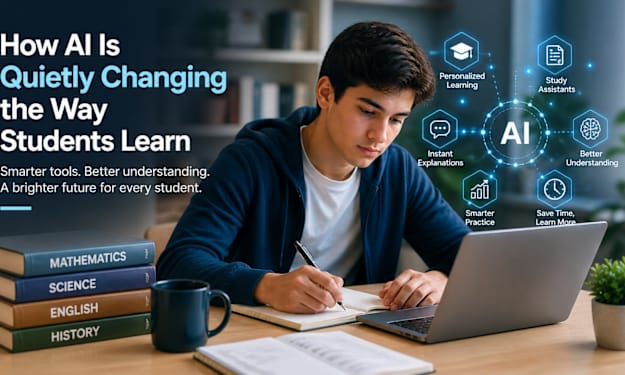
How AI Is Quietly Changing the Way Students Learn. AI-Generated.
A few years ago, studying looked the same for almost everyone. You opened a textbook, highlighted important lines, wrote notes by hand, and hoped that somewhere in all that effort, things would start to make sense. If you got stuck, you either searched endlessly online, asked a friend, or waited until the next class.
By Suresh Kumar K6 months ago in Education
Why University Admissions Boards Trust a Dedicated AI Detector Over Human Intuition
For decades, college admissions officers relied on their "gut feeling" to identify authentic student voices. They looked for the spark, the struggle, and the unique flair that defined a promising applicant. However, the arrival of sophisticated large language models has made human intuition surprisingly unreliable. Today, admissions boards are increasingly turning to technology, trusting a dedicated ai detector to maintain the integrity of the selection process.
By Rayan Smith6 months ago in Education
How to Finish Python Assignments Faster. AI-Generated.
Python assignments have a reputation for taking longer than they should. Not because the problems are necessarily hard, but because most students don't have a reliable process before they start typing. They open the editor, stare at the prompt, and then spend the first hour going in circles. The fix isn't working harder it's working with a better approach from the start.
By Python Homework Help6 months ago in Education
Abdul Rafay Gadit, Bitcoin as Digital Gold or Macro Asset: Inflation, Liquidity, and Market Reality
Abdul Rafay Gadit is Co-Founder of ZIGChain, where he works at the intersection of blockchain infrastructure, digital assets, and market strategy. His recent public commentary reflects a broad macro perspective spanning commodities, startups, and crypto markets. He has argued that a dramatic rise in silver would require sustained inflation, low real interest rates, and weakening confidence in monetary systems. He has also assessed the EU Inc proposal through the practical lens of startup formation, capital structures, tax, and labor constraints. On digital assets, Gadit has emphasized selectivity, suggesting that durable altcoin success depends on real utility, sustainable economics, and regulatory clarity.
By Scott Douglas Jacobsen6 months ago in Education
Bitcoin Regulation Evolution: From Legal Ambiguity to Institutional Integration
YuanJie Zhang is Co-Founder of Conflux Network, where he works at the intersection of blockchain infrastructure, digital assets, and global market development. He holds a Bachelor’s degree from Fudan University and a Master’s degree from Brandeis University. Before helping found Conflux, Zhang worked at Huatai Private Fund of Funds, UNC Endowment Management Company, and Novus on Wall Street, building experience in investments, capital markets, and business operations. His commentary has addressed stablecoins, crypto regulation, no-KYC exchanges, and Hong Kong’s role as a digital-asset hub. Outside work, he enjoys sci-fi, gaming, skiing, and, by his own description, degen culture.
By Scott Douglas Jacobsen6 months ago in Education
How AI Tools Are Changing the Way Students Get Android Assignment Help in 2026
Introduction Not long ago, a student staring at a blank Android Studio project at midnight had only a few options: dig through Stack Overflow threads, message a friend who might know Java, or simply give up and submit something incomplete. That reality has shifted dramatically. In 2026, artificial intelligence has embedded itself so deeply into the academic technology landscape that the entire experience of seeking Android Assignment Help looks nothing like it did even three years ago. Students are no longer passive recipients of pre-written solutions — they are active collaborators with intelligent systems that explain, debug, generate, and teach simultaneously. This transformation is profound, and understanding it matters for every student, educator, and institution navigating the new era of computing education.
By Robert Gandell6 months ago in Education