
Why University Admissions Boards Trust a Dedicated AI Detector Over Human Intuition
How AI detection outperforms human intuition in protecting fairness and authenticity in university admissions.

For decades, college admissions officers relied on their "gut feeling" to identify authentic student voices. They looked for the spark, the struggle, and the unique flair that defined a promising applicant. However, the arrival of sophisticated large language models has made human intuition surprisingly unreliable. Today, admissions boards are increasingly turning to technology, trusting a dedicated ai detector to maintain the integrity of the selection process.
The Fallibility of Human Intuition
Studies have shown that even experienced educators struggle to distinguish between high-quality AI-generated text and student writing. AI has become excellent at mimicking the "average" student voice — polished, grammatically correct, and structured. Where a human reader might see a "well-organized essay," a specialized tool like Edubrain sees mathematical predictability that the human brain simply isn't wired to detect.
Why Data Beats the "Gut Check"
Admissions boards are shifting toward automated detection for several data-driven reasons:
- Analysis of Perplexity: AI detectors measure the complexity of text. Human thoughts are naturally non-linear and "messy," whereas AI tends to choose the most statistically likely next word.
- Measuring Burstiness: Humans vary their sentence lengths and structures significantly based on emotion and emphasis. AI often produces a very consistent, "flat" rhythm that software can flag instantly.
- Eliminating Bias: Intuition can be clouded by personal bias. A detector provides a neutral, evidence-based probability score, ensuring every student is judged on a level playing field.
A Scalable Solution for Thousands of Applications
At major universities, admissions teams handle tens of thousands of essays in a matter of weeks. It is physically impossible for a human to maintain the same level of scrutiny for the 1st essay as they do for the 10,000th. Automated tools provide a consistent standard of verification at scale, flagging suspicious documents for further review without slowing down the enrollment cycle.
The New Definition of Authenticity
By incorporating these tools, admissions boards aren't trying to catch students in a "trap." Instead, they are protecting the students who did the work. When a dedicated detector confirms an essay is human-written, it validates the student's unique perspective and effort, ensuring that the "soul" of the application remains a true reflection of the applicant.
Key Takeaways for a Smarter Admissions Process
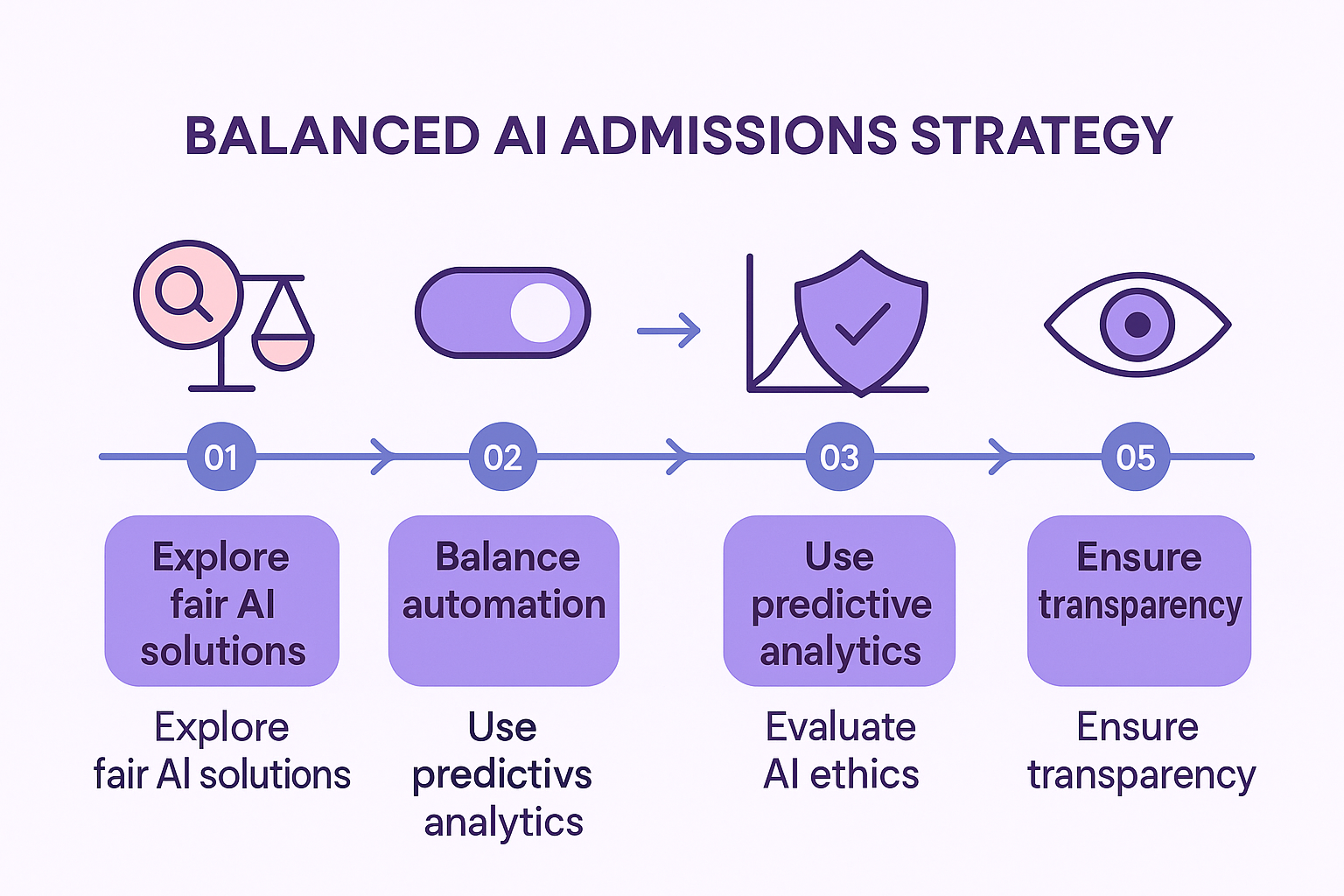
- To devise more equitable admissions decisions, harness the power of AI tools. By minimizing human error and biases, these devices offer a solution that is both fair and efficient.
- Over-reliance on a single metric or on “gut feelings” can skew the admissions process. AI analysis, however, allows for a broader, data-driven overview of applicants' strengths and potential.
- Balancing AI with personal perspective remains crucial; technology aids judgment, it should not replace it entirely. Constantly consider ethical questions around AI's role and ensure the maintenance of transparency and student integrity.
- Keep the focus on students. By using AI wisely, universities can support a more diverse, high-achieving student body and create an atmosphere of trust and fairness in higher education.
In the era of generative AI, the "gut check" is no longer enough. University admissions boards trust technology to do what the human eye cannot: preserve the boundary between machine-generated content and genuine human potential. As we look to the future, the partnership between human insight and AI detection will be the cornerstone of fair and honest admissions.
About the Creator
Rayan Smith
Hello Guys! My name is Rayan Smith a professional blogger and academic advisor. I love to share my knowledge with students for improving their academic performance.
Enjoyed the story? Support the Creator.
Subscribe for free to receive all their stories in your feed.
Comments
There are no comments for this story
Be the first to respond and start the conversation.