
Legacy Modernization vs. Legacy Migration: How to Make the Right Choice
A practical guide to choosing the best path for transforming aging enterprise systems in 2026

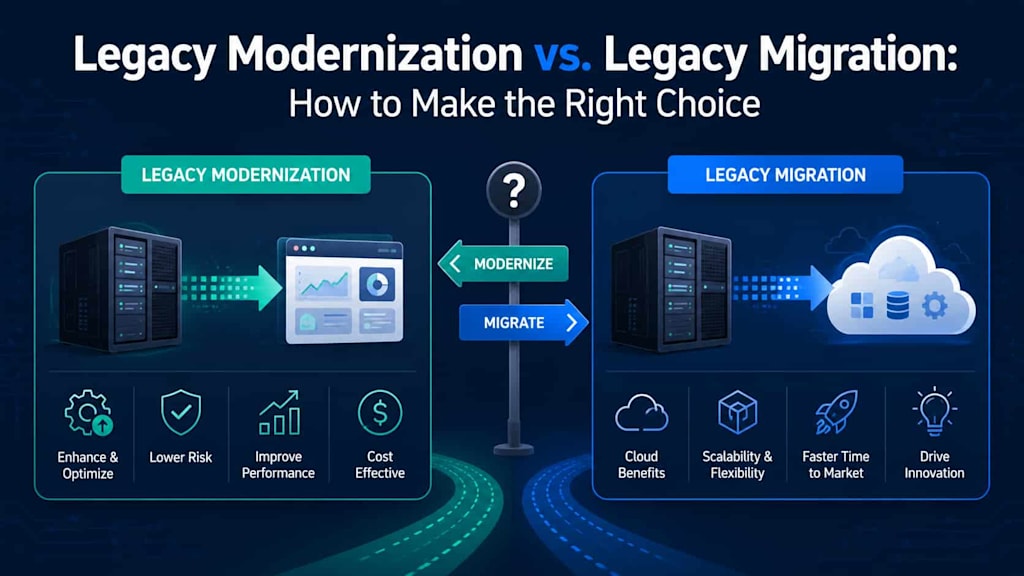
Modern businesses rely on software systems that were often built years — or even decades — ago. While these legacy systems may still support critical operations, they frequently create obstacles for innovation, scalability, and security. Organizations across industries are now facing a strategic decision: should they modernize their existing systems or migrate to entirely new environments?
The debate around legacy modernization versus legacy migration has become even more important as digital transformation accelerates and customer expectations continue to rise. Companies need technology ecosystems that can support cloud-native services, automation, AI integration, and rapid deployment cycles without disrupting business continuity.
Choosing the right approach is not simply a technical issue. It is a business decision that affects costs, operational stability, future growth, and competitive advantage. Understanding the strengths, risks, and long-term implications of each strategy is essential before investing in transformation initiatives.
Understanding Legacy Modernization
Legacy modernization focuses on improving and extending the value of existing systems instead of replacing them entirely. The goal is to update applications, infrastructure, databases, or workflows while preserving core business logic and operational continuity.
Many organizations choose modernization when their current systems still contain valuable functionality but struggle to support modern business demands. In these cases, the modernization of outdated applications can reduce technical debt while avoiding the disruption associated with full replacement projects.
Modernization strategies may include:
- Refactoring existing codebases
- Moving workloads to cloud infrastructure
- Updating user interfaces
- Integrating APIs and automation tools
- Replacing outdated databases
- Improving system security and compliance
One of the major benefits of modernization is the ability to preserve institutional knowledge embedded in existing systems. Legacy applications often contain years of business-specific workflows and rules that would be expensive and risky to recreate from scratch.
Modernization is also attractive for companies with limited budgets or strict operational requirements. Instead of rebuilding entire platforms, businesses can prioritize the most critical components and modernize incrementally.
However, modernization has limitations. If the underlying architecture is fundamentally outdated or difficult to scale, improvements may only provide temporary relief. Some systems were never designed to support cloud-native operations, real-time integrations, or advanced analytics. In such cases, organizations may eventually face the same challenges again after investing heavily in upgrades.
Another important factor is developer availability. Older programming languages and frameworks may be difficult to maintain because experienced specialists are becoming harder to find. Businesses should evaluate whether their legacy environment can realistically support long-term innovation.
What Legacy Migration Means
Legacy migration involves moving applications, infrastructure, or workloads from older environments to newer platforms. This often includes migrating systems from on-premises data centers to the cloud or replacing obsolete software ecosystems entirely.
Unlike modernization, migration usually introduces more substantial structural changes. The purpose is not merely to improve the existing system but to transition toward a more sustainable technological foundation.
Migration projects can take several forms:
- Rehosting (“lift and shift”)
- Replatforming applications
- Re-architecting systems
- Replacing software with SaaS platforms
- Database migrations
- Cloud-native application redesign
Migration is often the preferred option when legacy systems can no longer meet operational requirements or when maintenance costs become unsustainable. Companies pursuing rapid growth, global expansion, or advanced digital services frequently discover that their legacy platforms create bottlenecks that prevent innovation.
A critical part of successful migration planning is selecting the right target architecture. Businesses must determine whether they need public cloud infrastructure, hybrid environments, containerized services, event-driven systems, or fully cloud-native platforms.
Poor architectural decisions can create new operational challenges instead of solving old ones. That is why migration strategies require close collaboration between business leaders, software architects, infrastructure specialists, and security teams.
Migration also introduces risks that organizations must manage carefully. Large-scale transitions may result in downtime, data inconsistencies, integration failures, or user adoption issues if planning is inadequate. The more interconnected the legacy ecosystem becomes over time, the more complex migration efforts tend to be.
Despite these challenges, migration can unlock significant long-term advantages. Organizations gain access to modern development ecosystems, automated deployment pipelines, elastic cloud resources, and faster innovation cycles. These benefits are especially important for businesses building digital products and scalable web apps that require flexibility and rapid iteration.
How to Decide Between Modernization and Migration
There is no universal answer to whether modernization or migration is the better choice. The decision depends on business goals, technical constraints, operational priorities, and long-term strategy.
Several factors should guide the evaluation process.
Business Objectives
Companies must first identify what they are trying to achieve. If the primary goal is to reduce maintenance costs while extending the life of an existing platform, modernization may be sufficient.
However, if the business plans to launch new digital services, expand globally, or adopt AI-driven operations, migration may provide a stronger long-term foundation.
System Complexity
Some legacy systems contain deeply intertwined components that are difficult to separate or update incrementally. In these situations, modernization efforts may become increasingly expensive and complicated.
Organizations should assess how tightly coupled their applications, databases, and integrations are before selecting an approach.
Regulatory and Security Requirements
Industries such as healthcare, banking, and government often face strict compliance requirements. Businesses operating in highly regulated environments may prefer gradual modernization because it reduces operational disruption and simplifies compliance management.
At the same time, older systems frequently contain security vulnerabilities that modern platforms can address more effectively.
Cost Considerations
Modernization usually involves lower short-term costs because it focuses on targeted improvements rather than full replacement. Migration, however, may deliver stronger long-term savings through reduced infrastructure costs, automation, and improved operational efficiency.
Decision-makers should avoid focusing only on initial project expenses. Total cost of ownership over five to ten years often provides a more accurate comparison.
Organizational Readiness
Successful transformation requires more than technology upgrades. Teams must adapt to new workflows, tools, and operational models.
Organizations with limited cloud expertise or resistance to change may benefit from phased modernization initiatives before attempting large-scale migrations.
Monolithic Systems and Cloud-Native Architectures
One of the most important transformation challenges organizations face today involves moving away from monolithic architectures.
Traditional monolithic applications combine all business functions into tightly connected codebases. While this approach was common for many years, it often limits agility, scalability, and deployment flexibility.
As organizations modernize digital ecosystems, many begin exploring monolith to microservices migration strategies. This approach separates large applications into smaller, independently deployable services that communicate through APIs.
Microservices architectures offer several advantages:
- Faster deployment cycles
- Independent scaling of services
- Improved fault isolation
- Greater development flexibility
- Easier integration with cloud-native technologies
However, microservices are not automatically the right solution for every business. They introduce operational complexity related to orchestration, monitoring, networking, and distributed data management.
Companies should avoid adopting microservices solely because they are popular. Architectural decisions should align with actual business and operational needs.
In many cases, hybrid approaches work best. Businesses may modernize specific components while gradually migrating selected services to cloud-native environments over time.
This balanced strategy reduces transformation risk while enabling organizations to evolve their systems incrementally.
AI-Assisted Legacy Migration and Modernization
Artificial intelligence is becoming an increasingly valuable tool in enterprise transformation initiatives. AI-powered platforms can analyze legacy codebases, identify dependencies, automate documentation, and recommend modernization pathways more efficiently than traditional manual processes.
This shift is one of the major trends shaping 2026 in software engineering and enterprise IT strategy.
Organizations are now using AI-assisted development tools to support:
- Automated code analysis
- Legacy system documentation
- Dependency mapping
- Cloud migration planning
- Test generation
- Security vulnerability detection
- API generation
- Code refactoring recommendations
AI can significantly reduce the time required to understand large and poorly documented legacy systems. For enterprises managing millions of lines of code, this capability creates substantial operational advantages.
AI-assisted tools are also improving collaboration between technical and business teams. Automated analysis can help stakeholders visualize dependencies, estimate migration risks, and prioritize modernization initiatives more accurately.
At the same time, businesses should recognize that AI does not eliminate the need for experienced engineers and architects. Human oversight remains essential for validating architectural decisions, ensuring compliance, and managing organizational change.
The most effective transformation strategies combine AI automation with strong governance, skilled engineering teams, and clear business objectives.
Companies adopting AI-enhanced transformation workflows are often able to accelerate delivery timelines while reducing operational uncertainty. As AI capabilities continue to mature, these technologies will likely become standard components of enterprise modernization programs.
Companies Across Different Industries Are Adopting AI-Assisted Legacy Modernization
Organizations across various industries are increasingly adopting AI-assisted approaches to legacy system modernization. While modernization strategies and technology stacks may differ, companies often face similar challenges related to outdated infrastructure, technical debt, scalability, maintenance, and migration to modern platforms.
AI-assisted modernization helps accelerate system analysis, code refactoring, documentation, migration planning, testing, and application transformation while supporting more efficient and lower-risk modernization initiatives.
Some of these companies include:
- Chudovo
- DBB Software
- BRQ
- BigOhTech
- CI&T
Conclusion
Legacy modernization and legacy migration are both valid strategies for organizations seeking to remain competitive in rapidly evolving digital markets. The best choice depends on the condition of existing systems, long-term business goals, available resources, and organizational readiness.
Modernization allows businesses to preserve valuable systems while improving functionality, security, and maintainability. Migration, on the other hand, provides opportunities to build entirely new technological foundations capable of supporting future innovation and cloud-native operations.
Rather than treating modernization and migration as opposing strategies, many successful organizations combine elements of both. Incremental transformation often reduces operational risk while allowing businesses to evolve at a sustainable pace.
As enterprise technology continues to evolve, companies that make thoughtful, strategic transformation decisions will be better positioned to innovate, adapt, and compete in increasingly demanding digital environments.
About the Creator
Chudovo
Chudovo is a custom software development company, focused on complex systems implementation.
Enjoyed the story? Support the Creator.
Subscribe for free to receive all their stories in your feed.
Comments
There are no comments for this story
Be the first to respond and start the conversation.