
How to Identify the Right Target Architecture for Legacy Migration
A Strategic Guide to Modernizing Legacy Systems While Ensuring Scalability, Reliability, and Business Alignment

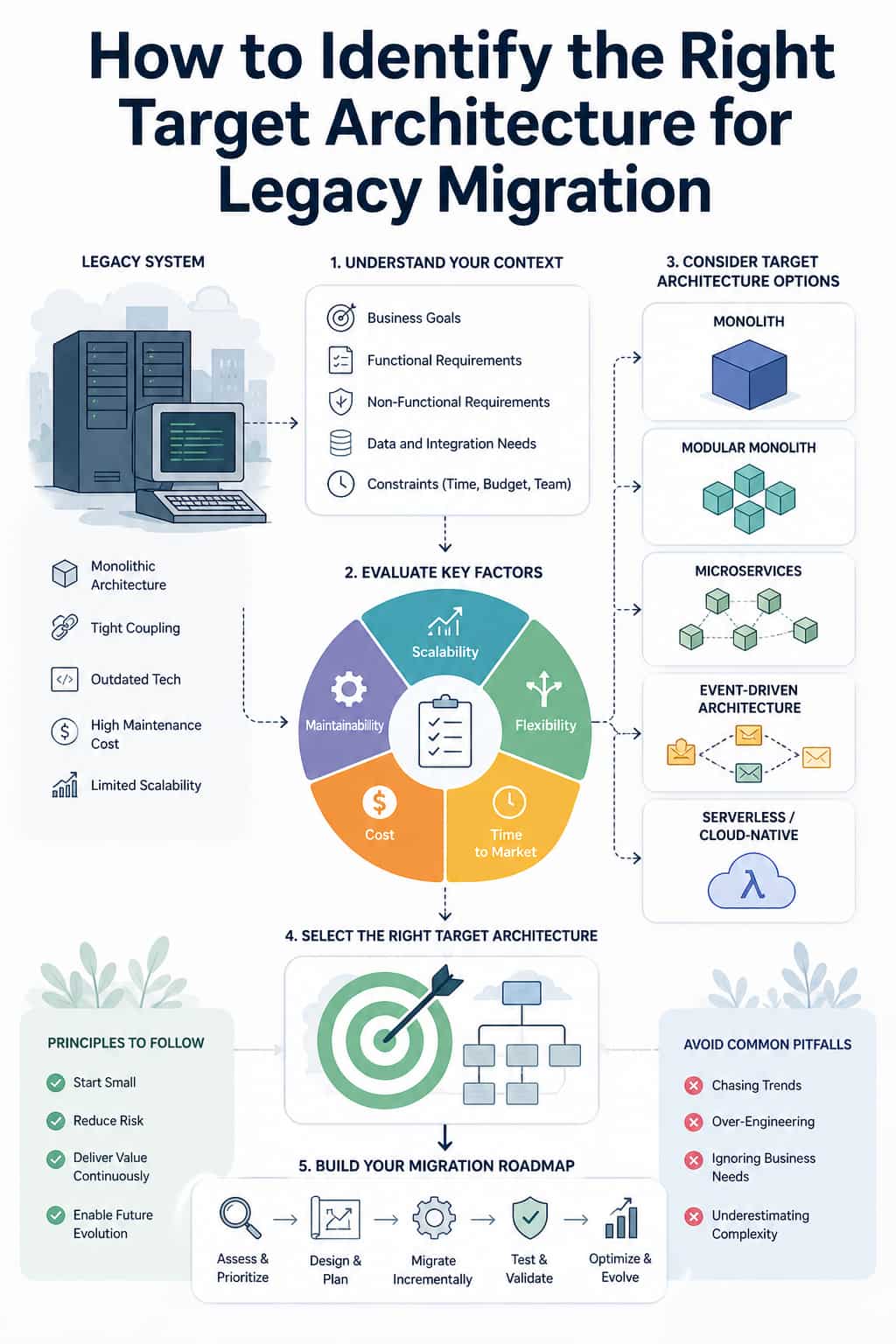
Legacy system migration is one of the most complex and high-stakes undertakings in modern IT management. While many organizations recognize the necessity of moving away from outdated, inflexible systems, the journey is fraught with challenges: data loss, operational disruption, unplanned costs, and poor alignment with future business needs. A crucial step that can determine the success or failure of such initiatives is identifying the right target architecture. This step goes beyond selecting technology—it requires understanding the current system landscape, business objectives, and long-term strategic goals.
In this article, we will explore a structured approach to selecting a target architecture legacy migration. This approach combines technical assessment, business alignment, and forward-looking architectural principles, ensuring the migration not only succeeds but delivers sustainable value.
Understanding Legacy Systems
Before any migration, it is essential to define what “legacy” means within your organization. A legacy system is typically characterized by:
- Obsolete technology stack – older programming languages, frameworks, or operating systems that are no longer supported.
- Monolithic architecture – tightly coupled components that are difficult to scale or modify individually.
- High maintenance cost – frequent bug fixes, dependency issues, and specialized knowledge requirements.
- Limited integration capabilities – inability to interact efficiently with modern tools, cloud services, or APIs.
Understanding these characteristics provides a baseline for evaluating the migration effort and shaping the requirements for a target architecture.
Step 1: Assess Current Systems and Dependencies
Identifying the right target architecture begins with a comprehensive audit of the existing environment. This includes:
1.1 Inventory of Applications and Components
Catalog every application, service, and database, noting:
- Programming language
- Framework version
- Database type and version
- Operating system and hardware dependencies
- Integration points and APIs
A clear inventory helps pinpoint which components are essential, which can be retired, and which are candidates for migration or refactoring.
1.2 Dependency Mapping
Legacy systems often evolve into complex interdependencies. Mapping these connections ensures that migrations do not break critical workflows. Dependency mapping should include:
- Data flows between systems
- Shared libraries or services
- Third-party integrations
Tools such as dependency graphs, application topology diagrams, and code analysis platforms can help visualize these relationships.
1.3 Performance and Bottleneck Analysis
Understanding the system’s current performance characteristics is critical. Identify:
- High-load components
- Latency issues
- Scalability limits
This step informs the target architecture design, helping prioritize which components require more robust solutions in the new environment.
Step 2: Define Business and Strategic Requirements
Technical considerations alone cannot determine the right target architecture. The new system must support both current operational needs and future business objectives.
2.1 Business Process Alignment
Analyze the workflows supported by the legacy system:
- Which processes are core to the business?
- Are there inefficiencies caused by the current system?
- Which processes may evolve or expand in the next 3–5 years?
By aligning the target architecture with business processes, organizations avoid creating a technically advanced but operationally irrelevant solution.
2.2 Regulatory and Compliance Requirements
Migration must comply with regulations such as GDPR, HIPAA, or industry-specific standards. Consider:
- Data residency and sovereignty
- Audit and logging requirements
- Security controls
The target architecture should facilitate compliance by design, rather than retrofitting controls after deployment.
2.3 Future Scalability and Flexibility
Legacy migrations offer an opportunity to future-proof the system. This involves identifying:
- Expected growth in user base, transactions, or data volume
- Emerging business requirements, such as AI integration or analytics
- Potential new channels or markets
Architectural decisions should accommodate growth without requiring another major migration soon after.
Step 3: Evaluate Migration Strategies
Choosing the right target architecture depends on the chosen migration strategy. Common approaches include:
3.1 Rehosting (Lift-and-Shift)
Rehosting involves moving the application as-is to a new environment, often a cloud platform. Benefits include speed and minimal code changes, but drawbacks include:
- Retention of existing inefficiencies
- Limited optimization opportunities
Rehosting is most suitable when the goal is quick infrastructure modernization rather than functional overhaul.
3.2 Refactoring
Refactoring reorganizes or rewrites parts of the application to improve performance, maintainability, or scalability. It may involve:
- Breaking a monolithic application into microservices
- Updating legacy code to modern frameworks
- Replacing proprietary components with open standards
Refactoring allows more granular optimization but requires deeper technical investment.
3.3 Replatforming
Replatforming modifies some components while keeping others intact. Examples include:
- Migrating databases to a managed cloud service
- Updating the operating system without changing the application logic
Replatforming balances effort and risk, offering benefits without full-scale rewriting.
3.4 Rebuilding / Redeveloping
Rebuilding creates the application from scratch, often using modern paradigms like cloud-native microservices. While the most expensive and time-consuming, it provides:
- Complete architectural flexibility
- Modern development practices
- Scalability and resilience
This approach is suitable when the legacy system cannot meet future business needs.
Step 4: Identify Target Architecture Principles
Once strategy is chosen, it is essential to define the principles that will guide architectural design:
4.1 Modularity
Breaking down the system into discrete, independent components improves maintainability, scalability, and flexibility. Microservices, service-oriented architectures, and modular monoliths are common approaches.
4.2 Scalability
The architecture should support horizontal and vertical scaling. This may involve:
- Stateless services
- Distributed caching
- Load balancing
4.3 Resilience and Reliability
Legacy systems often lack fault tolerance. The new architecture should include:
- Automatic failover
- Graceful degradation
- Disaster recovery strategies
4.4 Interoperability
Modern enterprises rely on interconnected systems. APIs, event-driven architectures, and standardized communication protocols enable seamless integration.
4.5 Security and Compliance
Security should be built into the architecture, not bolted on. Principles include:
- Encryption of data at rest and in transit
- Role-based access control
- Audit logging
Step 5: Select Technology Stack and Infrastructure
Target architecture is incomplete without selecting the underlying technology stack:
5.1 Cloud vs On-Premises
Consider whether the architecture will be hosted on:
- Public cloud (AWS, Azure, GCP)
- Private cloud
- On-premises data centers
- Hybrid approaches
Cloud adoption offers scalability, cost flexibility, and managed services, but on-premises may be necessary for sensitive data or legacy integration.
5.2 Database Strategy
Decide on database types based on workload requirements:
- Relational (SQL) for transactional consistency
- NoSQL for unstructured or high-volume data
- Multi-model or graph databases for specialized use cases
Database migration tools and replication mechanisms must be considered early.
5.3 Integration and Middleware
Integration frameworks, message brokers, and API gateways are critical for connecting new architecture with legacy or third-party systems. Consider:
- Event-driven vs request-response patterns
- Standardized API contracts
- Service orchestration
Step 6: Conduct Proof of Concept (PoC)
Before full migration, validate the target architecture with a PoC:
- Migrate a small, representative module
- Test for performance, reliability, and integration
- Evaluate maintainability and developer productivity
PoC results inform adjustments to architecture and migration strategy, mitigating risks before full-scale implementation.
Step 7: Evaluate Costs and Risk
Target architecture selection must be grounded in practical feasibility:
7.1 Cost Estimation
Include:
- Development and refactoring costs
- Licensing or subscription fees
- Infrastructure costs
- Training and change management expenses
7.2 Risk Assessment
Identify potential risks:
- Data migration errors
- System downtime
- Skills gap for new technologies
Mitigation strategies, such as incremental migration and parallel runs, reduce operational impact.
Step 8: Develop a Migration Roadmap
The final step is translating architecture into actionable steps:
- Prioritize modules by business criticality and complexity
- Define migration phases—incremental, parallel, or big-bang
- Set success metrics—uptime, performance, cost savings
- Plan for rollback and contingency—maintaining legacy systems until the new system is stable
A clear roadmap ensures alignment across technical teams, business stakeholders, and external partners.
Best Practices for Target Architecture Selection
- Involve business and technical stakeholders early – the architecture should balance operational needs and technical feasibility.
- Document architecture decisions – this provides a reference for future migrations or enhancements.
- Emphasize automation – CI/CD, automated testing, and deployment pipelines reduce human error.
- Monitor and iterate – post-migration, monitor system performance and refine architecture as needed.
- Consider cultural impact – new architectures often require changes in team structure and workflow; manage this proactively.
Conclusion
Identifying the right target architecture for legacy migration is a multi-dimensional challenge that blends technical rigor with business insight. By systematically assessing legacy systems, understanding business goals, evaluating migration strategies, and defining robust architectural principles, organizations can migrate safely and sustainably. The target architecture is not just a technical blueprint—it is a strategic foundation that enables operational efficiency, scalability, and innovation for years to come.
Legacy migration may be difficult, but with the right approach to architecture, it transforms from a reactive necessity into a strategic advantage.
About the Creator
Chudovo
Chudovo is a custom software development company, focused on complex systems implementation.
Enjoyed the story? Support the Creator.
Subscribe for free to receive all their stories in your feed.
Comments
There are no comments for this story
Be the first to respond and start the conversation.