
How To Secure App Data Without Slowing Performance
Smart strategies for balancing application security, speed, and scalability in modern software systems

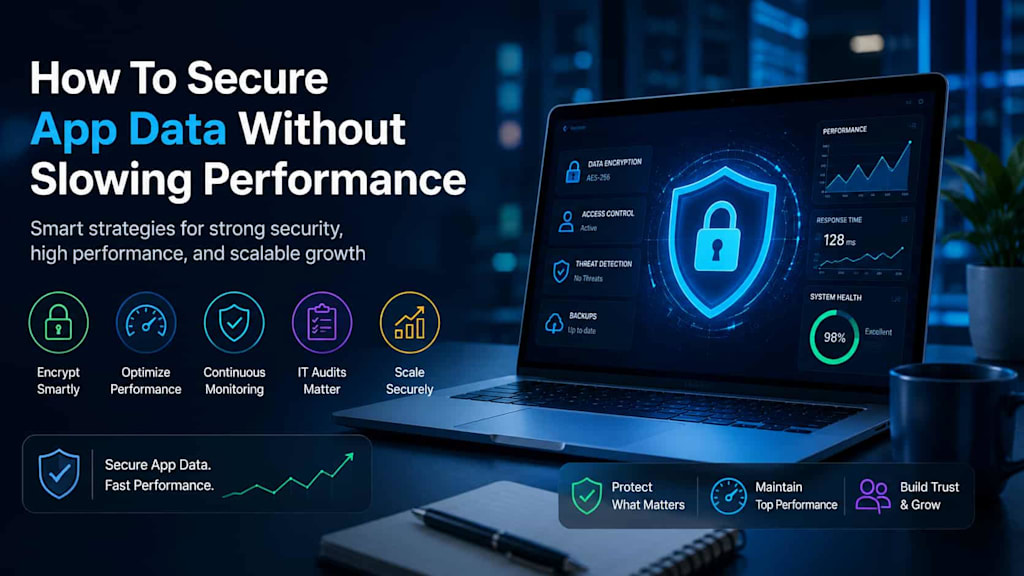
As digital products become more advanced, businesses face a growing challenge: protecting sensitive information without sacrificing speed and usability. Users expect applications to load instantly, process data in real time, and deliver seamless experiences across devices. At the same time, organizations must defend their systems against data breaches, cyberattacks, and compliance risks.
Many companies mistakenly believe that stronger security automatically reduces application speed. While poorly implemented security measures can create bottlenecks, modern development practices prove that it is possible to secure app data while maintaining high operational efficiency. The key lies in thoughtful system design, optimized infrastructure, and strategic engineering decisions.
Today’s applications process enormous amounts of customer information, financial records, business analytics, and operational data. A single vulnerability can result in legal issues, financial losses, and reputational damage. However, overly complex protection systems can also frustrate users and reduce system responsiveness.
Successful businesses understand that security and performance are not opposing goals. Instead, they are interconnected parts of a scalable software ecosystem. Companies that approach both strategically can build reliable applications that remain fast, secure, and adaptable as they grow.
Building Secure Foundations From the Start
One of the most common mistakes in software development is treating security as a final-stage addition rather than a core architectural principle. Retrofitting protection mechanisms into an already deployed application often creates inefficiencies and increases maintenance complexity.
Security should begin during the planning phase of development. This includes defining data flows, identifying sensitive information, selecting authentication methods, and designing infrastructure capable of handling future growth.
Development teams that understand how to structure hybrid projects efficiently often perform better when balancing scalability and protection requirements. Hybrid systems combine multiple technologies, frameworks, or deployment models, which can introduce additional complexity if not properly organized. Clear documentation, modular architecture, and standardized communication between services help prevent both security gaps and unnecessary processing overhead.
Encryption is another critical component of modern application security. However, encryption should be implemented intelligently. Encrypting every single operation may create latency issues, especially in applications with large-scale real-time interactions. Developers should focus on encrypting highly sensitive data both in transit and at rest while optimizing less critical operations for speed.
Authentication systems also play a major role in balancing protection and responsiveness. Multi-factor authentication, token-based access systems, and secure session management improve safety without significantly affecting user experience when implemented correctly.
Strong security foundations reduce the likelihood of expensive emergency fixes later in the development lifecycle. They also make future optimization efforts significantly easier.
Optimizing Infrastructure for Security and Speed
Infrastructure decisions directly influence both application safety and operational performance. Modern businesses increasingly rely on cloud-native architectures, distributed systems, and containerized environments to improve scalability and resilience.
However, infrastructure optimization requires careful planning. Poorly configured servers, inefficient APIs, and overloaded databases can create severe slowdowns regardless of how secure an application may be.
One of the most effective ways to improve both protection and performance is through intelligent load balancing. Distributing requests across multiple servers reduces pressure on individual systems while improving availability during traffic spikes.
Caching mechanisms also help maintain speed without compromising security. Frequently accessed non-sensitive data can be cached temporarily to reduce database requests and improve response times. At the same time, sensitive information should follow stricter access policies and shorter cache lifetimes.
API gateways are another valuable tool for modern applications. They allow developers to centralize authentication, traffic management, and request validation without overloading individual services. This approach simplifies monitoring and reduces security risks associated with fragmented architectures.
Businesses also benefit from adopting automated monitoring systems. Real-time infrastructure monitoring helps identify suspicious activity, unusual traffic patterns, and performance degradation before they become critical problems.
Organizations focused on long-term digital growth often recognize the main advantages of scalable business apps when infrastructure is designed with flexibility in mind. Scalable systems can support increasing workloads while maintaining stable response times and strong security standards, which is essential for modern customer expectations.
Proper infrastructure optimization creates a stable foundation that supports both rapid growth and reliable data protection.
Why Security Audits Are Essential for Modern Applications
Many vulnerabilities remain hidden until a system experiences a failure or attack. For this reason, proactive analysis is one of the most important aspects of application security management.
This is where the role of IT audits becomes especially valuable. Security audits help organizations evaluate existing systems, identify weaknesses, and improve operational reliability before major incidents occur.
Comprehensive audits typically include:
- Infrastructure analysis
- Source code review
- Dependency evaluation
- Access control verification
- Database security inspection
- API vulnerability testing
- Compliance assessment
- Performance bottleneck analysis
One major advantage of regular audits is early detection. Small vulnerabilities are significantly easier and cheaper to resolve before they evolve into larger security risks.
Audits also improve development workflows by revealing architectural inefficiencies. In many cases, applications become slower because of outdated integrations, duplicated logic, or poorly optimized backend processes rather than because of security systems themselves.
External audits can provide additional value because third-party specialists often identify issues internal teams may overlook. Independent experts evaluate applications from a fresh perspective and frequently uncover hidden risks that accumulate gradually over time.
Companies operating in regulated industries benefit even more from routine assessments. Compliance standards related to financial data, healthcare systems, and customer privacy continue becoming stricter worldwide. Regular evaluations help organizations maintain legal compliance while strengthening system reliability.
Security audits should not be viewed as isolated events. The most successful organizations treat them as part of an ongoing improvement process integrated into the broader software lifecycle.
Improving Collaboration Between Development and Security Teams
One reason applications become inefficient is poor communication between departments. Development teams often prioritize feature delivery and user experience, while security teams focus on minimizing risks. Without alignment, organizations may create systems that are either vulnerable or unnecessarily restrictive.
Modern software companies increasingly adopt DevSecOps practices to bridge this gap. DevSecOps integrates security into every stage of development instead of isolating it as a separate process.
This collaborative model improves both application quality and operational efficiency. Developers become more aware of security risks, while security specialists gain better insight into technical implementation challenges.
Adopting best practices for IT teams helps organizations create more consistent and scalable workflows. These practices typically include:
- Automated testing pipelines
- Continuous vulnerability scanning
- Shared documentation standards
- Regular cross-team reviews
- Incident response planning
- Infrastructure version control
- Access management policies
Automation is especially important for balancing speed and protection. Manual security reviews alone are too slow for modern agile development environments. Automated tools can identify vulnerabilities, dependency risks, and configuration errors much earlier in the deployment process.
Team education also plays a critical role. Developers who understand common attack vectors and secure coding principles make fewer mistakes during implementation. Continuous training reduces preventable vulnerabilities and improves overall software quality.
Collaboration becomes even more important in distributed development environments where teams work across multiple locations and time zones. Clear communication structures and standardized workflows help maintain consistency across projects.
Organizations that successfully align development and security priorities usually achieve better long-term results than companies that treat them as competing objectives.
Balancing User Experience With Advanced Protection
Users rarely notice strong security when it works properly. However, they immediately notice delays, crashes, or complicated authentication flows. That is why balancing protection with usability is essential for application success.
Modern consumers expect fast-loading interfaces, instant transactions, and uninterrupted access across devices. Applications that become slow due to excessive security checks risk losing customer trust and engagement.
One solution is adaptive security. Instead of applying maximum restrictions to every interaction, adaptive systems analyze contextual factors such as device behavior, login location, and traffic patterns. Low-risk activities can proceed quickly, while suspicious actions trigger additional verification steps.
Efficient database design also contributes significantly to application responsiveness. Poor query optimization often causes greater performance issues than security layers themselves. Proper indexing, data partitioning, and optimized storage architecture reduce processing delays while maintaining protection standards.
Another important factor is minimizing unnecessary data collection. Applications that store excessive user information create larger attack surfaces and require more processing resources. Collecting only essential data improves both security management and operational efficiency.
Strong engineering teams also follow clean architecture principles to separate business logic, infrastructure components, and security mechanisms in a structured way. This separation improves maintainability, simplifies updates, and reduces the likelihood of system-wide failures during future scaling efforts.
Testing remains critical throughout the entire lifecycle of an application. Performance testing under simulated real-world conditions helps teams understand how security systems behave during high traffic loads, cyberattacks, or infrastructure disruptions.
The goal is not simply to create the most secure application possible. Instead, businesses should aim to build systems that provide reliable protection while preserving the fast, seamless experiences users expect.
Conclusion
Modern applications must operate in an environment where both speed and security are equally important. Businesses can no longer afford to prioritize one at the expense of the other. Customers expect responsive digital experiences, while regulators and market conditions demand stronger protection for sensitive information.
Organizations that successfully secure app data without compromising operational efficiency usually take a proactive and strategic approach. They build secure foundations early, optimize infrastructure carefully, conduct regular audits, improve collaboration between teams, and continuously refine both security and performance practices.
Rather than treating security as an obstacle, successful companies integrate it into scalable system design and long-term product strategy. This mindset allows applications to grow safely while maintaining responsiveness and reliability.
As digital ecosystems continue evolving, businesses that balance protection, scalability, and performance effectively will be far better positioned to compete in increasingly demanding markets.
About the Creator
Markus Koch
I am a professional IT consultant with 5+ years of experience.
Enjoyed the story? Support the Creator.
Subscribe for free to receive all their stories in your feed.
Comments
There are no comments for this story
Be the first to respond and start the conversation.