
How to Apply Performance Optimization Techniques Without Violating Compliance Rules
A practical guide to improving system performance while staying aligned with regulatory and security requirements.

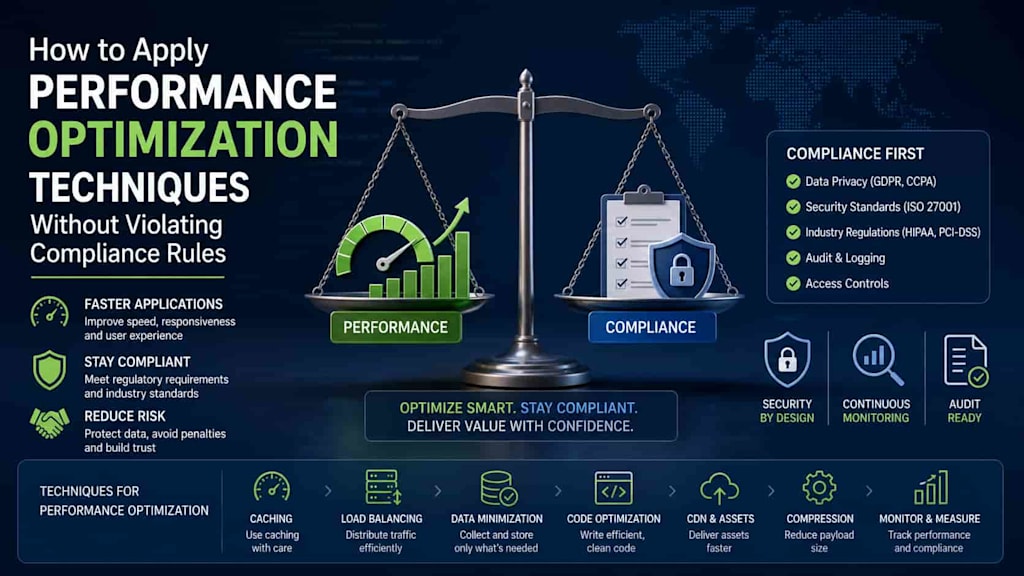
In modern software development, performance and compliance are often seen as competing priorities. On one hand, users expect fast, responsive applications that deliver seamless experiences. On the other hand, organizations must adhere to strict regulatory requirements that govern data handling, security, and system behavior.
This tension creates a common dilemma: how can teams optimize performance without introducing compliance risks? The answer lies not in choosing one over the other, but in integrating both into a unified strategy.
As compliance in modern software engineering becomes increasingly complex—driven by regulations such as GDPR, HIPAA, and industry-specific standards—developers and decision-makers must rethink how optimization efforts are planned and executed. Performance improvements should not be an afterthought, nor should compliance be a blocker to innovation. Instead, they must coexist as complementary goals.
Understanding the Compliance Landscape
Before applying any optimization strategy, it is essential to understand the regulatory environment in which your application operates. Compliance requirements vary depending on the industry, geography, and type of data being processed.
For example, applications handling personal data must ensure proper data protection and privacy controls. Financial systems must meet strict audit and reporting requirements. Healthcare applications must safeguard sensitive patient information.
These requirements directly impact performance optimization decisions. Techniques such as caching, data replication, and logging must be carefully evaluated to ensure they do not violate compliance rules.
A key challenge is that compliance is not static. Regulations evolve, and organizations must continuously adapt. This makes it critical to build systems that are both performant and flexible enough to accommodate changing requirements.
Another important aspect is accountability. Compliance frameworks often require detailed audit trails and traceability. While these features can introduce performance overhead, they are non-negotiable. The goal, therefore, is to implement them efficiently rather than avoid them.
By understanding the compliance landscape early, teams can design optimization strategies that align with regulatory expectations instead of conflicting with them.
Designing Performance Optimization Strategies with Compliance in Mind
Effective optimization begins at the design stage. Rather than retrofitting performance improvements into an existing system, teams should incorporate techniques for performance optimization into the architecture from the outset.
One of the most important principles is data minimization. Only collect and process the data that is absolutely necessary. This not only improves performance by reducing data volume but also simplifies compliance by limiting exposure.
Caching is another powerful optimization technique, but it must be implemented carefully. Sensitive data should not be cached in ways that could expose it to unauthorized access. Strategies such as encrypted caching, short-lived cache entries, and strict access controls can help mitigate risks.
Load balancing and horizontal scaling can improve performance without compromising compliance, as long as data consistency and integrity are maintained. Distributed systems should be designed with clear data governance policies to ensure compliance across all nodes.
Logging and monitoring are also critical. While detailed logs are essential for compliance, excessive logging can impact performance. The solution is to strike a balance—capturing necessary information while avoiding unnecessary overhead. Structured logging and log aggregation tools can help achieve this balance.
Another key consideration is encryption. Encrypting data in transit and at rest is often a compliance requirement, but it can introduce latency. Modern encryption algorithms and hardware acceleration can minimize this impact, allowing teams to maintain both security and performance.
By integrating compliance considerations into the design of optimization strategies, organizations can avoid costly rework and reduce the risk of violations.
Balancing Experimentation and Governance
Innovation often requires experimentation, but in regulated environments, experimentation must be carefully controlled. This is where best practices for prototyping become essential.
Prototyping allows teams to test performance improvements in a controlled environment before deploying them to production. However, even prototypes must adhere to compliance standards, especially when real data is involved.
One effective approach is to use anonymized or synthetic data during testing. This reduces the risk of exposing sensitive information while still providing meaningful insights into system performance.
Feature flags are another valuable tool. They enable teams to roll out performance optimizations gradually, monitor their impact, and roll them back if necessary. This reduces risk and ensures that changes can be controlled and audited.
Governance frameworks should also be established to oversee optimization efforts. This includes defining approval processes, documentation requirements, and compliance checks. While governance may seem like a constraint, it actually provides a structured way to innovate safely.
Collaboration between teams is critical in this process. Developers, compliance officers, and security experts must work together to evaluate potential risks and benefits. This cross-functional approach ensures that performance improvements align with organizational policies and regulatory requirements.
Ultimately, balancing experimentation and governance allows organizations to innovate without compromising compliance.
Tools, Automation, and Continuous Monitoring
Modern tools and automation play a crucial role in achieving both performance and compliance goals. By leveraging the right technologies, organizations can streamline optimization efforts while maintaining oversight.
Performance monitoring tools provide real-time insights into system behavior, helping teams identify bottlenecks and measure the impact of optimization efforts. When integrated with compliance monitoring systems, these tools can also detect potential violations.
Automation is particularly valuable in enforcing compliance policies. Automated checks can ensure that code changes meet predefined standards before they are deployed. This reduces the risk of human error and ensures consistency across the development process.
CI/CD pipelines can be configured to include both performance tests and compliance checks. This ensures that every deployment meets both criteria, creating a continuous feedback loop that drives improvement.
Another important aspect is observability. By collecting and analyzing metrics, logs, and traces, teams can gain a comprehensive understanding of their systems. This visibility is essential for both performance tuning and compliance reporting.
It is also important to consider the broader context of security and compliance when implementing these tools. Security measures such as access controls, authentication, and intrusion detection must be integrated into the overall strategy.
Continuous monitoring ensures that both performance and compliance are maintained over time. As systems evolve, new risks and opportunities will emerge, and organizations must be prepared to respond quickly.
Building a Culture of Performance and Compliance
Technology alone is not enough to achieve the right balance between performance and compliance. Organizations must also cultivate a culture that values both.
This begins with education. Developers and stakeholders should understand the importance of compliance and how it impacts their work. Training programs and documentation can help build this awareness.
Leadership also plays a key role. By prioritizing both performance and compliance, leaders set the tone for the organization. This includes allocating resources, defining goals, and recognizing achievements.
Clear communication is essential. Teams should have access to guidelines, best practices, and support when navigating complex decisions. Open channels of communication encourage collaboration and reduce misunderstandings.
Accountability is another important factor. Teams should be responsible for the performance and compliance of their systems. This includes tracking metrics, addressing issues, and continuously improving processes.
Finally, organizations should embrace a mindset of continuous improvement. Both performance and compliance are ongoing challenges that require constant attention. By learning from experience and adapting to change, organizations can stay ahead of the curve.
Conclusion
Applying performance optimization techniques without violating compliance rules is not only possible—it is essential for modern software development. By integrating compliance into the design process, leveraging the right tools, and fostering a culture of collaboration, organizations can achieve both speed and security.
The key is to view performance and compliance as complementary rather than conflicting goals. When approached strategically, optimization efforts can enhance both user experience and regulatory adherence.
As the complexity of software systems continues to grow, the ability to balance these priorities will become a defining factor for success. Organizations that master this balance will be better equipped to innovate, scale, and compete in an increasingly regulated world.
About the Creator
Markus Koch
I am a professional IT consultant with 5+ years of experience.
Enjoyed the story? Support the Creator.
Subscribe for free to receive all their stories in your feed.
Comments
There are no comments for this story
Be the first to respond and start the conversation.