
How to Build Maintainable Software Systems with Clean Architecture Principles
A practical approach to creating scalable, flexible, and long-lasting software architectures for modern development teams

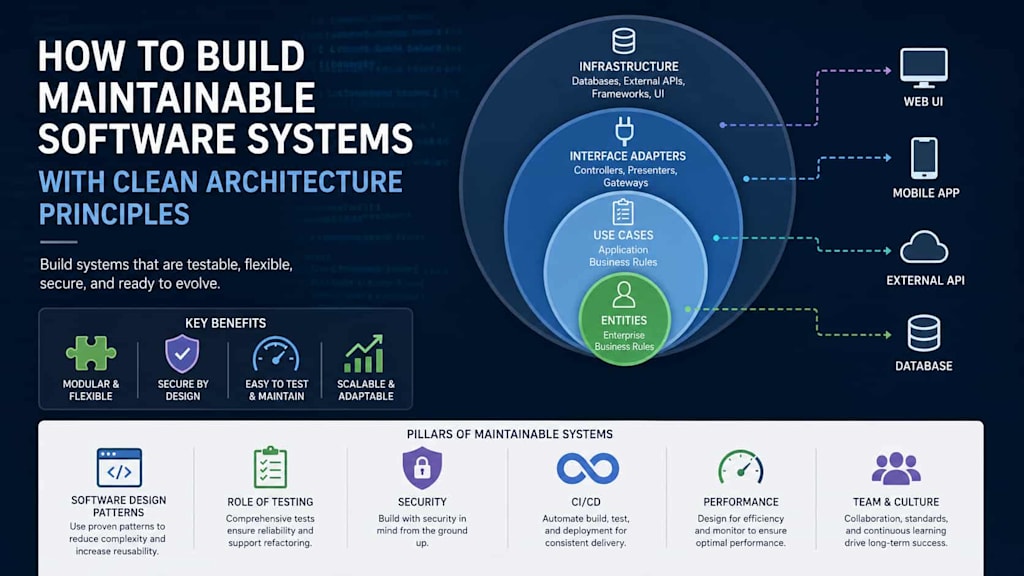
Modern software systems are expected to evolve continuously. Businesses add new features, integrate third-party services, migrate infrastructure, and respond to changing customer expectations faster than ever before. In this environment, maintainability has become one of the most valuable qualities of a software system. Applications that are difficult to modify quickly become expensive, unstable, and resistant to innovation.
Clean Architecture principles provide a structured way to design systems that remain adaptable over time. Instead of tightly coupling business logic to frameworks, databases, or user interfaces, Clean Architecture emphasizes separation of concerns and clear dependency management. This approach helps development teams build applications that are easier to test, extend, and maintain.
The concept became widely known through the work of software engineer Robert C. Martin, who proposed organizing applications into independent layers with business rules at the center. Since then, Clean Architecture has influenced enterprise systems, cloud-native applications, SaaS platforms, and microservices ecosystems across the industry.
This article explores how organizations can build maintainable software systems using Clean Architecture principles, which design decisions matter most, and how development teams can avoid common architectural mistakes.
Understanding the Core Principles of Clean Architecture
At its foundation, Clean Architecture focuses on independence. Business logic should not depend on external systems, frameworks, or delivery mechanisms. Instead, infrastructure components should depend on the core application logic.
This inversion of dependencies creates systems that are easier to evolve because changes in one area do not force widespread modifications elsewhere. A database migration, for example, should not require rewriting business rules. Similarly, replacing a frontend framework should not impact domain logic.
The architecture is typically organized into layers:
- Domain entities
- Use cases or application services
- Interface adapters
- Infrastructure and external systems
The innermost layers contain the most stable business rules, while outer layers manage implementation details such as APIs, databases, messaging systems, and UI frameworks.
One of the biggest advantages of this model is clarity. Teams can define strict boundaries between responsibilities, reducing the likelihood of tightly coupled components that become difficult to maintain over time.
Clean Architecture also works well alongside established software design patterns. Concepts such as dependency injection, repositories, mediators, factories, and domain-driven design often complement layered architectural structures. These patterns help developers organize code more predictably while reducing direct dependencies between modules.
Another key principle is explicit dependency direction. Dependencies should always point inward toward business logic. Infrastructure components may reference application services, but application services should never directly depend on framework-specific implementations.
This structure creates systems that are easier to test because core logic can run independently of databases, external APIs, or frontend environments. Developers can validate business rules without deploying entire infrastructure stacks.
While Clean Architecture introduces additional abstraction layers, the long-term maintainability benefits often outweigh the initial complexity. Large-scale systems especially benefit from clear separation between business logic and implementation details.
Designing Flexible Systems That Can Evolve Over Time
Maintainability is closely tied to adaptability. Software systems inevitably change, and architecture should support controlled evolution rather than resist it.
One of the most effective strategies for long-term maintainability is designing around business capabilities instead of technical components. Teams should organize services and modules according to domain responsibilities rather than framework structures alone.
For example, an e-commerce platform may contain modules for payments, inventory, customer management, and shipping. Each module should encapsulate its own business rules and interfaces. This reduces accidental coupling and allows teams to modify specific business areas independently.
Another important factor is interface-driven development. External integrations should communicate through clearly defined contracts rather than direct implementation dependencies. APIs, repositories, and service interfaces create stable boundaries that protect core business logic from infrastructure changes.
This becomes particularly valuable when organizations migrate technologies. A company switching cloud providers or replacing a database engine should ideally update only infrastructure adapters rather than rewriting application logic.
Choosing appropriate tools and frameworks also plays a major role in architectural maintainability. Frameworks can accelerate development, but overdependence on framework-specific conventions often creates rigid systems. Clean Architecture encourages treating frameworks as replaceable tools rather than foundational business dependencies.
This mindset allows organizations to adopt new technologies gradually without destabilizing existing systems. Teams can modernize infrastructure while preserving core domain logic.
Scalability considerations should also be incorporated early in architectural planning. Maintainable systems are not only easier to modify but also easier to scale operationally. Modular services, asynchronous communication patterns, and clear service boundaries support growth without creating excessive technical debt.
Documentation is another often-overlooked component of maintainability. Well-designed systems still require clear architectural diagrams, dependency explanations, and onboarding guides. Teams should document architectural decisions alongside implementation details to preserve institutional knowledge over time.
Code consistency also matters significantly. Shared conventions for naming, dependency management, error handling, and service communication reduce cognitive overhead for developers working across large codebases.
Why Testing and Automation Are Critical for Maintainability
No architecture remains maintainable without strong validation processes. As software systems grow, testing becomes essential for preserving stability and preventing regressions.
The role of testing within Clean Architecture is especially important because the architecture itself encourages isolation between layers. Since business logic remains independent from infrastructure, developers can write focused unit tests for core application behavior without relying on databases or external services.
This dramatically improves development speed and reliability. Teams receive faster feedback during implementation, making it easier to identify problems early in the development lifecycle.
Testing strategies should include multiple levels:
- Unit tests for business logic
- Integration tests for infrastructure interactions
- Contract tests for service communication
- End-to-end tests for critical workflows
Each layer serves a different purpose, and together they create confidence in system behavior as applications evolve.
Automated testing also supports safer refactoring. Maintainable systems require continuous improvement, but developers may hesitate to refactor tightly coupled applications without reliable validation mechanisms. Comprehensive test coverage reduces this risk significantly.
Continuous integration pipelines further strengthen architectural quality. Modern CI/CD workflows automatically run tests, validate dependencies, enforce code quality rules, and deploy applications consistently across environments.
CI/CD processes also encourage smaller, incremental changes rather than large unstable releases. Smaller deployments reduce operational risk and make debugging easier when issues occur.
Another important advantage of automated pipelines is architectural enforcement. Static analysis tools can verify dependency boundaries, identify circular references, and prevent unauthorized coupling between layers.
Security should also be integrated directly into automated workflows. Vulnerability scanning, dependency analysis, secret detection, and access validation can all become part of continuous delivery pipelines.
This proactive approach reduces the likelihood of introducing insecure dependencies or configuration errors into production systems. Rather than treating security as a separate phase, maintainable architectures integrate protection mechanisms throughout the development lifecycle.
Teams should additionally invest in observability and monitoring systems. Logging, tracing, and metrics collection help developers understand application behavior in production environments. Maintainability extends beyond writing code—it also involves diagnosing and resolving operational issues efficiently.
Common Mistakes That Make Software Systems Difficult to Maintain
Many maintainability problems originate from architectural shortcuts made during rapid development phases. While speed is often necessary, unmanaged technical debt eventually slows development dramatically.
One common issue is excessive coupling between layers. Business logic directly accessing databases, UI components containing validation rules, or services relying heavily on framework internals create systems that are difficult to modify safely.
Another frequent mistake is overengineering. Some teams introduce unnecessary abstraction layers or overly complex architectures before business requirements justify them. Maintainability depends on balance. Excessive complexity can become just as harmful as poor organization.
Lack of domain boundaries also creates significant challenges. When unrelated responsibilities become mixed within shared services or modules, changes in one area may unexpectedly impact others. This increases regression risk and slows development cycles.
Inconsistent architectural decisions often emerge in rapidly growing teams. Different developers may implement features using entirely different patterns, dependency structures, or communication approaches. Without governance and shared standards, codebases gradually lose coherence.
Insufficient testing coverage compounds these issues. Systems without reliable validation mechanisms become increasingly fragile over time. Developers avoid refactoring because they lack confidence in system behavior, leading to accumulating technical debt.
Another maintainability challenge involves ignoring operational requirements during design phases. Systems that are difficult to monitor, debug, or deploy create long-term maintenance burdens for engineering teams.
Architectures should also account for human collaboration. Maintainability is not purely technical—it affects how teams communicate and coordinate work. Clear modular boundaries reduce conflicts between teams and simplify parallel development efforts.
One particularly important factor is managing dependencies carefully. External libraries and frameworks evolve constantly, and poorly managed dependency chains can introduce compatibility issues or vulnerabilities. Teams should regularly audit dependencies and minimize unnecessary coupling to third-party systems.
Finally, organizations sometimes prioritize short-term delivery speed over architectural sustainability. While rapid feature delivery may produce temporary business gains, neglecting maintainability often results in higher long-term costs, slower innovation, and reduced product stability.
Building a Sustainable Engineering Culture Around Architecture
Clean Architecture alone does not guarantee maintainable software systems. Sustainable engineering culture plays an equally important role.
Teams should treat architecture as an ongoing discipline rather than a one-time design activity. Regular architecture reviews, refactoring discussions, and technical retrospectives help organizations identify weaknesses before they become major obstacles.
Mentorship and knowledge sharing are also critical. Junior developers should understand not only how systems are implemented but why architectural decisions were made. This creates stronger consistency across teams and improves long-term code quality.
Cross-functional collaboration strengthens maintainability as well. Developers, DevOps engineers, QA specialists, and product teams all influence architectural outcomes. Open communication between these groups reduces the risk of disconnected technical decisions.
Organizations should additionally encourage gradual improvement instead of waiting for large-scale rewrites. Incremental refactoring allows systems to evolve continuously without introducing excessive operational risk.
Engineering leadership also matters significantly. Technical leaders must protect architectural quality even under delivery pressure. Without leadership support, maintainability initiatives often lose priority in favor of short-term deadlines.
Modern development environments increasingly rely on distributed systems, cloud-native infrastructure, and service-oriented architectures. These environments require even stronger discipline around boundaries, observability, deployment automation, dependency management, and long-term performance optimization.
The long-term success of Clean Architecture depends on consistency, collaboration, and continuous improvement. Teams that embrace these principles create software systems capable of adapting to evolving business demands for many years.
Conclusion
Building maintainable software systems requires more than writing clean code. It demands thoughtful architectural design, clear dependency management, strong testing practices, and disciplined engineering culture.
Clean Architecture provides a practical framework for separating business logic from infrastructure concerns, allowing systems to evolve more safely over time. By organizing applications around stable domain rules and independent layers, teams can reduce technical debt, simplify testing, and improve long-term adaptability.
Successful maintainability also depends on automation, operational visibility, and collaborative development practices. Organizations that combine architectural discipline with continuous improvement processes are better positioned to scale both their software systems and engineering teams.
As modern applications grow increasingly complex, maintainability becomes a competitive advantage. Companies that invest in sustainable architecture today will gain greater flexibility, reliability, and development efficiency in the future.
About the Creator
Markus Koch
I am a professional IT consultant with 5+ years of experience.
Enjoyed the story? Support the Creator.
Subscribe for free to receive all their stories in your feed.
Comments
There are no comments for this story
Be the first to respond and start the conversation.