
How to Preserve Business Logic During Java Migration
A practical approach to identifying hidden business rules, modernizing legacy Java code, and maintaining functional consistency throughout migration.

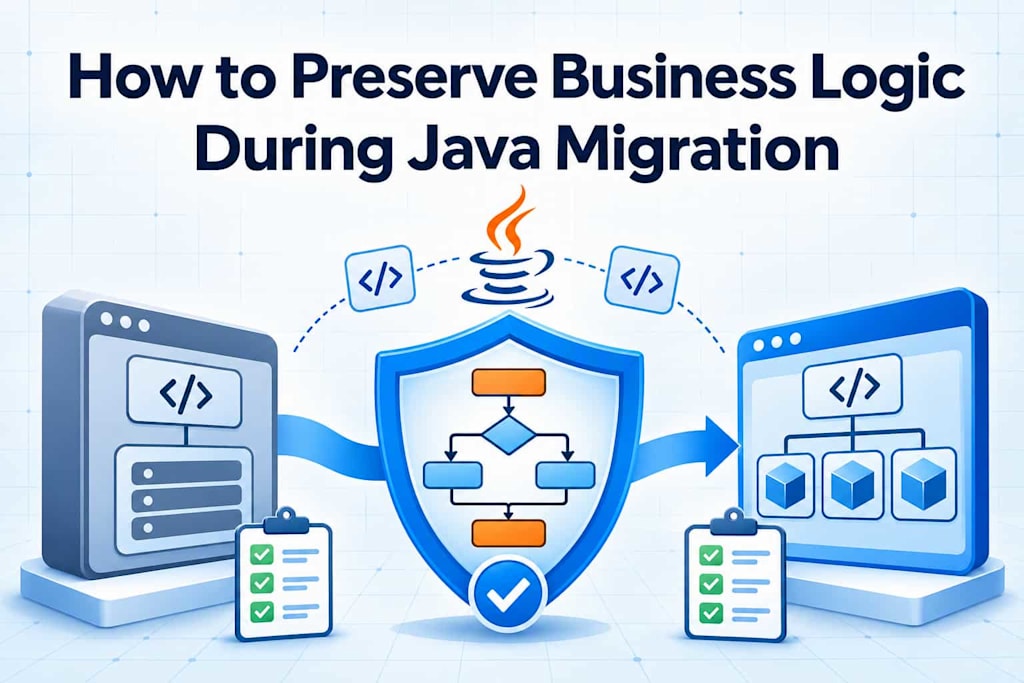
Migrating a legacy Java application to a modern technology stack is not simply a matter of updating frameworks, replacing outdated libraries, or restructuring code. The greater challenge is preserving the business logic that has accumulated over years of development. Behind seemingly ordinary methods and database operations, there may be complex pricing calculations, approval conditions, validation rules, and operational exceptions that directly influence how a business works.
When these rules are misunderstood or accidentally changed, even a technically successful migration can introduce serious operational problems. Financial calculations may produce different results, workflows may behave inconsistently, and previously supported business scenarios may stop working.
A successful migration therefore requires a systematic approach to understanding existing application behavior before changing its implementation. This involves identifying explicit and hidden business rules, documenting dependencies, using automated analysis, and validating the results of every modernization step.
Why Business Logic Is Difficult to Preserve
Business logic is not always concentrated in clearly defined service classes or domain models. In older Java applications, important rules are frequently distributed across multiple layers, including controllers, database procedures, utility classes, scheduled jobs, and external integrations.
Some business decisions may even be embedded in conditional statements that were originally introduced as temporary fixes but have remained in production for years.
For example, an e-commerce application might calculate discounts in several different places. One method handles standard customers, another applies special conditions to corporate accounts, and a database procedure adjusts prices for selected product categories. These mechanisms may have evolved independently while collectively supporting the company's pricing policy.
Documentation is another potential problem. Technical specifications may describe how the application was originally designed rather than how it actually behaves today. Developers who rely exclusively on documentation can overlook undocumented exceptions and dependencies.
Several warning signs in legacy Java applications indicate that business logic requires particular attention before migration:
Large service classes containing unrelated business operations.
Repeated calculations implemented differently across modules.
Extensive conditional statements with unclear business meaning.
Database procedures containing essential validation or calculation rules.
Dependencies between modules that are not reflected in architectural documentation.
Hardcoded values representing business policies or contractual conditions.
Tests that cover technical functionality but not important business scenarios.
These characteristics do not necessarily mean that an application is poorly designed. They often reflect years of incremental development in response to changing operational requirements.
The first migration objective should therefore be understanding actual business behavior rather than immediately improving code structure.
Identify and Document Hidden Business Rules
Before modifying an existing Java application, development teams should identify the rules that determine its behavior. This process requires examining source code, database structures, application configurations, integration interfaces, and existing tests.
A useful starting point is to identify the application's most important business processes. These might include customer registration, order processing, payment authorization, inventory management, financial reporting, or employee approval workflows.
For each process, developers should investigate:
What inputs does the process accept?
Which calculations does it perform?
What conditions determine its outcome?
Which exceptions can change the normal execution path?
What information does it read or modify?
Which external systems influence its decisions?
Consider an insurance application that calculates premiums based on customer characteristics, policy duration, and selected coverage. The calculation itself may appear straightforward, but additional conditions could include minimum premiums, regional adjustments, customer-specific discounts, and regulatory restrictions.
All these conditions form part of the business logic, even if they are implemented in different components.
It is also important to distinguish between business rules and technical implementation details. A rule stating that a customer cannot exceed a particular credit limit represents business behavior. The Java method or SQL query used to enforce that restriction is simply its current implementation.
This distinction makes it easier to preserve the original behavior while replacing outdated technical mechanisms.
Documentation should capture not only the expected results but also important exceptions, boundary conditions, and dependencies. Where possible, business analysts and experienced employees should review the documented rules to confirm that they accurately reflect operational requirements.
Use AI-Assisted Analysis to Understand Legacy Code
Large Java applications can contain hundreds of thousands of lines of code, making manual analysis expensive and time-consuming. AI can help development teams understand unfamiliar modules, identify dependencies, and discover potentially duplicated business rules.
Modern AI tools for Java migration can analyze source code, explain complicated methods, identify relationships between classes, and highlight areas that require additional investigation.
For example, an AI-assisted analysis process can help developers:
Locate methods responsible for specific business calculations.
Identify repeated validation conditions across different modules.
Explain complex conditional logic in understandable language.
Trace dependencies between service classes and database operations.
Suggest possible relationships between business rules and application entities.
Generate preliminary documentation for poorly documented components.
AI can also help investigate inconsistencies. If several modules calculate customer eligibility, developers can ask an AI system to compare their implementations and identify differences in conditions, thresholds, and exception handling.
However, AI-generated explanations should not automatically be treated as authoritative documentation. A model can misunderstand indirect dependencies, overlook runtime configuration, or interpret a technical condition incorrectly.
Static analysis, execution traces, database inspection, and discussions with experienced developers remain essential.
The most effective approach combines AI-assisted discovery with human verification. AI accelerates the investigation, while developers and business stakeholders determine whether the identified behavior is correct and must be preserved.
Modernize Incrementally Without Changing Business Behavior
Attempting to rewrite an entire legacy application in one project creates unnecessary risks. Large-scale changes make it difficult to identify the source of unexpected behavior, particularly when multiple business processes depend on the same components.
A safer approach is incremental system modernization, where teams improve the application in controlled stages while keeping existing business operations functional.
The first step is to identify components that can be modernized independently. These might include calculation services, validation modules, reporting functionality, or integration adapters.
Developers should prioritize components according to business importance, technical complexity, dependency levels, and the potential impact of failure.
For example, a calculation engine with a well-defined input and output interface may be a suitable early candidate. Its behavior can be documented, tested, and compared against a modernized implementation without changing the entire application.
This strategy supports the gradual replacement of legacy components while reducing the number of simultaneous changes.
An important principle is to separate improvements to implementation from changes to business policy. If the original application applies a particular discount under specific conditions, the migration should preserve that rule even if the new implementation uses a completely different architecture.
Business policy changes should be handled separately, documented explicitly, and approved by the relevant stakeholders.
This separation makes it possible to determine whether a difference in application behavior results from modernization or from an intentional business decision.
Apply AI-Assisted Refactoring Carefully
Once developers understand the existing rules, AI can help transform outdated Java code into a more maintainable implementation.
AI-assisted code transformation can support repetitive migration activities such as updating deprecated APIs, replacing obsolete language constructs, restructuring methods, and generating boilerplate code.
For example, an older Java application might contain complex methods that combine database access, calculations, validation, and exception handling. AI can suggest ways to separate these responsibilities into smaller components with clearer interfaces.
However, restructuring code does not automatically guarantee behavioral equivalence.
A refactored method might look cleaner while accidentally changing how null values, rounding, date boundaries, or exceptional conditions are handled.
This is particularly important for financial and transactional applications, where even small calculation differences can produce significant business consequences.
During AI-assisted refactoring, developers should therefore impose clear boundaries on automated changes.
Each transformation should have a defined scope, an identifiable expected result, and an associated set of tests. AI-generated code should undergo normal code review, security checks, and functional validation before being integrated into production.
Teams should also avoid combining unrelated changes in a single migration step. Separating framework updates, architectural restructuring, and business-rule modifications makes problems easier to investigate and resolve.
Validate Functional Equivalence Between Implementations
Testing is the most important mechanism for determining whether a modernized component preserves the behavior of its predecessor.
Traditional unit tests are useful, but they may not cover all the scenarios encountered by a mature business application. In many cases, existing tests were written to verify individual technical functions rather than the complete range of business rules.
A more comprehensive validation strategy should include several complementary techniques.
Characterization testing
Characterization tests capture how the existing application behaves under specific inputs. Developers can execute the legacy implementation with representative data and record its outputs.
These tests establish a behavioral reference that can be used to evaluate the modernized component.
Golden master testing
For complex calculations and workflows, teams can maintain a collection of known inputs and expected outputs. The same scenarios are executed against both implementations, and the results are compared.
This approach is particularly useful when the original logic is difficult to document completely.
Differential testing
Differential testing executes equivalent operations in the legacy and modernized components and identifies differences in their results.
For example, both implementations can process identical customer records and calculate eligibility, payment amounts, or approval decisions. Any discrepancy becomes an investigation point.
Boundary and exception testing
Developers should pay particular attention to unusual inputs and conditions, including zero values, missing fields, maximum limits, expired dates, invalid customer states, and rounding boundaries.
These scenarios frequently reveal hidden assumptions that ordinary functional tests overlook.
Validation should also cover side effects. Two implementations may return identical results while producing different database updates, triggering different notifications, or interacting with external systems in different ways.
Consequently, functional equivalence must include both visible outputs and relevant operational consequences.
Align Modernized Components With the Target Architecture
Preserving business logic does not mean preserving every aspect of the original architecture. Migration provides an opportunity to establish clearer boundaries between business rules, infrastructure, data access, and external integrations.
A well-defined target architecture for legacy migration should make business logic easier to understand, test, maintain, and extend.
For example, business calculations can be moved into dedicated domain services, while database operations are handled through separate repositories. External integrations can be isolated behind interfaces, reducing dependencies on specific vendors or outdated technologies.
This separation offers several advantages.
Business rules become less dependent on frameworks and infrastructure. Developers can test important calculations without starting the entire application. Changes to database technologies or integration providers become easier to manage.
It also improves long-term maintainability by reducing the likelihood that the same business rule will be implemented differently across multiple modules.
Nevertheless, architectural improvements should remain proportional to business requirements. Introducing additional abstraction layers, distributed services, or complex infrastructure without a clear operational benefit can make the modernized system unnecessarily difficult to maintain.
The objective is not to adopt the newest architectural trends but to create an environment in which business behavior remains transparent and reliable.
Conclusion
Preserving business logic is one of the most important responsibilities in any legacy Java migration. Technical modernization can improve performance, maintainability, security, and development efficiency, but these benefits have limited value if the application no longer behaves as the business expects.
Successful projects begin with a detailed investigation of existing behavior, including undocumented calculations, validation conditions, dependencies, and operational exceptions. AI can accelerate code analysis and refactoring, but its recommendations must be verified through technical testing and business expertise.
Incremental modernization, clearly defined component boundaries, characterization tests, and continuous comparison between old and new implementations help minimize migration risks.
Ultimately, the goal is not simply to replace outdated Java code. It is to preserve the business knowledge embedded in that code while creating a more flexible and maintainable foundation for future development.
About the Creator
Chudovo
Chudovo is a custom software development company, focused on complex systems implementation.
Enjoyed the story? Support the Creator.
Subscribe for free to receive all their stories in your feed.
Comments
There are no comments for this story
Be the first to respond and start the conversation.