
How to Reduce Technical Debt with AI-Assisted Refactoring
Discover how AI-assisted refactoring helps engineering teams identify, prioritize, and eliminate technical debt while improving code quality, maintainability, and long-term software scalability

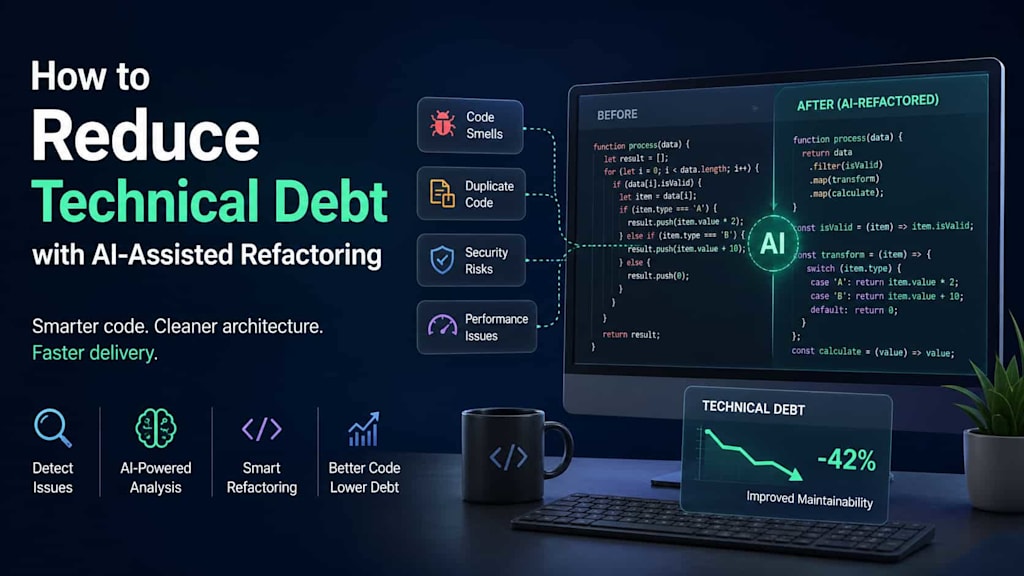
Technical debt is one of the most persistent challenges in modern software development. As businesses push for faster releases, new features, and rapid iteration, development teams often make compromises that eventually accumulate into maintenance burdens. While these shortcuts may accelerate delivery in the short term, they can significantly increase complexity, reduce code quality, and slow future development efforts.
The emergence of artificial intelligence in software development has introduced new possibilities for addressing technical debt more efficiently. AI-powered tools can analyze codebases, identify problematic patterns, suggest improvements, automate repetitive refactoring tasks, and help engineering teams maintain healthier software architectures.
However, reducing technical debt with AI is not simply a matter of running automated tools. Successful organizations combine AI capabilities with engineering expertise, architectural thinking, and systematic development practices. This article explores how teams can leverage AI-assisted refactoring to reduce technical debt while maintaining software reliability and long-term scalability.
Understanding Technical Debt in Modern Software Systems
Technical debt refers to the future cost incurred when development teams choose expedient solutions over more maintainable implementations. Similar to financial debt, technical debt accumulates interest over time. The longer it remains unresolved, the more expensive it becomes to fix.
Technical debt appears in many forms:
- Duplicated code across multiple modules
- Poorly structured architectures
- Inconsistent coding standards
- Obsolete dependencies
- Insufficient testing coverage
- Overly complex functions and classes
- Temporary fixes that become permanent solutions
Many organizations discover technical debt only after it begins affecting productivity. Development cycles become longer, bug rates increase, onboarding new developers becomes difficult, and implementing new features requires extensive workarounds.
Traditionally, identifying and addressing technical debt required significant manual effort. Senior engineers would review codebases, identify improvement opportunities, and allocate time for refactoring initiatives. While effective, this approach can be slow and difficult to scale across large systems.
AI-powered development tools are changing this dynamic by providing continuous analysis and automated recommendations that help teams detect technical debt earlier and resolve it more efficiently.
How AI-Assisted Refactoring Identifies Problem Areas
One of the greatest strengths of AI-assisted engineering is its ability to analyze large codebases rapidly and consistently. Unlike manual reviews that are limited by time and human attention, AI systems can examine thousands of files, dependencies, and code relationships simultaneously.
Modern AI tools can identify:
- Code duplication patterns
- Unused functions and variables
- Architecture violations
- Security vulnerabilities
- Performance bottlenecks
- Dependency risks
- Naming inconsistencies
- Maintainability concerns
Beyond simple static analysis, advanced AI systems understand contextual relationships within software projects. They can detect when multiple components perform similar functions, identify opportunities for abstraction, and recommend structural improvements that align with existing project patterns.
For example, an AI system may discover that several microservices contain nearly identical validation logic. Rather than requiring engineers to manually locate these instances, the tool can recommend extracting shared functionality into reusable components.
This capability allows teams to prioritize debt reduction efforts based on impact rather than intuition. Instead of addressing issues randomly, developers can focus on the areas that generate the greatest maintenance costs.
When integrated into development pipelines, AI can continuously monitor code quality and alert teams before technical debt becomes deeply embedded in the system.
Applying an AI-Driven Software Engineering Approach to Refactoring
An effective AI-driven software engineering approach treats AI as a collaborative engineering assistant rather than a replacement for developers. The goal is to combine machine efficiency with human judgment.
AI-assisted refactoring works best when applied systematically.
The first step involves establishing clear quality metrics. Teams should define measurable objectives such as reducing code complexity, improving test coverage, lowering duplication rates, or simplifying dependencies. AI tools can then evaluate progress against these goals.
Next, organizations should prioritize high-impact debt. Not all technical debt deserves immediate attention. Some issues create significant maintenance burdens, while others have minimal operational consequences. AI analysis can help quantify risk and identify the areas where refactoring will provide the greatest return on investment.
Developers can then use AI-generated recommendations to execute improvements. Examples include:
- Extracting reusable functions
- Simplifying complex conditionals
- Splitting oversized classes
- Improving naming conventions
- Removing dead code
- Reorganizing module structures
Importantly, engineers should review all AI-generated changes before deployment. AI can propose technically valid modifications that may not align with business requirements, architectural goals, or organizational standards.
The most successful teams establish workflows where AI handles repetitive analysis and implementation tasks while engineers maintain responsibility for strategic decisions.
This balance accelerates refactoring efforts without sacrificing code quality or architectural integrity.
Integrating AI into Continuous Debt Reduction Processes
Many organizations treat technical debt as a periodic cleanup project. Unfortunately, this approach often allows debt to accumulate faster than it can be eliminated.
A more sustainable strategy involves integrating AI directly into daily development activities.
AI systems can be embedded within code review processes, continuous integration pipelines, and development environments. This enables teams to identify quality issues immediately rather than months later.
For example, AI-powered code review tools can flag maintainability concerns before code reaches production. Developers receive suggestions while changes are still fresh, making remediation significantly easier.
Continuous monitoring also helps organizations establish proactive maintenance practices. Rather than waiting for major refactoring initiatives, teams can address small issues incrementally.
This approach offers several benefits:
- Lower long-term maintenance costs
- Faster feature delivery
- Reduced risk of large-scale rewrites
- Improved developer productivity
- More stable software architectures
Organizations pursuing building an efficient AI-assisted development workflow often discover that prevention is more valuable than remediation. AI not only helps eliminate existing technical debt but also reduces the likelihood of introducing new debt.
Over time, this creates a positive cycle where software quality improves continuously instead of deteriorating between cleanup efforts.
Best Practices for Successful AI-Assisted Refactoring
Although AI tools can dramatically improve refactoring efficiency, achieving meaningful results requires thoughtful implementation.
First, maintain strong testing practices. Refactoring changes internal code structure, and comprehensive automated testing helps ensure behavior remains unchanged. AI recommendations should always be validated against reliable test suites.
Second, avoid large-scale automated modifications without review. Even highly capable AI systems may overlook business context or project-specific constraints. Human oversight remains essential for protecting software quality.
Third, establish clear coding standards. AI systems perform best when they can align recommendations with documented engineering principles and architectural guidelines.
Fourth, measure outcomes rather than activity. Success should be evaluated using metrics such as maintainability improvements, reduced bug rates, faster development cycles, and lower operational costs.
Fifth, continuously educate development teams on AI capabilities and limitations. Engineers who understand how AI generates recommendations are better equipped to evaluate and apply them effectively.
Finally, treat technical debt management as an ongoing discipline rather than a one-time project. AI provides the greatest value when integrated into long-term engineering processes rather than isolated cleanup initiatives.
Organizations that combine AI capabilities with disciplined engineering practices often achieve substantial improvements in software quality while reducing the resources required for maintenance.
Companies Across Different Industries Are Adopting AI-Assisted Software Development
Organizations across various industries are increasingly adopting AI-assisted software development practices to accelerate innovation, improve software quality, and optimize development workflows. While technology stacks, business goals, and development methodologies may vary, companies often face similar challenges related to productivity, code quality, technical debt, maintenance, testing, and faster time-to-market.
AI-assisted software development helps streamline coding, code review, testing, documentation, debugging, and software maintenance processes while enabling development teams to deliver reliable applications more efficiently. By leveraging AI-powered tools, organizations can enhance developer productivity, reduce manual effort, and improve overall software delivery outcomes.
Some of these companies include:
- Chudovo
- Exxeta
- LeewayHertz
- DBB Software
- Tech Crusades
Conclusion
Technical debt is an unavoidable reality of software development, but it does not have to become an overwhelming burden. AI-assisted refactoring provides development teams with powerful tools for identifying, prioritizing, and resolving technical debt more efficiently than traditional manual approaches.
By leveraging AI to analyze codebases, automate repetitive improvements, and support continuous quality monitoring, organizations can significantly reduce maintenance costs and improve development velocity. At the same time, human expertise remains essential for making architectural decisions, validating recommendations, and ensuring that refactoring efforts align with business objectives.
The future of software maintenance will increasingly rely on collaboration between engineers and intelligent development tools. Teams that embrace AI-assisted engineering today will be better positioned to maintain scalable, reliable, and adaptable software systems as complexity continues to grow.
About the Creator
Eugene Afonin
Experienced IT Consultant specializing in software development strategy, legacy system modernization, and digital transformation.
Enjoyed the story? Support the Creator.
Subscribe for free to receive all their stories in your feed.
Comments
There are no comments for this story
Be the first to respond and start the conversation.