
How to Build an Effective AI-Assisted Development Workflow
A Practical Guide to Smarter, Faster, and More Reliable Software Engineering

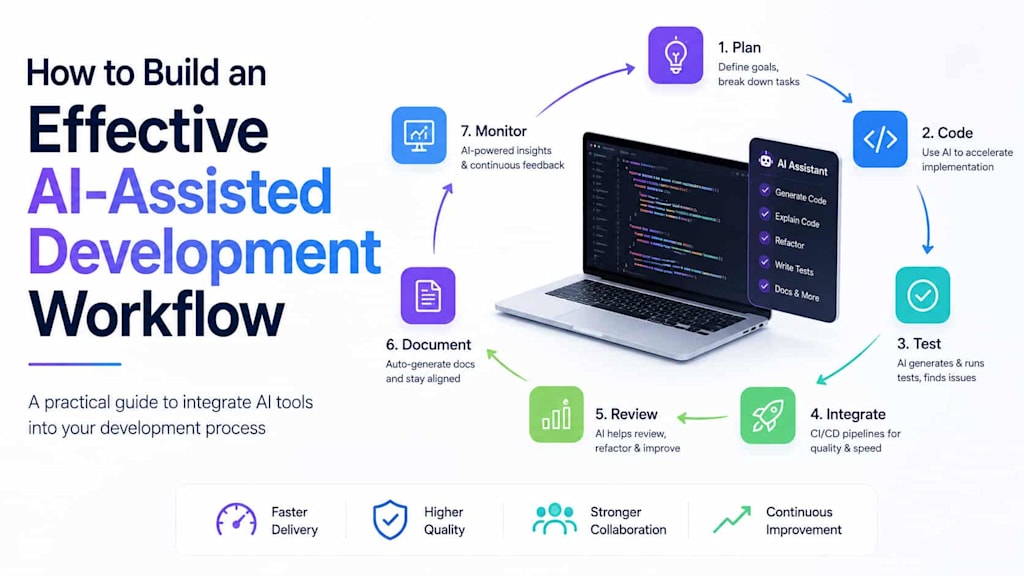
Artificial intelligence is transforming the way software teams design, build, test, and maintain applications. What once required hours of repetitive manual work can now be accelerated through intelligent automation, code suggestions, predictive testing, and AI-powered collaboration tools. As organizations continue integrating AI into engineering operations, the focus is shifting from simply adopting new technologies to building structured workflows that maximize productivity without compromising quality.
An effective AI-assisted development workflow is not about replacing developers. Instead, it is about empowering engineering teams with tools that improve efficiency, reduce repetitive tasks, and support better decision-making throughout the software lifecycle. Teams that successfully integrate AI into development processes often achieve faster delivery cycles, stronger collaboration, and improved software reliability.
However, achieving these results requires more than adding AI coding tools to the development environment. Organizations need clear strategies, governance standards, and optimized workflows that balance automation with human expertise.
This guide explores how engineering teams can build practical and scalable AI-assisted development workflows that support long-term growth and sustainable innovation.
Understanding the Role of AI in Modern Development
AI-powered development tools have evolved rapidly over the past few years. Today’s engineering teams can use AI to generate code snippets, automate documentation, analyze bugs, suggest refactoring opportunities, and even support project planning.
These technologies are helping organizations reduce manual overhead while enabling developers to focus on more strategic and creative tasks. Instead of spending hours writing repetitive boilerplate code or troubleshooting simple syntax issues, developers can dedicate more time to architecture, user experience, and product innovation.
One of the key advantages of AI integration is acceleration. AI tools can assist with rapid prototyping, automated testing, and continuous integration workflows, significantly reducing development timelines. This allows businesses to release products and features faster while maintaining competitive agility.
Another major benefit is knowledge accessibility. AI systems can help less experienced developers understand frameworks, libraries, and unfamiliar codebases more efficiently. This improves onboarding and helps teams scale productivity more effectively.
At the same time, AI tools are not flawless. Generated outputs may contain errors, security vulnerabilities, or inefficient logic. Human oversight remains essential to validate results and maintain engineering standards.
This is why organizations adopting development with AI-assisted approach strategies must focus on creating workflows where AI supports developers rather than replaces critical engineering judgment.
Building the Foundation for an AI-Assisted Workflow
Before implementing AI tools across development teams, organizations should establish a strong operational foundation. Successful adoption begins with clearly defined goals and realistic expectations.
The first step is identifying which tasks benefit most from AI assistance. In many teams, repetitive coding activities, automated testing, debugging, and documentation generation are ideal starting points. By focusing on low-risk and high-value tasks first, organizations can introduce AI gradually without disrupting existing processes.
It is also important to choose tools that integrate smoothly with current development environments. AI platforms should support the languages, frameworks, and infrastructure already used by engineering teams. Poor integration often creates friction that reduces adoption and productivity.
Workflow governance is another essential component. Teams should establish guidelines that define when AI-generated code is acceptable, how outputs are reviewed, and what security standards must be followed. These policies help ensure consistency and accountability across projects.
Training also plays a critical role. Developers need practical education on how to collaborate effectively with AI systems, interpret generated recommendations, and identify inaccurate outputs. Teams that invest in AI literacy often achieve significantly better adoption outcomes.
Communication between leadership and engineering teams is equally important. Developers should understand why AI tools are being introduced and how they will support rather than threaten existing roles. Transparent communication helps reduce resistance and encourages experimentation.
Organizations should also implement clear performance metrics. Tracking productivity improvements, defect rates, testing efficiency, and developer satisfaction can help teams evaluate whether AI-assisted workflows are delivering measurable value.
A successful AI-assisted workflow is ultimately built on balance. Automation should improve efficiency while preserving code quality, security, and engineering accountability.
Integrating AI Into Daily Development Processes
Once the foundation is established, organizations can begin integrating AI tools into daily engineering operations. This stage requires careful planning to ensure workflows remain efficient and manageable.
One of the most common use cases is AI-powered code generation. Developers can use intelligent coding assistants to accelerate repetitive programming tasks, generate templates, and suggest syntax improvements. This can significantly reduce development time for routine tasks while helping engineers maintain momentum.
AI can also improve debugging and troubleshooting workflows. Advanced systems can analyze stack traces, identify likely causes of errors, and recommend potential fixes. This allows developers to resolve issues more efficiently and reduce downtime during development cycles.
Testing is another area where AI delivers substantial value. Automated testing tools can generate test cases, identify edge conditions, and predict areas of vulnerability within applications. This improves software quality while reducing the manual burden on quality assurance teams.
Documentation management often becomes easier with AI integration as well. AI-powered tools can automatically generate API documentation, summarize code functionality, and maintain project records with greater consistency. This helps teams improve collaboration and reduce communication gaps.
Continuous integration and deployment pipelines can also benefit from AI-enhanced monitoring and analytics. Intelligent systems can detect anomalies, predict deployment risks, and optimize release timing based on historical performance patterns.
Despite these advantages, organizations should avoid excessive dependence on automation. Developers must continue reviewing generated outputs carefully to ensure accuracy, maintainability, and compliance with engineering standards.
Regular audits of AI-assisted workflows can help identify inefficiencies or unintended risks. Some organizations also schedule periodic cleanup sessions to remove outdated automation rules, review dependencies, and optimize tooling configurations.
The goal is not simply to automate faster but to create sustainable workflows that improve long-term engineering performance.
Best Practices for Responsible AI-Assisted Development
As AI adoption grows, engineering teams must establish responsible development standards that balance innovation with accountability. Successful organizations understand that effective AI integration depends on structured governance and disciplined engineering practices.
One important principle is maintaining human oversight at every stage of development. AI-generated outputs should never bypass code review processes or quality assurance standards. Human developers remain responsible for validating functionality, security, and performance.
Transparency is another essential factor. Teams should document where AI-generated code is used and ensure engineering managers understand how AI contributes to development workflows. This visibility supports accountability and simplifies future maintenance.
Security must remain a top priority. AI-generated code can occasionally introduce vulnerabilities or inefficient implementations. Organizations should integrate automated security scanning and manual review processes into development pipelines to reduce these risks.
Another key recommendation involves limiting AI usage in sensitive environments. Applications involving financial systems, healthcare records, or critical infrastructure often require stricter governance and additional human validation before deployment.
Collaboration also becomes increasingly important in AI-assisted environments. Engineering teams should regularly share insights, lessons learned, and workflow improvements to strengthen organizational knowledge.
Many successful companies now define internal frameworks based on the best practices teams apply in AI-assisted development to ensure consistency across projects. These frameworks often include approval requirements, documentation standards, security guidelines, and review protocols.
Training programs should evolve alongside these practices. As AI tools improve, developers must continuously update their knowledge and adapt workflows accordingly. Organizations that support ongoing learning often gain stronger long-term productivity advantages.
Responsible AI-assisted development is not only about efficiency. It is about building systems that remain secure, scalable, transparent, and maintainable over time.
Preparing for the Future of AI-Driven Engineering
AI-assisted development is still evolving, and its role within engineering organizations will likely continue expanding over the next decade. Future workflows may include more advanced autonomous testing, predictive maintenance systems, intelligent architecture planning, and real-time optimization capabilities.
As these technologies mature, developers will need to focus increasingly on strategic thinking, system design, and cross-functional collaboration. Human creativity, leadership, and critical reasoning will remain essential components of successful engineering teams.
Organizations that prepare early for this transition are likely to gain significant competitive advantages. Building adaptable workflows today allows companies to integrate future AI innovations more smoothly without disrupting operations.
One important consideration is scalability. Engineering leaders should design workflows that can evolve alongside changing technologies. Modular tooling, flexible governance structures, and continuous learning programs help organizations remain agile in rapidly changing environments.
Another important factor is culture. Teams that encourage experimentation and responsible innovation are often more successful in adopting AI-assisted workflows. Developers should feel comfortable exploring new tools while understanding the importance of maintaining engineering discipline.
The hiring landscape is also evolving. Companies increasingly seek developers who understand AI-enabled collaboration and can contribute effectively within AI-assisted environments. As a result, AI literacy is quickly becoming a valuable professional skill across the software industry.
Ultimately, AI-assisted development is not just a technological trend. It represents a broader shift in how engineering teams operate, collaborate, and deliver value.
Conclusion
Building an effective AI-assisted development workflow requires more than implementing new tools. Organizations must create structured processes that combine automation with human expertise, governance, and accountability.
AI-powered systems can significantly improve productivity, accelerate development cycles, enhance testing, and support better collaboration across engineering teams. However, long-term success depends on responsible integration and continuous optimization.
Teams that establish clear standards, invest in developer education, and maintain strong oversight are better positioned to unlock the full benefits of AI-assisted development while minimizing risks.
As the software industry continues evolving, AI-assisted workflows will become an increasingly important part of modern engineering operations. Companies that adapt early and build scalable, responsible workflows today will be better prepared for the future of software development.
About the Creator
Eugene Afonin
Experienced IT Consultant specializing in software development strategy, legacy system modernization, and digital transformation.
Enjoyed the story? Support the Creator.
Subscribe for free to receive all their stories in your feed.
Comments
There are no comments for this story
Be the first to respond and start the conversation.