
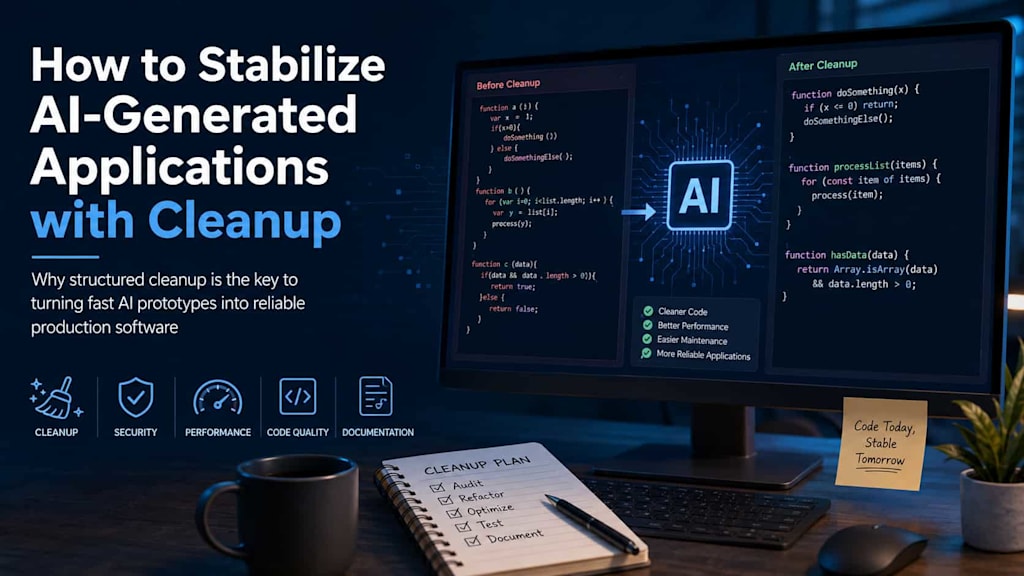
How to Stabilize AI-Generated Applications with Cleanup
Why structured cleanup is the key to turning fast AI prototypes into reliable production software

Artificial intelligence has dramatically accelerated software development. With modern code generation tools, developers can create interfaces, APIs, automation scripts, and entire applications in hours instead of weeks. This speed has changed expectations across startups, agencies, and enterprise teams alike. However, the rapid rise of AI-assisted development has introduced a new challenge: applications generated quickly often become unstable, inconsistent, and difficult to maintain.
Many AI-generated projects begin as promising prototypes but later struggle with scalability, security, and performance issues. Features may work initially, yet hidden architectural weaknesses emerge as the codebase grows. Without a structured cleanup process, these applications can become fragile and expensive to support.
The solution is not to abandon AI-assisted development. Instead, teams need a systematic approach to refining and stabilizing generated code. Proper cleanup transforms rough AI output into maintainable, production-ready software that can evolve safely over time.
Why AI-Generated Applications Become Unstable
AI coding systems excel at producing functional code quickly, but they do not fully understand long-term architectural goals. Generated code often focuses on solving immediate tasks rather than maintaining consistency across the entire application.
As a result, developers frequently encounter duplicated logic, conflicting frameworks, inconsistent naming conventions, and poorly organized dependencies. Some modules may use entirely different patterns for similar tasks because the AI generated them in separate sessions. While the application may appear functional at first glance, these inconsistencies gradually reduce reliability.
Another common issue is missing context. AI tools typically generate code based on prompts rather than a complete understanding of the project lifecycle. They may produce unnecessary abstractions, outdated library usage, or inefficient database queries. Security practices can also vary widely depending on the prompts and training patterns behind the generated output.
Over time, teams begin spending more energy fixing generated code than building new functionality. This is where cleanup becomes essential. The process is not simply about formatting or removing unused files. Effective stabilization requires deep analysis of architecture, dependencies, workflows, and maintainability.
The growing concern around technical debt in vibe-coded applications reflects this exact challenge. Teams that prioritize speed without structured refinement often discover that rapid development eventually creates long-term operational complexity.
The Role of Cleanup in AI-Assisted Development
The cleanup of AI-generated apps is a strategic process that improves reliability, readability, and scalability after the initial generation phase. It acts as the bridge between experimentation and production readiness.
One of the first goals of cleanup is standardization. AI-generated code frequently mixes styles, structures, and implementation patterns. Developers must establish clear coding standards and refactor inconsistent sections into unified patterns. This improves readability and makes collaboration easier across engineering teams.
Dependency management is another critical component. AI-generated projects often include unnecessary libraries or overlapping tools. Excessive dependencies increase security risks and slow down deployment pipelines. Cleanup helps identify which packages are truly required and removes redundant components that complicate maintenance.
Performance optimization also becomes important during stabilization. Generated applications may contain repetitive database calls, inefficient rendering processes, or excessive API requests. These inefficiencies might not appear during small-scale testing but can become major problems under production traffic. Refactoring these areas significantly improves scalability and user experience.
Security review is equally essential. AI-generated code can unintentionally expose vulnerabilities such as insecure authentication flows, poor input validation, or unsafe API handling. Cleanup gives developers the opportunity to audit sensitive areas and implement stronger security practices before deployment.
Beyond technical improvements, cleanup supports long-term business stability. Teams can onboard new developers faster when the codebase is organized and documented. Product updates become less risky because systems are easier to understand. In this way, stabilization is not merely a technical task—it is an investment in sustainable growth.
Key Steps to Stabilize AI-Generated Software
Successful stabilization requires a structured workflow rather than random fixes. Teams that approach cleanup systematically are far more likely to create scalable applications that remain maintainable over time.
Audit the Existing Codebase
The first step is understanding the current state of the application. Developers should review architecture, dependencies, APIs, database structures, and deployment configurations. This audit identifies duplicated logic, inconsistent modules, and hidden vulnerabilities.
Automated analysis tools can help detect dead code, memory leaks, and unused dependencies. However, manual review remains critical because AI-generated code often contains logical inconsistencies that automated tools cannot fully interpret.
Refactor for Consistency
Once weaknesses are identified, the next step is refactoring. Teams should establish unified coding conventions and reorganize modules according to a clear architectural structure.
This may involve:
- Standardizing naming conventions
- Consolidating duplicated functions
- Rewriting overly complex components
- Splitting oversized files into reusable modules
- Aligning frontend and backend communication patterns
Consistency significantly reduces maintenance complexity and improves collaboration across development teams.
Strengthen Security and Validation
AI-generated applications sometimes prioritize functionality over security. During cleanup, developers should implement proper authentication mechanisms, sanitize user input, validate API requests, and secure sensitive data handling.
Security testing should include both automated scanning and manual review. Penetration testing can also help identify vulnerabilities that may not appear during normal development workflows.
Optimize Infrastructure and Performance
Many generated applications rely on inefficient infrastructure setups because AI tools tend to prioritize immediate implementation over long-term optimization.
Cleanup should include:
- Database query optimization
- API response caching
- Reducing unnecessary network requests
- Improving rendering performance
- Streamlining deployment pipelines
These improvements help applications remain stable under real-world usage conditions.
Improve Documentation
AI-generated projects often lack clear documentation. Without documentation, future maintenance becomes increasingly difficult.
Teams should create:
- Architecture overviews
- Deployment instructions
- API documentation
- Dependency explanations
- Coding standards guides
Good documentation reduces onboarding time and minimizes future confusion during updates or debugging.
Human Oversight Remains Essential
Despite rapid advances in generative AI, human expertise remains critical in software development. AI can accelerate production, but experienced developers are still necessary to evaluate architecture, identify risks, and make strategic engineering decisions.
One major limitation of AI-generated code is the absence of contextual judgment. AI tools do not understand business priorities, user expectations, or long-term operational requirements in the same way human engineers do. They generate outputs based on probability rather than strategic intent.
Human oversight becomes especially important when applications scale. Small inconsistencies that appear harmless during prototyping can become serious operational issues under production conditions. Experienced engineers recognize these patterns early and address them before they create larger problems.
Cleanup also benefits from collaboration across disciplines. Developers, DevOps engineers, QA specialists, and security teams each contribute unique perspectives during stabilization. Together, they can identify issues that isolated AI generation workflows may overlook.
Organizations that combine AI-assisted development with disciplined engineering practices typically achieve the best results. They gain the speed advantages of automation while maintaining the reliability and scalability required for long-term success.
Building Sustainable AI Development Workflows
As AI-generated development becomes more common, organizations must rethink their workflows. The future of software engineering will likely involve hybrid systems where AI accelerates implementation while human teams focus on refinement, architecture, and governance.
Instead of treating cleanup as an optional final step, successful teams integrate stabilization directly into their development lifecycle. Continuous refactoring, testing, and auditing help prevent small inconsistencies from evolving into large structural problems.
This approach also changes how teams measure productivity. Faster code generation alone does not guarantee successful software delivery. Stability, maintainability, security, and scalability are equally important metrics. Sustainable development requires balancing rapid innovation with disciplined engineering standards.
Companies that adopt structured cleanup workflows often discover that they can move quickly without sacrificing reliability. AI-generated applications become easier to maintain, cheaper to scale, and more resilient to future changes.
Conclusion
AI-assisted software development has transformed how applications are built, enabling teams to create products faster than ever before. However, speed alone does not guarantee quality. Without proper refinement, generated applications can become unstable, inconsistent, and difficult to maintain.
A structured cleanup process is essential for turning AI-generated prototypes into reliable production systems. Through code audits, refactoring, security reviews, performance optimization, and documentation, teams can stabilize applications and support long-term growth.
The future of development is not about replacing engineers with AI. It is about combining AI-driven speed with human expertise and disciplined engineering practices. Organizations that embrace this balance will be better positioned to build scalable, secure, and sustainable applications in the evolving digital landscape.
About the Creator
Eugene Afonin
Experienced IT Consultant specializing in software development strategy, legacy system modernization, and digital transformation.
Enjoyed the story? Support the Creator.
Subscribe for free to receive all their stories in your feed.
Comments
There are no comments for this story
Be the first to respond and start the conversation.