
How to Plan Business Software That Can Scale With Company Growth
How to make smarter software investment decisions, prioritize essential functionality, and prepare business systems for long-term growth without unnecessary complexity.

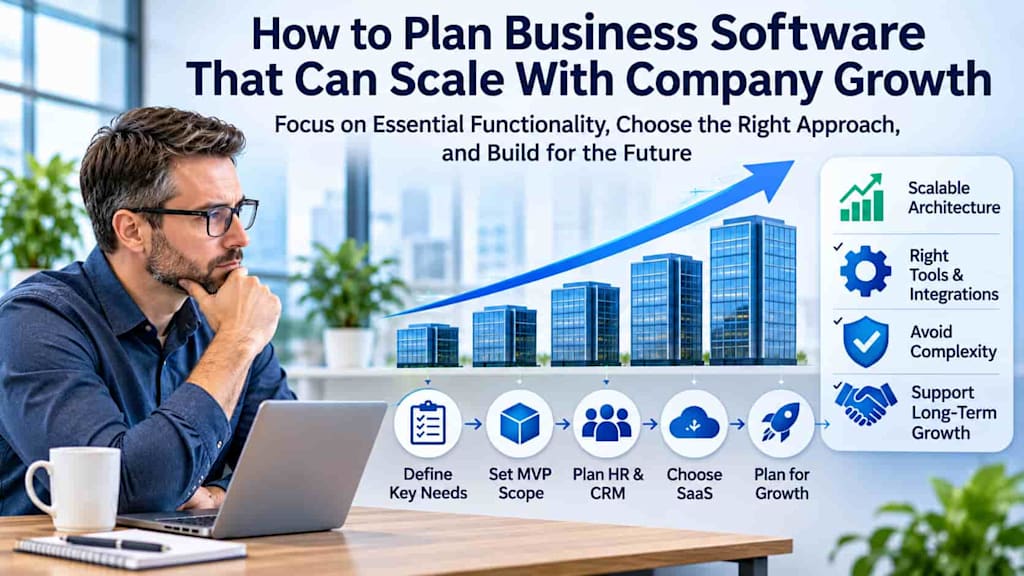
Business growth often creates operational challenges that existing software can no longer handle efficiently. Processes that once worked through spreadsheets, email, and a few standalone applications can become difficult to manage when a company expands its workforce, customer base, departments, or service offerings. As information becomes fragmented and employees rely on different tools, organizations may experience delays, duplication, inconsistent reporting, and increasing administrative overhead.
Planning business software for growth requires more than choosing a platform with a long list of features. Companies need to understand their operational priorities, identify where existing systems are failing, and determine which investments will provide meaningful value today while supporting future requirements. A well-planned software strategy allows organizations to expand capabilities gradually without creating an unnecessarily complicated technology environment.
Identify the Business Processes That Need Improvement
The first step in planning business software is understanding how the organization operates and where inefficiencies are affecting productivity. Businesses should examine workflows involving sales, customer management, human resources, finance, internal approvals, reporting, inventory, and project coordination.
Not every inefficient process requires new software. Some problems can be solved by simplifying procedures, clarifying responsibilities, or improving how existing applications are used. However, when employees repeatedly perform manual tasks, maintain duplicate records, or struggle to access reliable information, software investment may be justified.
Organizations should identify problems based on their operational impact. For example, slow recruitment processes may affect workforce expansion, inconsistent customer records may interfere with sales activities, and disconnected reporting systems may make it difficult for managers to evaluate performance.
Prioritizing these issues helps businesses focus on software that addresses measurable needs rather than purchasing technology simply because it offers attractive features.
Define Essential Functionality Before Expanding the Scope
Business software projects often become more expensive and difficult to manage when organizations attempt to solve every operational problem at once. Planning should begin with a clear distinction between essential functionality, useful improvements, and features that may become relevant later.
The process of defining the scope of an MVP can help businesses identify the smallest practical set of capabilities needed to support a specific workflow or business objective. Although the term MVP is often associated with startups and product launches, the same prioritization principles can apply to internal business systems and software modernization initiatives.
Essential functionality should support critical operations, eliminate significant inefficiencies, and provide a foundation for future expansion. Secondary features may be deferred until the organization has better visibility into actual usage and evolving requirements.
This approach does not mean accepting an incomplete or unreliable system. Core workflows must remain secure, usable, and dependable. The objective is to avoid investing in functionality that adds development and maintenance costs without delivering meaningful business value.
Plan HR Software Around Organizational Growth
As companies hire more employees, managing recruitment, onboarding, attendance, employee records, performance reviews, leave requests, and internal policies becomes increasingly difficult through manual processes.
Businesses should evaluate HR management software for growing organizations based on their current workforce structure and expected operational changes. A company with a small team may primarily need centralized employee records and basic leave management, while a larger organization may require recruitment workflows, role-based permissions, reporting, employee self-service, and connections with payroll or accounting systems.
HR software should also accommodate organizational changes. Businesses may introduce new departments, management layers, employment policies, locations, or approval responsibilities. A system that cannot support these changes may become a bottleneck even if it initially meets requirements.
Companies should consider whether a dedicated HR platform, an existing business suite, or an integrated custom solution provides the most appropriate balance of functionality, usability, and cost. The choice should reflect the complexity of HR processes rather than workforce size alone.
Choose CRM Capabilities That Match Business Operations
Customer relationship management systems help businesses organize customer information, manage sales pipelines, track interactions, coordinate follow-ups, and analyze commercial performance. However, CRM requirements differ significantly between companies.
When choosing CRM systems for business operations, organizations should evaluate how sales teams work, how leads are generated, how opportunities move through the pipeline, what information managers need, and how customer relationships are maintained after a sale.
A CRM should reflect the company's actual sales process without forcing employees into unnecessarily complicated procedures. If the system requires excessive data entry, contains too many mandatory fields, or introduces workflows that do not match employees' responsibilities, adoption may suffer.
Businesses should also consider whether the CRM needs to integrate with email, marketing platforms, customer support tools, invoicing systems, and reporting applications. Integration requirements should be identified early to avoid creating another disconnected information source.
A successful CRM investment is not measured by the number of available modules. It is measured by whether the system helps employees manage relationships more effectively and gives decision-makers access to reliable business information.
Avoid Disconnected Applications and Data Silos
As organizations grow, departments often select software independently to solve immediate problems. Sales may use one CRM, HR may maintain employee information in a separate platform, finance may rely on accounting software, and operations may introduce additional tools for task management and reporting.
Although individual applications may work well, the overall environment can become fragmented. Employees may have to transfer information manually between systems, customer records may become inconsistent, and management reports may rely on data from several different sources.
Disconnected applications also create security and administrative concerns. Multiple systems may require separate access controls, user accounts, subscriptions, backup procedures, and maintenance responsibilities. When employees leave or organizational roles change, managing permissions across disconnected platforms becomes more difficult.
Businesses should therefore assess their software environment as a whole. Integration capabilities, data ownership, information consistency, reporting requirements, and system responsibilities should be considered before introducing another application.
The goal is not necessarily to consolidate everything into one platform. Specialized applications may offer significant advantages. However, organizations should understand how their systems exchange information and how the entire software environment supports business operations.
Decide When SaaS Is the Right Delivery Model
Software as a Service (SaaS) can be an attractive option for businesses that want to reduce infrastructure responsibilities, simplify deployment, and access software through subscription-based services. SaaS platforms typically handle hosting, maintenance, updates, and infrastructure management, allowing organizations to focus more on using the software.
Scalable SaaS application development may be appropriate when the business needs a system accessible across locations, expects a changing number of users, or wants to introduce functionality gradually without maintaining its own hosting infrastructure. SaaS can also support more predictable operational planning, although subscription costs may increase as usage or service requirements expand.
However, SaaS is not automatically the most cost-effective option. Companies should review pricing structures, data ownership, customization limitations, integration capabilities, security requirements, service availability, and vendor dependency.
Some businesses may require dedicated hosting, a hybrid architecture, or a custom application because of specialized workflows, regulatory obligations, or technical constraints. The delivery model should be selected based on operational requirements and long-term costs rather than convenience alone.
Be Careful With Premature Customization
Business software frequently offers configuration options, automation tools, and customization capabilities. These features can help adapt applications to organizational processes, but excessive customization can increase complexity and make future upgrades more difficult.
Before changing a platform, companies should determine whether the workflow itself needs improvement. Existing procedures may have developed around outdated practices, manual approvals, or unnecessary steps. Reproducing every historical process in a new system may preserve inefficiencies instead of eliminating them.
For example, customizing Zoho for business workflows may help organizations adapt CRM, project management, automation, and reporting capabilities to their operational requirements. However, businesses should distinguish between necessary adjustments and modifications that create additional dependencies, complicate maintenance, or make the system harder for employees to use.
Customization decisions should be reviewed according to business value, implementation effort, maintenance impact, and upgrade risks. Wherever practical, organizations should prefer supported configuration options and maintain clear documentation of any changes.
Plan for Future Changes Without Overengineering
Software planning should account for changing requirements, but attempting to predict every future need can result in overengineering. Companies may introduce complex permissions, elaborate automation, excessive architectural layers, or unnecessary modules long before there is a real demand for them.
A better approach is to establish a flexible foundation. Systems should have clear data structures, manageable integrations, reasonable security controls, and an architecture that allows new functionality to be introduced without disrupting existing operations.
When building the first version of a SaaS product, businesses should focus on the core use cases, practical user experience, reliable data handling, and essential operational requirements rather than designing an oversized platform in anticipation of hypothetical growth.
Future flexibility should be evaluated through realistic scenarios. Will the company add new departments? Expand into other markets? Increase the number of users? Introduce additional customer-facing services? Change its reporting requirements? These questions can guide architectural decisions without forcing the initial implementation to support every imaginable possibility.
Preparing an MVP for changing business requirements involves understanding which decisions should remain flexible and which can be established early. Core functionality should be dependable, while secondary features, workflows, and integrations should be introduced as business priorities become clearer.
Conclusion
Planning business software that can scale with company growth requires balancing immediate operational needs with long-term adaptability. Organizations should identify their most important workflows, define essential functionality, evaluate HR and CRM requirements, and understand how new applications will fit into the existing software environment.
The most effective software investments are not necessarily the largest or most feature-rich. They are the systems that solve meaningful business problems, support employee adoption, reduce unnecessary complexity, and remain manageable as the organization evolves.
By prioritizing functionality, evaluating SaaS models carefully, avoiding premature customization, and planning for realistic future changes, businesses can build a software environment that supports growth without turning technology into an operational burden.
About the Creator
Chudovo
Chudovo is a custom software development company, focused on complex systems implementation.
Enjoyed the story? Support the Creator.
Subscribe for free to receive all their stories in your feed.
Comments
There are no comments for this story
Be the first to respond and start the conversation.